They Laughed When a Biker Paid With Coins — The Truth That Followed Silenced the Room
The laughter started the moment the coins hit the counter.
Not loud. Not cruel enough to draw a manager’s attention. Just enough to sting.
A biker stood at the register, leather vest creased with age, helmet tucked under his arm. He opened his palm and let the coins slide forward—quarters, dimes, nickels—clinking together like a confession. Someone behind him snorted. Another voice muttered, “You’ve got to be kidding me.”
The biker didn’t react. He kept counting.
The café was busy, the kind of late-morning crowd that mixed retirees with office workers killing time between meetings. Sunlight poured through the wide windows, catching dust in the air and turning the glass pastry case into a mirror of quiet judgment. The smell of burnt espresso and warm bread hung heavy.
Coins were slow. Everyone knew that.
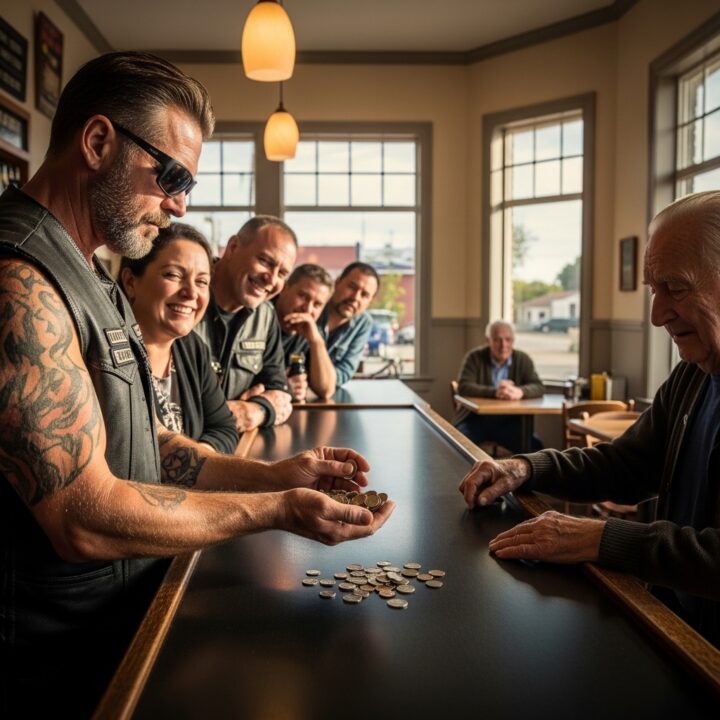
A woman near the window leaned to her friend and whispered something sharp enough to make them both smile. A man in a pressed jacket glanced at his watch. The barista’s eyebrows lifted just slightly—annoyance disguised as professionalism.
The biker finished counting and pushed the small pile forward. “That should cover it,” he said.
His voice was calm. Low. Not defensive.
The barista hesitated. The register beeped impatiently. The line shifted behind him like a restless animal.
“You know,” the man behind him said, loud enough to be heard, “they take cards.”
A few chuckles followed.
The biker nodded once. “I know.”
He didn’t explain.
For a moment, everything stopped. Cups waited half-filled. Steam hissed, then faded. The barista swept the coins into her hand, metal clicking against metal, and rang him up without comment.
The biker stepped aside to wait.
That was when the room noticed the other man.
He sat alone at a small table near the wall, posture slumped, hands trembling around a chipped mug. Late seventies, maybe older. His jacket was thin, frayed at the cuffs. A folded paper napkin lay untouched beside him, his name written on it in shaky ink by a server who hadn’t come back.
He watched the biker with a strange intensity. Not suspicion. Recognition.
The biker leaned against the counter, careful not to block anyone. His vest bore a faded patch, edges worn soft by miles and weather. His arms were scarred—not the loud kind of scars, but the quiet ones that tell stories only if you know how to look.
A sign above the counter read: Exact change appreciated.
Someone laughed again, softer this time.
Rules are easy when they favor you. Courtesy is harder when it costs time.
The barista called the order. The biker picked up the cup, nodded his thanks, and turned—not toward an empty table, but toward the old man by the wall.
“Mind if I sit?” the biker asked.
The old man blinked, then shook his head. “No. Please.”
They sat in silence. The biker wrapped his hands around the cup, warming them. Outside, traffic slid past in a steady hum. Inside, conversation slowly returned, cautious at first, then louder.
The old man finally spoke, voice thin but steady. “They don’t make it easy for folks like us anymore.”
The biker smiled faintly. “No, sir. They don’t.”
A pause. The old man studied the vest. The patch. The scars. “You ride long?”
“All my life.”
The old man nodded. “I used to, too. Different machine.”
The biker tilted his head. “What did you fly?”
The old man’s eyes sharpened. “You noticed.”
The biker shrugged. “Hands like yours don’t come from office work.”
The old man chuckled softly. “Hueys,” he said. “Vietnam.”
Something shifted between them. Invisible, but real.
A server approached, hesitant. “Sir,” she said to the old man, “we… your order—”
The old man waved her off. “I’m fine.”
She glanced at the biker, then back at the register. The line had thinned. The man with the pressed jacket was gone. The laughter had died down, replaced by the low clatter of dishes.
The old man leaned closer. “Those coins,” he said quietly. “They for you?”
The biker shook his head. “For him.”
He nodded toward the counter, where a small cardboard sign sat near the register. Coffee Fund — Pay It Forward. It was half-empty.
The old man’s throat tightened. “Why coins?”
The biker took a breath. “Because I promised myself I’d never spend his money.”
“His?”
“My son’s.”
The words landed gently, then spread.
“He was seven,” the biker continued. “Loved counting. Loved saving. We had a jar on the kitchen counter. Quarters were his favorite.”
The old man stared into his mug. “I’m sorry.”
The biker nodded once. “He passed three years ago. Cancer.” A beat. “I bring the jar with me. When I see someone who needs a cup more than I do, I use the coins.”
The old man’s hands shook harder now. He set the mug down before it spilled. “That coffee fund,” he said. “That’s mine.”
The biker looked up.
“I don’t have much,” the old man said. “But I come here every Thursday. I put what I can in. Sometimes it helps someone. Sometimes it helps me feel like I still can.”
They sat with that.
Across the room, a woman who had laughed earlier watched them, her smile gone. The barista slowed her movements, listening without meaning to. The café seemed to lean in.
The door opened. Then again.
Engines rumbled outside, low and respectful. A small group of bikers stepped in—men and women, late thirties to sixties. Sleeveless shirts, tattoos, sunglasses pushed up on heads. They didn’t crowd the counter. They didn’t order right away. They stood together, quiet, like they were waiting for a cue.
The room tensed.
The biker at the table raised a hand slightly. The newcomers nodded and took seats along the wall, spreading out, giving space. No spectacle. Just presence.
The old man swallowed. “Your people?”
“My family,” the biker said.
The barista approached the table, coins still in her apron pocket. “Sir,” she said, to the biker, “we… the fund—”
The biker shook his head. “Please. Let it be.”
She nodded, eyes wet, and returned to the register.
The old man reached into his jacket and pulled out a folded photograph. Two young men in uniform, arms slung over each other, smiling in a way that belonged to another lifetime. “That’s me,” he said, tapping one. “That’s my brother.”
The biker studied the photo. “He make it home?”
The old man shook his head. “No.”
They sat in silence again.
When the biker finished his coffee, he stood and slipped the empty cup into the return bin. He reached into his vest pocket and pulled out a small cloth pouch. He poured the remaining coins into the coffee fund, each one landing with a soft, deliberate sound.
No one laughed.
The manager came out from the back, eyes scanning the room. He saw the bikers. The old man. The fund. He opened his mouth, then closed it.
“Next round’s on the house,” he said quietly. “For anyone who needs it.”
The biker nodded his thanks but didn’t stay.
He walked to the door. His family followed, one by one, pausing to nod to the old man as they passed. Outside, engines waited, patient.
Before he left, the biker turned back to the room. “Kindness doesn’t need to be fast,” he said. “It just needs to be honest.”
Then he was gone.
The café exhaled.
Some things are heavier than coins.
Honor is one of them.
If this story moved you, share your thoughts—or a moment when quiet dignity changed your mind—down in the comments.