They Called the Old Veteran a Burden — Until Bikers Came to Take Him Outside
They called him a burden in the hallway, not knowing the old man could still hear every word from his wheelchair.
The television was on, volume low.
A game show flickered across the screen, bright smiles and loud applause filling a room that smelled faintly of disinfectant and overcooked vegetables. The old man sat by the window, hands folded neatly on his lap, staring at nothing in particular.
His name was Frank Miller.
Eighty-two years old.
Korean War veteran.
The aide didn’t lower her voice.
“He takes too much time,” she said, flipping through a clipboard. “And honestly, he doesn’t have family coming anymore. He’s just… extra work.”
Another voice answered, tired, careless. “At this point, he’s kind of a burden.”
Frank didn’t turn his head.
He had learned a long time ago that reacting only gave people permission to say worse things. So he stayed still, eyes fixed on the glass, watching his own reflection fade in and out with the light.
Down the hallway, a call bell rang. No one answered it right away.
Lunch trays rolled past him without stopping.
The nursing home was full, but Frank had never felt so invisible.
Outside, a low rumble cut through the afternoon air.
An engine.
Then another.
Frank’s eyes shifted, just slightly, toward the window.
A motorcycle passed the entrance.
Then slowed.
And turned back.
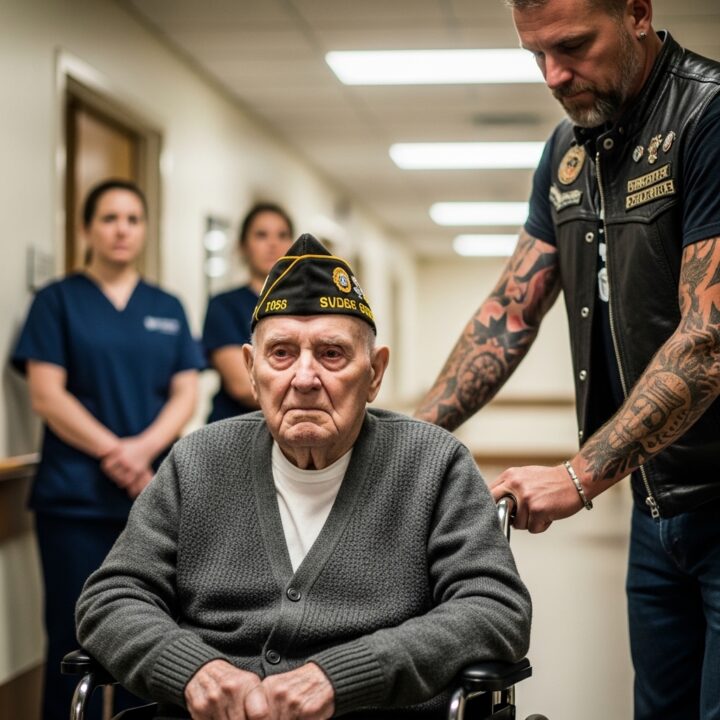
The front doors opened with a soft hydraulic sigh.
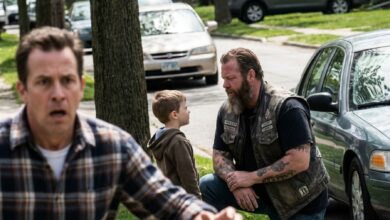
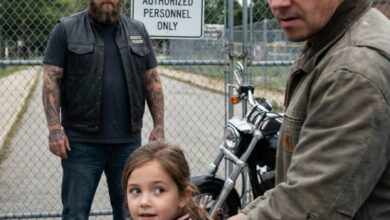
A man stepped inside wearing a leather vest over a short-sleeve shirt, tattoos visible down both arms. His hair was gray at the temples. His posture straight, controlled.
A biker.
The receptionist froze for half a second.
“Can I help you?” she asked, already reaching for the phone under the desk.
The biker nodded politely. “I’m here to see Frank Miller.”
That name didn’t come up often.
The receptionist frowned. “Are you family?”
“No,” he said. “But I’m expected.”
That didn’t help.
Down the hallway, aides peeked out of rooms. Whispers started immediately.
“What does he want?”
“Is this going to be a problem?”
“Should we call security?”
The biker didn’t raise his voice. He didn’t explain.
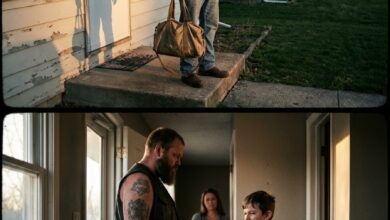
He walked slowly down the corridor, boots heavy against the tile, eyes scanning door numbers like he was counting steps in his head.
Frank noticed him before anyone else did.
Not because of the leather. Not because of the tattoos.
Because the biker stopped when he reached Frank’s doorway.
He removed his gloves.
“Sir,” he said quietly, respectful. “You ready?”
Frank blinked.
“I… excuse me?”
A nurse rushed forward. “You can’t just walk in here. He’s a resident. You need authorization.”
The biker turned, calm but unyielding. “He asked us to come.”
Frank’s heart began to pound.
He hadn’t asked anyone for anything in years.
Phones came out. Someone whispered, “This is getting out of hand.” Another voice said, louder this time, “Call administration.”
To the staff, the biker looked like a disruption.
A threat.
A man who didn’t belong.
Frank gripped the arms of his wheelchair, unsure whether to feel afraid or seen.
Security arrived first.
Two men in polo shirts stood between the biker and Frank, hands hovering near radios. The hallway felt suddenly narrow, crowded with judgment and suspicion.
“You need to leave,” one guard said. “Now.”
The biker didn’t move.
Instead, he reached into his vest.
A sharp intake of breath rippled through the hallway.
Frank’s fingers tightened. He hadn’t been scared like this since the winter of 1951, when silence meant something was about to go wrong.
The biker pulled out his phone.
Typed a short message.
Sent it.
Then he spoke—slow, measured.
“We’re not here to cause trouble,” he said. “We’re here to take him outside.”
The nurse scoffed. “For what? He barely leaves his room.”
Frank swallowed.
He wanted to say something. Anything. But his voice felt stuck somewhere behind decades of being told to sit down, to wait, to not be difficult.
“You don’t understand,” the biker continued. “He served. And today matters.”
Administration appeared at the end of the hallway. Clipboards. Badges. Tight smiles.
“Sir,” a manager said, “you’re making residents uncomfortable.”
The biker nodded once. “That’s not my intention.”
He looked back at Frank.
“Five minutes,” he said gently. “That’s all.”
No one knew who he had texted.
No one knew why he seemed so certain.
Outside, faint but unmistakable, the rumble returned.
Not one engine.
Several.
The hallway went quiet.
Everyone waited.
The sound reached the hallway before anyone saw them.
Not shouting.
Not sirens.
Engines.
Low. Even. Disciplined.
One by one, the rumble rolled across the parking lot, slipping through the glass doors and settling into the corridor like a presence that refused to be ignored. Conversations died mid-sentence. A clipboard clattered softly to the floor.
Frank felt it in his chest before he understood it.
The biker beside him didn’t react. He didn’t smile. He didn’t check his phone.
He simply waited.
The front doors opened.
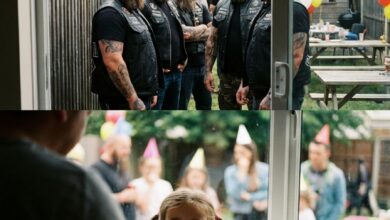
Another biker stepped inside. Then another. Then two more. Different ages. Different faces. Same posture. Helmets carried respectfully at their sides. No revving. No noise. Just boots on tile and eyes forward.
The hallway wasn’t theirs—but suddenly, it wasn’t controlled by the nursing home anymore either.
Security shifted uncomfortably.
The administrator straightened her jacket. “What exactly is going on here?”
One of the bikers spoke—not loudly, not sharply.
“We’re here to take a veteran outside,” he said. “With dignity.”
Frank’s throat tightened.
A nurse scoffed. “He’s fragile. He shouldn’t be—”
“He’s not broken,” the biker interrupted, calm as stone. “He’s just been waiting.”
Silence followed.
The manager glanced at Frank, really looked at him for the first time—not as a chart, not as a schedule problem, but as a man. An old man. A soldier.
Frank met her gaze.
“I’d like to go,” he said quietly.
No one argued after that.
They brought a jacket. A proper one. Someone adjusted his wheelchair straps with care instead of impatience. The bikers formed a loose, respectful line—not blocking, not crowding—just enough to make space where there hadn’t been any.
Outside, the afternoon sun waited.
Frank hadn’t felt it on his face in weeks.
A biker knelt and helped him stand. Not rushed. Not forced.
Frank straightened—slow, deliberate—leaning on the strength offered without pity.
Engines idled.
Not in celebration.
In honor.
They rolled him to the edge of the parking lot.
Someone saluted.
Frank didn’t notice at first. Then he did.
His hand shook as he returned it.
Later, someone would explain who they were. A veterans’ riding group. Men and women who’d served, or who rode for those who had. Someone would mention that Frank’s name had come up weeks ago—on a list. A quiet call. A message passed hand to hand.
No grand plan.
Just no one left behind.
The staff stood by the doors, watching the scene they hadn’t known how to make space for.
Frank sat among the bikes, sunlight warming his knees, leather and chrome reflecting a sky he’d almost forgotten. A biker placed a small folded flag in his hands.
“From us,” he said. “For what you did.”
Frank looked down at it for a long moment.
“I didn’t do much,” he said.
The biker shook his head. “You did enough.”
When they brought him back inside, it was quieter.
Different.
Aides spoke softer. A nurse adjusted his blanket without being asked. No one called him a burden again—at least not where he could hear.
That night, Frank placed the folded flag on his bedside table.
He slept with the window cracked, letting the distant echo of engines fade into memory.
And for the first time in a long while, he didn’t feel like extra weight.
He felt seen.
Sometimes dignity doesn’t come from policies or paperwork.
Sometimes it arrives on two wheels—
quiet, disciplined, and exactly on time.