They Called Him the “Problem Kid” — Until a Silent Biker Asked to See the Principal
The day a leather-vested biker walked into Jefferson Middle School asking for the principal was the day everyone realized they had misjudged the wrong person.
It started with a scream.
Not loud. Not dramatic. Just sharp enough to cut through the cafeteria noise like a crack in glass no one wanted to admit they heard.
Marcus Hill stood in the center of it all — skinny, hoodie too big for his frame, backpack half unzipped, papers spilling like evidence of a life always slightly out of control. Someone had shoved him again. A milk carton burst at his feet. Laughter scattered across the room like birds startled into flight.
“Problem kid,” someone muttered.
That label had followed him since September. Too loud. Too restless. Too angry. Teachers said he disrupted class. Parents whispered he had “issues.” Students treated him like a walking warning sign.
Today, two boys twice his size had cornered him near the exit. A shove. A taunt. A hand knocking his books down. Marcus swung back — not hard, not even well — but enough for a teacher to gasp.
“Marcus! Office. Now!”
The crowd shifted instantly. Phones lowered. Whispers sharpened. No one mentioned the other boys.
Marcus’s face burned. Not from pain. From humiliation. That familiar heat of being judged before you speak. His hands trembled as he gathered his scattered papers. No one bent down to help.
In the hallway, Assistant Principal Grant gripped Marcus’s shoulder a little too tightly. “You’re done for today.”
Marcus didn’t cry. He just stared at the floor like someone bracing for impact.
And that’s when the glass doors at the front entrance opened.
The rumble came first — low, distant, unmistakable. An engine idling like thunder waiting its turn.
Every head turned.
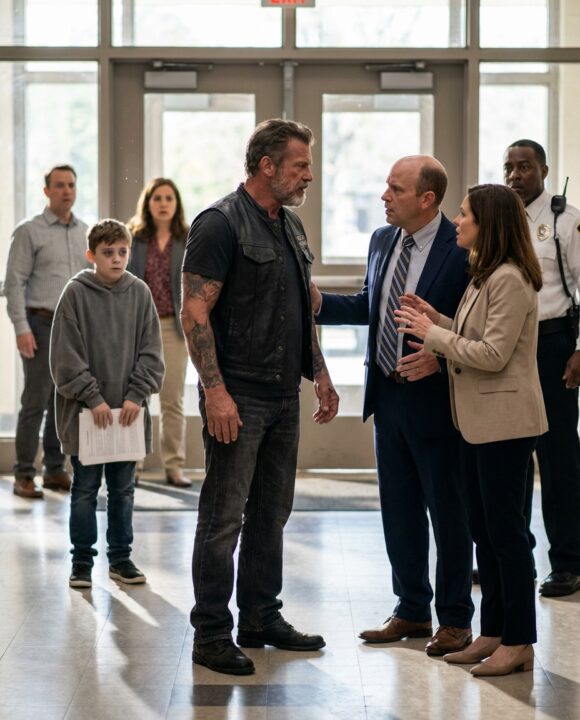
A tall man stepped inside, boots heavy, leather vest worn but clean. Graying beard trimmed short. Sunglasses pushed up onto his forehead. No patches screaming rebellion. Just a small stitched emblem over his heart.
He removed his helmet slowly.
“I’d like to see the principal,” he said.
His voice was calm.
Too calm.
No one knew yet that the real problem in that building wasn’t the boy standing in the hallway.
And they certainly didn’t know why the biker had come.
The secretary’s smile froze mid-gesture.
“Sir… do you have an appointment?”
The biker didn’t raise his voice. Didn’t fidget. Didn’t look around nervously like someone out of place.
“I don’t,” he replied. “But this won’t take long.”
Two teachers had already drifted closer. Assistant Principal Grant still held Marcus by the shoulder, now suddenly aware of the optics — a trembling seventh grader and a leather-clad stranger asking for authority.
“What’s this about?” Grant demanded.
The biker’s gaze shifted briefly toward Marcus. Not soft. Not sentimental. Just steady.
“It’s about him.”
The hallway stiffened.
“You his father?” Grant asked.
“No.”
“Then this is school business.”
“It is,” the biker answered.
A security officer appeared near the entrance. The secretary reached for the phone. Whispers traveled fast: “Call district.” “Is he threatening someone?” “Is that one of those gangs?”
The biker took one step forward.
Security reacted instantly. “Sir, I’m going to need you to stay where you are.”
He stopped.
Hands visible. Shoulders relaxed.
“I’m not here to cause trouble,” he said.
But in a building already primed for fear, a biker asking questions felt like a spark near dry wood.
Marcus stared at the man, confused. He didn’t recognize him. Didn’t understand why anyone would step into this moment for him.
Grant squared his shoulders. “This student was involved in a fight.”
Marcus flinched at the word fight.
The biker nodded once. “Was he?”
The tone wasn’t accusatory. It was surgical.
Grant bristled. “We have witnesses.”
“Do you?” the biker asked quietly.
That was enough. Phones came out. Someone whispered, “He’s challenging staff.” Another muttered, “He looks like trouble.”
The security officer placed a hand near his radio.
“Sir,” he warned, “if you don’t leave voluntarily—”
“I’m not leaving,” the biker said.
No raised voice. No clenched fists. Just a line drawn in still air.
The tension thickened like humidity before a storm.
“You’re intimidating staff,” Grant said sharply.
The biker’s jaw tightened slightly. “I’m asking for the principal.”
“Why?”
He paused.
“Because this isn’t the first time.”
Grant’s eyes narrowed. “What isn’t?”
The biker looked at Marcus again. The boy’s breathing had gone shallow. His hoodie sleeve hid a bruise no one had bothered to examine.
Security stepped closer.
“Sir, step outside.”
The biker did something that made everyone’s stomach drop.
He removed his phone.
Instantly, the officer grabbed his wrist.
“Whoa! Hands where I can see them!”
Gasps rippled through the hallway.
“It’s just a phone,” the biker said evenly.
But perception had already outrun reality.
A teacher whispered, “He’s calling someone.”
Exactly.
Marcus felt the shift before anyone else did.
The air changed. Heavy. Pressurized. Like the moment before something irreversible happens.
Grant motioned for Marcus to move toward the office. “We’re done here.”
Marcus didn’t move.
His eyes were locked on the biker.
The man typed something. Short. Deliberate. Then he lifted the phone to his ear.
He didn’t say a name.
“Yeah,” he said. “It’s happening again.”
A pause.
“No. Same place.”
Another pause.
“Bring it.”
He hung up.
The hallway erupted.
“Who are you calling?” Grant demanded.
The biker didn’t answer.
Security now stood directly between him and Marcus.
“You’re escalating this,” the officer said. “If backup arrives and this turns into a scene—”
“It already is,” the biker replied.
Grant’s face flushed. “You think we don’t know how to handle discipline?”
“I think,” the biker said carefully, “you’re looking at the wrong kid.”
The words hit harder than any shout.
Parents who had arrived early for pickup were now watching through the glass doors. Someone outside began recording.
Marcus’s heart pounded. He’d seen this pattern before. Adults arguing. Adults assuming. Adults deciding.
He whispered, barely audible, “It’s okay… you don’t have to.”
The biker heard him.
He stepped slightly sideways, ensuring Marcus was no longer directly exposed to the hallway crowd. A subtle move. Protective, but not dramatic.
Grant pointed toward the door. “Last warning.”
The biker’s boots didn’t move.
The silence stretched.
In that silence, you could hear everything — fluorescent lights humming, someone’s breath hitching, a distant locker slamming.
Then, faint at first…
A low rumble.
Not one engine.
Several.
Outside.
Every adult in that hallway stiffened.
Grant’s voice faltered. “What did you do?”
The biker didn’t smile.
He just waited.
The engines didn’t roar.
They idled.
Orderly. Controlled. Not chaos — coordination.
Through the glass doors, three motorcycles rolled into view, parking in a neat line. No revving. No theatrics. Helmets removed in unison.
Two men. One woman. All middle-aged. All wearing similar leather vests with the same small emblem stitched over the heart.
The doors opened.
Boots on tile.
The sound echoed louder than shouting would have.
Parents outside fell silent. Phones lowered.
Grant swallowed.
“This is a school.”
“Yes,” the biker replied.
The newcomers didn’t spread out aggressively. They stood beside him. Close enough to show solidarity. Far enough to avoid confrontation.
One of them — the woman — held a thin folder.
She stepped forward.
“Principal Alvarez expecting us?”
The name landed like a dropped plate.
Alvarez’s office door opened at the end of the hall.
He’d heard the engines.
He’d seen the emblem before.
His face changed when he recognized it.
“Mr. Dalton,” Alvarez said.
The hallway froze.
Grant blinked. “You know him?”
Alvarez nodded slowly.
“Yes.”
Mr. Dalton.
Not “that biker.”
Not “sir.”
Not “remove him.”
A name.
A relationship.
Dalton gestured slightly toward Marcus.
“We’d like to review incident reports from the last four months.”
Grant’s voice cracked. “On what grounds?”
The woman opened the folder.
“On the grounds that we’ve been documenting a pattern.”
She pulled out printed emails. Dates. Photographs. Time stamps.
Marcus stared, stunned.
Alvarez looked at Grant.
“Let’s take this to my office.”
The shift was almost invisible — but undeniable.
Security stepped back.
The hallway that had been ready to expel a boy and arrest a stranger now stood in complete silence.
Power had moved.
Without a single threat.
Without a single raised fist.
Just presence.
Just preparation.
Just truth waiting to be seen.
Inside the office, the story unfolded quietly.
Marcus’s mother had died the previous year. His father worked night shifts. Dalton had been his mother’s sponsor in a community recovery program — a man who checked in weekly. Who drove Marcus to school some mornings when his dad couldn’t.
Four months ago, Marcus had started getting detention.
Three months ago, Dalton started noticing bruises.
Two months ago, emails went unanswered.
One month ago, a substitute teacher finally responded.
And today, when Marcus texted only one word — “again” — Dalton came.
The folder revealed something else.
Camera angles that missed the first shove.
Witness statements that excluded certain names.
A pattern where Marcus reacted — but never initiated.
Alvarez leaned back slowly.
Grant stared at the papers like they were written in a foreign language.
Marcus sat in a chair too big for him, staring at his sneakers.
No speeches.
No apologies loud enough for the hallway.
Just the heavy sound of truth settling into place.
Later that afternoon, Marcus walked out the front doors.
No escort to detention.
No suspension slip.
Dalton stood by his bike.
“You okay?” he asked.
Marcus shrugged.
“Yeah.”
It wasn’t dramatic.
No hug. No tears.
Just a nod.
As Dalton put on his helmet, one of the teachers stepped outside.
“I… we didn’t realize.”
Dalton looked at her for a long moment.
“That’s the problem,” he said.
He started the engine.
Not loud.
Not aggressive.
Just steady.
Marcus watched as the bikes pulled away in a straight line down Maple Avenue.
Inside the building, the word “problem kid” felt suddenly smaller.
And in the quiet that followed, the people who had spoken the loudest earlier found themselves with nothing to say.
Because sometimes the most dangerous thing in a room isn’t the boy who swings back.
It’s the assumption that he swung first.