The Old Man Lost Everything to a Phone Scam — Then a Biker Rode to His Door
The old man was still holding the phone when he realized his entire life savings had vanished.
He didn’t scream.
He didn’t curse.
He just stood in the middle of his small Indiana living room, staring at the faded wallpaper, the ticking clock suddenly louder than anything else in the world.
“Sir, your account is secure now,” the voice had said. Calm. Professional. Reassuring.
And he had believed it.
Because when you’re eighty-two, and someone says they’re calling from your bank… you don’t imagine you’re about to lose everything you’ve built across four decades of factory shifts and military service.
Harold Whitman lowered himself into his recliner, hands trembling. His oxygen machine hummed softly beside him. The television played an afternoon game show he wasn’t watching.
His checking account: zero.
His savings: zero.
The retirement fund he never touched? Gone.
He had followed instructions. Read them the verification codes. Moved money “for protection.”
Now there was nothing left to protect.
Across the street, a neighbor glanced through her blinds. She’d seen him pacing earlier. Phone pressed to his ear. Confused. Anxious.
But nobody knocked.
Nobody asked.
Because these things… they happen to “other people.”
Inside that quiet house, Harold whispered something that sounded more like surrender than words.
“I’m sorry, Mary.”
Mary had been gone three years.
That’s when the engine rolled down his street.
Low. Heavy. Distinct.
A motorcycle slowed in front of his house.
Harold didn’t notice at first.
But the rider did.
He had not come by accident.
And he was not just passing through.
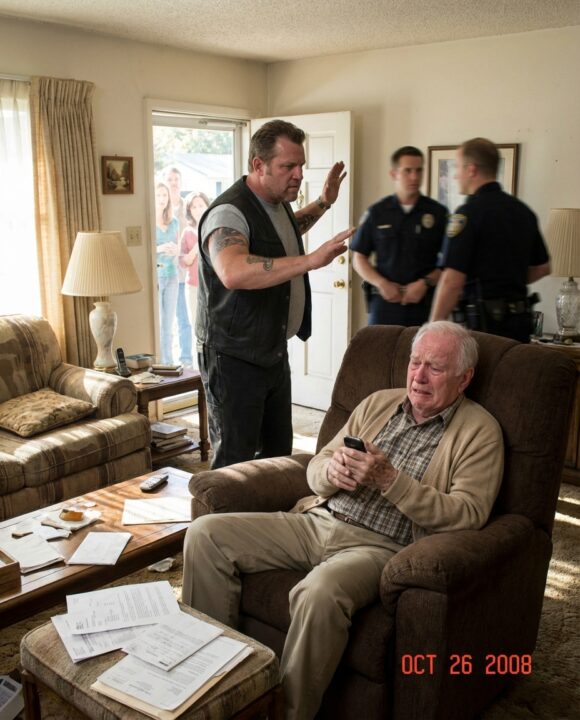
The biker didn’t remove his helmet immediately.
He sat there for a moment, staring at the modest one-story home with peeling shutters and a small American flag planted crookedly near the mailbox.
Then he killed the engine.
The silence felt deliberate.
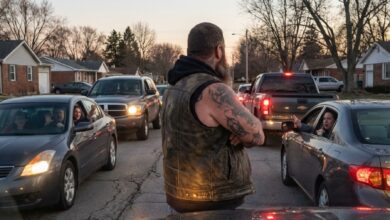
Across the street, Mrs. Donnelly pulled her curtain back a little further. A tall man stepped off the bike—late forties, broad shoulders, leather vest over a gray T-shirt, faded Marine Corps tattoo along one forearm.
He looked like trouble.
He walked straight toward Harold’s front door.
No hesitation.
No smile.
Just purpose.
Mrs. Donnelly grabbed her cordless phone.
Inside, Harold was still staring at his bank statement on the laptop when a firm knock rattled the door.
He flinched.
Another knock. Louder.
He shuffled to the entryway and opened it halfway.
The biker stood there, eyes steady.
“Mr. Whitman?”
Harold’s stomach tightened.
“Yes?”
“My name’s Daniel Mercer.”
No explanation.
Just a name.
“I need to talk to you about a phone call you received today.”
The air shifted.
Harold’s heart dropped.
“How would you know that?” he whispered.
Daniel didn’t answer directly.
Instead, he stepped forward—just slightly.
From across the street, it looked aggressive.
Threatening.
Mrs. Donnelly dialed 911.
“There’s a biker harassing Mr. Whitman,” she whispered urgently. “He looks dangerous.”
Daniel kept his voice calm. Low. Controlled.
“Sir, did someone ask you to transfer money?”
Harold’s hands began to shake harder.
“Who are you?” he demanded.
Daniel reached slowly into his vest.
Harold stumbled back.
Across the street, Mrs. Donnelly gasped as police sirens began to echo faintly in the distance.
Daniel pulled out… not a weapon.
A phone.
On the screen was a paused video.
Harold’s voice.
Recorded.
“But they said it was to secure my account…”
Daniel looked him directly in the eye.
“Sir,” he said quietly, “you were scammed.”
The word hit like a physical blow.
Harold’s knees nearly buckled.
Police cruisers pulled up.
Officers stepped out.
And what they saw—
A leather-clad biker inside an elderly man’s doorway.
An old man trembling.
And a situation that looked very, very wrong.
“Step away from him!” one officer ordered.
Daniel didn’t argue.
He raised his hands calmly.
But he did not leave.
“I’m trying to help him,” Daniel said evenly.
“That’s not what it looks like,” the officer replied.
Harold tried to speak, but words tangled in his throat. Shame crawled up his spine. The humiliation of being fooled burned hotter than fear.
Daniel kept his hands visible.
“Sir, I work with a veterans’ fraud recovery group.”
The officers exchanged a look.
Harold blinked.
“What?”
Daniel turned slightly toward him.
“You’re not the first. And you’re not alone.”
The officers remained skeptical.
One of them moved closer to Daniel.
“You got ID?”
Daniel nodded slowly.
Again, the movement toward his vest made everyone tense.
He removed a worn leather wallet and handed over a credential card.
Midwest Veterans Cyberwatch Initiative.
The younger officer frowned.
“Never heard of it.”
Daniel didn’t react.
“That’s fine. You will.”
Harold’s breathing grew uneven. His oxygen tube trembled against his cheek.
“They took everything,” he whispered. “Every dollar.”
Daniel’s jaw tightened.
Across the street, neighbors had begun gathering. Phones raised. Recording.
Some whispered.
Some shook their heads.
A biker inside an old man’s house while police stand watch — it looked like a crime scene.
The older officer lowered his voice.
“What exactly are you doing here?”
Daniel answered carefully.
“I traced the call.”
The officer’s eyes narrowed.
“How?”
Daniel glanced at Harold.
“Sir, when they called you… did they mention a wire transfer through Cedar Regional Bank?”
Harold nodded slowly.
Daniel’s phone buzzed.
He didn’t look at it yet.
“I need ten minutes,” Daniel said quietly. “If I’m wrong, I leave.”
The officers hesitated.
The neighbors leaned closer.
And in that moment, the power dynamic felt fragile.
Like glass under pressure.
Daniel finally looked at his phone.
A message.
He exhaled.
“Okay,” he murmured.
Not triumphantly.
Not dramatically.
Just… steadily.
And somewhere beyond that quiet Indiana street—
Something had already begun to shift.
It wasn’t the sirens this time.
It was the engines.
Low at first. Distant. Then closer. Not chaotic. Not reckless. Controlled.
One motorcycle.
Then another.
Then three more turning onto the quiet residential street in tight formation.
Neighbors stopped whispering.
Phones lowered slightly.
The sound alone carried something different — not threat, but discipline.
The lead rider slowed, killed his engine, and removed his helmet. A woman in her early forties stepped off first — jeans, riding jacket, calm eyes. Not wild. Not loud.
Professional.
Two more riders parked behind her. One carried a slim laptop bag. Another wore a polo under his leather vest — small embroidered logo: MCVI.
The older officer stiffened.
Daniel didn’t move. He didn’t smirk. He didn’t gesture.
He simply stood beside Harold, hands relaxed at his sides.
The woman approached the officers first.
“Officer,” she said evenly, extending a card. “Midwest Veterans Cyberwatch Initiative. We coordinate directly with regional fraud task forces.”
The younger officer blinked.
The older one took the card.
His radio crackled suddenly.
Dispatch.
He stepped aside to answer.
A pause.
Another pause.
Then his posture shifted.
“Yes, sir… understood.”
When he returned, the tension had changed direction.
“You traced a routing path through Cedar Regional and flagged it with state cybercrime?” the officer asked Daniel carefully.
Daniel nodded once.
The rider with the laptop had already opened it on Harold’s kitchen table. He worked fast but respectfully, asking permission before touching anything.
Within minutes, screens filled with transaction logs.
IP traces.
Flagged mule accounts.
The woman rider spoke softly to Harold.
“Mr. Whitman, did they tell you the money was going to be ‘secured overseas temporarily’?”
Harold swallowed.
“Yes.”
She nodded gently.
“They used that script on six veterans this month.”
The street had gone quiet.
No one was filming now.
The officers stood not as enforcers — but as witnesses.
The younger officer cleared his throat.
“You’re saying… some of it can be stopped?”
Daniel looked at Harold, not at the officers.
“Some of it already has.”
The rider at the laptop turned the screen around.
“Forty-eight thousand frozen mid-transfer. Thirty-two pending reversal.”
Harold’s mouth opened but no sound came out.
He gripped the arm of his recliner as if bracing against wind.
Mrs. Donnelly, still standing near her porch, lowered her phone completely.
The older officer removed his hat slowly.
“I didn’t know this program existed,” he admitted.
Daniel finally spoke more than a sentence.
“We don’t advertise. We just ride.”
There was no pride in it.
No theatrics.
Just fact.
And in that moment, the crowd understood something simple and heavy:
The biker hadn’t come to intimidate.
He had come because someone had to.
And when Harold’s voice broke into a whisper — “You found it?” —
The woman rider squeezed his shoulder gently.
“We found most of it.”
The street, once tight with suspicion, felt suddenly fragile with relief.
Power had shifted.
Not through force.
But through presence.
It took hours.
Paperwork.
Calls to the bank.
Statements.
The officers remained — not guarding against Daniel, but assisting.
By dusk, the street looked almost ordinary again.
The riders packed their equipment without ceremony.
No press.
No applause.
No speeches.
Harold stood in his doorway as Daniel secured his helmet.
“You didn’t have to come,” Harold said.
Daniel adjusted his gloves.
“Yes, I did.”
It wasn’t heroic.
It was simple.
Harold hesitated, then asked quietly, “Why me?”
Daniel paused.
“Because three years ago, you donated to a veterans legal fund online. Your name ended up in a database scammers target.”
Harold’s shoulders sank — not in shame, but in understanding.
“I thought I was helping someone.”
“You were,” Daniel said gently. “You just helped the wrong one.”
Silence stretched.
The evening air cooled.
The crooked little American flag near the mailbox fluttered.
Harold’s voice cracked.
“My wife used to say I trusted too easily.”
Daniel met his eyes.
“That’s not a flaw.”
He didn’t say more.
He didn’t need to.
The other riders mounted up.
Engines rumbled again — steady, not loud.
As they prepared to leave, the older officer stepped closer.
“For what it’s worth,” he said to Daniel, “we were wrong.”
Daniel shook his head.
“No,” he replied calmly. “You were doing your job.”
He swung onto his motorcycle.
Harold stepped forward awkwardly.
“I can’t repay you.”
Daniel looked at the house — the worn paint, the oxygen tank visible through the window, the recliner near the TV.
“You already did,” he said.
Then he added something so quiet only Harold heard it:
“Next time the phone rings, call us first.”
The engines rolled away.
Neighbors didn’t clap.
They didn’t cheer.
They simply watched.
Because sometimes the loudest thing isn’t the engine.
It’s the realization that the man you feared at first… was the only one who showed up.
Inside the house, Harold sat back down in his recliner.
His account wasn’t fully restored yet.
The paperwork wasn’t done.
But something else had returned.
Not money.
Not pride.
Something steadier.
The belief that even after you lose everything, someone might still ride toward you instead of away.
And outside, the street returned to quiet.
As if nothing dramatic had happened at all.
Except it had.