The Most Feared Biker on Route 60 Hid a Crooked Pink “Daddy” Patch Inside His Vest for Twelve Years—Until a Crash Tore Open the Promise No Brother Knew He Carried
The crash tore Graves’s vest from shoulder to waist, and beneath thirteen years of skulls, memorial patches, and road dust, we found one crooked word stitched in pink yarn: DADDY.
I had ridden beside Mason “Graves” Rourke for nine years, yet I had never heard him say he had a child.
None of us had.
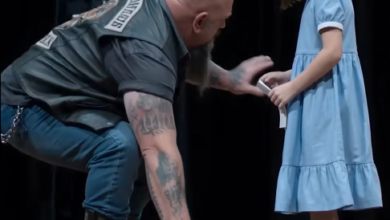
To strangers, Graves looked like the man parents warned their kids not to stare at. He stood six-foot-four, weighed close to 280 pounds, kept his head shaved to the skin, and wore a black-and-gray beard thick enough to hide the scar running under his jaw. Faded tattoos covered both forearms. A black raven climbed the left side of his neck. His knuckles carried four dark letters that people always misread from a distance.
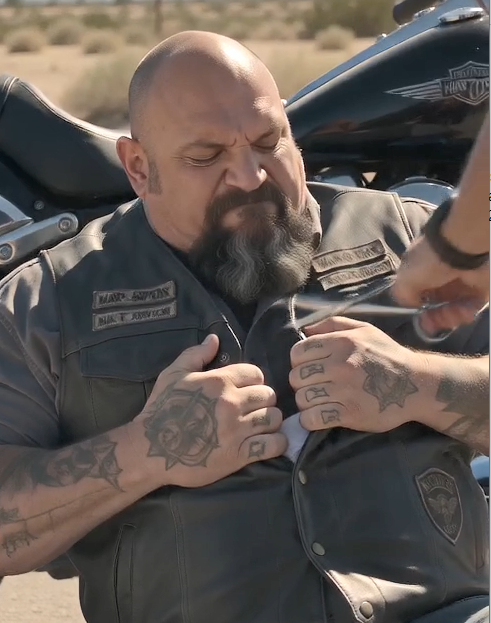
His leather cut frightened people even more.
The back displayed the black iron wheel of the Black River Riders. Smaller patches covered the front: funeral runs, prison charity rides, fallen brothers, skulls, broken chains, and the dates of men who had gone down on roads across Arizona. Nothing on that vest was bright. Nothing was soft.
At least, nothing we could see.
Graves had rules about the cut. Nobody touched it. Nobody wore it. Nobody placed it on the ground, leaned it over a chair, or threw it into a truck bed. When the leather cracked, he repaired it alone behind the locked door of his garage. When rain soaked it, he dried it beneath a ceiling fan and sat nearby until morning.
We assumed it was about the club patch.
We were wrong.
The crash happened on Route 60 outside Superior, Arizona, during a Saturday memorial ride. Twenty-one Harleys were moving west through the heat when a blue sedan drifted across the center line near a rock cut. I was three bikes behind Graves. I heard the sudden rise of his V-twin, saw his brake light flash, and watched him throw nearly 900 pounds of motorcycle toward the gravel shoulder.
He could have held his line.
Instead, he moved directly into the worst place on the road.
His Harley struck the guardrail, slid sideways, and disappeared in a storm of dust and sparks. The sedan stopped forty yards ahead. Our engines died one after another until the desert became so quiet I could hear hot metal ticking against stone.
Graves lay beside the rail.
His right boot was trapped beneath the motorcycle. Blood darkened one sleeve, but his eyes were open. I knelt beside him while Boone and Ortega lifted the bike away.
“Don’t move,” I told him.
He ignored me and grabbed the front of his vest with both hands.
“Don’t cut it.”
The leather had caught on a bolt during the slide. Its outer layer had split open from his left shoulder to the bottom seam. The paramedic reached for trauma shears, and Graves—who had remained silent while three men lifted a Harley off his ankle—roared loud enough to make everyone freeze.
“Not through the inside.”
The paramedic thought he was protecting the Black River patch. So did I.
Then the torn leather folded backward.
Under the skulls and dark embroidery was a small square of faded white cloth, hidden against the lining over his heart. Pink yarn wandered unevenly across it. The first D leaned left. One side of the A had been stitched twice. The final Y curled downward in a loose loop.
It looked as if a child had fought with every stitch.
Boone reached toward it.
Graves caught his wrist.
“Leave her work alone.”
Her.
Before anyone could ask what that meant, the door of the blue sedan opened. A sixteen-year-old white girl stepped onto the shoulder, shaking so badly she had to hold the doorframe. She had dark hair, purple glasses, and a small crescent-shaped scar above her eyebrow—the same scar Graves carried beneath his beard.
She stared at the torn vest.
Then she whispered one word none of us were prepared to hear.
“Dad?”
Graves closed his eyes, not from the pain in his leg, but as if the secret beneath the leather had finally become heavier than the motorcycle that had landed on him.
The girl’s grandfather stepped out behind her, took one look at Graves, and said, “You were never supposed to come near her again.”
That was when Boone stood up.
That was when our brothers began asking why Graves had lied.
And that was when I realized the pink patch was not merely something a daughter had made. It was evidence of a promise that had cost Graves twelve years of her life.
Part 2, The Brother Who Never Rode Home
My name is Daniel Crowe, although everyone in the Black River Riders calls me Crow. I manage a transmission shop in Mesa, ride a black Road King with more miles than resale value, and spent nine years believing I knew everything worth knowing about Graves.
He joined our club after serving eighteen months at the Arizona State Prison Complex in Florence. He never lied about the conviction. A fight outside a bar in Globe had left another man with a fractured cheekbone, three broken ribs, and permanent damage to one eye.
Graves did not call it self-defense.
“He stopped swinging,” Graves told us during his membership interview. “I didn’t.”
That answer mattered. Men who blame everybody else usually bring their excuses into the club. Graves brought responsibility instead.
He arrived at the shop before everyone else, swept metal shavings from the floor, and stayed after dark to teach young prospects how to rebuild carburetors without stripping old screws. He did not drink. He never carried a gun on a ride. When arguments began, he stepped between people and made his body the wall, but I never saw him throw a punch.
Children still moved behind their parents when he approached.
Dogs did not.
Every stray around our clubhouse trusted Graves. They came from drainage ditches, gas stations, truck stops, and desert pullouts. He kept water under both saddlebags, carried dried beef in his tool roll, and had a habit of stopping his motorcycle whenever he saw an animal pacing near traffic.
“Big man likes little things,” Boone once joked.
Graves looked at him for a long second.
“Little things get missed.”
That was all he said.
There were other details we failed to understand. Graves never rode with us on the second Sunday of each month. He claimed he worked overtime, although my shop had once called his freight depot on a Sunday and learned it was closed. He carried a folded sheet of purple construction paper inside a waterproof envelope. Whenever anyone asked about it, he put it away.
He also hated pink thread.
Not the color. The waste.
One night, a prospect used pink nylon cord to tie a loose sleeping roll onto the back of his bike. Graves cut the engine, removed the cord, rolled it carefully, and handed it back.
“Don’t leave ends hanging,” he said.
The prospect laughed. “Afraid it’ll ruin your image?”
Graves looked toward the dark highway.
“Loose thread catches.”
We assumed he meant a chain or wheel.
After the crash, those words returned to me differently.
Two weeks before the memorial ride, I had been helping Graves replace a clutch cable when his phone rang. He wiped his hands before answering, something he never did for any of us.
“Yeah,” he said.
Then his voice softened.
“No. Purple’s fine.”
I pretended to inspect the cable.
“You don’t have to explain it to him,” Graves continued. “If you like it, wear it.”
There was a pause.
“I’ll be there where we agreed.”
After the call, I asked whether he had a woman.
“No.”
“Then who wears purple?”
His hand stopped above the toolbox.
“Somebody who shouldn’t have to defend it.”
He shut the drawer.
That Saturday morning, before the ride, Graves arrived with a fresh strip of black tape around the left inner seam of his vest. Boone noticed it while we fueled in Apache Junction.
“Your cut coming apart?”
“It’ll hold.”
“Let Stitch repair it.”
“No.”
Stitch was our club’s best leatherworker. He had repaired half the cuts in three counties. Graves would not let him inspect the seam.
Boone frowned. “That patch belongs to all of us.”
“The back does,” Graves replied.
He tapped the leather above his heart.
“This part’s mine.”
That answer irritated Boone more than it should have. Boone was our president then, and to him the cut was not clothing. It was a flag. Every visible mark had to be approved. Every change carried meaning.
He told Graves to remove the vest if he did not trust the brotherhood with it.
Graves did.
For the first time in nine years, he finished fueling without his cut. He folded it carefully, placed it inside his saddlebag, and stood beside his Harley in a gray T-shirt while twenty men watched.
Nobody knew what to do.
Then Boone exhaled, handed the vest back, and said, “Fix the seam after the ride.”
Graves put it on without a word.
The argument appeared settled, but something had shifted. Boone believed Graves was hiding an unauthorized patch, perhaps an old affiliation from before prison. Ortega thought he might be carrying a name connected to the man he had assaulted. I wondered if the vest concealed the initials of a woman who had died.
None of us imagined a four-year-old girl with pink yarn.
We rode east under a hard white sun. Graves served as road captain, as he had for six years. He checked every intersection, counted bikes in every mirror, and adjusted the formation when an older rider’s engine began overheating.
At the cemetery outside Miami, we buried Calvin Reese, one of our founding members. Graves stood behind Calvin’s widow without touching her. When her knees weakened, he placed a folding chair behind her before anyone else noticed.
During the final prayer, his phone vibrated.
He looked at the screen.
A photograph appeared for less than a second: a teenage girl in purple glasses sitting behind the steering wheel of a blue sedan, smiling with both hands in the correct position.
Graves turned the phone facedown.
I saw pride move through his expression and disappear.
“Your niece?” I asked.
He looked toward Calvin’s grave.
“No.”
He said nothing more until we started west.
Forty minutes later, that same blue sedan crossed the center line.
Part 3, The Lane He Refused to Take
The road through the rock cut narrowed before the crash. There was no broad shoulder, only a strip of gravel between the asphalt and an old steel guardrail bolted into stone. Traffic moved slowly around the memorial procession, but a delivery truck had begun passing the rear riders, squeezing the formation.
Graves signaled us tighter.
The blue sedan approached from the opposite direction. It entered the curve too quickly, corrected left, then snapped back across the center line. I saw the driver’s face for only a moment.
A teenager.
Terrified.
Graves had three choices. He could brake hard and risk twenty motorcycles stacking behind him. He could hold his lane and strike the sedan near the driver’s door. Or he could use the gravel gap beside the guardrail, a space barely wider than his Harley.
He chose the gap.
His left saddlebag clipped the rail. The motorcycle twisted beneath him. Leather scraped steel. The rear tire lifted, and Graves went down with the bike between his body and the sedan.
The blue car passed without contact.
That detail became important later. At the time, it simply looked impossible.
We reached him within seconds. Boone killed traffic while Ortega and I lifted the Harley. Graves’s ankle lay at an angle that made my stomach tighten, but there was no bone through the skin. His shoulder had taken most of the slide.
“Girl?” he asked.
I thought he meant someone from our procession.
“What girl?”
“The driver.”
“She stopped.”
“Breathing?”
“I don’t know.”
Graves tried to sit up.
I pressed him down. “You move, I’ll hit you myself.”
That almost made him smile. Almost.
Then the paramedics arrived and found the vest caught on the guardrail bolt. The leather had folded beneath Graves, pulling tight across his throat. They had to remove it before stabilizing his neck and shoulder.
Graves would not let them cut the lining.
“Sir, the jacket doesn’t matter,” the paramedic said.
“Vest.”
“What?”
“It’s a vest.”
The man glanced at me, silently asking whether head trauma had made Graves irrational.
I knelt closer. “Brother, let them work.”
Graves’s fingers closed around my wrist. His grip remained brutal despite the blood running from his forearm.
“Crow. Inside seam.”
“What’s inside it?”
His eyes moved toward the sedan.
“Mine.”
The paramedic cut through the outer layer beside the damaged seam. The leather opened. Black fabric peeled away, exposing the white square and pink word beneath.
DADDY.
The road changed.
The sirens were still running. Engines still ticked in the heat. A truck driver still shouted at Boone from behind the stopped traffic. Yet every Black River Rider stared at those five childish letters as if the desert had swallowed all other sound.
The patch had not been professionally embroidered. It had been constructed with wide, uneven loops of yarn, some doubled over, some barely holding. Two pink fingerprints had stained the edge of the white cloth, perhaps from paint or marker.
Graves covered it with his palm.
“Leave her work alone.”
Then the girl from the sedan called him Dad.
Her name was June Rourke. She was sixteen. She had held a learner’s permit for three months and was driving with her maternal grandfather, Harold Bell, in the passenger seat. A plastic bottle had rolled beneath the brake pedal as they entered the curve. June looked down for less than two seconds.
Two seconds was enough.
Harold crossed the shoulder with anger doing the work fear could not. He grabbed June by one arm, moved her behind him, and pointed at Graves.
“You stay away from her.”
Graves did not argue.
Boone did.
“Your girl crossed the line.”
“She’s a child.”
“So was every rider behind him.”
Harold stepped toward Boone. “I know what his kind does.”
The Black River Riders shifted.
Boots scraped gravel. Chains clicked against denim. Twenty large men closed the distance without discussing it. No one drew a weapon. Nobody needed to. Their bodies made the threat.
Graves saw it.
“Back.”
His voice was weak, but we knew the command.
Boone looked at him. “She nearly killed you.”
“Back.”
“We’re protecting you.”
“No. You’re scaring her.”
June stood behind her grandfather with both arms folded across her stomach. Her face had gone pale. She was staring not at Graves’s blood or the wrecked Harley, but at the pink patch beneath his hand.
“I made that,” she whispered.
Harold turned. “Get in the car.”
“I made it.”
“June.”
“I was four.”
Graves’s fingers tightened around the cloth.
A highway patrol officer arrived and separated everyone. He tested June for impairment, inspected the roadway, and took statements from witnesses. The bottle beneath the pedal explained the drift. The skid marks explained Graves’s decision.
There was still a problem.
The delivery truck passing behind us had blocked the escape lane on our right. Graves could not safely brake into it. Had he remained upright, the rear motorcycles might have hit him. Had he held his line, the front of his Harley would have entered June’s door.
The guardrail had been the only choice that endangered him more than anyone else.
The paramedics placed Graves on a stretcher. He insisted they fold the torn vest across his chest, lining inward. Before the ambulance doors closed, June stepped past Harold.
“Did you know it was me?”
Graves looked at her purple glasses.
“Before the curve.”
“How?”
“Crescent sticker on the mirror.”
June had placed a silver crescent sticker on the sedan’s side mirror. It matched the one on her phone case in the photograph Graves had received that morning.
“You recognized my car?”
“Yeah.”
“And you still—”
Harold pulled her away before she could finish.
The ambulance left.
For several seconds, the Black River Riders remained beside the wreck. Boone picked up a strand of pink yarn that had torn loose and caught against the guardrail.
He held it between two thick fingers.
Then he looked at me.
“He knew.”
I nodded.
“He chose the rail because he knew.”
That felt like the story’s ending. Graves had protected his daughter even after being ordered away from her. His secret had been exposed. The girl was alive. The brotherhood had witnessed what he had done.
But the patrol officer returned from the sedan carrying a sealed envelope.
June had hidden it inside the glove box.
Graves’s name was written across the front.
Under his name were five words:
FOR AFTER MY DRIVING TEST.
Harold saw the envelope and tried to take it.
Boone closed his hand around it first.
Part 4, What a Four-Year-Old Asked Him to Carry
We followed the ambulance to a trauma center in Mesa. Graves had a fractured ankle, a dislocated shoulder, three broken ribs, and road rash along his right forearm. Nothing inside his skull was bleeding. His spine was intact.
He would heal.
His vest might not.
Stitch spread it across a table in the waiting room. The outer leather was split in two places. One memorial patch had been ground nearly blank. The club wheel on the back was scratched but whole.
The hidden square had survived.
Boone placed June’s envelope beside it. He wanted Graves to open it, but hospital staff had taken him for surgery. Harold and June had not arrived. The patrol officer said their sedan was being towed and that a relative was driving them to the hospital.
For the first time, we had nothing to do.
Twenty men occupied the waiting room in black leather and road dust. Families moved to chairs farther away. A security guard watched us from the doorway. A little boy pointed at Boone’s skull ring until his mother lowered his hand.
Stitch turned the vest over.
Beneath the white patch, stitched to the lining, was a narrow cloth pocket. Inside it were twelve folded pieces of purple paper.
One for each year.
Boone swore under his breath.
“We shouldn’t read them,” I said.
He looked at the surgery doors. “Then how do we know what we’re protecting?”
“We protect him.”
“That secret nearly split the club before the road did.”
Boone’s anger was not really about secrecy. He had spent twenty-three years believing the patch on a man’s back meant the brothers knew who stood inside it. Graves had trusted us with prison, violence, and every mile after release.
He had not trusted us with June.
Before Boone could decide, she entered.
June walked into the waiting room wearing the same jeans and white shirt from the crash. Someone had cleaned the dust from her face, but a line of dried blood remained on her wrist. It was Graves’s blood.
Harold followed with his jaw locked.
June saw the letters on the table.
“Those are mine.”
She took the purple pages before Boone could answer. Each one had been folded around a date. Some carried stickers. One had a pressed yellow flower. Another had been decorated with a drawing of a black motorcycle beneath an oversized pink moon.
“You wrote to him?” Harold demanded.
“Every birthday.”
“You told me you stopped.”
“I stopped mailing them.”
She looked at Graves’s vest.
“I gave them to Aunt Rachel.”
Rachel was Graves’s younger sister. We knew she lived in Tucson, but none of us knew she had served as the bridge between father and daughter. Once a year, at a public library in Florence, she arranged for June to leave a letter inside a motorcycle repair manual. Graves retrieved it later.
He never answered directly.
Instead, he placed his reply inside another book: The Little Engine That Could, the same book he had read to June before prison.
Harold knew nothing.
Neither did we.
June sat beside the ruined vest and touched the pink yarn. “I made this during family day.”
The truth came slowly.
Graves had not gone to prison because of a random bar fight. The injured man was Aaron Pike, the drunk driver who had killed Graves’s wife, Melissa, and escaped a felony charge after evidence problems reduced the case to reckless driving. Six months later, Graves found him drinking in a Globe tavern.
Pike mocked the dead woman.
Graves struck him.
Then he kept striking.
June had been three when her mother died and four when her father was sentenced. Harold and his wife obtained guardianship. They did not trust Graves’s temper, his club connections, or the men who visited him in prison.
They were not entirely wrong.
Graves had been dangerous. Grief had emptied every room inside him except the one containing rage. He entered prison believing the assault was justified and spent his first months planning what he would do to Pike after release.
Then June visited.
During a family craft program, children were given cloth squares, plastic needles, and thick yarn. June struggled to form letters. A volunteer offered to help, but she slapped the woman’s hand away.
“I know my daddy,” she said.
She stitched the word herself.
The D leaned left because she began too close to the edge. The A had two sides but no proper middle. The final Y curled because the visit ended before she could knot it.
When the guard announced time, June pressed the square into Graves’s palm.
“Put it outside,” she told him. “So people know you’re Daddy.”
Graves looked through the visiting-room window at Harold, who had agreed to only one visit.
“I can’t wear it outside here.”
“Then put it inside.”
“Why inside?”
Four-year-old June touched the center of his prison shirt.
“So it knows where you are.”
Graves had kept the cloth during the rest of his sentence. After release, he sewed it into his first riding vest, directly over his heart. When that vest wore out, he moved the patch into the next one. No club brother ever saw it because he repaired the lining himself.
Harold believed Graves had abandoned June.
In truth, Graves had signed an agreement.
After release, Harold offered him a choice: contest guardianship and drag June through court, or remain out of sight until she turned eighteen. Graves’s prison counselor warned that a custody fight could fail and frighten the child further. Rachel told him June had begun sleeping normally again.
So Graves signed.
He did not lose his daughter in court.
He stepped away.
“Why didn’t he tell us?” Boone asked.
June held the patch against her palm.
“Because Grandpa said if the club came near me, he’d move us out of Arizona.”
Harold’s face hardened. “I protected her.”
June looked at the surgery doors.
“So did he.”
Boone placed the sealed driving-test envelope in front of her.
June opened it.
Inside was a photocopy of the old guardianship agreement, a completed petition asking the court to restore contact, and a handwritten note.
She read it once.
Then she passed it to me.
Dad, I turn seventeen next month. I don’t want another year of library books and roads you pretend not to ride past. If I pass my test, I want my first drive to be to your house. I want to hear your answer where nobody can hide it.
At the bottom, she had written a question.
Will you teach me how to sew the patch properly?
Stitch turned away.
Boone sat down.
Harold remained standing, but the fight had left his shoulders.
The surgery doors opened. A nurse told us Graves was stable and awake. Only one visitor could enter.
Every brother expected June to go.
Harold stepped in front of her.
“No.”
Boone rose.
This time Graves was not there to order us back.
Part 5, The Brotherhood at the Hospital Door
Boone could have frightened Harold without touching him. He was sixty-two, broad across the chest, with a white beard tied beneath his chin and twenty-three years of club history on his back. Behind him stood nineteen riders who had just watched Graves break himself to protect the girl Harold would not let through a hospital door.
But Boone did something harder.
He removed his vest.
He folded it over one arm and motioned for the rest of us to do the same.
Leather creaked around the waiting room. One by one, the Black River Riders took off their cuts. We placed them over chairs, across our laps, or beneath our arms until no club patch faced Harold.
Boone removed his skull ring too.
“We’re not here as a club,” he said. “We’re here because he has nobody else.”
Harold looked around at twenty men in faded shirts. Without the leather, we appeared older. Sunburned. Tired. Less like a wall and more like mechanics, truck drivers, veterans, roofers, and fathers who had left breakfast dishes in sinks before the ride.
“You think clothing changes what you are?” Harold asked.
“No,” Boone said. “But sometimes it changes what you can see.”
June moved around him.
Harold caught her wrist.
She did not pull away. “He knew it was my car.”
“He caused that wreck.”
“He prevented mine.”
“He is violent.”
“He was.”
“He chose those men over you.”
June’s face changed. Not dramatically. She simply stopped looking like someone asking permission.
“No. You chose that for him.”
Harold released her.
The nurse led June through the doors.
We waited.
Twenty minutes passed. Then forty. A vending machine hummed in the corner. Ortega bought coffee for everyone, but nobody drank it. Stitch worked a loose strand of pink yarn between his fingers without cutting it.
When June returned, her eyes were dry.
“He wants Crow.”
I entered Graves’s room alone.
His right arm was immobilized. Purple bruising had begun beneath his ribs. A clear tube ran into his left hand. Without his beard shadowed by the vest collar, he looked less frightening and more exhausted than I had ever seen him.
The torn cut lay on a chair.
“You read the letter?” he asked.
“June did.”
“What’d she say?”
“That depends. Did you give her an answer?”
Graves looked toward the window. “Told her I don’t sew worth a damn.”
“That isn’t an answer.”
“Yeah. It is.”
I knew him well enough to understand. He would teach her. He would let her fix the patch. He would allow her into the garage, show her the locked cabinet, and make room in a life he had arranged around absence.
Then his gaze moved to the vest.
“Boone see it?”
“Everybody did.”
His jaw tightened.
“You ashamed?” I asked.
Graves looked at me with enough force to bend steel.
“No.”
“Then what?”
“She was four. That belonged to me.”
He had not hidden the patch because pink yarn weakened the image of a feared biker. He had hidden it because it was the last thing June had placed directly in his hands. The club displayed public history on the outside of a cut—rides, funerals, rank, loyalty.
The inside held the thing that kept a man alive when public history was not enough.
“I need the vest,” he said.
“You need pain medicine.”
“Crow.”
I carried it to the bed. He touched the damaged leather, then lifted the lining far enough to inspect the child’s stitches. One pink loop had pulled free near the A.
His hand began shaking.
Not his voice. His hand.
“Can Stitch save it?”
“He says yes.”
“No new cloth.”
“I’ll tell him.”
“No machine over her stitches.”
“I’ll tell him.”
“No straightening the letters.”
I almost smiled. “Brother, nobody’s making that word pretty.”
Graves relaxed against the pillow.
Outside the room, Boone was waiting. He entered without his cut and stood at the foot of the bed.
“We’ve got a problem,” Boone said.
Graves glanced at him. “Bike?”
“Bike’s replaceable.”
“Then what?”
“Our rules say every patch added to a cut needs approval.”
The room went still.
I wanted to drag Boone out by his beard. Graves had just come through surgery. June was ten yards away. This was not the hour for club law.
Boone placed the pink strand from the guardrail on the blanket.
“Nobody approved this one.”
Graves’s expression emptied.
Boone continued. “So we need a vote.”
He opened the door.
The other riders filed in until the room could hold no more. Those outside remained visible through the glass. None wore their vests.
Boone asked whether the hidden patch violated the Black River Riders’ rules.
Every hand went up.
Yes.
Then he asked whether Graves should remove it.
No hand moved.
Finally, Boone asked whether the rule should change: one personal patch, hidden inside the cut, no approval required, provided it represented a person or promise the rider was responsible for carrying.
Every hand rose.
Boone looked at Graves.
“Motion passes.”
Graves stared at the men around him. He did not thank us. He did not give a speech. He reached for the strand of yarn and closed it inside his fist.
That was enough.
Harold appeared in the doorway.
He held the twelve purple letters.
“I read them,” he said.
June stood behind him.
Graves’s body became rigid.
Harold placed the letters beside the bed. “You should have fought me.”
Graves’s answer was quiet.
“Would’ve made her the rope.”
Harold sat in the chair beside the ruined vest. For the first time since the crash, he looked directly at the man instead of the biker, prisoner, or threat he remembered.
“I hated you for not fighting.”
“I hated me too.”
June stepped between them and laid the pink patch over Graves’s chest.
“Then both of you wasted enough time.”
Neither man argued.
Part 6, The Stitch Nobody Corrected
Graves remained in the hospital for five days. June visited every afternoon. Harold came twice, sat near the window, and spoke mostly about insurance forms, the damaged sedan, and the court petition.
It was not forgiveness.
It was a beginning small enough to survive.
Stitch repaired the vest in the hospital waiting room. He replaced the torn outer leather with material taken from an old cut Graves had worn during his prospect year. He reinforced the shoulder by hand and restored the damaged memorial patches without polishing away the road marks.
He did not touch the word DADDY.
June did.
She sat beside him with pink yarn looped through a wide plastic needle like the one she had used at four. Stitch showed her how to secure the loose A from the back without covering the original loop.
Her first new stitch came out crooked.
She started to remove it.
Graves stopped her.
“Leave it.”
“It doesn’t match.”
“Exactly.”
She added one small knot beneath the Y. Then she turned the lining over and embroidered the date of the crash in thread so pale it could only be seen up close.
Boone watched from the doorway.
“Does that count as a second patch?”
June looked at him over her purple glasses. “Do you want to vote again?”
Boone shook his head. “No, ma’am.”
When Graves returned home, Harold drove June to his garage. She found twelve birthday gifts stacked in a locked metal cabinet. Graves had bought one each year but never mailed them because the agreement forbade direct contact.
Some no longer fit her.
There was a child-sized helmet painted purple, a box of astronomy stickers, a leather tool pouch, a beginner’s camera, and a pair of riding gloves meant for hands half her current size.
June did not open everything that day.
She chose the gloves.
Then she placed them beside the repaired vest.
The blue sedan was eventually repaired. Graves refused reimbursement for the Harley. He said the accident report was sufficient and that no insurance company could return what the crash had accidentally given him.
He spent twelve weeks off the bike. While his ankle healed, June visited every second Sunday—the same Sundays Graves had once disappeared from club rides to collect her letters at the library.
Now we knew.
The first time she entered our clubhouse, every man stood. She looked around at the skulls, black leather, scarred faces, and heavy boots, then placed a sewing basket on the table.
“Dad says some of you have loose inside seams.”
Nobody laughed.
By sunset, six riders had asked her for pink thread.
Part 7, What We Carry on the Inside
Graves rode again the following spring.
His rebuilt Harley was black, heavy, and louder than the original. The repaired vest sat differently across his left shoulder, but the Black River wheel remained visible on the back. The pink patch stayed hidden against his chest.
He still did not show it to strangers.
He did not need to.
Our first ride took us east along Route 60. June followed in the blue sedan with Harold in the passenger seat. She had passed her driving test months earlier, yet Graves insisted on checking her tires, mirrors, brake lights, and bottle holders before allowing her onto the highway.
“No loose bottles,” he told her.
“I know.”
“No looking down.”
“I know.”
“If the road narrows—”
“Dad.”
He stopped.
June reached through the open window and tapped the leather above his heart.
“It knows where you are.”
Graves stepped back.
We rode to the same rock cut where he had chosen the guardrail. No memorial waited there because nobody had died. Instead, Boone carried a small steel box containing the pink yarn recovered from the road, the bent bolt that had torn the vest, and a photograph June had taken of her father’s repaired cut.
Graves refused to leave the box beside the highway.
“This isn’t a grave,” he said.
So June carried it home.
That became our ritual. Every spring, we rode through the curve once. No speeches. No flowers. We simply reduced speed, widened the formation, and listened to the V-twins settle into the lower rhythm Graves had taught us.
Years later, the outside of his vest gathered more dark patches. Two marked fallen riders. One honored a shelter fundraiser. Another carried the date Boone finally stepped down as president.
Inside, the crooked pink word remained alone.
When new prospects asked why our club allowed hidden personal patches, Boone never told Graves’s story. He only said every man carries one truth that does not belong to the crowd.
Some riders stitched wedding fabric inside their cuts. One carried his son’s hospital bracelet. Ortega added a square cut from his mother’s kitchen apron. Boone sewed in the corner of an old photograph but refused to explain whose hand appeared in it.
Graves kept the first patch.
The worst-looking one.
The best one.
On Sunday mornings, June sometimes rode behind him. Her purple helmet barely rose above his shoulder. Before starting the Harley, Graves always reached beneath the left side of his vest and pressed two fingers against the loose curl of the Y.
Then the engine started.
The leather closed.
And Daddy rode home.
Follow our page for more biker stories about misunderstood riders, hidden promises, tested brotherhood, and the quiet truths carried beneath black leather.