The Boy Whose Bike Was Seized Over Fees — And the Biker Who Bought It Back
They took the boy’s bicycle in front of everyone — and he didn’t cry until the wheels left the ground.
It happened on a bright Tuesday afternoon outside Jefferson Community Center in a small Ohio town where people believed rules kept everything orderly and fair.
A thin twelve-year-old boy stood on the sidewalk, fingers still wrapped around the handlebars of a blue mountain bike that was clearly older than he was. The chain squeaked. The paint was chipped. But the tires were freshly pumped, like someone cared.
“Unpaid registration and storage fees,” a uniformed facility manager announced loudly, clipboard tucked under his arm like a badge of authority.
The boy blinked.
“I was going to pay,” he said. “I just need a few more days.”
Behind him, kids from the summer sports program whispered.
“That’s what happens.”
“My mom says you gotta follow the rules.”
The manager bent down and snapped a small red tag around the frame. The sound of plastic tightening echoed louder than it should have.
“It’s policy,” the man said, not unkindly — just unmoved.
The boy’s hands trembled. He looked around, searching faces. No one stepped forward. Parents stood by their SUVs. A coach crossed his arms and looked away.
The manager signaled to a maintenance worker.
They lifted the bike.
That’s when the boy broke.
“Please,” he said. Not shouting. Not demanding. Just small. “That’s how I get home.”
The worker hesitated, but only for a second.
Policy.
They loaded the bike into a storage cage attached to the side of the building — a place meant for equipment, not childhood.
The cage door slammed shut with a metal echo that felt like hope locking itself away.
That’s when a low engine rumble rolled across the parking lot.
Heads turned.
A black Harley eased into the space near the curb, engine cutting off slowly, deliberately.
The rider removed his helmet.
Mid-50s. Broad shoulders. Sun-worn face. Short gray beard. Sleeveless leather jacket, tattoos faded but visible. The kind of man people watched carefully.
He looked at the cage.
Then at the boy.
Then at the clipboard.
And he walked toward them without saying a word.
No one knew yet what he was there to do.
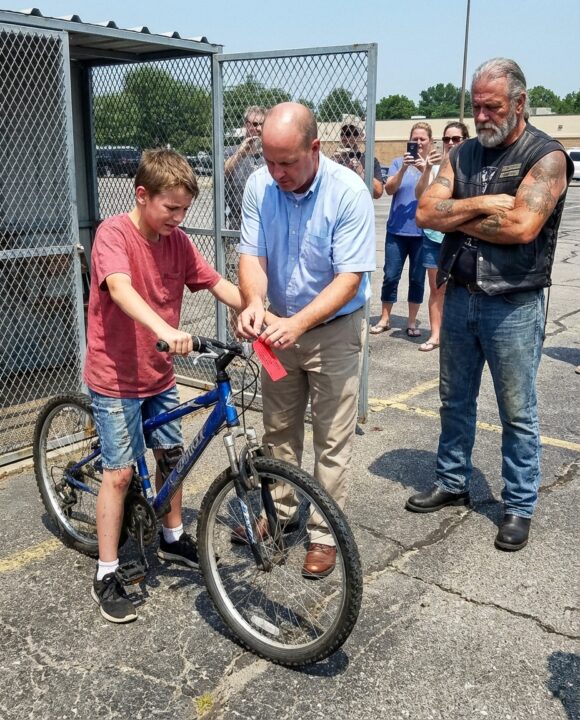
The biker didn’t rush.
Didn’t storm.
He approached like someone who had time — which somehow felt more threatening than anger.
“Problem?” he asked.
The manager straightened.
“This doesn’t concern you.”
The boy wiped his face quickly, embarrassed now by his own tears. “It’s fine,” he muttered, though it clearly wasn’t.
The biker stepped closer to the storage cage. He ran his fingers lightly along the metal bars, studying the tag.
“Unpaid fees,” the manager repeated. “Three months. Written notices were sent.”
“To who?” the biker asked.
“To the address on file.”
The boy’s face dropped further. “That’s my old apartment,” he whispered. “We had to move.”
The biker turned to the manager.
“How much?”
“That’s not how this works,” the manager replied sharply.
Parents nearby started shifting.
One woman leaned toward another and murmured, “This feels aggressive.”
Another pulled out her phone.
The biker placed one boot up on the curb and leaned slightly toward the cage, testing the latch.
From a distance, it looked like he was about to break it open.
Gasps.
“Hey!” the manager snapped. “Step away from the property!”
The biker didn’t raise his voice. Didn’t back off immediately either.
He looked at the boy.
“You ride this to school?”
The boy nodded.
“And home?”
Another nod.
A security guard appeared from inside the building, hand resting near his belt.
“Sir, I’m going to ask you to step back.”
The biker lowered his foot slowly and turned toward the guard.
No sudden moves.
But his posture didn’t soften.
“Just asking questions,” he said.
The manager crossed his arms.
“If you interfere with facility property, I will call the police.”
A murmur ran through the parking lot.
“Typical,” someone muttered. “Bikers always think they can bully their way through.”
The boy’s shoulders tightened. “It’s okay,” he said again, though his voice had cracked into something fragile.
The biker looked at the clipboard one more time.
Then he reached into his vest.
Several people flinched.
Phones lifted higher.
The guard stiffened.
But the biker only pulled out his phone.
He typed something.
Then made a call.
“Yes,” he said calmly. “Jefferson Center. Bring the paperwork.”
He hung up.
He didn’t explain.
Didn’t argue.
He simply stepped aside and waited.
And the waiting felt like a fuse burning toward something none of them could yet see.
The manager’s patience thinned visibly.
“You need to leave,” he said. “You’re causing a scene.”
“I’m standing,” the biker replied.
The guard moved closer.
Parents whispered louder now. Some children edged farther away, unsure if this was about to turn into a fight.
The boy stood frozen between embarrassment and fear.
The sun beat down harder, or maybe it just felt that way.
The manager gestured toward the storage cage.
“The bike remains confiscated until the balance is cleared. End of discussion.”
“How much?” the biker asked again.
The manager exhaled sharply. “Two hundred and thirty-seven dollars and fifty cents. Plus processing.”
The number hit like a punch.
For a bike that was maybe worth half that.
The boy looked at the pavement.
“I was saving,” he said quietly. “From mowing lawns.”
The biker studied him carefully.
“Anyone explain the fees to you?” he asked.
The boy shook his head.
The manager interjected. “We sent notices.”
“To a place he doesn’t live,” the biker said.
The guard stepped between them now.
“That’s enough.”
The crowd sensed escalation.
This could go wrong.
The biker’s jaw tightened, but he didn’t step forward.
Instead, he looked at the boy again.
“You got anywhere to be?”
“Practice,” the boy said. “Across town.”
“With no bike?”
Silence.
The manager checked his watch.
“You have five minutes to clear the property.”
The biker nodded once.
Then he did something small.
He sent a second text.
Just three words.
“Bring the receipt.”
No one knew who he had contacted.
The guard radioed someone inside.
A parent whispered loudly, “Call the police before this turns ugly.”
The boy stood alone in the middle of grown-up power structures — policy, authority, pride — all heavier than he was.
The biker remained still.
Hands at his sides.
Waiting.
And then, from the far end of the parking lot, came another engine.
Then another.
Not loud.
Not aggressive.
But deliberate.
Heads turned again.
The manager’s expression shifted — irritation turning into something uncertain.
Because this time, the rumble didn’t belong to one man.
And the balance of the afternoon was about to change.
The engines didn’t roar.
They rolled in low and even — not loud enough to threaten, but steady enough to change the air.
Three motorcycles entered the Jefferson Community Center parking lot in controlled formation. No revving. No theatrics. Just presence.
Parents who had been whispering now fell quiet.
The manager’s hand tightened around his clipboard.
The boy looked up, confused.
The first biker didn’t move. He didn’t wave them over. He didn’t signal anything dramatic. He just stood where he had been standing all along — beside a storage cage holding a twelve-year-old’s only way home.
The other riders parked in a line near the curb.
Helmets came off one by one.
Older men. Late 40s. 50s. One maybe early 60s. Not reckless. Not wild. Their leather vests carried small, understated patches:
“Veterans Support.”
“Community Outreach.”
“Local Fire Association.”
Not gang colors.
Not chaos.
Organization.
One of them stepped forward carrying a slim black folder.
He approached the first biker, nodding once.
“You good?” he asked quietly.
“Yeah.”
Nothing else.
The manager cleared his throat loudly. “This isn’t some kind of intimidation tactic, is it?”
No one answered him.
The security guard looked uncertain now. His hand drifted away from his belt.
The man with the folder stepped up beside the first biker and addressed the manager calmly.
“You’re holding the bicycle under unpaid facility fees?”
“That’s correct.”
“And you’re within policy?”
“Yes.”
“Good,” the man replied. “We’re here for the balance.”
The manager blinked.
“I’m sorry?”
The first biker finally stepped closer to the clipboard.
“How much was it again?” he asked.
“Two hundred thirty-seven dollars and fifty cents,” the manager said stiffly.
The man with the folder opened it.
Inside was a check already filled out.
The number written clearly.
Signed.
Dated.
He handed it over without flourish.
The manager stared at it.
“This isn’t necessary,” he muttered, though his voice lacked conviction.
“It’s policy, right?” the first biker said evenly.
A small ripple passed through the watching crowd.
The parents who had been ready to call the police now stood motionless.
No one was yelling.
No one was breaking locks.
No one was threatening anything.
They were simply… paying.
But it didn’t feel simple.
It felt like authority being mirrored back calmly and without fear.
The manager hesitated only a second longer before signaling the maintenance worker.
The metal cage door creaked open.
The sound seemed louder than it should have.
The boy stared as the bike was rolled out, the red confiscation tag snipped away.
For a moment, he didn’t move.
Like he wasn’t sure it was real.
The first biker walked over, took the handlebars gently, and wheeled it toward him.
“Check the tires,” he said.
The boy crouched automatically, pressing his thumb into the rubber.
Still firm.
Still his.
The parents watched in complete silence now.
The power in the parking lot had shifted — not through force, not through shouting, but through discipline and preparation.
One of the additional riders spoke quietly to the first biker.
“All set?”
“Yeah.”
The manager handed over a receipt, forced professionalism back in place.
The man with the folder tucked it away.
No speeches.
No celebration.
Just order restored — but on different terms.
And the quiet that followed felt heavier than any confrontation would have.
The boy stood beside his bike like someone who had just been handed back something more than metal and rubber.
He swallowed hard.
“Thank you,” he said, barely above a whisper.
The first biker shrugged.
“Ride safe.”
“That’s it?” the boy asked, confused.
“That’s it.”
The other riders began fastening helmets again.
Engines turned over one at a time.
Low. Controlled.
Before putting his helmet on, the first biker crouched slightly to meet the boy’s eye level.
“You keep your address updated,” he said calmly.
The boy nodded quickly.
“And if you don’t understand something — you ask.”
Another nod.
No lecture. No moral.
Just instruction.
The manager stood a few feet away, holding his clipboard like it suddenly weighed more.
One of the parents approached him.
“Maybe next time,” she said quietly, “you could talk to the kid first.”
He didn’t respond.
The security guard shifted awkwardly, avoiding eye contact with the bikers he had assumed were about to cause trouble.
The first biker stood, pulled on his helmet, and mounted his Harley.
Before starting it, he looked once more at the boy.
“Why were you late on the fees?” he asked.
The boy hesitated.
“My mom works two jobs,” he said. “I didn’t want her to know.”
The biker nodded once.
No pity in his face.
Just understanding.
He started the engine.
As the group rode out of the parking lot in calm formation, the sunlight caught on chrome and faded tattoos.
No one cheered.
No one clapped.
They didn’t stay for thanks.
They didn’t post about it.
They simply left.
The boy stood in the lot long after they were gone, one hand resting on his handlebars.
The parents drifted back toward their cars.
Conversations changed tone.
Some looked embarrassed.
Some thoughtful.
The manager walked back inside with his clipboard.
But something on that Tuesday afternoon had shifted.
Not the policy.
Not the fees.
But the way people saw a man in leather stepping forward.
The boy swung his leg over the bike.
Paused.
Then rode toward the exit of the lot.
The chain squeaked softly as he pedaled away.
On the back of the bike, a small scratch caught the sunlight.
A mark from years of use.
Still there.
Still his.
And miles away, the rumble of motorcycles faded into regular traffic — just another sound in America’s wide open afternoon.
Except now, in one small town, a few people would hesitate before assuming that the loudest engine belonged to the worst intention.
And a twelve-year-old boy learned something too.
Sometimes rules stand firm.
Sometimes people do.
And sometimes the difference between humiliation and dignity is one man who chooses to stay — and then quietly pays the balance.