The Boy Who Returned a Pink Helmet After Six Years — And the Question He Was Afraid to Ask the Bikers Who Lent It to Him
The boy stood outside our clubhouse for two hours with a battered pink child’s helmet in his arms, and when I finally opened the door, he said he had come to return something we had lent him six years ago.
His name was Owen Bell, though I did not know it yet. He was sixteen, tall enough to look me in the eye if he straightened his back, with a rain jacket too thin for the March wind coming off the Tennessee River. The helmet was sized for a ten-year-old. Its paint had flaked away near the visor, and one side carried a silver star sticker with only three points left. He held it against his ribs as if putting it down might give somebody permission to take it.
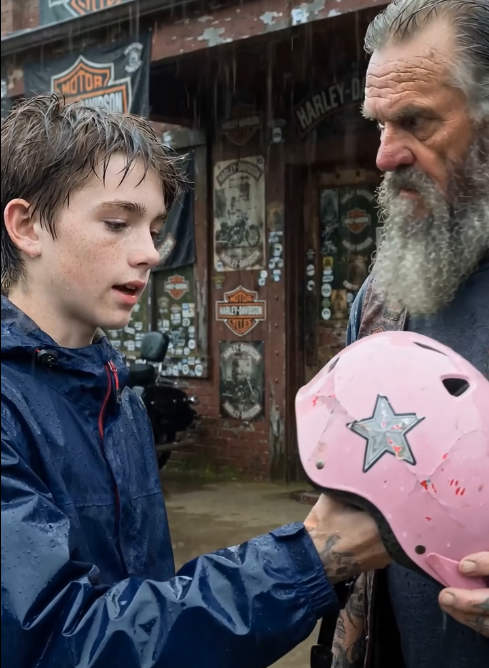
I am Ray Dawson, president of the Iron Lanterns. Our clubhouse sits behind a motorcycle repair garage outside Knoxville. We had finished a charity ride that morning, and I was sweeping gravel off the front step while the other members argued over lunch upstairs. A security camera showed the kid arriving a little before ten. He had stayed by the gate through a brief shower, watching each time the door opened, but he never rang the bell.
“You could’ve knocked,” I said.
He gave the helmet a small squeeze. “I wasn’t sure you’d remember me.”
I took another look at his face. Nothing. I had met hundreds of kids at fairgrounds, school fundraisers, and hospital rides. They had grown up while I kept riding the same black Harley, and sometimes it seemed they all remembered the vest and the beard better than I remembered the people inside the photographs.
“I’m sorry,” I told him. “Help me out.”
“At the county fair.” His voice came out carefully, like each word had already been rehearsed. “Six years ago. I got separated from my mom. Three of you helped me look. You let me wear this because I couldn’t ride without a helmet.”
From the open doorway behind me, Boone said, “That can’t be one of ours.” His granddaughter had outgrown two bright helmets, but I had never seen this pink one in our equipment cabinet. I glanced back at him, then at the boy, who stared past us into the clubhouse.
“I promised I’d return it,” Owen said. “I kept it clean.”
He had tried. Someone had glued the broken foam lining along the edge, and the strap had been stitched where the fabric had frayed. It was still an old helmet, one nobody should have used again. Keeping it had required attention, though. I could see that in the careful repairs and in the way his thumb rubbed the surviving point of the star.
Travis came down the stairs behind Boone. He was our youngest full member and could turn a conversation into a joke before anyone noticed it had become serious. This time he simply asked whether the boy wanted to come inside out of the cold.
“Maybe in a minute,” Owen said.
There were motorcycles parked along the building, tool carts visible beyond the garage windows, and the smell of hot coffee slipping through the open door. Owen looked at all of it. He looked like somebody who had come to a place after studying its address for a long time and still did not know whether he was allowed to enter.
I asked what the fair looked like that night. He remembered a stall selling carved wooden animals, a generator failing near the food trucks, and a woman who had tied a red balloon to his wrist so he would be easier to spot. At the balloon, something old shifted in my memory. I remembered a smaller boy with wet hair, one red balloon snagging on the buckle of a leather vest, and an officer at the fairgrounds trying to reach a mother on a number that rang and rang.
“Owen?” I asked.
He nodded once. Relief crossed his face, followed so quickly by caution that I might have missed it if I had blinked.
Boone leaned toward me. “You know him?”
I did. And I remembered that our trip with the helmet had not ended with a boy finding his mother. We had taken him to the police station after every attempt to reach her failed. She had left the fairgrounds. She did not come back that night.
Owen glanced between us. “You remember the promise, then?”
I could have answered yes. Instead, I asked whether there was someone with him, and the question made his shoulders pull tight beneath the rain jacket. He said he had taken the bus alone. A little notebook stuck out of his pocket, worn at the corners from being opened often.
“Who knows you’re here?” I asked.
“My caseworker.”
The clubhouse noise faded behind me. Owen placed the pink helmet on the step between us, but left his fingers resting on the visor.
“I didn’t only come about the helmet,” he said.
For six years I had remembered the mother who never answered. Owen had spent those same years remembering three men who came back whenever they said they would. I opened the door wider and waited for him to finish.
Part 2
Owen did not finish on the doorstep. He picked up the helmet again and followed me into the front room, where we kept a scarred wooden table, a coffee maker that rattled, and photographs from rides nobody wanted taken down. Travis fetched a dry towel for the rain on Owen’s jacket. Boone offered hot chocolate before remembering the boy was sixteen. Owen accepted it anyway. Nobody asked him to perform gratitude for being let inside.
He sat at the edge of a chair and set the helmet on the floor between his shoes. When he looked at the walls, I caught myself hoping he would find proof that our club deserved the memory he carried of us. We had done useful things. We had also spent six years without asking what became of him. He knew the address because the club name had been on a plain card I gave to the fairgrounds officer that night, and he had written it in his notebook years later when he found the card in his records.
The county fair had been loud and muddy that evening. Boone, Luis, and I were returning from a veterans’ fundraiser when an attendant flagged us down near the livestock barn. A little boy sat behind the ticket booth gripping a red balloon, his face streaked with dirt and tears. He knew his mother’s first name and the color of her coat. He thought she might be at the rides. When the attendant said police had been called, we offered to help look while everyone stayed in contact with the officer.
We did not put a frightened child on a motorcycle on impulse. The officer stayed involved, and Owen remembered asking to go with us because he could see farther down the fairground road from Boone’s sidecar. Boone had a child-sized helmet left by a family member who had ridden in it before, pink because nobody in his house thought colors belonged to one kind of child. We checked the fit before a slow trip around a closed service lane with the officer following. We found no one answering his mother’s description. Back at the ticket booth, the officer told us to bring Owen to the station so the search could continue safely.
I remembered promising Owen that I would stay until the officer knew how to reach his family. I stayed. What happened after I left had lived in my head as a blank space I had been ashamed to examine. On the way out I had told the boy he could keep the helmet until things settled, and when he asked how to return it, I said, “Find our garage. Somebody’s always there.” At the time I imagined a parent calling the next week.
“There wasn’t anyone,” Owen said now.
The officer had reached a grandmother in another state, but she could not take him. His mother’s phone had been switched off. When Owen was old enough to see more of the file, he learned she had been seen leaving the fairgrounds alone. The facts were plain; the reasons were not. I did not ask him to guess why she went. He had already spent too many years living with that question.
From the station, he had entered foster care. He told us about five homes with an economy that made me listen harder: one had a dog named Peanut, another had a kitchen with a blue ceiling, and one family taught him to make fried rice. He had been safe in some places and deeply unhappy in others. Placements ended for reasons that sometimes had nothing to do with him. A caregiver became ill. A family moved. One home was not a good fit. Every change meant a new room, a new set of house rules, and a decision about what would fit in his bag.
“The helmet always came,” he said.
Boone looked down at it. “That strap shouldn’t be on the road anymore.”
“I know. I haven’t worn it since I was ten.” Owen drew his feet closer around it. “It came with me anyway.”
I could picture a child entering five unfamiliar bedrooms carrying a helmet too small for his head. An object with a return address had become something he could count on when addresses around him changed. He had kept a promise we barely remembered because the promise had been his own.
Travis wanted to say something. I could see it in his jaw, in the way he gripped his mug. Instead, he asked whether Owen needed to call his caseworker. Owen showed us a message confirming she knew where he was and when he intended to return. He had told her he wanted to visit our garage. He had not told her what question he planned to ask us.
I told him we had time. He watched me for a moment, then pulled the notebook from his pocket and opened it to a page covered with bus times and small, heavily crossed-out sentences. In the margin, he had written the word ASK and underlined it three times.
Part 3
Before Owen read from the notebook, a customer came into the garage with a damaged gate hinge in the back of a pickup. We could have let Luis handle it. Owen saw the piece from his chair and asked how it had broken, then caught himself. He apologized for interrupting as though curiosity were another thing he might be asked to pack away.
“Come look if you want,” Luis said. “Stay behind the yellow line.”
The three of us went into the shop. Owen spotted the bend before Travis did and asked whether the gate had dragged along the ground. Luis said it had. Owen smiled with the private pleasure of getting a question right. He did not claim he could fix it. He wanted to know what kind of work happened in each bay, what the members did on weekdays, and whether everybody with a vest repaired motorcycles. He was learning the shape of the place before he decided whether to ask it to hold him.
Back in the clubhouse, I told him what I remembered about the fair. I did not soften the last part. “We looked for your mom. When we couldn’t find her, we took you to the station. I stayed until the officer had someone with you.”
He nodded. “I know.”
“For a long time, I didn’t know what happened next.”
“Neither did I,” he said. “Not right away.”
I thought he might ask why we had not followed up. I had an answer involving what information officers could share, ordinary responsibilities, and my mistaken hope that his family would appear. None of it would change the six years he had lived. When he finally asked, it was smaller: “Did I cry the whole time?”
“Most of the time. You stopped when Boone let you choose which helmet he’d bring.”
Boone blinked. “That’s where it came from?”
“You had two in the sidecar box. The other was black and too big.”
He reached out, stopping short of the pink visor. “My granddaughter’s. I’d forgotten she left it there.”
Owen’s face changed. “Does she want it back?”
“She’s twenty-three,” Boone said. “She has other things to worry about.” Then, more gently: “You can decide what happens to it.”
Owen nodded and looked away. He was still holding the notebook open. Finally, he said he was sixteen and had spoken with his caseworker about finding supervised work outside school hours. He had checked which bus served our road and what time it returned downtown. He could clean floors, wash motorcycles, sort parts, and carry boxes if someone showed him where they went. He began to say he would work for free.
“No,” Boone said before the sentence was finished. His voice came out hard enough that Owen flinched. Boone set down his mug. “I mean if there’s work, we pay for it. I’m sorry I said that sharp.”
Owen studied the tabletop. “I don’t need much.”
“I heard you,” I said. “Tell us the rest.”
He swallowed. “Could I come here sometimes? Even if it isn’t a workday?”
The room went quiet. Upstairs, the old refrigerator clicked on. Outside, a motorcycle pulled away from the curb and its engine settled into the distance. Owen stared at his underlined ASK as though the word might still disappear.
“I don’t have anywhere that stays mine for long,” he said. “I thought if I brought the helmet back, you might remember me. Then maybe I could ask.”
I had been ready to offer a job before he said that. A job was easier. I knew where to put a person on a schedule and how to sign a check. He was asking whether he could enter the garage without first earning the right to be seen there, and I did not want to answer with a promise I could not keep.
Travis leaned forward. “We have room.”
I put a hand on his arm. “Let me talk to him.”
He looked at me as if I had decided to send Owen back out into the rain. I had not. But Owen had a caseworker, school, placement arrangements, and rights that were his; the club could not appoint itself his family at a table because we liked the idea. Wanting to help was the first step, not a plan.
“You can visit,” I told Owen. “We’ll speak with your caseworker about what work is allowed, what transport is safe, and who supervises you. We can start there. You don’t have to work free to be welcome.”
He pressed the notebook flat with both hands. “I thought you’d say I’d waited too long.”
“For returning a helmet?”
“For asking.”
I had no sentence ready for that. Boone pushed the hot chocolate closer to him, and this time Owen took a drink. The phone on the wall rang. Luis answered it, then appeared in the doorway with an expression that told me the next hour would require more than kind intentions.
“Ray,” he said. “His caseworker wants to speak with you.”
Part 4
Her name was Denise Porter. She introduced herself, confirmed Owen was safe, and asked if we could put the call on speaker with his agreement. He said yes and stayed beside me. Denise had known he wanted to visit the garage, but she had not known whether we would recognize him or how he would feel afterward. Her first questions were about the bus, the weather, and when he expected to leave. I appreciated that she began with the boy in the room, not the story we wanted to tell about him.
I described our shop and what Owen had asked. She asked whether there would be a written work arrangement, a responsible supervisor, and a way to contact her if plans changed. She also explained that turning sixteen did not mean Owen could decide every aspect of his placement or work without the adults legally responsible for him. He could express what he wanted, and he had done exactly that. The rest required careful coordination, including age-appropriate duties and the rules governing young workers.
“Nobody is offering him a motorcycle ride today,” I said.
“Good,” she replied. “Start with a visit and let me meet you.”
Owen gave me a quick look. I could tell he had feared the call would close the door. I told him what Denise had suggested and asked if he wanted us to arrange it. He signed his name in his notebook as though taking a pledge and said yes. Denise would come with him later in the week; today he would go back to the placement where he was staying, on the bus time he had planned, after we bought him lunch.
Travis cornered me when Owen went to wash his hands. “We could take him,” he said. “Boone has a spare room. Why make him ride back to people he barely knows?”
“Because we don’t know his home,” I said. “And because he gets a say before any of us starts moving him around.”
Travis looked toward the bathroom door. “He asked to belong here.”
“Then give him a reason to trust what we say tomorrow.”
I understood Travis’s urgency. He had entered the club after his own father died, and the garage had been a place where somebody gave him a task and remembered whether he finished it. But he was an adult then. Owen’s life had been changed too many times by other people’s sudden decisions. We would have to be steadier than our first emotion.
On Thursday Denise came with Owen after school. She toured the garage, looked at the separate areas where customers’ vehicles were kept, and sat with Boone to discuss tasks suitable for a paid trainee. Luis could teach Owen to clean and catalog hand tools, prepare work areas, and learn how a shop received and tracked parts. He would not operate hazardous equipment, work unsupervised, or perform tasks restricted to adults. Boone wrote a schedule that would not interfere with school. We reviewed transport, contact details, wages, and the people who had authority to pick him up.
Owen asked whether he needed a club vest. Boone said no. Owen then asked whether not having a vest meant he could not come by on a day he was off the clock. I answered that he could visit when the clubhouse was open and an adult he knew was present, with his caseworker and placement aware of the plan. If there was an event or a ride unsuitable for him, we would tell him ahead of time. A clear no for one activity would not mean no to him.
His first paid shift began with a box of mixed bolts whose labels had fallen off. It was not glamorous work. He spent forty minutes separating sizes, another twenty checking what he had sorted, and the last ten teasing Travis about misplacing a wrench he had left inside his own boot. At the end, Boone paid him through the proper payroll process and gave him a written record of his hours. Owen stared at it longer than he had stared at his first motorbike.
“It says my name,” he said.
“Most pay records do,” Boone replied.
“I know.” Owen folded it carefully. “I just like seeing it.”
The helmet stayed on a shelf in the clubhouse. We agreed it was a keepsake, not safety equipment. Sometimes Owen took it down while waiting for a ride home, turning the cracked star sticker toward the light. When a visitor asked why we displayed a child’s helmet, I looked to Owen. He shrugged and said, “Long story.” That was his right. The past belonged to the person who had carried it.
Weeks went by. Some were easy. On others, Owen missed a shift because a meeting ran late or a ride fell through. We called Denise, adjusted what we could, and did not turn each disruption into a test of his character. The first real test came from our own side: a member wanted to post Owen’s story to raise money for the shop’s youth program. He had already drafted the words “abandoned at the fair” beneath a photograph of the pink helmet.
I told him to take it down before it went live. Owen had come for a place to return to, and we would not make him pay for it with his most painful memory.
Part 5
By summer, Owen knew the shop’s opening routine better than Travis. He checked whether the parts counter was ready, asked Luis what needed doing, and put his bag in the same cabinet every shift. His foster placement at the time was stable, but he still kept the bus schedule folded inside his wallet. He preferred knowing how he could get home by himself, even on days somebody had promised to drive.
Boone’s wife, Ellen, began bringing sandwiches when she stopped by the garage. She knew Owen liked tomato on bread but disliked it mixed into anything warm. She remembered the week he had a school exam and asked about it afterward. Owen talked to her while she reorganized the first-aid cabinet, usually about ordinary things: a history teacher with terrible handwriting, a movie he wanted to see, the dog at a former foster home whose photographs he still carried. Nobody asked her to become a mother to him. She became someone who remembered what he had said last Tuesday.
When Boone and Ellen told me they were thinking about offering Owen a permanent home, I told them the first conversation had to be with him and Denise, not the club. They agreed. They spoke to the appropriate professionals about what a foster or adoptive path could involve, including Owen’s wishes and the permissions and legal steps that would be required. They understood it could take time and that love for the idea of helping a teenager would not substitute for listening to the teenager himself.
Ellen asked Owen if he wanted to have dinner at their house with Denise’s knowledge. He did. There was no announcement afterward. The next weekend he helped Boone fix a loose porch board; the following week he went over just to watch a game and fell asleep on their sofa. Over months, everyone involved worked through the arrangements for him to live there. Later, when it was possible and when Owen wanted it, Boone and Ellen completed the adoption process. He was included in every conversation that was his to have.
One evening, before the legal process was finished, Owen brought the pink helmet to their kitchen table. He told them he had worried that returning it would mean he no longer had a reason to come back. Boone listened while Owen ran a finger along the visor.
“You’ve got better reasons now,” Boone said.
Owen smiled, but he needed to hear more than that. “If I stop working at the shop someday?”
“Then we still expect you for dinner,” Ellen said. “You’ll just be late, like my husband.”
He laughed. A minute later he asked again, in another form, whether they meant it. Neither of them told him to stop worrying. They answered. The next week they answered again. A promise held because people kept showing up inside it, not because they had said it perfectly once.
I talked with Owen, too, about the night at the station. I told him plainly that I had been wrong to let the years pass without even trying to find an appropriate way to check on him. I could not have demanded details about a child’s placement. I could have asked the agency whether there was a permitted way to pass along a card saying our door remained open. I had not done it because I assumed his life had sorted itself out after I went home.
“I did have good days,” he told me. “I had people who helped.”
“I’m glad.”
“I also wanted to find you.”
Both were true. I let them stand together. Owen did not need his years reduced to a straight line from disaster to rescue just because that made a cleaner story for us. Some foster families had loved him. One had taught him to cook; another had taken him camping. He had lost connections he wished he could keep. He could feel grateful to Boone and Ellen without being asked to deny the parts of his past that had held warmth.
At the shop, we paid him to learn inventory systems and customer intake. Luis gradually introduced mechanical concepts at a pace suited to his age, with safety boundaries that changed as he grew and completed training. Owen’s favorite task was still washing motorcycles after a ride, because everyone returned at different times and told him where they had been. He would hand back a set of keys, ask one question, and hear a story about a road he had never seen.
One evening I found him standing before the helmet shelf after closing. “Why pink?” he asked. I reminded him he had chosen the only one that fit. He shook his head.
“I mean, why did you keep the other helmet?”
I had to think. Boone had carried both because his granddaughter might come along on a ride that weekend. A small ordinary possibility had put a spare helmet in the sidecar box, and that had given us a way to make Owen’s brief trip at the fair. The memory had begun with somebody preparing a place for a child who might show up.
Owen set the helmet back carefully. “I’m glad she didn’t,” he said, then winced at how it sounded. I told him I knew what he meant. There had been room for him that night. There was room now.
Part 6
Two years after Owen came to the gate, he turned eighteen. He had finished school, kept working in the garage, and enrolled in formal technical training while continuing to learn from Luis and Boone. The club did not make him a full member as a reward for surviving his childhood. Membership carried responsibilities, and Owen had to choose whether he wanted them. He asked for the criteria, met them, and waited while the members followed the same process they used for any candidate.
On the evening we voted him in, Travis stood beside him trying to look solemn and failing. Owen became the youngest full member in our club’s history. His patch was made for his own vest; it had nothing to do with the helmet or with being “the fairground kid.” He was a young man who had learned the work, held his temper when a customer was rude, and turned up to help others without needing his own history mentioned first.
Boone and Ellen sat in the front row. Ellen brought tissues for herself and passed one to Boone, who insisted his eyes were watering because the garage dust had followed us upstairs. Owen hugged them both after the meeting. He held on to Boone longer. Nobody counted the seconds.
We put the pink helmet in a glass case in the entrance, with Owen’s permission. It had once sat in his bag through five homes; now it stayed in a place he could enter whenever the door was open. He chose the wording for the small card beneath it: SOMETIMES WHAT WE LEND RETURNS SIX YEARS LATER, CARRYING SOMEONE WHO NEEDS A PLACE TO COME HOME TO. He made us remove a sentence calling him brave. “The helmet can stay,” he said. “I’d rather people ask me what I’m building.”
Customers did ask about the case. I told them it was Owen’s story to share. Most noticed the flaking paint, glanced toward the young mechanic working in the bay, and left it alone. Once in a while he told a visitor about the fair. He usually mentioned the red balloon first. His mother was rarely part of the conversation, and nobody at the club filled that silence on his behalf.
The fifth foster family came to his graduation. So did the woman who had taught him fried rice. They stood near Boone and Ellen for a photograph, all of them looking pleased and a little awkward about where to put their hands. Owen kept a copy above his workbench. His life had room for more than one kind of family.
That same week, he asked Denise whether she could help him send a note to one earlier family he had missed. They had moved, and he had wondered for years whether they thought he had forgotten them. She helped him find an appropriate way to make contact. Owen wrote about his training, the garage, and the dog named Peanut. He did not ask for an explanation of everything that had ended. When a letter came back, he read it alone in Boone’s truck, then came inside carrying a photograph of a much older dog. He put it beside the graduation picture. Coming home had given him room to remember elsewhere, too.
Part 7
On a rainy Saturday not unlike the day Owen brought the helmet back, I arrived at the clubhouse before the rest of the club. There was already a light on in the garage. Owen had an old motorcycle on a lift and a notebook open beside him, the same one in which he had once written ASK three times. Most of those pages were filled now with measurements, parts numbers, and sketches of repairs he wanted Luis to review.
He came out when he heard my boots on the gravel. “You left the front gate open,” he said.
“I just got here.”
“I opened it.” He handed me the key. “I figured somebody else might come early.”
Inside, the helmet caught the gray morning light. The silver star had three points left, exactly as it had when he carried it up our steps. Its strap was still stitched. The case kept dust off it; nothing had been polished into a different story. I remembered the boy outside waiting two hours because he wanted to ask for work, and because work was the only reason he thought he was allowed to ask to stay.
Owen went back to the garage. A minute later, Luis arrived with two coffees. He gave one to Owen without checking whether the young man was still there. Boone’s truck pulled in after that, Ellen in the passenger seat with a bag of sandwiches. No one had arranged a welcome. They had simply expected to see him.
Before opening the parts drawer, Owen checked his phone. Ellen had sent him a reminder that her sister was coming to dinner and that there would be enough food if he brought a friend. I watched him type a reply without measuring the invitation for a hidden condition. Six years earlier he had saved a card with our address because he needed proof a door might open. Now he was letting someone know when he would be home. The difference appeared in a message so ordinary that I would have missed it if he had not smiled while sending it.
He looked out through the open bay at the gathering rain, then turned to the bike on the lift. “Can you ask Boone to look at this bracket when he’s ready?”
“Sure.”
I took the message across the room. Owen reached for a pencil and wrote another measurement in the notebook. Behind us, the clubhouse door closed gently against the wind, and the pink helmet remained visible through the glass.
He had returned it. He could stay.
Follow our page for more biker stories about promises kept, doors left open, and the people who finally find somewhere they can return.