The Boy Crying Outside the School Without Shoes — Then a Biker’s Engine Stopped Behind Him
The bell rang, the doors opened, and children rushed past—but the boy without shoes stayed frozen on the concrete, crying quietly like he didn’t exist.
It was early morning outside a public elementary school in a small American town. Parents double-parked. Teachers waved kids inside. Backpacks bounced. Laughter filled the air in uneven bursts.
And there he was.
A boy—no older than eight—sat on the curb just beyond the school gate, knees pulled tight to his chest, head lowered. His backpack lay beside him, worn thin, zipper half-broken. His socks were dirty, damp at the toes.
No shoes.
Every time a child ran past him, he flinched. Every time a car door slammed, his shoulders tightened. His hands kept twisting together like he was trying to hold himself in one piece.
A woman slowed, frowned, then kept walking.
A man glanced, checked his watch, and looked away.
Someone muttered, “Where are his parents?”
The boy sniffed hard, wiping his face with his sleeve. His lips trembled as if he was trying not to make a sound, like crying was something he’d already learned could get him in trouble.
A teacher noticed him and hesitated—but the bell rang again, sharper this time, and duty pulled her inside.
The boy stayed.
Bare feet on cold concrete.
Morning wind cutting through thin socks.
Fear pressing down harder than hunger.
Then the sound broke through it all.
A motorcycle engine.
Low. Heavy. Slow.
It rolled to a stop behind him.
The boy didn’t turn around. He just curled tighter—because whatever was coming next felt dangerous.
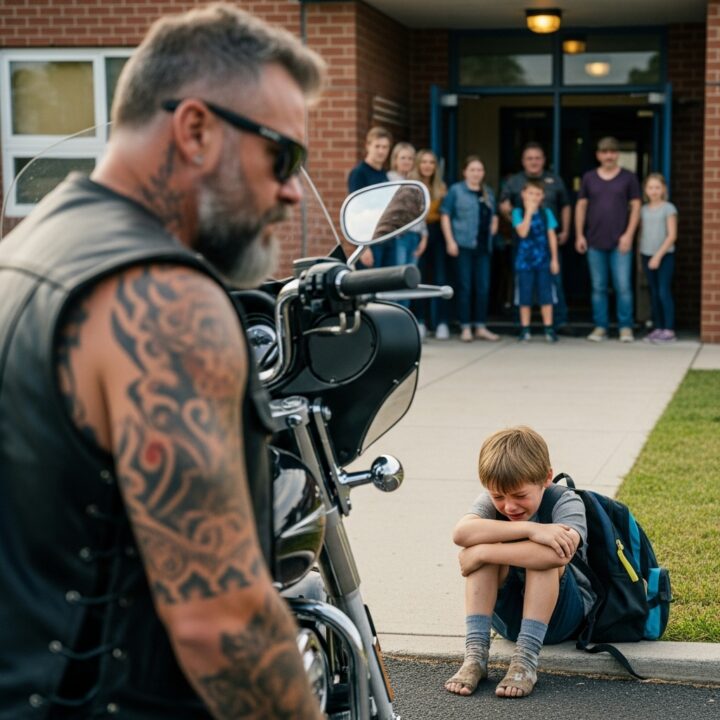
The engine cut off.
Silence rushed in, thick and uneasy.
People turned.
The biker swung one leg off his bike and stood up slowly. He was tall, broad-shouldered, wearing a sleeveless black shirt that revealed tattooed arms etched with years and stories no one bothered to ask about. Dark sunglasses hid his eyes. His boots were scuffed. His posture was straight—disciplined, controlled, deliberate.
To the parents nearby, he didn’t look like help.
He looked like trouble.
A woman grabbed her child’s hand.
A man stepped closer to the school gate.
Someone whispered, “What’s he doing here?”
The biker took a few steps forward, stopping several feet from the boy. He didn’t touch him. Didn’t speak right away. Just looked down.
The boy peeked up for half a second, saw the shape towering over him, and immediately dropped his gaze again. His breath hitched like he expected to be yelled at—or worse.
“Hey,” the biker said, voice low.
The boy didn’t respond.
The biker crouched—not too close, not invading. He set his helmet on the ground carefully, like sudden movements mattered. “Where’re your shoes, kid?”
The boy shook his head. Hard. No words.
From behind them, a father called out sharply, “Back off, man.”
The biker didn’t turn. “I’m talking to him.”
That didn’t help.
Phones came out.
Someone dialed the front office.
A staff member stepped outside, eyes widening.
To everyone watching, it looked wrong. A biker kneeling in front of a crying child. Tattoos. Sunglasses. Silence.
A mother whispered, “This is how bad things start.”
The boy suddenly stood up, panic flooding his face. “I—I didn’t do anything,” he blurted out, voice cracking. “I just—”
The biker raised one hand, palm open. “I know.”
That gesture—meant to calm—only raised alarms.
“Sir, step away from the child,” the staff member said, tense. “Now.”
The biker straightened slowly.
He didn’t argue.
He didn’t explain.
Which made it worse.
Security was called. Someone mentioned the police. Fear turned into accusation with terrifying speed.
The boy began to cry again—harder this time—because now it felt like everything was his fault.
The situation tightened like a knot pulled too far.
Two security officers approached from the building, hands hovering near their radios. A few parents moved closer, forming a loose, uneasy circle. The air buzzed with judgment, suspicion, and misplaced certainty.
“Sir,” one guard said, “you need to step back.”
The biker did. One step. Calm. Controlled.
But he didn’t leave.
He looked at the boy again—really looked this time. The scraped heel. The threadbare socks. The way the kid kept glancing at the school doors like they were already closed to him.
“What’s your name?” the biker asked.
The boy swallowed. “Evan.”
“Why aren’t you inside, Evan?”
Evan’s voice dropped to almost nothing. “They said I can’t come in without shoes.”
A murmur rippled through the crowd.
The teacher who’d hesitated earlier stepped forward. “That’s policy,” she said quickly, defensively. “We can’t—”
“I know,” the biker cut in. Not loud. Not angry. Just firm. The kind of voice that didn’t ask permission to be heard.
A guard shifted closer. “Sir, this is getting inappropriate.”
The biker nodded once. Then reached into his pocket.
That movement snapped the tension.
“Hey—!”
“Watch his hands!”
“Step back, now!”
He ignored the noise and pulled out his phone.
Unlocked it.
Typed a short message.
Hit send.
That was it.
No explanation. No threats. No raised voice.
Just a message sent into the air like a flare no one else could see.
He looked at Evan again. “Sit tight, kid.”
Evan nodded, terrified but somehow trusting him more than anyone else there.
The guards closed in another step.
And then—
The sound came.
Engines.
Not one.
More than one.
Low. Approaching. Controlled.
Every head turned.
Whatever was coming next, it wasn’t small.
The engines reached the school before anyone fully understood what they were hearing.
Low. Steady. Not reckless, not aggressive—controlled, synchronized, like a line of disciplined thought moving toward a single point. The sound didn’t roar. It pressed into the space, vibrating in the chest, demanding attention without asking for permission.
A few parents instinctively pulled their children closer.
Security stiffened.
Evan looked up, eyes wide, confused and frightened all at once.
The first motorcycle rolled into view beyond the drop-off lane, then another, then another. They parked neatly along the curb, one after the other, engines cutting off in clean succession. No revving. No show.
Just arrival.
The bikers dismounted calmly. Men and women. Different ages. Sleeveless shirts. Tattoos. Sunglasses. Weathered faces that had seen enough to stop needing to explain themselves. They moved with quiet coordination, spacing themselves naturally—not blocking doors, not crowding anyone, simply being there.
The crowd fell silent.
A woman whispered, “Oh my God…”
The original biker—still standing near Evan—didn’t turn around. He didn’t need to. He knew who had come.
One of the bikers stepped forward, an older man with gray threaded through his beard. No patches. No insignia. He walked past security, not challenging them, just expecting not to be stopped.
“Morning,” he said politely.
His voice carried weight—not volume. Experience.
The guards hesitated. No one moved.
The man looked at Evan, then at the teacher, then at the security officers. “This boy goes to school here?”
“Yes,” the teacher replied, her confidence thinning.
“And he’s not inside because…?”
“He doesn’t have shoes,” she said again, weaker this time.
The man nodded slowly, as if confirming something he already suspected. He turned to one of the bikers behind him. “You bring them?”
A woman stepped forward and opened a saddlebag. Inside were children’s sneakers. New. Still boxed.
She knelt—not in front of Evan, but beside him. At his level. “What size, sweetheart?”
Evan blinked. “I… I think three.”
She handed him a pair without comment.
The school bell rang again, sharp and impatient.
No one moved.
The original biker crouched once more, untied Evan’s damp socks, and helped him slip into the shoes. His hands were careful, practiced. The hands of someone who’d learned that small moments matter most.
When Evan stood, the shoes fit perfectly.
The crowd didn’t cheer.
No one clapped.
They just watched—because something inside the moment demanded silence.
Later—much later—people would piece together the truth.
The biker who’d stopped wasn’t passing through. He rode that road every morning on his way to work. He’d noticed Evan before. The bare feet. The hesitation. The way the boy waited until the last second to approach the gate.
The group that arrived wasn’t a gang. They were a local riding club—veterans, tradespeople, nurses, mechanics—who quietly ran a fund for school supplies. Shoes. Jackets. Backpacks. No social media. No donations page. Just needs met without announcements.
They’d learned, over time, that systems didn’t always bend fast enough for children.
The teacher apologized—quietly, privately.
Security stepped back, embarrassed.
Parents avoided eye contact.
No one gave a speech.
No one defended themselves.
The bikers didn’t stay.
As they prepared to leave, Evan tugged on the original biker’s shirt. “Mister?”
The biker looked down.
“Thank you,” Evan said. His voice was steadier now. Stronger.
The biker nodded once. “Go learn something.”
Evan ran toward the school doors, shoes slapping against the pavement like they’d always belonged there.
The motorcycles started again—low, respectful.
As the last bike pulled away, the curb looked the same as it always had.
But the people standing there weren’t.
Because they’d all thought the same thing when the biker stopped.
That he was a threat.
And now they had to live with the fact that the real danger had been their assumptions.
Nothing dramatic marked the end.
Just a boy walking into school.
And a sound fading down the road.