The Biker Who Stormed the Church and Took the Pulpit — After the Groom Walked Away
The church doors slammed open so hard the stained glass rattled — and every guest turned in outrage before anyone knew why.
It was supposed to be a quiet Saturday wedding in a small Midwestern town. White lilies along the aisle. A string quartet mid-hymn. The bride standing alone beneath the soft arch of flowers.
Alone.
Because ten minutes earlier, the groom had stepped aside with his parents. Whispers turned sharp. Words like “arrangement,” “agreement,” “financial misunderstanding” floated near the altar.
Then he didn’t come back.
The bride — twenty-three, pale beneath her veil — stood frozen while the priest adjusted his glasses and cleared his throat.
“Given the circumstances,” he began carefully, “we may need to postpone—”
A murmur spread like dry leaves catching fire.
Her mother’s face tightened with humiliation. An aunt shook her head. Someone whispered, “They didn’t secure the dowry.”
The bride’s bouquet trembled in her hands. A wedding dress suddenly felt like a costume for public shame.
The groom stood near the side exit now, avoiding her eyes. His father spoke firmly to the priest, voice low but decisive.
“No payment. No marriage.”
The words didn’t echo — but they landed.
The bride swallowed hard, trying not to crumble in front of two hundred guests who suddenly felt like spectators.
And then—
The church doors burst open.
Heavy boots hit tile.
A man in a sleeveless leather vest, broad shoulders, graying beard, tattoos visible beneath cuffed sleeves, stepped into the sacred quiet like thunder in daylight.
Gasps.
“He can’t be in here—”
“Is that him?”
The bride’s mother went pale.
Because everyone in that church recognized him.
They just didn’t expect him to show up.
He walked down the aisle without hesitation.
And for the first time that day, the bride lifted her eyes.
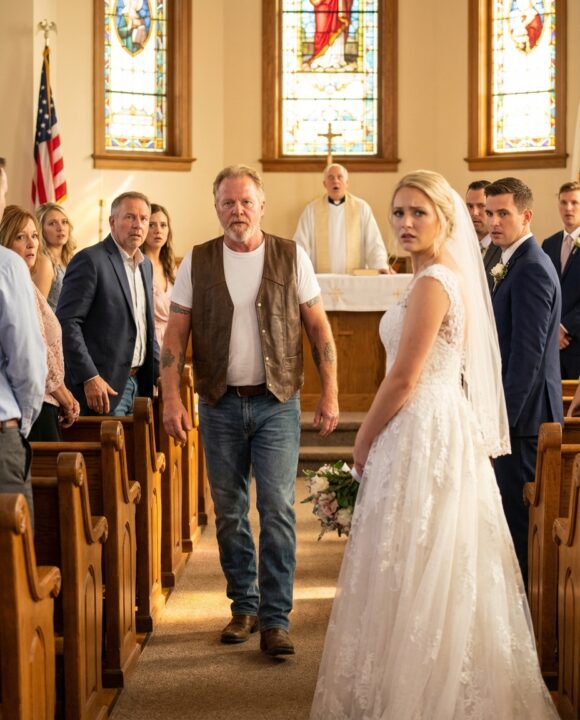
The biker didn’t slow.
Didn’t bow his head.
Didn’t remove his vest.
He moved straight down the aisle, boots echoing against polished wood floors as if he had every right to be there.
Whispers grew louder.
“That’s her father.”
“He just got out.”
“He was told not to come.”
The bride’s mother stepped forward in panic.
“You were forbidden to be here,” she hissed.
The biker didn’t answer her.
He stopped at the front row, eyes fixed on the young man who had stepped away from the altar.
“You leaving?” he asked calmly.
The groom stiffened.
“This is a family matter.”
The biker tilted his head slightly.
“I am family.”
The groom’s father bristled.
“You forfeited that right when you went to prison.”
A ripple of judgment moved through the pews.
The biker’s jaw tightened, but his voice remained even.
“Prison ended. Blood doesn’t.”
The priest stepped forward cautiously.
“Sir, I must ask you to respect the sanctity of this ceremony.”
The biker looked around the church — at the flowers, the guests, the white dress trembling under humiliation.
“Sanctity?” he repeated softly.
He turned to the groom.
“You’re canceling because of money?”
The groom’s mother snapped, “This is none of your concern.”
The bride stood still, eyes glassy.
“Dad…” she whispered — the first word she’d said since he entered.
Gasps rippled again.
So it was true.
The disgraced father.
The ex-con.
The biker.
He stepped closer to the altar.
From the back pews, someone whispered loudly, “He’s going to make a scene.”
A groomsman pulled out his phone.
Another guest slipped toward the doors to call security.
The biker climbed the small steps to the pulpit without permission.
That was the moment outrage erupted.
“He’s taking over the ceremony!”
“Call the police!”
The priest tried to intercept him, but the biker didn’t shove him aside — just stepped past with controlled calm.
From the outside, it looked aggressive.
Like a hostile takeover of a holy place.
But his hands were empty.
He stood at the pulpit, facing the congregation.
And he said nothing.
Just looked at his daughter.
Then at the groom.
Then at the families who had judged him before he’d even spoken.
The silence stretched thin.
And it felt like something was about to break.
The groom’s father stepped forward.
“You will step down immediately.”
The biker remained still.
“You’re humiliating her further,” the man added sharply.
The biker’s eyes shifted toward his daughter again.
“Who humiliated her first?” he asked.
The bride finally dropped her bouquet.
The flowers hit the floor with a soft thud that sounded louder than shouting.
Security entered from the back of the church — two volunteers in navy jackets.
“Sir, please come with us.”
The biker didn’t resist.
But he didn’t step down either.
He reached into his vest slowly.
Gasps.
Phones lifted higher.
The priest’s voice cracked slightly. “Sir—”
He pulled out his phone.
Not a weapon.
He typed a short message.
Three words.
“Bring the file.”
No one understood.
The groom crossed his arms.
“This is embarrassing.”
The biker looked directly at him.
“You embarrassed her.”
The groom’s face reddened.
“This was an agreement between families.”
The biker nodded once.
“And agreements work both ways.”
The room felt unstable now — like a courtroom without a judge.
The bride stood in the center of it all, abandoned yet exposed, as two generations of pride collided in public.
The security volunteers hovered, uncertain.
“Last warning,” one said quietly.
The biker stepped down from the pulpit at last.
But instead of walking toward the exit—
He took his daughter’s hand.
Gently.
The first physical contact of the entire ceremony.
The church collectively inhaled.
“Dad, please,” she whispered, unsure whether she was begging him to leave… or to stay.
He leaned slightly closer.
“You deserve better.”
The groom scoffed.
“You can’t offer better.”
The biker didn’t respond to the insult.
Instead, he looked at the side doors of the church.
Waiting.
A low rumble drifted faintly from outside.
Distant at first.
Then closer.
Engines.
More than one.
The congregation turned toward the stained glass windows as the sound grew.
And the groom’s father’s confidence flickered for the first time.
Because whatever was arriving—
Was clearly connected to the man everyone had just tried to throw out.
And the balance of power inside that church was about to change.
The engines didn’t roar.
They approached slow. Measured. Not chaos — coordination.
The low rumble vibrated through the church floor before anyone saw headlights through the stained glass windows. Conversations stalled mid-whisper. The bride’s veil trembled slightly in the draft that slipped beneath the heavy wooden doors.
Outside, motorcycles lined the curb in deliberate formation.
Not reckless young men.
Not shouting.
Older riders. Disciplined. Clean boots. Sleeveless leather vests with understated patches. No skulls. No loud insignias. Just quiet words stitched across their backs:
“Veterans Association.”
“Reentry Support.”
“Community Aid.”
The doors opened again — not kicked this time — just pushed.
Three men entered. Helmets off. Eyes forward. Calm.
Gasps rippled through the pews.
“Is this intimidation?” someone whispered.
The groom’s father stiffened.
The priest gripped the edge of the altar.
The original biker — the father — didn’t move. He didn’t wave them in. He didn’t posture. He simply stood beside his daughter, one hand resting lightly at her elbow.
One of the newly arrived riders carried a slim leather folder.
He walked straight down the aisle.
Boots steady. No theatrics.
When he reached the altar, he stopped at a respectful distance.
“Is this about a financial agreement?” he asked evenly.
The groom’s father tried to regain control.
“This is private.”
“Then we’ll keep it simple,” the rider replied.
He opened the folder.
Inside were documents.
Bank statements. Legal transfers. Certified copies.
The church felt suddenly less like a wedding venue and more like a courtroom without a judge.
The first biker stepped forward.
“You asked for payment before commitment,” he said quietly to the groom’s father. “That’s your right.”
He paused.
“But don’t mistake silence for poverty.”
The rider handed the folder to the groom.
Inside was a cashier’s check. Certified. In full.
More than the dowry originally demanded.
Not folded. Not rushed. Official.
The groom’s face drained of color.
The congregation murmured.
The bride’s mother blinked in disbelief.
“You… you had this?” she whispered toward the biker.
He didn’t look at her.
He looked only at his daughter.
The groom’s father cleared his throat.
“This is… unnecessary.”
The biker’s expression remained steady.
“You said no payment, no marriage.”
He gestured lightly toward the check.
“Now the decision is about character.”
The silence that followed wasn’t loud.
It was heavy.
The kind that presses on ribs.
No shouting.
No violence.
Just the weight of truth standing upright in leather.
The groom looked at the check. Then at the bride. Then at the room that had watched her humiliation.
He hesitated.
And for the first time, he looked small.
The engines outside cooled into silence.
Inside the church, authority had changed hands — not through force, but through preparedness.
The power no longer belonged to the family who had demanded proof.
It belonged to the man they had tried to erase.
And he still wasn’t raising his voice.
The groom didn’t reach for the check.
He stepped back instead.
“This isn’t how I want to start a marriage,” he muttered.
The words floated weakly in the open air.
The bride stood still.
Her mascara had smudged slightly beneath her eyes. Her bouquet lay forgotten at her feet.
“Then how did you want to start it?” she asked.
Her voice wasn’t loud.
But it carried.
The groom didn’t answer.
He glanced at his parents — searching for direction that no longer felt steady.
The church waited.
The priest looked from one face to another, unsure whether he was officiating a ceremony or witnessing its unraveling.
The biker — the father — didn’t push the check forward again.
He didn’t argue.
He simply folded his daughter’s trembling hand inside his own.
“If he walks,” he said quietly, “you walk taller.”
No speech.
No anger.
Just presence.
The bride bent down slowly and picked up her bouquet.
She looked at the groom for a long moment.
Then she turned — not toward him.
Toward her father.
Gasps filled the pews again, but this time softer.
Not scandal.
Recognition.
The groom’s mother opened her mouth to object, but nothing came out.
The father in leather didn’t smile.
Didn’t celebrate.
He simply stepped aside, letting his daughter decide.
She lifted her chin.
“I won’t marry someone who negotiates my worth,” she said.
The sentence landed with more impact than any raised voice that day.
The groom lowered his eyes.
The priest removed his glasses slowly.
Outside, the riders waited silently beside their bikes.
The bride walked down the aisle — not abandoned now, but supported.
Her father walked beside her.
Not in front.
Not pulling.
Just present.
Guests moved aside instinctively.
Some avoided eye contact.
Some looked ashamed.
Others thoughtful.
The church doors opened.
Sunlight flooded in.
For a moment, the white dress glowed against the darker leather vest at her side — a contrast that would linger in memory.
At the top of the steps, she stopped.
“Dad,” she said softly.
He looked at her.
“I didn’t invite you because they told me not to.”
“I know.”
“I thought you’d make it worse.”
He nodded slightly.
“That’s fair.”
She hesitated.
“Thank you for coming anyway.”
He didn’t respond with a speech.
He just squeezed her shoulder once.
Behind them, the congregation slowly dispersed.
Inside the church, the groom stood alone near the altar where he had once held authority.
Outside, engines started one by one.
Low.
Controlled.
As the motorcycles rolled away in formation, no one cheered.
No one clapped.
There were no grand declarations.
Just a father who had been barred from the door — and chose to walk through it anyway.
Not to fight.
Not to threaten.
But to stand.
And as the bride stepped off the church steps into daylight without a husband but without humiliation, something quiet settled over the town.
A realization.
Sometimes the man people fear most is the one who refuses to let his child be priced.
Sometimes redemption doesn’t shout.
It shows up.
And leaves just as quietly.
The church bells rang at the scheduled hour — unaware that the ceremony they marked had never truly begun.
But dignity had.
And that was enough.