The Biker Who Sat Outside the ICU — After Being Told He “Didn’t Belong There”
“You can’t stay here. You don’t belong in this area.”
The words were calm. Too calm.
Spoken the way people speak when they have already decided who you are.
The nurse stood with her clipboard pressed against her chest, eyes steady but guarded. Behind her, the ICU doors slid shut with a soft mechanical hiss, sealing off a world of machines, monitors, and fragile breaths.
The biker did not argue.
He did not raise his voice.
He did not step back either.
He sat in the hard plastic chair just outside the doors, his leather vest darkened by rain, boots still carrying the dust of the road. His hands rested on his knees. One of them trembled slightly. The other was still.
Around them, the hallway slowed. Conversations stopped halfway through sentences. A man lowered his phone. A woman pulled her purse closer. Someone whispered a word that carried farther than intended.
Trouble.
The biker’s vest bore a patch—faded, stitched by hand, unmistakable to anyone who knew the look. To those who didn’t, it meant only one thing.
Danger.
Security glanced up from the end of the corridor.
A doctor paused, then turned away.
The air grew thick, heavy with judgment.
The nurse repeated herself, quieter this time. “This area is for family only.”
The biker looked at the closed doors. Just once.
Then back at the floor.
“I’ll wait,” he said.
And the hallway seemed to freeze around him.
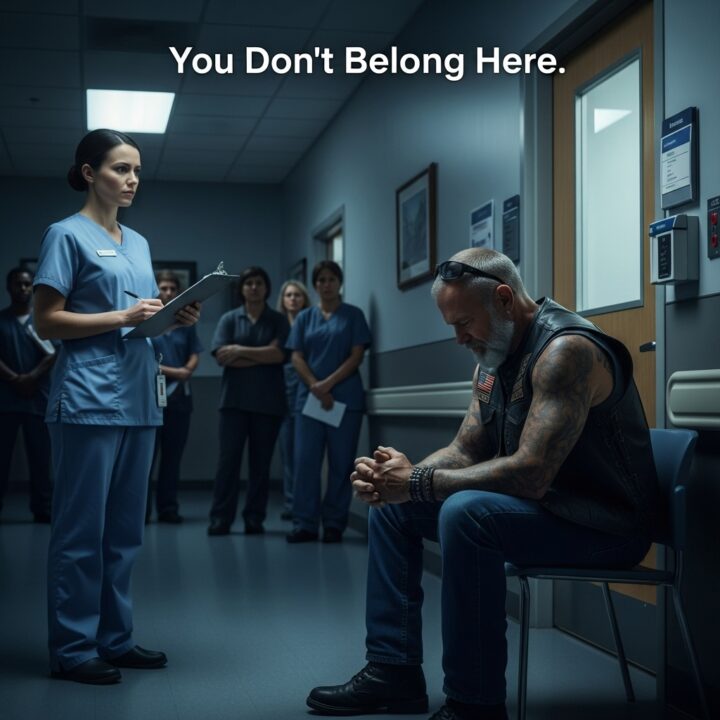
People avoided his eyes.
A middle-aged man shook his head, lips pressed thin, as if offended by the very sight of him. A young intern whispered to another, both glancing over their shoulders. Someone muttered that security should handle it before something happened.
The assumptions came quickly. They always did.
Too big.
Too quiet.
Too rough around the edges to belong in a place that smelled of antiseptic and whispered prayers.
Security approached, hand resting near the radio clipped to his belt. “Sir, we’ve had a complaint.”
The biker nodded once. “I understand.”
No excuses. No explanation.
That seemed to make it worse.
The officer hesitated, clearly expecting resistance. “We may have to ask you to leave.”
The biker’s jaw tightened. He swallowed, slow and deliberate.
“I was told I could wait,” he said.
The officer looked past him, toward the ICU doors. “Family only.”
The biker did not respond. He simply remained where he was.
The silence unsettled people more than shouting ever could.
It forced them to sit with their own discomfort. With the uneasy thought that maybe—just maybe—they were judging a man without knowing a single thing about why he was there.
The tension did not break. It grew.
A supervisor arrived. Then another nurse. Someone mentioned calling the police. The word escort was used.
The biker felt the weight of it all pressing in—the eyes, the whispers, the careful distance people kept as if judgment were contagious.
He reached into his pocket.
Several people stiffened.
Slowly, deliberately, he pulled out his phone.
No sudden movements.
No defiance.
He typed a short message. Read it once. Then sent it.
That was all.
He placed the phone back in his pocket and folded his hands again.
“I’ll stay out of the way,” he said quietly.
No one knew who he had contacted.
No one knew why.
But something shifted.
As if the story had taken a breath and was waiting for its next line.
The sound came first.
Low. Distant. Almost like thunder rolling beneath the town.
Heads turned.
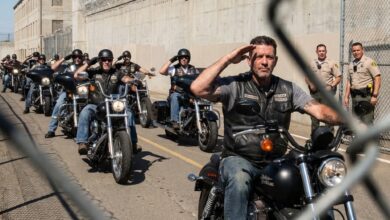
Through the glass doors at the far end of the hospital, headlights appeared. One by one. Then dozens more. The sound of engines grew—not wild, not chaotic—but measured. Controlled.
Motorcycles lined the curb outside, parking with precision. Riders dismounted calmly, removing helmets, straightening jackets.
They did not rush.
They did not shout.
They walked inside in small groups, boots echoing softly on tile.
Veterans.
Tradesmen.
Fathers. Grandfathers.
Men who carried themselves with quiet discipline.
They stopped several feet behind the biker in the chair. No one spoke. They simply stood there—present, respectful, unmistakably united.
A hospital administrator hurried over, face pale. “Is there a problem?”
One of the bikers stepped forward, voice even. “No, ma’am. We’re here to sit with our brother.”
The word brother landed heavily in the room.
The administrator glanced at the biker in the chair. Then at the men behind him. Then at the ICU doors.
Her posture changed.
“Let me check something,” she said.
The truth emerged quietly.
The biker’s name was already in the system. Listed as next of kin. Authorized by a woman now fighting for her life behind those doors.
A woman he had met years ago through a roadside accident. A woman whose family had long since drifted away. A woman who had once told him, half-joking, “If anything happens to me, you’re my people.”
No speeches followed.
No apologies loud enough to undo what had already been felt.
The ICU doors opened.
The biker stood, removing his vest before stepping inside.
Behind him, his brothers remained where they were. Silent. Watchful. Respectful of the space they were in.
Those who had judged him looked away. Some with shame. Some with quiet understanding arriving far too late.
Hours later, when the machines finally steadied and the night softened, the biker emerged again.
He did not smile.
He did not celebrate.
He simply sat back down.
One of the nurses placed a cup of coffee beside him. Their eyes met briefly. She nodded.
Outside, the motorcycles remained parked, engines off, riders waiting as long as they needed to.
In a hallway that had once felt cold and divided, there now lingered something else.
A lesson without words.
A reminder without accusation.
And the image stayed with those who witnessed it:
A man in worn leather, sitting quietly outside an ICU door—not because he looked like he belonged there, but because he did.