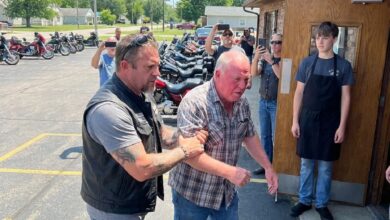
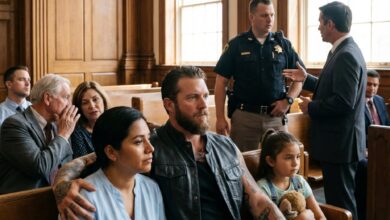
The Biker Who Knocked Down a Cop in Broad Daylight — And the Footage That Changed Everything
The motorcycle came out of nowhere and slammed into the officer hard enough to send both men crashing into the asphalt.
For a split second, nobody understood what they had just seen.
It was late afternoon in downtown St. Louis. Bright sun. Traffic idling at a red light. A small crowd gathered on the sidewalk outside a corner convenience store.
On the pavement, a Black teenage boy — maybe sixteen — lay face-down, one cheek pressed against the hot concrete. His hoodie was pulled half over his head. One arm twisted awkwardly behind his back.
“Stop resisting!” the officer shouted.
The boy’s voice cracked. “I’m not— I’m not!”
People stood ten feet away, phones raised, recording.
Some shook their heads.
Some muttered, “He shouldn’t have run.”
No one stepped forward.
The officer, white male mid-30s, jaw clenched, pressed a knee into the boy’s lower back. His partner stood nearby, scanning the crowd.
The boy wasn’t fighting.
He was trembling.
“Please,” he said. Not loud. Not defiant. Just scared.
Then something shifted.
The officer’s hand moved toward his holster.
Maybe it was routine.
Maybe it wasn’t.
But the crowd reacted instantly.
“Why is he reaching for his gun?”
“Yo, he’s got him pinned!”
Voices rose.
The officer snapped, “Back up!”
And then—
An engine roared.
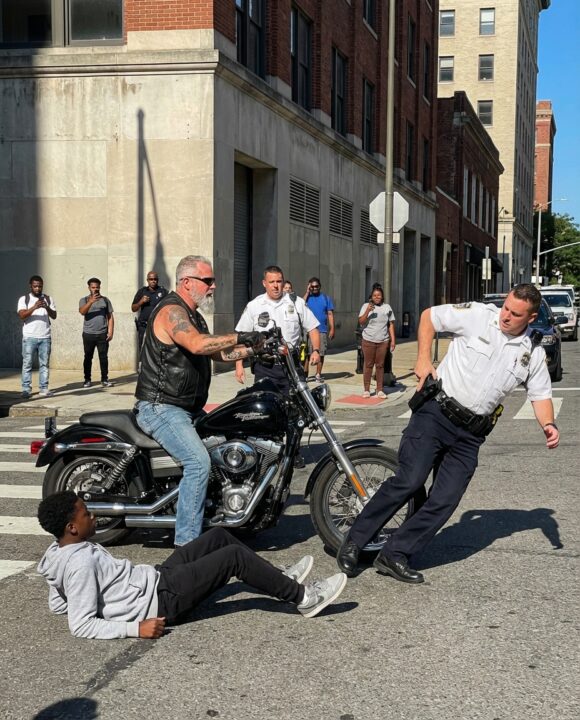
A black Harley surged forward from the curb lane, cutting across the intersection in a sharp arc.
Before anyone processed it, the biker struck the officer sideways.
Not at full speed.
But enough.
The officer toppled.
The crowd exploded.
“What the hell!”
“He attacked a cop!”
Phones whipped toward the fallen biker — a broad-shouldered man in a sleeveless leather vest, graying beard, tattoos inked along both arms.
He rolled once, hit the pavement hard, and came up on one knee.
The officer scrambled for balance.
Sirens began in the distance.
The teenager stared, stunned, still pinned partly beneath the chaos.
From every angle, it looked like an assault.
A deliberate, reckless attack on law enforcement.
The biker didn’t yell.
Didn’t run.
He just looked at the officer.
And then at the boy.
And for a moment — just a moment — something about the scene didn’t align.
But no one could see it yet.
The crowd erupted in outrage.
“He just tried to kill him!”
“Get that guy!”
The officer’s partner drew his weapon immediately.
“Get on the ground! Now!”
The biker didn’t argue.
He raised both hands slowly and lowered himself to his knees on the asphalt.
Calm.
Controlled.
No shouting.
No scrambling.
The officer who had been knocked down grabbed his shoulder, furious.
“You assaulted an officer!”
The biker said nothing.
His breathing was steady despite the impact.
Behind them, the teenage boy remained on the pavement, eyes wide, hands shaking.
Someone in the crowd screamed, “He was about to shoot him!”
Another shouted back, “You don’t know that!”
Sirens grew louder.
Traffic backed up.
The partner officer cuffed the biker roughly, pushing him down.
“You think this is a game?” the officer spat.
Still, no response.
The biker turned his head slightly — not toward the officers.
Toward the teenager.
“You okay?” he asked quietly.
The boy swallowed.
“I— I didn’t do anything.”
The officer snapped, “Shut up!”
More patrol cars arrived.
Red and blue lights splashed against storefront windows.
The story formed instantly in the minds of bystanders:
A biker attacked a cop during an arrest.
Another reckless outlaw.
Another headline.
Phones streamed live video.
Comments flooded social media in real time.
“Lock him up.”
“Bikers think they’re above the law.”
The first officer stood now, brushing dust from his uniform, rage simmering.
“You hit me,” he said to the biker.
The biker’s gaze didn’t shift.
“You were reaching.”
The officer’s eyes narrowed.
“For my duty weapon?” he snapped.
The biker didn’t answer.
From a distance, it sounded like an accusation.
Like justification.
Like defiance.
Backup officers pulled the teenager to his feet now, more aggressively than before.
The boy winced.
“Don’t move,” one officer barked.
The biker watched — silent.
His wrists cuffed behind his back.
A smear of blood along his forearm from the fall.
The crowd’s anger shifted uneasily.
“Why would he do that?”
“He must’ve known something.”
But it didn’t matter.
From every visible angle, it looked like the biker had made things worse.
Much worse.
And now he was the one lying face-down on the pavement.
The situation spiraled fast.
The officer who had been struck demanded assault charges.
The partner insisted the biker had interfered with an active arrest.
The teenager stood shaking beside a patrol car, hands cuffed now, eyes darting between authority and uncertainty.
The biker remained kneeling on the asphalt.
Quiet.
Controlled.
Watching.
One of the newer officers stepped forward.
“What were you thinking?” he asked sharply.
The biker looked up slowly.
“I saw his hand move.”
“That’s called procedure.”
The biker didn’t argue.
He turned his head slightly toward the convenience store’s front window.
There was a security camera mounted high above the entrance.
Small.
Almost forgettable.
He nodded toward it.
“Check that.”
The officer frowned.
“You’re in no position to give instructions.”
The biker said nothing more.
The officer who had been knocked down adjusted his belt.
“I was securing control.”
The crowd murmured.
Some replayed their phone footage.
But most angles were chaotic.
Blurry.
Incomplete.
The biker’s impact had happened too fast.
From most phones, it looked like pure aggression.
Sirens still echoed faintly in the background.
An ambulance arrived, though no one appeared seriously injured.
The officer who had been struck insisted loudly, “He could’ve killed me.”
The biker’s jaw tightened slightly.
“I didn’t accelerate.”
It was the first defensive thing he’d said.
And even that sounded measured.
A supervising sergeant stepped in now, assessing.
“What happened?”
The partner answered immediately.
“He rammed him. Out of nowhere.”
The biker looked at the sergeant.
“You’re missing three seconds.”
The sergeant frowned.
“What three seconds?”
The biker didn’t elaborate.
Instead, he shifted slightly and spoke calmly:
“Slow it down.”
The sergeant glanced at the store’s security camera again.
Then at the growing crowd.
Then at the officer who had drawn his weapon.
“Pull the footage,” he ordered finally.
The tension thickened.
The teenager’s breathing became visible in the heat.
The biker remained cuffed.
Still kneeling.
Waiting.
And for the first time, the certainty in the officers’ posture began to flicker.
Because if those three seconds existed—
Everything might look different.
But no one knew yet what the camera had captured.
And the entire intersection held its breath.
The footage arrived before the explanation did.
Not with drama.
Not with shouting.
Just a store employee jogging out of the convenience shop holding a tablet, breath slightly uneven.
“Sergeant,” he said. “You asked for it.”
The crowd shifted closer, then hesitated. Phones still up. Engines idling. Afternoon sun burning down on a scene that had already been judged.
The supervising sergeant stepped aside and watched the screen.
The first clip played at regular speed.
Officer kneeling.
Teenager face-down.
Crowd shouting.
Motorcycle cutting across frame.
Impact.
It looked exactly like what everyone believed.
The officer crossed his arms.
“See?”
The biker remained silent on his knees, hands cuffed behind him.
“Slow it down,” he said quietly.
The employee rewound.
Tapped.
Frame by frame.
And that’s when the air changed.
The officer’s knee pressed into the boy’s back.
The boy’s hands trembled.
The officer’s right hand moved.
Not to his radio.
Not to adjust his belt.
It moved deliberately toward the grip of his firearm.
The teen’s head turned slightly.
The officer’s thumb hooked under the retention strap.
One more frame.
The weapon lifted an inch from its holster.
The biker’s engine entered the edge of the frame.
Another frame.
The gun was no longer secured.
The biker’s front tire angled sharply.
Impact.
Not centered.
Not head-on.
He had clipped the officer’s shoulder — redirecting force, not crushing it.
The sergeant replayed the sequence twice.
No one spoke.
The officer who had been struck stared at the screen, jaw tight.
The crowd’s murmur shifted from outrage to confusion.
“Wait…”
“He pulled it.”
“He was drawing.”
The sergeant looked up slowly.
“You were drawing your weapon?” he asked the officer.
“It was precaution,” the officer snapped. “Crowd was escalating.”
The biker finally raised his eyes.
“He wasn’t escalating,” he said calmly, nodding toward the teen. “He was scared.”
The words weren’t loud.
But they carried.
The boy stood beside the patrol car, still cuffed, staring at the tablet.
The officer’s partner shifted uncomfortably.
“It looked like he was reaching for something,” he muttered weakly.
The biker didn’t argue.
He simply held the sergeant’s gaze.
“You’re missing three seconds,” he repeated.
The sergeant looked again at the screen.
Three seconds.
That was all.
Three seconds between procedure and tragedy.
Three seconds that changed the narrative from assault… to interruption.
The crowd fell silent.
Phones lowered.
Someone in the back whispered, “He stopped it.”
The biker didn’t smile.
Didn’t nod.
Didn’t say anything triumphant.
He just remained on his knees.
The sergeant turned to the officer whose shoulder still bore the mark of impact.
“You drew before there was lethal threat,” he said evenly.
The officer didn’t answer.
He stared straight ahead.
The sergeant nodded once to another deputy.
“Uncuff him.”
The metal clicked open around the biker’s wrists.
He stood slowly.
Not in victory.
Not in anger.
Just steady.
The crowd parted slightly as he stepped aside.
The boy’s cuffs were removed next.
His hands trembled as circulation returned.
The officer avoided eye contact.
The air at the intersection felt heavier than before — not with rage, but with realization.
The sirens stopped.
The red and blue lights dimmed.
And for the first time since the motorcycle struck asphalt, no one shouted.
The biker rolled his shoulders once, testing for injury.
His forearm was scraped raw. His vest torn at the seam.
He didn’t complain.
The sergeant approached him carefully.
“You could’ve been killed,” he said.
The biker shrugged slightly.
“I’ve seen worse.”
No elaboration.
The teenager stood a few feet away, still processing.
“You… you hit him on purpose?” he asked quietly.
The biker looked at him.
“Not to hurt him.”
The boy nodded slowly.
“You thought he was gonna shoot me.”
The biker didn’t confirm.
He didn’t deny.
He just held the boy’s gaze for a long moment.
“Go home,” he said softly. “Stay close to people who know you.”
The boy swallowed hard.
“Thank you.”
The officer who had drawn his weapon adjusted his uniform and walked toward his cruiser without another word.
He didn’t apologize.
He didn’t argue.
He just got in and shut the door.
The crowd began to disperse.
Conversations were quieter now.
Less certain.
Some faces looked embarrassed.
Others thoughtful.
The biker walked back to his Harley.
He didn’t rev the engine aggressively.
Didn’t glance back at the crowd.
As he swung his leg over the seat, the boy called out one last time.
“Why’d you do it?”
The biker paused.
He didn’t turn fully.
“Because I saw it.”
That was it.
No speech about justice.
No grand statement.
Just observation.
He started the engine.
The low rumble returned — not chaotic, not threatening — just steady.
As he rode off down the sunlit street, the intersection looked ordinary again.
Traffic resumed.
Pedestrians crossed.
The convenience store door chimed as customers went in and out.
But something had shifted.
Not loudly.
Not dramatically.
Quietly.
Three seconds had almost rewritten a life.
Three seconds that would’ve been forgotten without a camera.
Three seconds that forced everyone to rewind their certainty.
Later that night, the slowed footage would circulate online.
Arguments would continue.
Opinions would split.
But anyone who watched carefully would see the same thing:
A hand reaching.
A weapon lifting.
A motorcycle intercepting.
And a man in leather who didn’t run when it would’ve been easier to.
He had taken the fall.
Not to make a statement.
But to buy time.
And sometimes, in the middle of chaos, time is the only thing that stands between fear… and something irreversible.
The city moved on.
But for those who had been there, the replay lingered.
Not as an attack.
Not as rebellion.
But as a reminder that perspective can be as dangerous as it is powerful.
And that sometimes the truth hides in three seconds most people never notice.