The Biker Who Crashed Into a Pawn Shop — And the Brotherhood That Walked In After Him
The motorcycle didn’t slow down when it aimed straight for the pawn shop’s front door.
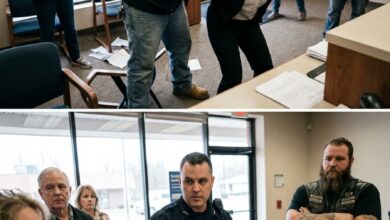
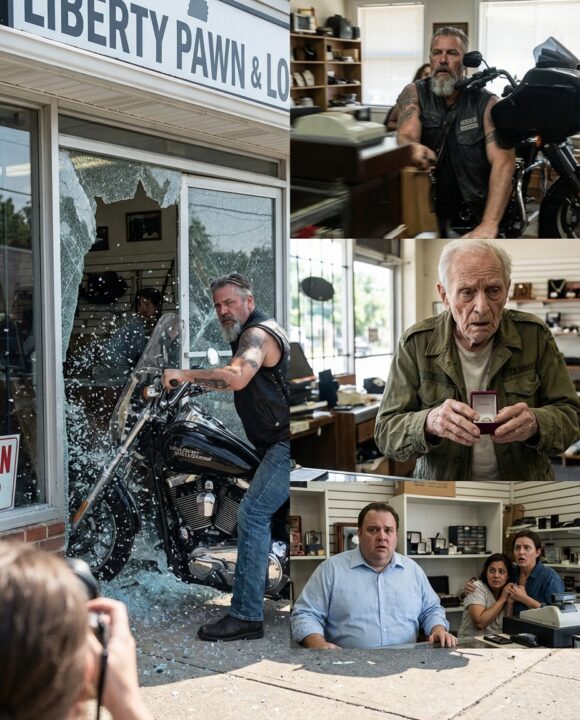
Glass exploded inward. A woman screamed. Someone dropped a rack of cheap guitars that clattered like gunshots across the tile floor. For a split second, the entire store froze in stunned disbelief, dust hanging in the sunlight like smoke after a bomb.
At the counter stood an old man in a wrinkled Army jacket, hands trembling over a small velvet box. His voice had cracked five minutes earlier when he said, “Please… that medal isn’t worth what you’re asking.”
The pawn shop owner, red-faced and thick around the middle, had leaned across the counter and said, “Double. That’s the price now. Or it stays here.”
The old man’s shoulders had collapsed inward, as if the years suddenly weighed more than the fabric of his coat could carry. A couple browsing used jewelry whispered, “He should’ve known better.” Someone near the door muttered, “It’s just metal.”
But it wasn’t just metal.
It was a Bronze Star.
And now shards of glass skidded across the floor as a black Harley rolled halfway into the shop, engine growling low like an animal refusing to be ignored.
The rider cut the engine.
Silence swallowed the chaos.
He stepped off the bike slowly—leather vest, gray-streaked beard, sleeves tight around tattooed forearms, boots crunching on broken glass. His expression was unreadable. No shouting. No rush.
Just presence.
The old veteran blinked, confused. The pawn shop owner’s face drained of color.
Nobody knew who the biker was.
Nobody knew why he had come.
But everyone in that room felt it at the same time—
something had just shifted.
“Call 911!” someone yelled.
A young employee ducked behind a display case. A mother pulled her teenage son close and whispered, “Don’t look at him.” Two men near the back instinctively raised their phones, already recording.
The biker didn’t look at any of them.
He walked past the shattered doorway, boots heavy but controlled, and stopped at the counter.
The pawn shop owner found his voice. “Are you out of your damn mind? You just destroyed my property!”
The biker glanced once at the old man’s hands—still clutching that velvet box like it was the last fragile thing he owned in the world.
Then he looked at the price tag taped beside the medal.
His jaw tightened.
“That’s not what you paid for it,” he said quietly.
The owner scoffed. “It’s my store. I can price it however I want.”
The biker reached over the counter—not fast, not violent—but enough to make the crowd gasp. The owner stumbled backward, shouting, “He’s threatening me!”
Phones rose higher. Someone shouted, “He’s robbing the place!”
But he didn’t grab money.
He didn’t grab the medal.
Instead, he picked up the receipt book sitting open beside the register.
“You doubled it,” he said. “After he came back.”
“It’s business!” the owner barked. “Supply and demand!”
The old veteran tried to speak but his words tangled together. “I… I just needed it for my grandson’s ceremony. I didn’t think…”
“Sir,” someone whispered harshly from the crowd, “don’t get involved. Let the police handle it.”
But the police weren’t there.
And the medal wasn’t in the veteran’s hands.
The biker turned slowly, scanning the room. His eyes were steady, not wild. Controlled. But control can look like danger when you’re already afraid.
One man near the door stepped forward. “You’re not helping. You’re making it worse.”
“Am I?” the biker asked, voice even.
The owner, emboldened by the crowd’s fear, shouted louder. “He crashed into my store! That’s felony damage! You all saw it!”
Sirens were faint in the distance now.
The biker rested one palm flat on the counter. “How much did you give him for it?”
The owner hesitated.
The veteran whispered the number under his breath.
It was less than half the new price.
The room shifted again—but not enough.
“Doesn’t matter,” someone muttered. “He still wrecked the place.”
The biker nodded once, almost to himself. Then he reached into his pocket.
Gasps rippled through the store.
He didn’t pull a weapon.
He pulled out his phone.
He typed something. Calm. Deliberate.
“Who are you texting?” the owner demanded.
No answer.
The tension thickened into a suffocating kind of silence. The sirens were closer now. The young employee peeked over the counter, whispering, “They’re coming.”
The biker put the phone away and stepped back from the counter.
He didn’t look afraid.
He didn’t look angry.
He looked… resolved.
And that was somehow worse.
Because whatever he had just done, he had done it with certainty.
And no one in that room knew what was about to walk through the broken door next.
The sirens cut abruptly outside.
Red and blue light flickered across the shattered glass like a heartbeat under stress.
Two officers entered first, hands resting near their belts. “Step away from the counter!” one commanded.
The biker raised his hands without hesitation.
Slow. Measured. Palms open.
The crowd exhaled—some in relief, some in triumph. “See?” someone whispered. “Told you.”
The pawn shop owner pointed dramatically. “He rammed his motorcycle into my building! He tried to intimidate me! I want him arrested!”
The officers looked at the wrecked door, then at the Harley resting inside like an accusation made of steel.
“Sir, is that true?” one officer asked the biker.
“Yes,” he said.
The room reacted—murmurs of outrage, vindication.
“But,” the officer continued, “why?”
The biker glanced at the old veteran, who now looked smaller than before, shoulders hunched, eyes wet. “Because he changed the price.”
“That’s not a crime,” the owner snapped.
“No,” the biker agreed. “But extortion is.”
The word landed heavy.
The owner laughed, too loud. “You can’t prove that.”
The officer turned to the veteran. “Sir, what happened?”
The old man swallowed. “I… I sold it last month. Needed money for my wife’s hospital bill.” His voice shook. “She passed. I came back to get it. He said it was double now.”
“Market value changes,” the owner insisted.
The biker said nothing.
Instead, he reached into his pocket again.
The crowd tensed.
He pulled out his phone and handed it—not to the police—but to the veteran.
On the screen was a photo.
The receipt.
Timestamped.
And beneath it, another message: a name.
The officer read it aloud.
A name that made the pawn shop owner’s face go pale.
“Is that…?” one of the employees whispered.
The biker spoke for the first time with weight behind his words. “He’s not the only one who came back.”
Outside, engines rumbled.
Not sirens.
Not patrol cars.
Something deeper. Louder.
The sound rolled down the street like distant thunder.
The crowd inside turned toward the door instinctively.
The pawn shop owner’s breathing changed. Faster.
“What did you do?” he asked.
The biker didn’t answer.
He simply stepped aside, hands still raised, as if clearing space.
The rumble grew stronger—layered, synchronized, unmistakable.
Motorcycles.
More than one.
The officer glanced toward the doorway, uncertainty flickering across his face.
The veteran clutched the phone, eyes wide—not in fear, but recognition.
The engines stopped all at once.
The sudden silence was almost violent.
Then came the sound of boots.
Not rushing.
Not chaotic.
Measured.
Disciplined.
A shadow stretched across the broken threshold before the first figure appeared.
The room held its breath.
Because whoever was about to walk through that door—
was not coming alone.
The boots entered first.
Heavy leather. Steel toes. Slow.
Then the jackets.
Black. Worn. Clean. Not flashy—no skulls, no neon patches—just a single stitched emblem over the chest: a small American flag and the words Iron Resolve.
One biker stepped in. Then another. Then five more.
They didn’t spread out wildly. They didn’t shout.
They simply formed a quiet line across the broken doorway, sunlight catching chrome behind them where at least a dozen motorcycles now idled in perfect formation along the curb.
The pawn shop owner swallowed.
“What is this?” he demanded, but the edge had left his voice.
The first biker removed his sunglasses. Late forties. Clean beard. Calm eyes. “You called?” he asked, looking not at the store owner—but at the man who had crashed the Harley through the door.
The room shifted again.
The officers glanced at each other. This wasn’t a gang swarm. It wasn’t chaos.
It was order.
The biker who had entered first—the one who had shattered the glass—finally lowered his hands. Not defiant. Not aggressive.
Just steady.
“I did,” he said.
The new arrival stepped forward and looked at the old veteran.
Recognition flickered.
“Sergeant Whitaker?”
The veteran blinked, stunned. “Yes?”
The man straightened slightly. “Marine Corps League. We were told you might need assistance.”
A murmur rippled through the crowd.
The pawn shop owner tried to recover. “This is intimidation! I’ll press charges!”
“For what?” the lead biker asked mildly. “Standing?”
No one had touched him.
No one raised a fist.
But the sheer presence of them—disciplined, silent, unflinching—shifted the balance of the room.
One of the officers cleared his throat. “Sir,” he addressed the pawn shop owner, “we’ll need to review the transaction records.”
“It’s private business!” the owner snapped.
The biker who had crashed through the door spoke quietly. “You doubled the price after he returned.”
The veteran held up the phone with the receipt image.
The second biker stepped to the counter and placed a thin folder down. No slam. No drama.
Inside were printed screenshots.
Text messages.
Public posts.
The pawn shop owner’s own social media bragging about “veterans desperate to reclaim sentimental junk.”
The air changed.
The crowd that had once whispered about a robbery now stared at the counter in disbelief.
The owner’s confidence cracked.
“You don’t understand how resale works,” he stammered.
The lead biker looked him dead in the eye. “We understand service.”
Another engine cut off outside. A final arrival.
The door frame groaned slightly from the earlier impact, but the bikers didn’t move.
They didn’t need to.
One of them stepped toward the shattered glass and quietly began sweeping it aside with his boot so no one would step on it.
Another picked up the fallen guitars and set them upright.
The officers’ posture relaxed.
This wasn’t a riot.
It was a line drawn without violence.
“Sir,” the officer said to the pawn shop owner, “if the price was altered under coercive circumstances, we may have a civil issue here.”
The owner’s face was now slick with sweat.
“You can’t prove coercion.”
The veteran finally found his voice. “You told me if I didn’t pay today, you’d melt it down.”
The crowd gasped.
The lead biker didn’t react outwardly.
But his jaw flexed.
The pawn shop owner opened his mouth again—
—and then stopped.
Because behind the line of leather jackets, more riders stood silently along the sidewalk.
Not chanting.
Not threatening.
Just watching.
And suddenly, the loudest man in the room felt very small.
The officer extended a hand. “Let’s see the item.”
The velvet box was placed back on the counter.
The medal caught the light.
For the first time since the glass shattered, the room was not afraid.
It was waiting.
And the weight of that waiting rested entirely on the man behind the register.
It didn’t end with shouting.
It ended with a receipt.
The pawn shop owner, hands trembling now, reopened the transaction file. The original amount. The altered markup. The timestamp.
Under the officers’ steady gaze and the silent wall of bikers behind them, the owner swallowed hard and recalculated the price.
Original buy-back amount.
Plus standard fee.
Nothing more.
He slid the paper across the counter without meeting anyone’s eyes.
“Fine,” he muttered.
The old veteran reached into his jacket pocket and counted out folded bills. His fingers shook—not from fear now, but from something closer to relief.
The biker who had crashed into the store placed a thick envelope beside the money.
“No,” the veteran whispered. “I can manage.”
The biker nodded once and stepped back.
No speeches.
No grand gesture.
The officer handed the medal back across the counter.
The old man cradled it in both hands as if it were warm.
For a moment, no one spoke.
The crowd that had once filmed, judged, whispered—now stood in a heavy, almost reverent silence.
One woman quietly lowered her phone.
The employee who had hidden behind the case stepped out and avoided eye contact.
The pawn shop owner said nothing.
The veteran turned toward the biker who had caused the chaos.
“Why?” he asked simply.
The biker adjusted his gloves. “You earned it,” he said.
“That doesn’t answer my question.”
The biker glanced toward the line of men outside.
“He was my CO,” the lead biker answered gently from behind him. “I served under him.”
The room stilled again.
The veteran’s eyes widened. “I don’t—”
“You pulled three of us out of Fallujah,” the biker said quietly. “Didn’t ask for our names.”
A long pause.
The veteran’s breath caught.
The man who had rammed a Harley through a storefront stood awkwardly, almost uncomfortable with the attention.
“I heard about the medal,” he said. “Couldn’t let it stay here.”
The pawn shop owner shifted, shrinking under the weight of realization.
The officers finished their notes.
“Property damage will be handled separately,” one said, glancing at the broken entrance.
The biker nodded. “Send the estimate.”
No argument.
No escape.
He accepted it.
Because that wasn’t the point.
The veteran stepped outside into the sunlight, medal tucked safely inside his jacket.
The row of motorcycles gleamed along the curb like a silent honor guard.
People from neighboring stores had gathered, whispering.
Not in fear now.
In awe.
The bikers didn’t celebrate.
They mounted their bikes one by one.
Engines ignited in low harmony.
The veteran stood on the sidewalk, small against the line of chrome and leather.
The biker who had started it all paused before putting on his helmet.
He extended his hand.
The veteran gripped it.
Two men. No audience needed.
Then the helmet lowered.
The engines roared—not angrily, but steadily—and the line of motorcycles pulled away in perfect order.
The broken glass still glittered on the floor inside the pawn shop.
The owner stared at it long after they were gone.
Across the street, the veteran held the medal up to the light once more.
And in the reflection of that small piece of bronze, you could see something no one in that pawn shop had expected to witness—
a debt repaid, not in money… but in loyalty.
No one clapped.
No one cheered.
But everyone who had stood there that afternoon walked away knowing one thing:
Sometimes the most dangerous-looking man in the room
is the only reason something sacred survives.