Part 2: Ten Bikers Started Their Harleys Outside an Orphanage for the Boy Everyone Called Uncontrollable—Then One Rider Recognized Why the Noise Made Him Still
Part 2 — Ten Engines, One Open Door
My name is Rachel Moreno. I was thirty-four that summer, worked weekdays as an occupational therapy assistant in Tulsa, and volunteered at Cedar Ridge because my younger brother had spent fourteen months in foster care before our aunt obtained custody of him. I thought that history made me less likely to misjudge children.
Eli proved otherwise.
I never called him bad, but I often treated his behavior as something that had to end before anything good could begin. I offered sticker charts, quiet corners, breathing games, weighted blankets, and rewards for sitting through meals. Some helped for minutes. None answered the question Diesel had asked: What makes him quiet?
After the ten engines stopped, Eli remained at the window. His breath clouded the glass despite the heat outside, and both hands stayed spread against it as though he could preserve the vibration after the motorcycles fell silent.
“Again!” he shouted.
The director looked at Dr. Park’s plan. “One more time. Thirty seconds.”
Stone started his Harley alone. The engine settled into a slow, uneven pulse. Eli tilted his head. His shoulders dropped almost immediately.
Diesel pointed toward the rear door, then waited.
Eli ran downstairs. Two staff members moved to stop him, but Dr. Park raised a hand. He reached the exit, seized the knob, and froze when he saw ten riders beyond the glass.
From outside, they looked intimidating even to me. Broad shoulders stretched worn leather cuts. Tattoos climbed thick necks and disappeared beneath sleeves. Chain wallets hung from faded jeans. Their Harleys stood in two black-and-chrome rows, releasing heat, gasoline, and the metallic tick of cooling engines.
Nobody approached him.
Diesel lowered himself onto one knee twenty feet away. He removed his gloves and placed them on the pavement, making both hands visible.
“You want the door open?” he asked.
Eli nodded.
“You open it.”
The boy pushed. Warm air rolled inside carrying exhaust, oil, and cut grass. He stepped onto the threshold but kept one foot behind the door.
Diesel tapped the Harley’s fuel tank. “This is Mabel.”
“Why?”
“Because she complains when she’s cold.”
Eli looked suspiciously at the motorcycle. “Bikes don’t talk.”
“This one argues.”
Stone coughed into his fist to hide a laugh.
Diesel did not ask Eli to come closer. He started the engine, let it idle for five seconds, then shut it down. Eli watched every movement of his hand.
“Again,” the boy said.
“You do it.”
The director moved forward. “Absolutely not.”
Diesel held up the ignition key. “He turns it. My hand stays on the cutoff. Bike stays in neutral. Stone holds the bars.”
Dr. Park inspected the arrangement and agreed. Eli crossed the yard in short, rapid steps, then stopped just beyond Diesel’s reach. Up close, the Harley towered over him. Its engine fins radiated heat, and the chrome reflected a distorted child with grass-stained knees and one shoelace untied.
Diesel placed the key in Eli’s palm.
“Your choice.”
The boy inserted it after three attempts. Stone steadied the motorcycle. Diesel showed him the switch and starter.
Eli pressed.
The engine struck beneath them.
His entire face changed.
The vibration traveled through the handlebar into his fingers. He leaned forward, not frightened but intensely alert, and wrapped both hands around the rubber grips. His jaw loosened. The tight line between his eyebrows disappeared.
Then he laughed.
I had heard him laugh before, usually while running away with something he should not have taken. This was different. It came from lower in his chest, surprised and almost breathless, as if his body had discovered a door none of us knew existed.
Diesel’s face stayed still.
Only his left hand betrayed him. It closed over the brass key hanging beneath his vest.
After thirty seconds, he shut down the Harley.
Eli kept holding the bars.
“Can I sit?”
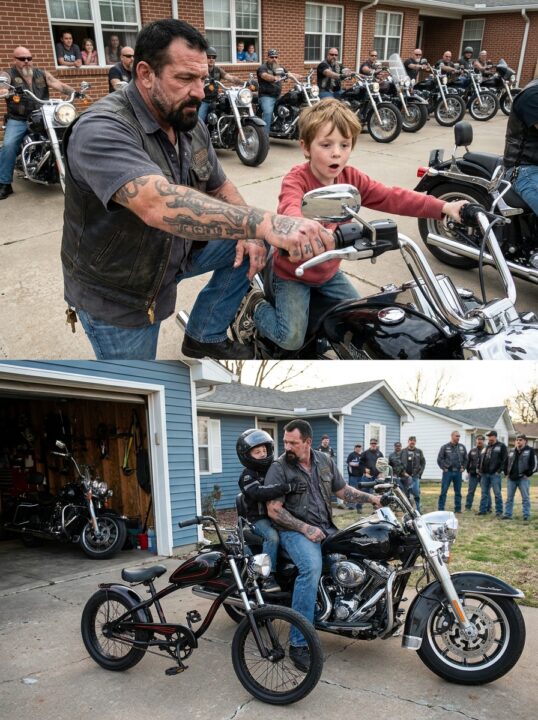
Diesel looked at Dr. Park, then at the director. With their permission, he lifted Eli carefully beneath the arms and placed him on the wide passenger seat. The boy’s shoes dangled above the ground. Diesel climbed on in front, leaving the motorcycle off, and showed him where to rest his hands.
Eli placed them around Diesel’s waist instead.
The big biker stopped breathing for a second.
“Ready?” he asked.
“For what?”
“Nothing yet.”
That answer mattered. Cedar Ridge had taught Eli that every invitation concealed a demand: sit and behave, listen and earn, stop moving and prove he could be wanted. Diesel offered him a motorcycle seat without requiring improvement in return.
They sat there for seven minutes.
Eli did not shout.
He did not kick.
He did not break anything.
When Diesel lifted him down, Eli touched the burn scar near the biker’s jaw.
“Did the bike do that?”
“Fire did.”
“Were you bad?”
The adults around us went quiet.
Diesel looked directly at him. “No, kid.”
“Then why did it happen?”
“Bad things don’t wait for bad people.”
Eli considered that, then pointed at the brass key. “What’s that for?”
Diesel tucked it beneath his shirt.
“Old door.”
He would not say more.
Before the club left, Stone knelt beside Eli and asked permission to return the following Sunday. Eli pretended to inspect Stone’s skull ring.
“All ten?”
“All ten.”
“Twelve.”
Stone looked toward his brothers. “Kid’s already negotiating.”
“Fourteen.”
“Ten,” Diesel said. “Don’t get greedy.”
Eli smiled.
As the riders departed, he ran the entire length of the fence beside them. The yard was too short, so he turned and ran it again after the final taillight disappeared.
That evening, he ate dinner standing at the table, but he did not throw his plate. He slept for six uninterrupted hours, longer than he had slept since I began volunteering.
Monday was calmer.
Tuesday too.
By Thursday, the running and yelling returned.
Dr. Park wrote one sentence across the top of her notes: His behavior may be communication, not defiance.
It was the first sentence in his file that sounded like a door opening.
Part 3 — What Diesel Heard in the Noise
The Iron Hollow riders returned the next Sunday at exactly ten in the morning. They brought no toys, balloons, cameras, or oversized donation check.
They brought ear protection in six sizes.
Dr. Park had insisted the sessions be optional for every child. Some watched through the windows. Three wore protective earmuffs and stood near the door. Two chose to remain upstairs with a staff member. Nobody was told that courage meant tolerating a sound they disliked.
Eli waited beside the fence in shoes he had tied himself.
Diesel arrived last.
The boy immediately noticed something different. A small metal bar had been installed behind the passenger seat, and adjustable foot platforms rested above the exhaust at a safe distance.
“For me?”
“For anybody your size.”
“For me.”
Diesel looked at him. “Mostly.”
The first session lasted twelve minutes. Eli sat on the parked Harley while Diesel controlled the engine. Dr. Park watched his breathing, posture, speech, and recovery afterward. She never called the motorcycle medicine. She described it as predictable vibration, low-frequency sound, firm body pressure, and focused movement—a combination that seemed to help Eli organize sensations his nervous system usually chased without finding.
She also made one point clear to all of us: a Harley was not a cure, and a child’s medical needs could not be decided by a motorcycle club.
What the bike gave us was evidence.
The next week, Cedar Ridge obtained a large therapy ball, a mini-trampoline with a safety rail, resistance bands, and a crash mat. Staff created scheduled movement breaks. Eli was allowed to push a weighted laundry cart down the hallway, carry sealed boxes, jump under supervision, and spend more time outdoors.
The changes looked simple.
They were not.
Cedar Ridge had to alter routines built around keeping twelve children manageable with too few adults. One staff member complained that Eli was receiving special treatment. Another said the motorcycle club had made him expect entertainment.
Diesel heard about it.
The following Sunday, he stood inside the office with his leather cut dripping rainwater onto the floor. He did not raise his voice.
“You punish a thirsty kid for looking for water?”
The supervisor folded her arms. “He disrupts every child in this building.”
“Then give him work.”
“We are not equipped for this.”
“Get equipped.”
“You don’t run a children’s home.”
Diesel’s jaw tightened. “No. I survived one.”
That was the first crack in the wall around him.
Stone turned toward Diesel, but he was already leaving. He crossed the wet yard, mounted his Harley, and sat without starting it. Eli watched from beneath the awning.
“Were you here?” the boy asked.
“No.”
“A different one?”
“Yeah.”
“Did they say you were bad?”
Diesel pulled on one glove, then the other. “Every day.”
“What’d you break?”
“Most things.”
Eli stepped into the rain. “Why?”
Diesel looked at the child standing before him, then at the orphanage windows behind him.
“Nobody let me run.”
The words reached me from fifteen feet away.
Diesel had entered state care at five after his father disappeared and his mother was incarcerated. His first placement lasted nine days. The second ended when he tore a cabinet door from its hinges. At seven, he was moved to St. Bartholomew’s Boys’ Home near Muskogee, a brick building run with military schedules and locked recreation yards.
He rocked in chairs until screws loosened.
He struck walls with both palms.
He slept with his mattress pressed against the washing-room wall because the old industrial dryers made the floor vibrate. A staff member caught him there and called it another behavioral problem.
At nine, Diesel discovered the maintenance garage.
A groundskeeper named Arthur Bell repaired lawn equipment and an old police Harley behind the home. Arthur did not tell the boy to be still. He handed him a stiff wire brush and let him scrape rust from an exhaust shield for two hours.
When the motorcycle finally ran, Daniel Kane sat on the concrete with both hands touching the garage floor.
The vibration steadied him.
Arthur gave him a brass key to the side door so he could enter after school. It became the first place in Diesel’s childhood where movement was not treated as disobedience.
When St. Bartholomew’s closed years later, former residents were invited to collect stored belongings. Diesel recovered a small locker containing Arthur’s gloves, the brass garage key, and a photograph of himself sitting on the old Harley at age nine.
He kept the key against his chest.
He never kept the photograph there.
That stayed in Mabel’s saddlebag, protected inside a plastic freezer bag.
Eli did not know any of this yet. All he knew was that the frightening biker understood what it felt like to be trapped in a body adults wanted quiet.
“Can we run?” Eli asked.
Diesel dismounted.
In heavy motorcycle boots and wet jeans, he chased Eli around the narrow yard. The boy was fast. Diesel was not. His club brothers lined the fence and shouted false racing commentary while Stone timed them using a watch with a cracked face.
Eli completed twenty-three laps.
Diesel completed nine and claimed a mechanical failure in his left knee.
For the rest of the afternoon, Eli remained calm enough to help wipe rain from the motorcycle seats. When a younger boy grabbed his cloth, his arm pulled back as if to strike.
Diesel caught his wrist gently.
“Name it.”
“He took it!”
“Name what’s happening in you.”
Eli’s chest rose fast. “Too much.”
“Good. Move it somewhere safe.”
Diesel held out both palms. Eli pushed against them as hard as he could. The biker’s boots slid two inches across wet pavement.
Again.
Eli pushed.
Again.
By the fifth time, his breathing slowed.
He picked up another cloth.
That small moment changed Iron Hollow’s role. The bikers stopped thinking of Sunday as a motorcycle visit. It became a commitment, and commitment meant they had to show up when it was inconvenient.
That test came sooner than expected.
Part 4 — The Sunday Nobody Came
In late September, Iron Hollow organized its annual veterans’ memorial ride. Riders were coming from three states, and Stone had spent six months securing permits, police escorts, and a closure along a section of Route 66.
The memorial began Sunday morning.
So did Eli’s weekly visit.
Stone assumed Cedar Ridge would understand one cancellation. The club had already missed family events, repair jobs, and sleep to maintain the schedule. One Sunday could not erase twelve weeks of consistency.
Diesel disagreed.
“We told him we’d come.”
Stone rested both hands on the clubhouse table. “We’re leading four hundred bikes.”
“Then lead them.”
“You’re road captain.”
“Not Sunday.”
The room changed.
Iron Hollow had escorted the remains of soldiers, protected grieving families from harassment, delivered supplies after tornadoes, and stood beside members through funerals and prison gates. The memorial ride mattered.
So did a six-year-old boy waiting beside a fence.
Bishop, a long-time member, told Diesel he was confusing personal history with club responsibility. Another rider said the child had staff, psychologists, and equipment now. He no longer needed ten grown men turning an orphanage into a weekly motorcycle show.
Diesel did not argue.
He removed his road captain’s patch and placed it on the table.
Stone stared at it. “Don’t be stupid.”
“I made the promise.”
“We made it.”
“Then decide what that means.”
The meeting ended without an answer.
Sunday arrived under a low gray sky. Cedar Ridge staff had drawn chalk parking marks where the ten motorcycles usually stood. Eli waited in his red sweatshirt, pacing between the gate and the rear door.
Ten o’clock passed.
Then ten-fifteen.
At ten-thirty, he kicked the fence.
I called Stone. His phone went to voicemail beneath the memorial noise. I called Diesel. No answer.
Eli began pulling chalk from the pavement with the sole of his shoe.
“They lied.”
“Maybe they’re delayed.”
“They lied!”
He ran inside, overturned a dining chair, tore the weekly schedule from the wall, and shoved a bookshelf hard enough to spill paperbacks across the floor. Staff moved the younger children away.
He locked himself in the laundry room.
I found him wedged between two silent dryers, striking his forehead lightly against his knees.
“They said Sunday.”
“I know.”
“Everybody says.”
I sat on the floor outside the door. “I know.”
A motorcycle sounded in the distance.
Eli stopped rocking.
The engine came closer, but it was only one. A black Harley turned through the gate at 10:47, rainwater streaming from the headlight. Diesel parked crookedly, dropped the stand, and crossed the yard without removing his helmet.
Blood darkened the knee of his jeans.
He had gone down on wet pavement six miles away after avoiding a deer. The crash bent his highway bar and tore skin from his palms beneath both gloves. An ambulance crew had advised him to go for stitches.
He refused the ride.
The director met him at the door. “You’re injured.”
“Where’s Eli?”
Diesel entered the laundry room and sat on the floor. He removed one glove with his teeth. The heel of his hand was raw and bleeding.
Eli stared at it.
“You crashed?”
“Little.”
“You’re late.”
“Yep.”
“You lied.”
Diesel’s face tightened more at that word than at the pain in his hand. “I said I’d come. Didn’t say I’d be on time.”
The boy looked toward the empty yard. “Where are the others?”
“Memorial ride.”
“So they lied.”
Diesel pulled the brass key from beneath his shirt and placed it on the floor between them.
“Sometimes people fail a promise without deciding you don’t matter.”
Eli did not answer.
Diesel leaned against the dryer. “I need you to do something.”
“What?”
“Help me up.”
The request interrupted the shape of the crisis. Eli unfolded himself, planted both shoes, and gripped Diesel’s uninjured wrist. He could not lift a 260-pound man, but Diesel used the boy’s pull as a reason to stand.
They walked outside together.
Mabel’s right crash bar was scraped. One mirror hung loose. Diesel sat on the pavement while Eli retrieved the small tool roll from the saddlebag. He selected the wrong wrench twice, cursed once, and held the mirror steady while Diesel tightened it.
At 11:06, another engine entered the gate.
Stone arrived first.
Behind him came nine Iron Hollow riders, followed by a line of motorcycles so long that the final riders were still turning off Cedar Ridge Road when the leaders parked. Stone had shortened the memorial route, explained the promise to its organizers, and invited anyone willing to finish at the children’s home.
Four hundred and twelve motorcycles surrounded Cedar Ridge.
Nobody revved.
Nobody performed.
The riders shut down in waves until only rain remained against leather and chrome.
Stone walked toward Diesel carrying the road captain patch. Diesel did not take it.
“You chose?” he asked.
Stone nodded toward Eli. “We did.”
Eli stood inside a circle of tattooed adults, his fingers black with grease from Diesel’s damaged mirror. He looked at the hundreds of machines, then back at the single empty chalk space the boy had guarded for Mabel.
“Start them,” he whispered.
Dr. Park intervened before anyone moved. Four hundred engines could produce dangerously intense sound. Children and neighbors had not consented to it, and regulation was not the same as overwhelming exposure.
So the riders did something harder.
They waited.
Ten motorcycles remained in the yard. The others left in groups without revving. Only after the road cleared, every child had chosen a safe location, and hearing protection was available did Stone lift his hand.
Ten engines started.
Eli climbed behind Diesel, placed his palms against the biker’s leather cut, and closed his eyes.
For the first time, the sound of the Harleys was not the biggest thing that happened that Sunday.
The return was.
Part 5 — The Diagnosis That Changed One Word
Dr. Park evaluated Eli over six weeks. She interviewed staff, reviewed his history, observed him during meals and play, and compared his behavior before and after structured movement.
She never reduced him to one dramatic diagnosis.
Eli showed signs consistent with attention-regulation difficulties, developmental trauma, and strong sensory-seeking needs. The three could overlap. One did not cancel the others, and no responsible clinician could determine treatment from a child sitting on a motorcycle.
But she changed the question Cedar Ridge had been asking.
Instead of “How do we stop him?” she asked, “What is his body trying to obtain or escape?”
Running gave him speed and pressure through his joints. Pushing furniture gave him resistance. Shouting gave him strong sound. Sitting near the washing machine gave him predictable vibration. Car rides gave him motion, a steady engine hum, and a stream of visual input that moved in one direction.
The Harley combined several of those sensations.
It was not that Eli needed noise for its own sake. Random shouting and slammed doors could upset him. He responded to the motorcycle because its pulse was powerful but predictable, and because the rider controlling it was an adult he trusted.
“He doesn’t need punishment for seeking regulation,” Dr. Park told the staff. “He needs safe choices before he becomes overwhelmed.”
A local pediatric team reviewed whether medication might help his attention and sleep. Nobody declared that he would never need it, and nobody treated the motorcycle as a substitute for care. The immediate change was simpler: he did not need to be sedated merely to make the building easier to manage.
He needed movement.
He needed pressure.
He needed adults who could recognize “too much” before it became a broken chair.
Cedar Ridge converted an unused storage room into a movement space. Iron Hollow removed the shelves, repaired the floor, and installed equipment chosen by professionals. Diesel insisted that club money pay for construction but refused to hang an Iron Hollow sign.
“This is his room,” he said. “Not our billboard.”
Eli began each morning by pushing a weighted cart, jumping on the small trampoline, and carrying soft bags from one side of the room to the other. Before school lessons, he used resistance bands. At meals, he sat on a cushion that allowed slight movement instead of being punished for leaving his chair.
He still had hard days.
He still yelled.
He broke another lamp in October and bit a staff member’s sleeve during a panic in November. Progress did not move in a straight line simply because a Harley appeared beneath his window.
But now the adults looked for the hour before the explosion.
When Eli’s fingers began tapping rapidly, someone offered movement. When he paced the hallway, he could ask for the yard. When his words disappeared, he learned to say—or point to—a card reading “too much.”
Diesel carried a copy of that card inside his vest.
The Sunday rides evolved slowly. At first, the Harley remained stationary. Then Diesel walked it around the fenced yard with the engine off while Eli sat behind him. Later, after safety equipment and permission were in place, he rode at walking speed along a closed paved loop Iron Hollow helped build beyond the rear fence.
The club called it Eli’s Track.
Diesel corrected them every time.
“Kids’ track.”
Other Cedar Ridge children used bicycles and scooters there. A girl who feared engines drew chalk roads on the far side. Two brothers raced tricycles. Eli sometimes became angry when required to share, but Diesel never gave him ownership over a space built for everyone.
“You know what it’s like to have nothing,” the biker told him. “Don’t become the man who keeps everything.”
“Did you keep everything?”
“I stole Arthur’s socket wrench.”
“Did you give it back?”
“Twenty years late.”
“Still counts.”
“Arthur was dead.”
Eli thought about that. “Then you gave it back to the garage?”
“Put it in his toolbox.”
“Still counts.”
Diesel had never told anyone that story. Stone heard it from across the track and looked away, smiling into his beard.
By December, Eli could attend school for longer periods. His teacher replaced long seated lessons with short work blocks and movement breaks. He stopped tearing his papers when his handwriting became messy. He began finishing books aloud, although he still skipped words when excited.
His adoption file changed too.
The word uncontrollable was removed.
In its place appeared a detailed support plan explaining what helped him regulate, what overwhelmed him, and how adults could respond safely.
Three families requested meetings.
Eli refused all of them.
One couple asked whether Iron Hollow would stop visiting after adoption. Another wanted to change his name. The third brought him a tablet and said their quiet suburban home would “settle him down.”
He overturned no chairs.
He simply walked away.
Later, he found Diesel repairing a chain on a child’s bicycle.
“Do I gotta pick one?”
“No.”
“What if nobody comes back?”
Diesel pulled the chain over the sprocket. “Somebody comes back.”
“You?”
“Sunday.”
“That’s not what I asked.”
Diesel’s hands stopped.
Eli waited.
The biker reached beneath his shirt and touched the brass key. “I know.”
That night, Diesel did something he had never done during twelve years with Iron Hollow.
He asked Stone for help.
Part 6 — The Man Who Said He Wasn’t Father Material
Daniel Kane lived alone in a two-bedroom house near Sapulpa, twelve miles from Cedar Ridge. His garage was larger than his living room. One bedroom held motorcycle parts, three unopened moving boxes, and an exercise bike covered in dust.
He had never married.
He had no children.
His kitchen contained one plate, two coffee mugs, and enough canned chili to survive a minor disaster.
“You’re not ready,” Stone told him.
Diesel stood beside the clubhouse workbench. “I didn’t ask if I was.”
“You asked how to adopt him.”
“Yeah.”
“That means you’re asking whether we think you should.”
“No. Means I don’t know the forms.”
Stone leaned back in his chair. “You work ten-hour shifts at the truck shop. You ride weekends. You don’t own a couch that doesn’t smell like motor oil.”
“Kid likes motor oil.”
“That ain’t parenting.”
Diesel’s eyes hardened. “Neither was St. Bart’s.”
Stone let the silence sit between them. He had known Diesel for seventeen years. He knew about the group home, the garage, Arthur Bell, and the three years Diesel spent drifting between construction jobs after aging out of care.
He also knew what Diesel had not told Eli.
At nineteen, Diesel had been arrested after fighting a man who struck a teenage dishwasher. The assault charge was reduced, but Diesel spent ninety days in county jail. At twenty-three, he lost his license for riding intoxicated and did not touch alcohol again after Stone collected him from court.
Those facts would appear during a home study.
So would his stable job, paid mortgage, clean record since his twenties, club support, and years of volunteer work never photographed for social media. Adoption workers would examine all of it.
Diesel looked frightening.
The process would ask whether he was safe.
Stone slid a legal pad across the table. “First, you need references.”
“How many?”
“More than you got chairs.”
The brotherhood began preparing him.
Grudge donated a couch that smelled only slightly like dog. Bishop installed locks on the gun cabinet. Switch’s wife taught Diesel how to build a weekly meal plan containing vegetables. Stone walked through the house with a caseworker’s checklist and failed him in seventeen categories.
The second bedroom became Eli’s.
Diesel painted it gray, then learned from Rachel that gray felt like Cedar Ridge. He repainted it blue. Eli had not been promised anything, so Diesel could not ask what he wanted without raising hope the state might later crush.
He left one wall unfinished.
Inside the garage, he began building a small bicycle. The frame came from a child’s cruiser, but Diesel lengthened it, lowered the seat, added wide handlebars, and shaped a false fuel tank from lightweight metal. He painted it black with a thin red line matching Mabel.
The bicycle was not part of the adoption plan.
It was a promise Diesel was afraid to speak.
The home study began in January. Caseworker Ellen Price inspected smoke detectors, medication storage, bedroom windows, finances, work schedules, criminal history, and the people Diesel intended to use for childcare.
“Your support network is a motorcycle club?” she asked.
“Some got wives.”
“That wasn’t my question.”
“Then yes.”
Stone provided a binder containing schedules, emergency contacts, background checks for key members, and signed commitments covering transportation and after-school care. Diesel stared at him.
Stone shrugged. “Road captains plan.”
The first interview with Eli went badly.
When Ellen asked how he felt about Diesel, he kicked the table leg and said he did not care. When she asked whether he wanted to live in Diesel’s house, he crawled beneath a chair.
Diesel remained across the room.
He did not coax him out.
“What if he says no?” Ellen asked.
“Then no.”
“You’ve invested months.”
“Ain’t a debt.”
From beneath the chair, Eli listened.
The next question came softly.
“What would you call Daniel if you lived together?”
Eli struck the chair leg once more. “Diesel.”
“Not Dad?”
The biker’s face changed.
“Don’t make him answer that,” he said.
Ellen closed the folder. “I needed to know whether either of you had expectations.”
“I got one.”
“What is it?”
“He keeps his name until he wants different. Mine too.”
Eli crawled out.
For the rest of the interview, he sat beside Diesel without touching him.
The adoption review lasted five months. A supervisor questioned whether a single man with no parenting experience could meet Eli’s needs. Another worried that the motorcycle environment encouraged risk. Dr. Park documented the boundaries, safety practices, and broader regulation plan. Rachel described every Sunday Diesel had returned.
Then Cedar Ridge received a complaint.
An anonymous caller claimed Iron Hollow was exposing children to dangerous exhaust, excessive noise, and criminal club activity. The county suspended motorcycle visits pending review.
Eli heard only one sentence.
The Harleys were not coming Sunday.
He tore the support plan from his classroom wall.
This time, Diesel could not enter the building to help him.
The final test had begun.
Part 7 — When Brotherhood Had to Become Quiet
Iron Hollow’s first reaction was anger.
Bishop wanted to identify the caller. Grudge wanted every rider in Oklahoma parked outside the county office. Several members proposed a public campaign showing photographs of the movement room, the children’s track, and Eli smiling on Mabel.
Diesel rejected all of it.
“No kid’s face.”
Stone crossed his arms. “We can defend ourselves.”
“Not with him.”
“If we stay silent, they’ll decide the complaint is true.”
Diesel removed his leather cut and laid it across a chair. Without it, he looked less like a club road captain and more like a tired mechanic who had not slept.
“Then show records. Safety plan. Sound readings. Background checks. No pictures.”
The club faced an impossible choice. Public pressure might restore the visits quickly, but turning Eli into evidence would repeat what Diesel hated most: asking a child to display his pain so adults could prove their goodness.
They chose the slower road.
Dr. Park provided clinical observations. Cedar Ridge submitted consent procedures, hearing-protection protocols, and incident reports showing fewer injuries after the program began. A county environmental officer measured sound from the approved ten-engine sessions and recommended shorter start periods plus greater distance from neighboring homes.
Iron Hollow accepted every reasonable condition.
The background review found no current criminal activity. Several old arrests belonging to members were disclosed, including Diesel’s assault and impaired-riding record. He answered every question without minimizing either.
“I hit a man,” he told Ellen. “I also rode when I had no business holding keys.”
“What changed?”
“Consequences.”
“Is that all?”
Diesel looked through the office window toward Eli’s empty track. “Somebody kept coming back after I gave them reasons not to.”
Arthur Bell had visited Diesel during his ninety days in jail. He brought no speeches. He sat across the scratched metal table and placed the old Harley’s brass garage key between them.
“You still know what opens,” Arthur said.
Diesel never drank again.
During the suspension, he returned to Cedar Ridge every Sunday without his motorcycle. The complaint prohibited organized riding activities, not ordinary visits. He arrived in Stone’s pickup, carrying no leather cut, and met Eli inside the movement room.
At first, the boy refused to see him.
Diesel sat in the hall.
The next week, Eli slid the “too much” card beneath the door.
Diesel slid back another card. Rachel recognized it as one he had asked Dr. Park to make.
STILL HERE.
No explanation.
No demand.
On the third Sunday, Eli opened the door. He did not speak. Diesel sat on the floor, and they rolled a weighted ball back and forth for forty minutes.
On the fourth, Diesel brought a wooden box containing Arthur’s gloves and the photograph from St. Bartholomew’s. Eli studied the skinny nine-year-old boy sitting on an old police Harley.
“That you?”
“Yeah.”
“You look mad.”
“Was.”
“Did Arthur adopt you?”
“No.”
“Why not?”
“He had a family. Was sick by then.”
“But he came back?”
“Every week.”
Eli touched the photograph’s cracked corner. “Did you want him to be your dad?”
Diesel’s answer took a long time.
“Wanted him to ask.”
“Why didn’t you ask?”
“Thought good kids got asked.”
Eli pushed the photograph back into the box.
“I’m not good.”
Diesel’s palm came down flat on the floor, not violently, but hard enough to make the weighted ball jump.
“Don’t say that.”
“It’s in my papers.”
“It was.”
“I break stuff.”
“So do storms.”
“People send me back.”
Diesel moved closer but did not touch him. “That was adults failing a hard day.”
Eli’s eyes narrowed. “You gonna fail?”
“Probably.”
The boy looked startled.
“I’ll get things wrong,” Diesel continued. “I’ll get mad. You’ll get mad. We’ll need help. Failing a day ain’t leaving.”
Eli began pulling at the wet collar of his shirt.
“Are you adopting me?”
Diesel’s breath caught.
“If the state says yes.”
“What if I say no?”
“Then I’m here Sunday.”
“What if I say yes and break your house?”
“Then we fix the house.”
“What if I break Mabel?”
Diesel considered this more seriously.
“We fix Mabel.”
Eli leaned forward until his forehead rested against Diesel’s shoulder. It was not an embrace. Not yet.
The biker remained absolutely still.
Outside, there were no engines. No cheering club. No camera.
Only a six-year-old boy testing whether the largest man he knew would stay when nothing exciting was happening.
Diesel stayed.
The county reinstated the program three weeks later under revised safety rules. Iron Hollow celebrated by bringing exactly ten motorcycles and starting none of them until every child had chosen where to stand.
Eli sat on Mabel.
Diesel gave him the key.
This time, the boy did not start the engine immediately.
“Still here?” he asked.
Diesel covered Eli’s small fist with his scarred hand.
“Still here.”
Part 8 — The Ride Home
The adoption was finalized on a Tuesday morning in June.
Eli wore a blue button-down shirt for eleven minutes before removing it in the courthouse bathroom. He returned in his favorite red sweatshirt, the one with a repaired cuff and a faint oil stain from Mabel’s chain.
Judge Cynthia Hall asked whether he understood what adoption meant.
Eli looked at Diesel.
“He can’t send me back?”
The courtroom went silent.
The judge leaned forward. “Adoption means Daniel becomes your legal parent. Families can have difficult days, arguments, and problems, but you are not being taken home for a trial.”
Eli examined the floor. “What if I’m too much?”
Diesel’s chair scraped backward.
He knelt beside the boy, ignoring the court photographer who lowered her camera without being asked.
“You’re six,” Diesel said. “You’re supposed to be too much sometimes.”
“Even loud?”
“House has walls.”
“Even running?”
“Yard has room.”
“Even breaking?”
“Garage has tools.”
The judge signed the order.
Stone released a breath that moved his entire beard. Grudge covered his face with one hand. Bishop stared fiercely at a blank wall. Rachel held the brass key Arthur had once given Diesel because his hands were shaking too badly to keep it still.
Eli did not hug anyone.
He asked whether they could leave.
Outside the courthouse, ten Iron Hollow Harleys waited along the curb. No engines ran. No reporters had been invited. Diesel’s black Road King stood at the front with a child-sized helmet resting on the passenger seat.
A county-approved transport car would follow them, and the route to Diesel’s house had been planned along slower roads. Dr. Park had reminded everyone that Eli’s comfort did not cancel ordinary motorcycle safety.
Diesel helped him into protective gear. He checked the helmet strap twice, the jacket closures three times, and the passenger foot platforms until Stone told him he was wearing out the bolts.
Eli climbed behind him.
“What do I hold?”
“Me.”
The boy’s arms encircled Diesel’s waist.
That was the first complete hug he had given anyone during his three years at Cedar Ridge.
Diesel lowered his head. His scarred hand closed around Eli’s wrist for one second, then returned to the handlebar.
Stone raised two fingers.
Ten engines started one after another, not simultaneously. Eli felt each pulse join the next beneath him. When Mabel came alive, he tightened his arms and laughed against Diesel’s back.
They traveled west from Tulsa at a measured pace, avoiding the highway. Cottonwoods flickered beside the road. Warm wind pressed Eli’s sweatshirt against his narrow chest. At every stop, Diesel reached back and tapped the boy’s knee.
At the third light, Eli shouted through the helmet.
“Still here!”
Diesel raised one thumb.
Iron Hollow escorted them only to the edge of Sapulpa. Stone peeled away first, followed by the others, until Mabel continued alone toward the small blue house.
Eli saw the yard before the motorcycle stopped.
It was not enormous, but it was six times wider than Cedar Ridge’s fenced strip. Diesel had built a packed-dirt loop along the perimeter, leaving the center open for running. A wooden swing hung from an oak branch. The back steps had a handrail polished smooth by new work gloves.
Inside, Eli found his blue bedroom.
One wall remained unpainted.
“What color?” Diesel asked.
Eli touched it. “Red.”
“All of it?”
“Red and black.”
“Gonna look like a tire shop.”
“Good.”
Then he heard a metallic click from the garage.
He ran.
Mabel rolled inside behind them. Beside the full-sized Harley stood the custom bicycle Diesel had spent months building: a low black cruiser with wide bars, a false fuel tank, a thin red stripe, small saddlebags, and a hand-painted name on the frame.
MABEL JR.
Eli circled it without touching.
“Whose bike?”
Diesel removed his helmet. “Take a guess.”
“Mine?”
“Unless Stone fits it.”
Eli gripped the handlebars. “It looks like yours.”
“Little less expensive when you drop it.”
“I won’t drop it.”
“You will.”
“No.”
“Everybody does.”
Eli looked toward the large Harley, then back at the bicycle. “Can we ride together?”
“Every morning we can.”
“Even Sunday?”
“Sunday we ride to Cedar Ridge.”
“Why?”
Diesel placed Arthur’s brass key on a hook above the workbench.
“Somebody’s waiting at a window.”
Eli stared at him. In that instant, his face carried the uncertainty of every goodbye he had survived. Diesel saw it and lowered himself onto one knee.
“Deal?” he asked.
Eli crossed the garage in two steps and threw both arms around his neck.
This time, there was no hesitation.
“Deal, Dad.”
Diesel’s eyes closed. One scarred hand covered the back of Eli’s head while the other gripped the workbench until his knuckles whitened.
The following Sunday, Mabel entered Cedar Ridge with the little bicycle secured inside Stone’s pickup. Eli rode the paved loop beside the children who had watched him leave. He let a younger boy squeeze the horn. When another child asked whether Diesel was returning next week, Eli answered before the biker could.
“He always comes back.”
Years later, Iron Hollow still visits Cedar Ridge. The club no longer starts ten engines merely for Eli. Instead, it funds movement equipment, maintains the track, supports professional assessments, and teaches volunteers to ask what a child’s behavior might be communicating.
Diesel still rides last when the children circle the yard.
Eli rides first.
At the garage each morning, two machines wait side by side—one Harley with a deep V-twin pulse and one small bicycle built to resemble it.
The brass key hangs above both.
Follow the page for more biker stories—and leave DIESEL for the next road where a misunderstood rider quietly becomes someone’s home.