Part 2: A 46-Year-Old Biker Was Blocked From a Little Girl’s School Performance Because He Wasn’t on the Family List — Until Everyone Learned the Promise He Made to Her Dying Mother
Part 2
Nolan Mercer had met Rachel Ward five years earlier in a bar that smelled like fried onions, cigarette smoke trapped in old wood, and black coffee strong enough to wake the dead.
The place was called The Silver Spur, a roadside bar twenty miles outside Nashville where truckers, night-shift nurses, construction crews, and bikers passed through when the rest of the city had gone quiet. Rachel worked the counter from six in the evening until two in the morning, usually with her hair tied in a messy bun and a pencil behind one ear.
She was not impressed by bikers.
That was the first thing Nolan liked about her.
When his club rolled in on a rainy night, loud boots and louder engines, most waitresses either tried too hard to be friendly or avoided eye contact completely. Rachel only pointed at a sign near the register and said, “If any of you break my chairs, you’re paying double and leaving a tip large enough to make me forgive your mothers.”
Nolan laughed before he meant to.
Rachel raised one eyebrow.
“You the leader?”
“No, ma’am.”
“Good. Leaders are usually the reason chairs get broken.”
From that night on, Nolan stopped there whenever he rode through. He never flirted, never pushed, never acted like the bar owed him softness. He ordered coffee, sometimes pie, sometimes nothing if Rachel looked tired and needed one less table to manage. Over time, she learned his name, his road name, the way he took his coffee, and the fact that he always paid for the meal of whatever older veteran happened to be sitting alone.
Nolan learned about Emily through photographs.
Rachel kept them taped beside the register, where the edges curled from steam. Emily in a pumpkin costume. Emily with missing front teeth. Emily holding a paper crown from kindergarten. Emily asleep in a car seat with one ballet slipper still on.
“My whole paycheck has legs,” Rachel once said, tapping the picture of the ballet slippers.
“She dance?”
“She tries,” Rachel said. “That counts more.”
Rachel was not a woman who asked for help easily. She had survived too many men who turned help into ownership, and Nolan respected that line as if it were painted on the floor. When her car needed a battery, he sent a mechanic friend and told him to charge her half. When she caught him doing it, she cursed him for ten straight minutes, then made him eat pie without paying.
That was their friendship.
Boundaries.
Coffee.
Small kindnesses neither of them named too loudly.
Then came the accident.
Part 3
The call came on a Sunday morning.
Nolan was in his garage, wiping rainwater from his bike, when one of the bartenders from The Silver Spur called and said Rachel had been hit coming home from a double shift. The words were broken, fast, and impossible to place in a world where Rachel had seemed too stubborn to be removed from anything.
The hospital was forty minutes away.
Nolan made it in twenty-eight.
Rachel was awake when he arrived, though the machines around her told him awake did not mean safe. Her face looked smaller against the pillow. There was a bandage along her hairline, bruising near one cheek, and a tiredness in her eyes that scared him more than any doctor’s expression.
“You look terrible,” she whispered.
Nolan pulled a chair close.
“You always did have high standards.”
That almost made her smile.
Her sister was on the way. The hospital had already called family. Emily was with a neighbor, still asleep, still unaware that the world had cracked open while she dreamed.
Rachel kept trying to ask practical questions.
Was Emily picked up?
Was the rent paid?
Did someone know where the dance shoes were?
Nolan answered what he could and lied gently about what he could not.
Then Rachel reached for his hand.
That was when he knew she understood more than anyone had said aloud.
“Nolan.”
“I’m here.”
“She loves performing,” Rachel whispered. “But she looks for me first. Always.”
Nolan could not speak.
Rachel’s fingers tightened weakly around his.
“If I’m not there someday…”
“Don’t.”
“If I’m not,” she said again, with the fierce impatience he knew from the bar, “promise me she won’t look out and see nobody clapping.”
Nolan looked at the machines.
At the bruises.
At the woman who had never asked him for anything that mattered until now.
“I promise.”
Rachel closed her eyes.
“Not taking over. Not making trouble.”
“I know.”
“Just clap.”
His throat burned.
“Just clap.”
She died before sunrise.
Nolan went to the funeral and stood in the back, behind family, behind coworkers, behind people who had known Rachel longer and had more right to grieve visibly. Emily stood beside her aunt in a black dress too stiff for a child, holding a stuffed rabbit against her chest.
She did not know the biker in the back row.
Nolan did not approach her.
He had made a promise to Rachel, not a claim on Emily.
So he waited for the day that promise would call him.
Part 4
The school performance was listed on a flyer taped to the bar’s register.
Nolan saw it by accident.
Rachel’s sister had brought Emily by The Silver Spur two weeks earlier to thank the staff for sending groceries and gift cards after the funeral. Emily had been quiet, polite, and thinner in the face than the photos Nolan remembered. She carried a small green dance bag and stood near her aunt while the bartender showed her the old pictures Rachel had kept by the register.
When Emily left, one flyer remained behind.
Brookside Elementary Winter Showcase.
Second grade performance.
Thursday, 6:30 p.m.
Nolan stared at it for a long time.
He did not take it at first.
Then the bartender, a fifty-year-old Black American woman named Marlene, slid it across the counter.
“She told you, didn’t she?”
Nolan looked up.
Marlene had been at the hospital too.
“She told me to clap,” he said.
“Then clap.”
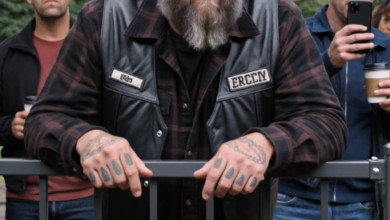
That was how he ended up at the school with washed hands, a clean shirt, and his leather vest because he did not own anything dressier that still felt honest. He arrived early, parked far from the entrance, and walked past families carrying flowers, cameras, and paper cups of hot chocolate.
He was not trying to scare anyone.
But people noticed anyway.
A father in a gray sweater pulled his daughter closer. Two mothers near the doors glanced at his tattoos. A staff member watched his boots track rainwater across the tile.
At the check-in table, Mrs. Hill asked his name.
“Nolan Mercer.”
She checked the list.
Then checked again.
“I don’t see you here.”
“I won’t need to go backstage,” Nolan said. “I won’t speak to her. I just want a seat in the back.”
Mrs. Hill’s face tightened in the way people do when caution and judgment stand too close together.
“What is your relationship to Emily?”
Nolan had prepared for that question.
Still, it hurt.
“Her mother was my friend.”
“That doesn’t make you family.”
“No, ma’am,” he said. “It doesn’t.”
The honesty seemed to confuse her.
A younger staff member leaned closer and whispered, “Should we call security?”
Nolan heard it.
So did half the families in the hallway.
He kept his hands open at his sides.
“Call whoever you need,” he said quietly. “But please don’t make me leave until someone hears why I came.”
Mrs. Hill stepped between him and the auditorium doors.
Inside, the children were beginning to sing.
Part 5
Security arrived before the first song ended.
The guard was a thirty-eight-year-old white American man named Paul Bennett, broad in the shoulders, polite in the face, and clearly unsure whether the situation was dangerous or simply uncomfortable. Behind him came Assistant Principal Grace Lee, a forty-two-year-old Korean American woman with black hair pinned neatly back, a navy blazer, and the exhausted alertness of someone who had spent years keeping schools safe without turning them into fortresses.
“Nolan Mercer?” she asked.
“Yes, ma’am.”
“I’m told you’re trying to attend a student performance, but you’re not listed as an approved family member.”
“That’s right.”
Grace waited.
Most people filled silence with excuses.
Nolan did not.
He took a folded photograph from the inside pocket of his vest and held it out, not forcing it into her hand. Grace accepted it carefully. The photo showed Rachel behind the bar at The Silver Spur, smiling with one arm around Nolan’s shoulder while Emily, much younger then, sat on the counter holding a cupcake with too much frosting.
Grace looked at the photo.
Then at Nolan.
“Who was she?”
“Rachel Ward. Emily’s mother.”
Mrs. Hill’s face changed slightly.
Nolan’s voice stayed low.
“She died last year. Before she passed, she made me promise something.”
The hallway seemed to narrow around them.
The muffled music from the auditorium carried through the doors, bright and heartbreaking.
“She said Emily always looked for her when she performed,” Nolan continued. “She asked me to make sure the child never looked out and saw nobody clapping.”
Grace lowered the photo.
“I’m very sorry.”
Nolan nodded once.
“I’m not asking to take her anywhere. I’m not asking to meet her after. I’m not asking you to change your safety rules. Put me beside the door. Put the guard next to me. I just need to clap when she bows.”
The guard looked away.
Mrs. Hill pressed her lips together.
Grace studied Nolan for a long moment, then asked, “Does Emily know you?”
“Not really.”
That answer mattered.
Nolan did not try to make himself larger in the child’s life than he was. He did not say he was like an uncle. He did not say Rachel would have wanted special permission. He stood there as a man with no legal claim, carrying one moral obligation that could not fit inside a school form.
Grace opened the auditorium door quietly.
“Back row,” she said. “Aisle seat. Mr. Bennett stays nearby.”
Nolan swallowed.
“Yes, ma’am.”
Then he stepped inside.
Part 6
Emily was already onstage.
She stood in the second row, third from the left, wearing a simple blue dress, white tights, and shoes that caught the stage lights when she shifted nervously from one foot to the other. Her soft brown curls had been pinned back with a silver clip, but one piece had escaped near her cheek. She kept looking into the audience between lyrics, searching faces with the careful hope of a child who knows what absence feels like but still checks anyway.
Nolan sat in the back row.
He made himself as small as a man his size could.
Mr. Bennett stood by the wall a few feet away. Grace Lee remained near the auditorium door. Mrs. Hill returned to the check-in table, though her eyes looked different now. Around Nolan, parents held up phones, whispered reminders, and smiled at their children as if love were an ordinary thing that could always be counted on from the seats.
Nolan kept both hands on his knees.
He watched Emily.
Not like a stranger watching a child.
Like a man watching a promise take human shape under stage lights.
The song ended.
The children bowed together.
Families clapped.
Nolan clapped too.
Not louder than anyone else at first.
Just steady.
Then the next group shifted and Emily stepped forward with four other children for a short dance. She moved carefully, a little behind the beat, eyes flicking toward the audience at the wrong moments. Nolan felt something inside him tighten because he recognized that searching look from Rachel’s hospital bed story.
She was looking for someone who was gone.
The dance ended.
The audience applauded.
Emily lifted her eyes toward the back of the room.
For one second, she saw the biker standing.
Nolan had not meant to stand first. His body did it before his caution could stop him. He stood in the back row, big hands clapping slowly, face controlled, eyes shining under the dim auditorium lights.
Emily froze.
Not in fear.
In recognition, though not of him.
Maybe she recognized the shape of being seen.
Maybe she recognized a person clapping as if it mattered whether she bowed.
The other children turned to leave the stage.
Emily stayed.
Then she bent forward in the deepest little bow anyone in that auditorium had ever seen, holding it a second longer than necessary, as if the back row contained not one biker, but an entire family.
Nolan lowered his hands.
His promise was kept.
But his heart was not ready.
Part 7
Nolan tried to leave before anyone could stop him.
That had been the plan from the beginning. Sit in the back. Clap. Leave. No meeting. No explanation to the child. No dramatic moment where he turned Rachel’s daughter into proof of his grief. He had promised to be applause, not a replacement.
But Grace Lee met him at the auditorium door.
“Mr. Mercer.”
Nolan paused.
Mr. Bennett stood nearby, no longer with suspicion in his posture.
Grace held out the photograph.
“I think you should keep this.”
Nolan took it carefully.
“Thank you for letting me in.”
“I’m sorry we almost didn’t.”
“You were protecting kids.”
“We were,” she said. “But we were also guessing.”
Nolan did not correct her.
Behind them, families spilled into the hallway with flowers and coats. Children ran toward parents. Grandparents crouched for hugs. Fathers lifted daughters into the air. Mothers adjusted collars and wiped lipstick from cheeks. All around Nolan, children were being claimed by people who had come to see them.
Then Emily walked out holding her aunt’s hand.
Her aunt, Claire Ward, was a thirty-nine-year-old white American woman with tired hazel eyes, a brown coat, and Rachel’s same careful mouth. She saw Nolan and stopped. For a moment, he thought she might ask why he was there, and he would have accepted that. She had the right to protect Emily from strangers, even kind ones.
Instead, Claire looked at the photo in his hand.
“She told you too,” she said softly.
Nolan nodded.
“She made me promise.”
Claire’s eyes filled.
“She made a lot of people promise things. Most people don’t keep the quiet ones.”
Emily looked up at Nolan.
“You knew my mom?”
Nolan crouched, slowly, leaving space between them.
“Yes,” he said. “She made the best bad coffee in Tennessee.”
Emily smiled a little.
“She said it was strong coffee.”
“She lied.”
That made Claire laugh through tears.
Emily studied him, then glanced back toward the auditorium.
“You clapped loud.”
“I tried.”
“Were you clapping for Mom too?”
Nolan’s throat tightened.
“Yes.”
Emily nodded as if that answered something important.
Then she did not hug him. She did not need to. She only took the small paper program from her aunt, walked over, and handed it to Nolan.
“I bowed at you,” she said.
“I saw.”
“It was for her.”
Nolan held the program with both hands.
“I think she saw too.”
Years later, he kept that program folded inside his vest pocket, behind Rachel’s photo. He still never called himself family. He never asked for more than he was given. But whenever Emily performed and Claire said it was okay, Nolan sat in the back row and clapped until the room knew one child had not been forgotten.
Sometimes love does not get a title.
Sometimes it only gets a seat in the back.
And sometimes that is enough to keep a promise alive.