She Was Being Escorted Out of a Luxury Restaurant — When a Biker Stepped Inside and Asked for a Table
She was already halfway out the door, her coat clutched tight like a shield, when the maître d’ said the words that froze the entire dining room.
The restaurant was one of those places people talked about in lowered voices. White tablecloths pressed so sharply they looked untouched. Cutlery aligned with surgical precision. Soft jazz floating just loud enough to feel expensive. Every guest inside wore confidence like tailored clothing.
She didn’t.
The woman stood near the entrance, early forties, hair pulled back too tightly, hands slightly red from the cold outside. Her shoes were clean but worn. Her coat was old—well cared for, but old. She looked like someone who had learned to make things last.
At first, no one noticed her discomfort. That was the beauty of places like this: discomfort blended easily into the décor.
Then the whispering started.
A server leaned toward the maître d’, murmuring something while glancing at the woman’s table—now empty, napkin folded neatly, water untouched. Another server slowed as he passed, eyes flicking over her appearance, then away.
The maître d’ approached with a practiced smile that didn’t reach his eyes.
“I’m sorry,” he said softly, but not kindly. “We don’t think this restaurant is the right fit for you tonight.”
She blinked. “I—I have a reservation.”
He nodded. “Yes. But there’s been a concern.”
Her voice dropped. “A concern about what?”
The pause was just long enough to hurt.
About how she looked.
About how she didn’t belong.
About how everyone else had silently agreed before she even spoke.
A couple at the nearest table stopped eating. A man in a tailored jacket watched with thinly veiled curiosity. Someone near the bar shook their head slightly, as if to say, How embarrassing.
The woman’s face flushed. She reached into her purse, pulled out her phone, then stopped. She already knew it wouldn’t help.
“I can pay,” she said quickly. “I just wanted a meal.”
The maître d’ stepped aside, opening the door with polite finality.
That was when the sound cut through the room.
A motorcycle engine.
Low. Heavy. Close.
The front doors swung open again.
And a biker stepped inside.
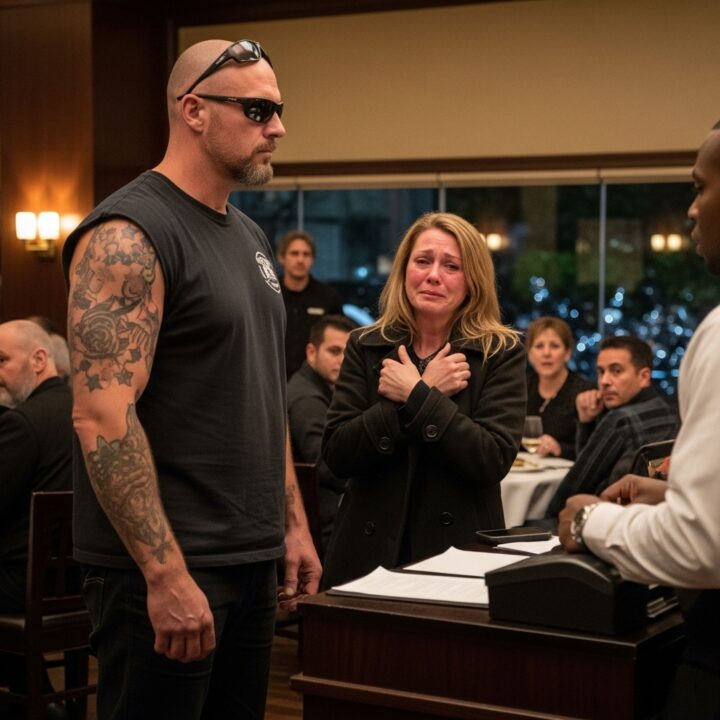
The temperature in the room shifted the second he crossed the threshold.
He was broad-shouldered, mid-forties, wearing a sleeveless black shirt that revealed arms marked with old tattoos and newer scars. His boots were solid, worn by miles rather than fashion. Dark sunglasses hid his eyes despite the low light. He carried his helmet under one arm, posture straight, controlled.
Every conversation stopped.
A woman near the window whispered, “Oh no.”
A man set his glass down carefully, like the sound might provoke something.
The biker didn’t look around. He walked straight to the host stand, stopping beside the woman who was being ushered out.
For a brief moment, no one breathed.
The maître d’ stiffened. “Sir, do you have a reservation?”
The biker glanced at the woman. Not at her clothes. Not at her shoes. At her face. He noticed the way her jaw was set, the way her fingers trembled despite her effort to stay composed.
Then he turned back to the maître d’.
“Table for one,” he said.
The maître d’ hesitated. “We’re fully booked.”
The biker tilted his head slightly. “Funny. I see an empty table.”
The tension sharpened.
A manager emerged from the back, alerted by instinct or experience. “Is there a problem?”
The maître d’ lowered his voice. “This gentleman just arrived. And this guest was—”
“Asked to leave,” the woman finished quietly.
The biker’s jaw tightened—not in anger, but in something heavier, more controlled.
He placed his helmet gently on the host stand. The sound was small, but it echoed.
“I’ll take her table,” he said.
A ripple of discomfort spread through the room.
A man near the bar muttered, “This isn’t going to end well.”
Someone else reached for their phone.
The manager smiled tightly. “Sir, we reserve the right to—”
The biker stepped half a pace closer. Not threatening. Not loud. Just close enough to make the air feel crowded.
“I said I’ll take her table.”
Security shifted near the entrance.
The woman looked up at him, alarmed now. “Please,” she whispered. “It’s okay. I don’t want trouble.”
The biker didn’t answer her.
He didn’t explain himself.
Which made everyone else assume the worst.
The situation teetered on a thin, invisible edge.
Security approached, hands clasped in front, voices rehearsed. “Sir, we’re going to need you to step outside.”
The biker nodded once. Calm. Composed. Unimpressed by authority that mistook silence for submission.
He didn’t move.
Instead, he pulled out his phone.
That single action sent a ripple of alarm through the room.
“Sir—”
“Watch his hands.”
“Call the police.”
The woman’s breath quickened. She took a step back, heart pounding—not because she feared him, but because she feared what others were about to do to him.
The biker typed a short message. No flourish. No drama. Just a few words sent into the quiet.
He slipped the phone back into his pocket.
Then he spoke again, voice steady.
“I’ll order now.”
The manager laughed, sharp and nervous. “You’re not ordering anything.”
The biker met his eyes. “I’ll have the ribeye. Medium rare. And a glass of whatever you’d recommend.”
Silence.
The woman stared at him, confused. The diners stared too, unsure whether to be offended or afraid.
Outside, faintly at first, came a sound.
Engines.
Plural.
Low. Approaching.
The biker didn’t react.
But everyone else did.
The sound reached the dining room before anyone could place it.
Low. Steady. Unmistakably mechanical, unmistakably deliberate.
Engines.
Conversation died mid-sentence. Forks hovered inches above porcelain. A wineglass trembled slightly as someone’s hand tightened around the stem.
Outside the tall glass windows, headlights slid across polished metal and marble like slow-moving shadows. One motorcycle. Then another. Then more.
They didn’t roar. They arrived.
The valet froze near the entrance, eyes wide. The maître d’ swallowed hard. Security shifted positions, suddenly uncertain.
The front doors opened again.
Boots crossed the threshold—measured, unhurried. Not a rush. Not a charge. A presence.
Five bikers entered first. Men and women. Sleeveless shirts. Tattoos worn like quiet histories rather than warnings. Sunglasses came off as they stepped inside, revealing calm eyes that scanned the room without hostility.
They didn’t spread out aggressively. They positioned themselves naturally—by walls, near empty spaces, leaving walkways clear. Nothing illegal. Nothing theatrical. Everything intentional.
A sixth figure followed.
Older. Late fifties, maybe early sixties. Gray threaded through a trimmed beard. No patches. No insignia. His jacket was plain. His posture carried authority without demanding it.
He stopped beside the original biker.
Neither nodded. Neither spoke.
They didn’t need to.
The older man turned to the manager. “Good evening.”
The manager straightened instinctively. “Sir—this is a private establishment.”
The man smiled faintly. “I know. I helped open it.”
The sentence landed softly.
And the room tilted.
The maître d’ blinked. “Excuse me?”
The man reached into his jacket and placed a card on the host stand. No flourish. No announcement.
The manager picked it up.
His face changed.
Not fear.
Recognition.
He cleared his throat. “We—uh—can we speak privately?”
The older man shook his head once. “There’s no need.”
He turned toward the woman still standing near the door, coat clutched tight, eyes darting between the bikers and the staff.
“Ma’am,” he said gently, “would you like to sit down?”
Her voice caught. “I… I don’t think I’m welcome.”
The original biker finally spoke again.
“You are.”
The authority in those two words was quiet—but absolute.
The manager forced a smile that no longer convinced anyone. “Of course. Please. This way.”
A server rushed forward, pulling out a chair at the very table that had been deemed unsuitable minutes earlier.
The woman hesitated.
Every eye in the room was on her now.
Not judging—waiting.
She took one step. Then another.
She sat.
The sound of the chair sliding across the floor felt louder than applause ever could.
No one clapped.
No one spoke.
Power doesn’t always change hands with noise. Sometimes it just moves.
The truth emerged quietly, the way real truths often do—not in speeches, but in fragments.
The older man had been one of the restaurant’s original investors decades earlier. He’d sold his stake long ago, kept his name out of things, never once stepped back inside after opening night.
The biker who had walked in first? His son.
Not by blood—by choice.
Years ago, the woman being pushed out had worked as a cleaner in that same restaurant during its early days. Overnight shifts. Invisible hours. She’d helped keep the place running before it became polished enough to forget the hands that built it.
She hadn’t recognized the older man.
He had recognized her.
“She used to bring her own food,” he said quietly to the manager. “Ate alone. Never complained. Never asked for anything.”
The manager said nothing.
Neither did the diners who’d watched her be escorted out without protest.
The bikers didn’t linger.
The original biker ate his meal slowly. Paid in cash. Left a tip large enough to make the server blink twice. When the woman tried to thank him, he shook his head.
“Just eat,” he said.
Outside, engines started again—one by one—like a heartbeat returning to normal.
As they rode away, the restaurant looked exactly the same as it always had.
But the people inside didn’t.
Because they’d seen how quickly dignity could be stripped away—and how quietly it could be restored.
The woman finished her meal alone. When she stood to leave, the staff watched her go, unsure how to meet her eyes.
At the door, she paused.
Not to speak.
Not to accuse.
Just long enough to let them feel it.
Then she stepped into the night.
And somewhere down the street, the sound of motorcycles faded—leaving behind a silence heavy with understanding.
No lessons were given.
But no one forgot.