She Had No Money for Her Child’s Medicine — Then a Biker Opened His Wallet
She stood at the pharmacy counter counting coins with shaking hands, knowing the medicine her child needed was slipping out of reach one cent at a time.
The line behind her grew restless.
A bell chimed every time the door opened, letting in cold air and the smell of rain. Shelves were stacked with brightly colored boxes promising relief, rest, recovery—things that felt impossibly far away.
Sarah Miller, twenty-nine, leaned closer to the counter as if lowering her voice could lower the price.
“I’m short,” she said. “Just a little.”
The pharmacist glanced at the screen again. Then at Sarah. Then at the small boy slumped against her leg, cheeks flushed, breathing uneven.
“It’s forty-two dollars,” the pharmacist said, not unkindly. “Insurance didn’t cover this one.”
Sarah swallowed hard. She opened her wallet again, even though she already knew what was inside.
A few crumpled bills.
Loose change.
Nothing else.
Her son tugged at her sleeve. “Mom?”
“I’m okay,” she lied, forcing a smile.
Behind them, someone sighed loudly. Another voice muttered, “Come on.”
Sarah’s face burned.
“I can put some back,” she said, fingers brushing the counter. “Maybe just half the dose—”
“I can’t do that,” the pharmacist replied gently.
Sarah nodded, humiliation washing over her. She started scooping the coins back into her palm, hands trembling so badly she dropped one. It rolled across the tile floor.
That’s when the door chimed again.
Heavy boots stepped inside.
The sound didn’t belong in a place like this.
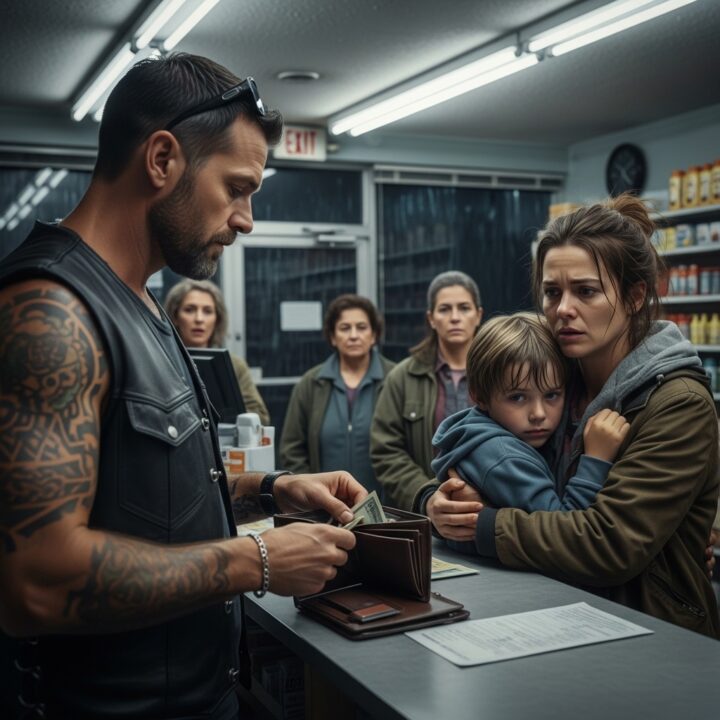
The biker stopped just inside the doorway.
Leather vest. Short sleeves. Tattoos crawling down both arms. His jacket was damp from the rain. A helmet hung from his hand like an afterthought.
People noticed immediately.
A mother near the greeting cards pulled her child closer. Someone in line stiffened. A cashier glanced up, alert.
The biker took in the room with one slow look.
Then his eyes landed on Sarah.
On the boy leaning into her leg.
On the coins scattered in her open palm.
On the pharmacist waiting in that uncomfortable pause between policy and pity.
He stepped forward.
Sarah froze.
Her instincts screamed to protect what little dignity she had left. She shifted her body slightly, blocking her son, clutching her wallet like a shield.
“Please,” she said quickly, not even looking at him. “I don’t have anything.”
The biker stopped immediately.
“I’m not asking,” he said.
But that wasn’t how it looked.
From the back of the line, it seemed like a biker was closing in on a struggling mother. Too close. Too sudden. Too quiet.
Someone whispered, “What’s he doing?”
Another said, “This isn’t safe.”
The pharmacist cleared his throat. “Sir, can I help you?”
The biker nodded toward the counter. “How much?”
The question hung there.
Sarah shook her head. “No. I’m fine.”
The biker reached into his vest.
A ripple of tension moved through the room.
A hand tightened around a phone.
A cashier shifted, ready to call security.
Sarah’s breath caught.
She thought he was pulling out something else entirely.
Instead, he pulled out his wallet.
The room didn’t relax.
It tightened.
Because no one knew why a man who looked like trouble would get involved at all.
The biker opened the wallet slowly.
Cash inside. Cards. Nothing dramatic.
He counted without rushing, hands steady. Then placed the bills on the counter.
“For the medicine,” he said.
Sarah’s eyes filled instantly. “You don’t have to—”
“I know,” he replied.
The pharmacist hesitated. “Sir, I can’t—”
The biker met his gaze. Calm. Direct. “It’s a gift.”
A man in line scoffed. “What’s the catch?”
The biker didn’t answer.
Sarah stepped back, shaking her head. “I can’t take this.”
The biker slid the money closer. “Your kid can’t wait.”
The words were quiet.
They landed anyway.
A woman near the aisle crossed her arms. “This feels wrong.”
Another muttered, “There’s always something.”
The tension spiked again.
The biker felt it. He straightened slightly—not aggressive, but suddenly very aware that every eye was on him.
He pulled out his phone this time.
Typed one message.
Sent it.
Then he slipped the phone away and rested his hands at his sides.
The pharmacist stared. “Sir… who did you just text?”
The biker didn’t answer.
Outside, through the fogged glass, the low rumble of engines began to roll through the parking lot.
More than one.
Sarah felt her stomach drop.
“What’s happening?” she whispered.
The biker finally looked at her again, voice steady.
“They’re coming.”
And in that moment—standing in a small pharmacy with too many judgments and not enough answers—
no one was sure if help had just arrived… or if things were about to get much worse.
The sound came before anyone saw them.
Low. Controlled. Steady.
Not roaring.
Not reckless.
Just engines rolling in with purpose.
Every head turned toward the glass storefront.
One bike pulled into the lot.
Then another.
Then three more.
They parked in a neat line, angled precisely, as if someone had planned it long before today. Men dismounted quietly. Leather vests. Sleeves rolled up. Helmets tucked under arms. No shouting. No swagger.
They didn’t rush inside.
They waited.
The biker at the counter didn’t move.
A cashier whispered, “Oh my God.”
The man in line who’d scoffed earlier suddenly found the floor interesting.
The pharmacist straightened, unsure now which side of the counter he should be worried about.
The door chimed again.
One of the bikers stepped in first. Older. Gray at the beard. Calm eyes that had seen enough chaos to stop chasing it.
He nodded once at the biker near Sarah.
Then he looked around the room.
“Everything alright in here?” he asked.
No threat in his voice.
No challenge.
Just a question that shifted the balance of the room instantly.
The tension broke—not with noise, but with silence.
No one answered.
Because suddenly, the power had changed hands, and everyone felt it.
The biker at the counter finally spoke again.
“She needs the medicine,” he said. “That’s all.”
The older biker nodded. “Then that’s what happens.”
No argument.
No escalation.
Just presence.
The pharmacist cleared his throat, hands suddenly steadier. He rang up the order, slid the bag across the counter, and quietly said, “I’m sorry.”
Sarah stood frozen, tears streaming freely now.
No one stopped her as she took the medicine.
No one questioned it anymore.
Outside, the bikes stayed still.
Inside, the room exhaled.
The bikers didn’t linger.
They didn’t pose.
Didn’t explain.
Didn’t wait for thanks.
The older one stepped closer to Sarah, keeping a respectful distance.
“He’s gonna be okay,” he said, glancing at her son. “You did the right thing.”
Sarah tried to speak. Nothing came out.
The biker who’d opened his wallet was already heading for the door.
She caught up to him just before he stepped outside.
“I don’t even know your name,” she said, voice breaking. “I can’t— I don’t know how to thank you.”
He paused.
“You don’t need to,” he replied. “Just take care of him.”
That was it.
He put on his helmet.
Outside, the engines started again—low, even, restrained.
As they pulled away, one by one, the parking lot returned to normal. Cars moved. Doors opened. Life resumed.
Inside the pharmacy, people stood awkwardly in place.
No applause.
No speeches.
Just the quiet weight of realizing how wrong they’d been.
The man who had scoffed earlier stared at the counter, jaw tight.
The cashier wiped her eyes when she thought no one was looking.
The pharmacist watched the door long after it closed.
Sarah knelt beside her son, holding the bag of medicine like it was fragile glass.
Later that night, she would tuck him into bed, press a cool cloth to his forehead, and listen to his breathing steady again.
And when she closed her wallet—still almost empty—she would remember the weight of it opening in that pharmacy.
Not as charity.
But as a moment when judgment lost, and quiet courage won.
Somewhere down the road, the biker rode on.
No one cheering.
No one filming.
Just another man in leather, carrying on—
having done exactly what needed to be done,
and nothing more.