A Dog Was Beaten in the Park — One Biker’s Shout Made the Entire Block Turn Around
People heard the shout before they understood what it meant, and by then a small dog was already shaking on the grass.
The park sat between two quiet streets in a working-class neighborhood—patchy grass, rusted swings, a basketball hoop with no net. Late afternoon. The kind of place people passed through, not a place anyone watched closely.
Near the benches, a thin brown dog cowered low, tail tucked, ribs showing with every breath. A man stood over it, angry and loud, leash wrapped tight around his fist. Each sharp jerk made the dog yelp, a sound so quick it felt swallowed by the air.
Some people noticed.
A woman looked up from her phone, frowned, then looked away.
Two teenagers slowed their bikes, exchanged a glance, and kept going.
A jogger muttered, “Not my business.”
The dog tried to crawl backward. There was nowhere to go.
Then the shout tore across the park.
“HEY!”
It wasn’t panic.
It wasn’t rage.
It was command.
Heads turned.
A motorcycle had stopped hard at the curb. A biker swung his leg over and walked toward the grass, boots heavy, movement fast and direct.
No one knew who he was.
No one knew why he was there.
Only that the air changed the moment he stepped in.
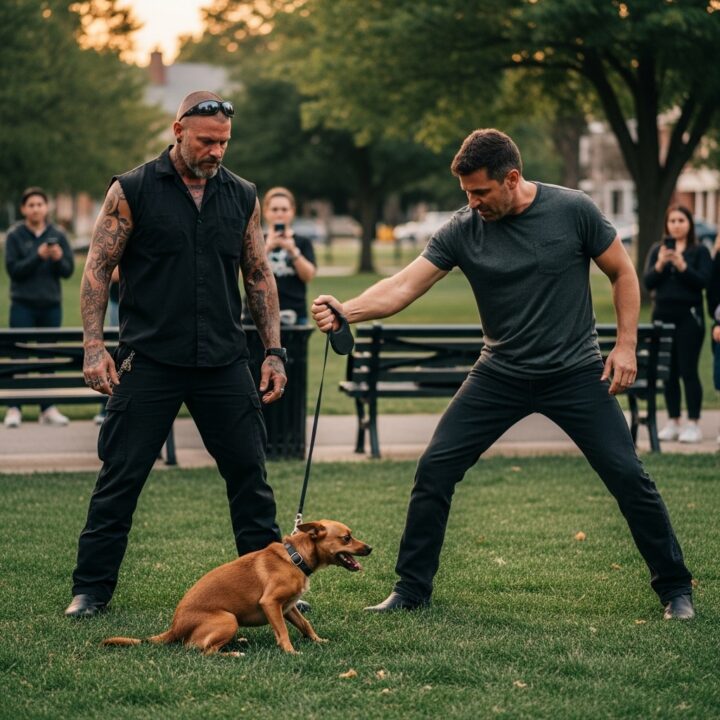
The biker was mid-40s, white American, broad through the shoulders, sleeveless black shirt, arms marked with old tattoos that didn’t ask for attention. Sunglasses hid his eyes. His jaw was set, not clenched—controlled.
He didn’t touch the man.
He didn’t touch the dog.
He stepped between them.
“That’s enough,” he said.
The words landed heavy.
The man holding the leash laughed, sharp and defensive. “Mind your own damn business.”
The biker took one more step forward.
That was when the park decided who he was.
A woman gasped.
Someone whispered, “This is going to get ugly.”
A man on a bench stood up and shouted, “Call the cops!”
From a distance, it looked bad.
A biker confronting a man in public.
Raised voices. Tight space. A dog in the middle.
The biker’s presence alone felt like a threat to people who had already chosen a story.
“You threatening me?” the man snapped.
The biker didn’t answer him.
He crouched—slowly—placing himself between the dog and the man’s legs. The dog flinched, unsure which danger was closer.
“Easy,” the biker said, voice lower now. “I see you.”
Someone yelled, “Don’t touch that dog!”
Another voice: “He’s going to attack him!”
Phones came out.
Someone dialed 911.
The biker didn’t explain.
Didn’t look around for support.
He held his position.
The tension stacked itself higher with every breath.
The man yanked the leash hard.
The dog cried out and collapsed sideways, legs folding like they’d forgotten how to work.
That’s when the crowd surged.
People shouted at once.
“Stop it!”
“Back off!”
“Get away from him!”
No one was talking to the man anymore.
They were all watching the biker.
The biker stood up.
Not fast.
Not slow.
Just enough.
He raised one hand, palm out—not to threaten, not to beg. To pause the moment.
“Drop the leash,” he said. Quiet. Certain.
The man sneered. “Or what?”
The biker didn’t answer.
He reached into his pocket.
Gasps rippled.
Someone screamed, “He’s got something!”
The biker pulled out his phone.
He typed with his thumb once.
Then he said one sentence, not loud enough for the whole park—only loud enough to matter.
“You’ve got witnesses now.”
No one knew who he had contacted.
No one knew what that meant.
Sirens sounded faintly somewhere beyond the trees.
The dog lay still, chest fluttering.
The crowd pressed in, tight and restless, a circle built on fear and assumption.
Everything balanced on the edge of becoming something worse.
The sound came first.
Not sirens.
Engines.
Multiple.
Motorcycles rolled up along the curb in a line—slow, disciplined, controlled. Men dismounted. Sleeveless shirts. Faded tattoos. Older. Calm.
They didn’t rush the scene.
They didn’t speak over each other.
They stood.
The effect was immediate.
The shouting stopped.
Phones lowered.
People stepped back without being asked.
One of the bikers, gray-bearded, nodded toward the man with the leash. “Everything okay here?”
The question wasn’t aggressive.
It didn’t need to be.
The man’s grip loosened.
Behind the bikers, a woman in a city jacket approached quickly, badge clipped to her belt. Animal control. She took in the scene in seconds—the dog, the leash marks, the crowd.
She knelt beside the dog.
“This dog needs help,” she said.
The biker stepped back immediately, giving space. He didn’t argue. Didn’t posture.
The man started talking all at once, excuses tumbling over each other. No one listened.
The park had gone quiet in a way that felt heavy.
Power had shifted, not by force—but by presence.
It came out slowly.
The dog wasn’t his.
He’d “found it.”
It wouldn’t listen.
He was “teaching it.”
The animal control officer didn’t debate him. She cut the leash, wrapped the dog gently in a blanket, and lifted it with practiced care.
The dog didn’t resist.
Its eyes followed the biker.
Someone in the crowd swallowed hard.
A woman wiped her face.
A man stared at the ground, embarrassed by how certain he’d been.
The biker said nothing.
One of the bikers clapped him once on the shoulder. Quiet. Familiar.
The man with the leash was led away, still talking, his voice fading.
As the truck doors closed, the dog poked its head out from the blanket. Its tail thumped once—tentative, unsure.
The biker crouched again.
Not close.
Just enough.
“You’re okay now,” he said.
The dog blinked.
That was all.
No speeches followed.
No applause.
No explanation from the biker.
He put his sunglasses back on, swung onto his bike, and rolled away with the others—engines low, controlled, gone.
The park returned to its normal sounds. Birds. Distant traffic. A basketball bouncing.
But something stayed behind.
The memory of how quickly fear chose a villain.
How loudly assumptions shouted.
How close everyone came to missing the real problem.
On the grass where the dog had been, a patch of flattened green slowly lifted back up.
And the people who had watched stood there longer than they meant to, replaying the moment they looked at a man trying to stop harm—
and almost let harm continue because he didn’t look like help.
No lesson was spoken.
None was needed.
The silence did the work.