A Boy Blocked Forty-Two Harleys With His Walker—Then Took Three Steps to Return the Badge His Father Never Brought Home
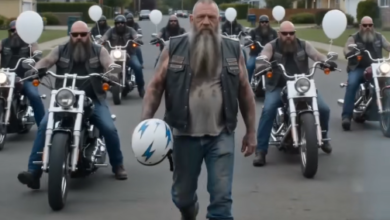
Forty-two Harleys were rolling toward Route 89 when a little boy pushed his walker into the road, planted himself before the lead bike, and raised one trembling fist as if he meant to stop every engine alone.
I was leading the convoy.
My name is Benjamin “Gravel” Hayes. I was fifty-four that October morning, broad through the shoulders, gray in the beard and carrying enough ink on my arms to make strangers lock their car doors. Behind me rode forty-one members of the Iron Ridge Brotherhood, their V-twins shaking the windows along Whiskey Row as we left Prescott, Arizona.
We were riding for a dead brother.
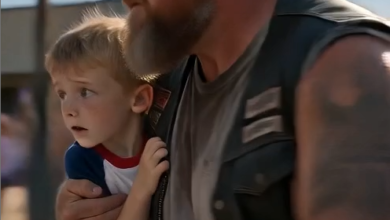
The boy could not have been older than nine. His legs were held in black braces, both hands clamped around a blue aluminum walker decorated with strips of electrical tape. He wore a denim jacket three sizes too large, and something silver flashed between his fingers.
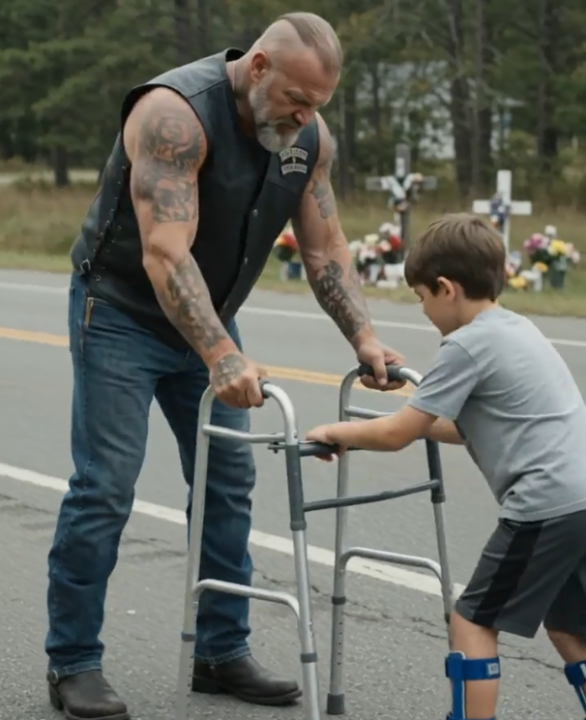
At first, I thought he had wandered away from someone.
Then I saw his face.
He knew exactly where he was.
I closed my fist above my shoulder, giving the emergency-stop signal. Forty-one engines dropped from thunder to scattered coughs before dying one after another. The silence that followed felt heavier than the noise.
The boy remained in the road.
“Easy, son,” I called. “Stay where you are.”
He pushed the walker forward.
One wheel caught in a crack. His right knee folded, but he locked both elbows and stayed upright. A woman screamed from the sidewalk. Several riders dismounted, boots striking pavement, yet I held out one hand and kept them back.
The child stared only at me.
“Are you Gravel?”
Hearing that road name from him tightened something inside my chest.
“Who’s asking?”
He opened his fist.
The silver object was a winged Road Captain badge, scratched along one edge and darkened by age. I had last seen it pinned above the heart of Cole Bennett—the man whose memorial ride we were beginning that morning.
Cole had been dead for one year.
The badge had vanished after the crash.
Some brothers believed it had burned with his cut. Others thought his widow had buried it with him. A few wanted to create a replacement, but I had stopped them. You did not duplicate a badge carried by a man who had brought every rider home for sixteen years.
The boy knew that too.
“My dad said this doesn’t belong in a drawer.”
Nobody behind me spoke.
The child’s name was Noah Bennett. Cole’s son.
I had seen photographs of him when he was younger, usually sitting on his father’s Harley while Cole stood beside him, one hand around the boy’s waist. I had not seen Noah since the funeral. None of us had.
Now he stood twenty feet from my front tire, breathing as if he had pushed that walker across the entire state.
I started toward him.
“No,” Noah said.
His voice cracked, but the command stopped me.
He looked toward a strip of white tape placed across the pavement behind his walker. Then he looked down at three more short strips leading toward me, each separated by less than a child’s stride.
His mother stood on the sidewalk with both hands pressed over her mouth. She was crying, but she did not move to help him.
That was when I understood the walker was not there because Noah had gotten lost.
It marked where he meant to leave it.
Noah locked the brakes, removed both hands and stood between the metal rails. His knees shook so hard the braces clicked. The silver badge remained clenched in his right fist.
“Dad told me the last three had to be mine,” he whispered.
Then he released the walker.
He lifted one foot.
Behind me, forty-one hardened bikers watched a nine-year-old boy attempt the three steps he had spent an entire year learning to take—so he could return the badge of the man whose final act had saved my life.
What Noah said when he reached me would force the Iron Ridge Brotherhood to confront the promise we had broken after his father died.
Want to know why Cole gave Noah the badge and what was engraved beneath its silver wings? Drop BADGE in the comments—I’ll share more soon.
Part 2 — The Empty Place at the Front
Cole Bennett had not looked like a man built for quiet work. He stood six-foot-three, weighed nearly 260 pounds and wore his brown beard in two short braids held by steel beads. His forearms carried an old desert map, his knuckles spelled HOLD FAST, and the left shoulder of his leather cut had been repaired so often the stitches resembled railroad tracks.
Yet Cole noticed what everyone else missed.
If a prospect’s hands shook at breakfast, Cole quietly changed the route so the kid would not be riding through high crosswinds. If an older brother fell behind, Cole found a reason for the entire club to stop. He checked gas caps, brake lights and helmet straps without making a man feel inspected.
That was why he had carried the winged badge.
Road Captain was not the loudest position in the Brotherhood. It was the one that required a man to count every head before leaving and count them again when the engines stopped. Cole used to say the front motorcycle mattered less than the final one.
“A leader ain’t home,” he told me once, “until the slowest brother sees his own porch.”
I had ridden beside him for twenty-two years. He knew where I kept the spare key to my house, which anniversary I always forgot and why I never crossed the Verde River bridge without touching two fingers to my gas tank.
He also knew I blamed myself for everything.
That tendency had worsened after my daughter died at nineteen. Maggie had been driving home from college when a drunk driver crossed the center line outside Camp Verde. I stopped answering calls after the funeral. For months, I slept on a cot inside my motorcycle shop because my house still smelled like her shampoo.
Cole came every morning.
He never told me to recover. He brought burnt coffee, opened the bay door and sat on an overturned bucket until I was ready to work. Some days, neither of us spoke.
He saved me long before the crash.
Noah was born with spastic diplegic cerebral palsy, a condition that affected the muscles in both legs. Doctors told Cole and his wife, Sarah, that their son might walk with assistance, but nobody could predict how far or when.
Cole treated that uncertainty like a road with poor markings. You slowed down. You watched carefully. You kept going.
He installed parallel rails in his garage beside two Harley touring bikes. Every afternoon, Noah practiced between them while Cole crouched several feet ahead, still wearing oil-stained work clothes from the municipal garage.
“One step counts,” Cole would say.
Noah usually answered, “Three counts more.”
That became their ritual. One step belonged to balance. The second belonged to fear. The third proved the first two had not been accidents.
Cole sent us short videos of Noah practicing, but never the failed attempts. He said a boy deserved to own the moments when his body did not cooperate. The clips he shared ended only when Noah reached him and slapped both hands against his father’s vest.
Three steps.
Then an embrace.
By the spring before Cole died, Noah could manage the distance on good days. On difficult days, his left foot dragged and his knees crossed inward. Cole never called those bad days. He called them heavier roads.
The Brotherhood became part of Noah’s training without realizing it. Mack Torres welded the garage rails. Doc Alvarez adjusted the walker’s handles. Little Ray Collins wrapped the grips with black motorcycle tape so Noah’s palms would not blister.
I made the mistake of buying him a tiny leather vest.
Sarah returned it.
“He is not a mascot,” she told me. “He is a child.”
She was right. I disliked her for saying it because being right made the words sting harder.
Cole later brought the vest to my shop and placed it on the workbench. “You keep trying to give people club things when what they need is you.”
“What’s that supposed to mean?”
“It means Noah doesn’t need a patch. He needs Uncle Ben to show up when the motorcycle ain’t running.”
I promised I would.
Then Cole died, and I failed at the only part of brotherhood that could not be stitched onto leather.
After the funeral, Sarah asked us to stay away. The sound of motorcycles sent Noah into panic. The boy had been at the crash scene, and every V-twin became the engine he heard seconds before his father disappeared beneath twisted steel.
Some brothers were hurt. Others were angry. Mack wanted to visit without his cut. Doc suggested sending letters. I said Sarah had made her decision and we would respect it.
That sounded honorable.
Mostly, it allowed me to hide.
I resigned as Road Captain and removed the temporary badge the club had pinned to my chest after Cole’s death. For the next year, the front position remained empty. We still rode, but the formation felt wrong. Mack gave directions. Doc counted helmets. I stayed near the rear where nobody could mistake me for the man Cole had saved.
On the first anniversary of his death, the Brotherhood planned a memorial ride from Prescott to the overlook above Mingus Mountain. I refused to lead until Cole’s widow sent a handwritten note.
He put you at the front for a reason. Stop making his choice meaningless.
I thought Sarah meant the crash.
I did not know Noah had dictated the words.
Nor did I know that every morning for twelve months, the boy had been practicing toward three strips of white tape while his father’s silver badge waited inside a wooden box.
Part 3 — The Morning Cole Broke Formation
The crash happened on a cold October morning along Route 89A, where the road twisted upward toward Mingus Mountain and the desert dropped away beneath the guardrail. There were eighteen of us that day, riding toward Jerome to deliver winter coats to a youth shelter.
Cole led.
I rode second.
The sky was clear, but wind came hard across the exposed sections. It smelled of dust, hot brakes and juniper. Cole reduced our speed twice, then extended two fingers toward the pavement, warning us about loose gravel.
We had made that ride dozens of times.
Nothing felt unusual until the landscaping truck appeared above us.
It came around a blind curve too fast, towing a dual-axle trailer loaded with stone pavers. The trailer began to sway. Once. Twice. Then its left wheel climbed across the center line.
Cole saw it before I did.
He gave the danger signal and moved right. I reacted half a second late because I was looking into my mirror, checking the riders behind me. When I turned forward again, the trailer had broken loose.
It crossed both lanes sideways.
No space. No shoulder. No time.
Cole struck my handlebar with his left hand and kicked the side of my Harley, forcing my front wheel toward a shallow drainage strip beside the mountain. The move threw both of us off balance. My bike slid under the edge of the trailer.
Cole’s remained in its path.
Metal folded. Stone blocks scattered. Engines screamed against asphalt before going quiet.
I remember the taste of blood and road grit. I remember leather scraping from my right shoulder. I remember crawling back while Mack shouted at me to stay down.
Cole lay beside the guardrail.
His helmet had remained intact, but the trailer tongue had crushed the lower half of his motorcycle and trapped one leg. He was conscious. That made what followed harder.
Noah and Sarah had been traveling several minutes behind us in their SUV. They were supposed to meet the club at the shelter because Cole wanted Noah to hand out the first coat. Traffic stopped them beyond the curve, but Sarah recognized the bikes and left the vehicle.
Noah saw the wreck through the windshield.
He heard the remaining engines idling.
By the time Sarah reached us, Cole’s breathing had become shallow. An off-duty paramedic stabilized him while we waited for the rescue crew. I knelt near his head, unable to feel my right arm.
“You stay with me,” I said.
Cole looked at my torn jacket. “You still counting?”
“Shut up.”
“How many?”
“Seventeen.”
“Eighteen with me.”
“You’re coming.”
Cole knew he was not.
He asked for Noah.
Sarah initially refused. The scene was chaotic, but Cole said the boy’s name again. Firefighters positioned a blanket to block the wreckage, and Mack carried Noah from the SUV in his walker.
The moment Noah heard his father, he fought to get down.
Cole told him not to.
“Use the wheels today, little man.”
Noah stopped struggling. Mack rolled him close enough that Cole could touch one taped handle of the walker. His glove left a black mark.
Cole then reached toward his vest.
The winged badge was pinned above his heart. He could not remove it with one hand, so I did it for him. The clasp was bent, and I cut my thumb forcing it open.
He placed the badge in Noah’s palm.
Sarah demanded that I take it. She believed Cole was confused from blood loss. I believed the same thing.
Cole closed Noah’s fingers around the silver wings.
“Three steps,” he said.
Noah began crying. “Not today.”
“Not today.”
“When?”
“When they’re yours.”
Those were the last complete words Cole spoke to his son.
He died in the helicopter before reaching Flagstaff Medical Center.
For months, I replayed the collision until memory became punishment. Cole had shoved me away from the trailer. The angle of the impact proved it. So did a driver’s dash camera.
The Brotherhood called him a hero.
I could not stand the word.
Hero was what people said when they wanted a clean shape around a dirty absence. It did not show Sarah sitting beside an empty hospital bed. It did not show Noah asking why his father had saved Uncle Ben instead of coming home.
At the funeral, the Iron Ridge Brotherhood placed Cole’s cut across the casket. The Road Captain badge was missing, but nobody asked Sarah about it. We assumed it belonged with Noah.
After the service, I tried to approach him.
A motorcycle started outside.
Noah screamed so violently that his entire body stiffened. His walker tipped, and Sarah caught him before his head struck the floor. She looked at forty men in leather as though we had brought the crash into the chapel.
“No more bikes near him,” she said.
Mack removed his keys from his pocket. Doc offered to help carry Noah. Sarah would not let any of us touch him.
Then she looked at me.
“You should have been the one in front.”
I had no answer.
She left with Noah and the badge.
The Brotherhood divided in the parking lot. Several men believed Sarah’s grief had made her cruel. Mack said we owed her time. A younger member named Travis muttered that Cole had chosen his own risk.
I hit him.
One punch.
Enough to split his lip and reopen the wound across my thumb.
The club suspended me for thirty days, though punishment meant little when I had already decided never to ride at the front again. Sarah heard about the fight and changed her telephone number.
That was the last direct news we received for eleven months.
What we did not know was that Noah had stopped walking completely.
He would grip the rails in the garage, hear a phantom engine and collapse before taking the first step. The silver badge remained in his room, but he could not look at it without remembering his father pinned beside the guardrail.
For three months, the boy refused even to touch his walker.
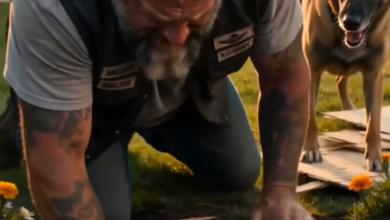
Then Sarah found him crawling across the garage floor toward the white tape Cole had placed there.
He reached the first strip.
Pulled himself upright.
And began again.
Part 4 — The Three Steps Nobody Could Take for Him
Noah’s first step lasted less than a second.
His knees crossed. His left ankle rolled against the brace, and he dropped between the garage rails before Sarah could reach him. He struck one elbow, bit his tongue and pushed her hand away when she tried to lift him.
“Dad said mine.”
Sarah sat on the floor.
The garage still held Cole’s tools, a half-used bottle of chain lubricant and a dented thermos nobody had washed. His Harley was gone, but the concrete beneath its old parking spot carried a dark oil stain shaped almost like a shadow.
Sarah wanted to sell the house.
Noah refused.
He believed his father’s three steps still lived there.
Physical therapy resumed twice a week. Noah’s therapist, Dr. Elena Ruiz, taught him to shift weight without locking his knees. She changed the braces, strengthened his hips and required him to rest when determination became dangerous.
He hated rest.
Every session ended with the same question.
“Can I do three?”
“Not safely.”
“When?”
“When your body and your courage agree.”
Courage usually arrived first.
His body took longer.
Sarah worked nights as a respiratory therapist and slept in fragments. Medical bills accumulated. Cole’s life insurance covered the mortgage but not the accessible van repairs, new braces and private therapy the insurer called nonessential.
The Brotherhood learned about the financial strain by accident. Doc Alvarez saw Sarah at a pharmacy arguing over a rejected prescription. She made him promise not to tell me.
He told Mack instead.
Mack brought the problem to a club meeting. Some brothers wanted to hand Sarah cash. Others suggested a public fundraiser using Cole’s name. I rejected both.
“She asked us to stay away.”
“She asked for no motorcycles,” Mack said. “She didn’t ask for an eviction notice.”
The argument lasted two hours.
It was the closest Iron Ridge came to splitting.
Travis, the man I had punched, offered the answer. His sister managed billing at a rehabilitation foundation in Phoenix. Through her, the club could anonymously pay for therapy grants without using Cole’s photograph or turning Noah into a charity poster.
We voted.
Every hand rose.
For the next nine months, Iron Ridge funded Noah’s therapy through a memorial account labeled Route Home. Sarah discovered the source quickly but said nothing. She understood the compromise. No engines. No photographs. No debt mentioned aloud.
Brotherhood, from a distance.
I contributed money but never visited. Mack called that respect. I knew better.
I was afraid Noah would ask why his father had chosen me.
No answer could satisfy a child.
During the sixth month, Sarah found a memory card inside Cole’s old garage radio. It contained dozens of short recordings he had made during Noah’s practices. Most were ordinary: Cole counting, teasing, breathing hard as he crouched in front of the rails.
Then she found twelve files named HEAVY ROAD.
Cole had recorded them for the difficult days.
In the first, he said, “Feet being stubborn? Let ’em. We’ve got time.”
In another: “Don’t fight the shake. Find where it stops.”
The final recording was eleven seconds long.
“If I’m not in front of you, little man, pick somebody worth walking toward.”
Sarah listened once.
Then she locked the memory card in a drawer.
She feared Noah would hear his father’s voice and collapse. A week later, he found her crying beside the computer. He asked to hear the files.
The first recording broke him. He pressed both hands over his ears and begged her to stop. That night, however, he asked again.
Soon, Cole’s voice returned to the garage.
Not daily. Not as a ghost summoned on command. Sarah and Dr. Ruiz rationed the recordings because memory could motivate Noah or swallow him. On strong afternoons, Cole counted from the small radio while Noah moved between the rails.
One.
Rest.
Two.
Breathe.
Three.
Mine.
By late summer, Noah could take three assisted steps while holding one rail. In September, he managed two steps without support before falling into Sarah’s arms.
The memorial ride was four weeks away.
That was when Noah told his mother where he intended to finish.
She refused immediately.
“You are not standing in front of motorcycles.”
“They’ll stop.”
“You don’t know that.”
“Dad always stopped for people.”
Sarah left the garage because she could not explain that good men died even when they followed every rule.
Noah persisted. He showed her the badge and the three strips of white tape. He wanted the walker placed before the convoy. He would lock it, step out and walk to me.
“Why Ben?”
“Dad picked him.”
“You were seven, Noah. You had just seen—”
“I remember.”
Sarah froze.
Noah had never described the full conversation beside the wreck. Therapists warned against pressing him, so she had accepted the fragments he volunteered. Now he repeated words nobody else had heard.
After Cole gave him the badge, he had pulled Noah closer.
“Gravel will leave the front,” Cole whispered.
Noah asked why.
“Because he thinks hurting proves he loved us.”
Then Cole made his son promise something.
When Noah owned the three steps, he would carry the badge to me. He would not ask why I survived. He would tell me what Cole no longer had time to say.
A road captain brings the living home.
Sarah wrote the note that convinced me to lead the memorial ride. Mack helped her arrange traffic control without telling me why. Dr. Ruiz measured the pavement and placed four strips of removable white tape near the starting point.
Everyone knew.
Except the man at the front.
At 8:11 on that October morning, Noah pushed his walker into the road.
Forty-two Harleys stopped.
He locked the brakes.
Then he took his hands away.
Part 5 — What Was Engraved Beneath the Wings
Noah’s first step landed crooked.
His right foot moved forward, but the knee buckled inward. The braces clicked, and his body tilted toward the pavement. Forty-two riders leaned without moving, each man fighting the same instinct to catch him.
Sarah cried out.
Dr. Ruiz touched her arm.
“Let him choose.”
Noah steadied himself. His face had gone pale. The denim jacket slipped from one shoulder, revealing a gray T-shirt bearing a faded grease mark shaped like Cole’s thumb.
He lifted his left foot.
The second step was smaller. His boot barely cleared the asphalt, but it crossed the next strip of tape. His arms floated outward, searching for rails no longer beside him.
I was close enough to reach him.
I did not.
Cole had spent years teaching us that help given too early could become another kind of obstacle. Noah did not need forty-two men carrying him through the final distance.
He needed witnesses.
The third step took seventeen seconds.
I know because Mack later timed the video recorded by the city traffic camera. No club member raised a phone. We watched with empty hands as Noah fought the tremor moving from his ankles into his hips.
He whispered something.
At first, I could not hear it.
Then the wind shifted.
“Heavier road.”
Noah raised his right knee. The boot advanced, struck the final strip and remained there.
Three.
He had made them his.
I dropped to one knee before him, not because he was small, but because my legs would no longer hold me.
Noah opened his fist.
The Road Captain badge rested in his palm. Its bent clasp had been replaced, though the scratched wing remained. A thin line of dried blood still darkened one corner—mine, from the morning I removed it from Cole’s vest.
“Dad said you need this.”
“I can’t take it.”
Noah’s expression hardened in a way that belonged entirely to his father.
“He said you’d say that.”
A few riders lowered their heads. Mack made a sound that was almost a laugh and almost something else.
I stared at the badge. “Your dad earned it.”
“He gave it away.”
“To you.”
“No. He gave me the carrying part.”
The boy pressed the badge against my closed hand.
I did not open it.
Noah’s balance began to fail. His arms shook, but he refused to reach for me. I finally turned my hand upward, and he released the silver wings into my palm.
The metal was warm.
“Dad said a road captain brings the living home,” Noah told me. “He said you keep trying to ride after him.”
That sentence struck harder than the trailer.
For a year, I had treated survival as a mistake Cole had made on my behalf. I stayed behind because the front position belonged to the dead. I called it loyalty.
Cole had called it before he died.
Hurting proves he loved us.
Noah pointed at the badge. “Turn it over.”
The back carried an inscription I had never seen. Cole must have added it shortly before the crash.
BEN—THE LAST THREE ARE YOURS.
Below it, in smaller letters:
COUNT THE LIVING.
I closed my fist.
Noah finally swayed toward me. I caught him beneath the arms, careful of the braces, and he landed against my chest. His hands gripped the front of my cut exactly as they had gripped Cole’s in those old garage videos.
The Brotherhood remained silent.
Sarah walked into the road and knelt beside us. I expected anger. I expected her to repeat the words she had spoken after the funeral—that I should have been at the front.
Instead, she touched the damaged wing of the badge.
“I spent a year blaming you for being alive,” she said. “Then I spent another year watching my son try to walk something back to you.”
“I’m sorry.”
“I know.”
It was not forgiveness. Not entirely. Grief did not become tidy because a boy crossed three strips of tape.
But Sarah allowed me to help Noah back into his walker.
That was a beginning.
When I stood, Mack approached with a small leather punch, black thread and the vest I had stopped wearing after the crash. He had brought it because Sarah told him to.
The left chest held two empty holes where my temporary badge had been removed.
Noah took the silver wings from me once more.
“May I?”
My voice disappeared. I nodded.
His fingers struggled with the clasp, so I lowered myself again. He pushed the pin through the leather above my heart. The point caught twice before passing through.
Click.
The sound was tiny.
Forty-two men heard it.
Noah leaned close and whispered, “Now count.”
I stood and faced the line.
For the first time in a year, I counted every rider aloud.
One through forty-two.
Then Sarah.
Then Dr. Ruiz.
Then Noah.
Forty-five living people stood on that road.
Cole was not among us.
That hurt.
It was supposed to.
Part 6 — The Rider Who Had Been Missing From the Count
We did not begin the memorial ride immediately.
Noah was exhausted. Dr. Ruiz checked his legs while Sarah gave him water. The city officer assigned to traffic control pretended to study the intersection so none of us would see him wiping his face.
Mack asked whether we should cancel.
Noah heard him.
“Dad hated late starts.”
That settled it.
The route to Mingus Mountain had been planned for motorcycles only, but Sarah’s accessible SUV joined behind the final bike. Noah sat near the window with his walker secured in the back. We kept the pace low enough that he could see every rider lean through the long curves.
I rode at the front.
The badge felt heavier than metal.
At the overlook where we had once stopped with Cole, the Brotherhood formed a broken circle around an empty space. We had planned to place a plaque there, but Noah carried something different from the SUV.
The tiny leather vest I had bought him years earlier.
Sarah had kept it.
It still had no club colors. Across the back, she had sewn one plain strip bearing Cole’s favorite words:
ONE STEP COUNTS.
Noah handed the vest to me. “It doesn’t fit.”
“I noticed.”
“It’s not for wearing.”
He asked us to place it inside the circle where Cole would have stood. Then he removed the Road Captain badge from my chest.
My stomach dropped.
Noah turned toward Cole’s little vest, and for one terrible second I thought he had changed his mind. Instead, he touched the silver wings to the words on the back.
Then he pinned the badge on me again.
“Just showing him.”
Several riders turned toward the valley.
Leather creaked. Chains moved against wallets. Wind rattled dry grass around our boots.
Travis—the brother I had struck after the funeral—stepped forward. The scar on his lip had faded, but I still noticed it.
“Cole’s account has enough for another year of therapy,” he told Sarah. “No pictures. No club name. Same as before.”
Sarah looked at Mack, then Doc, then me.
“You paid for Route Home?”
Nobody answered.
Noah did.
“I knew.”
“How?”
“Uncle Travis’s sister talks too loud.”
Travis smiled and wiped his nose with the back of one tattooed hand.
Sarah did not thank us. That would have turned help into a transaction, and Cole had taught us better. She only asked whether the account could be opened to other children whose insurers rejected mobility therapy.
Mack said yes before checking the balance.
Within six months, Route Home became a small nonprofit managed by Sarah, Dr. Ruiz and two club members who hated paperwork but showed up for every meeting. The Brotherhood did not put motorcycles on its logo. It used three white lines.
Noah returned to the garage rails, but the goal changed. He no longer trained to deliver the badge. He trained to walk from his bedroom to the breakfast table.
Some mornings he made it.
Some mornings he used the walker.
Nobody called either outcome failure.
I began visiting on Tuesdays. I parked three houses away and pushed the Harley down the block until Noah decided he was ready for the engine. At first, I stayed in the garage while he practiced. Later, he let me count.
I tried to imitate Cole.
Noah stopped me.
“Use your own voice.”
So I did.
Part 7 — When the Engines Returned
One year after Noah stopped our convoy, the Iron Ridge Brotherhood gathered on the same stretch of road. This time, the city had closed one lane, and dozens of families from Route Home waited along the sidewalk with walkers, braces, wheelchairs and forearm crutches.
Noah was ten.
He had grown nearly three inches, though Cole’s denim jacket still hung loose around his shoulders. The blue walker remained covered in black tape. A new silver strip had been added across its front bar.
It carried no club name.
Only three engraved marks.
Noah did not block the motorcycles that morning. He stood beside me while the engines idled, their low pulse moving through the pavement and into his braces.
A year earlier, that sound had carried him back to the crash.
Now he listened.
“You good?” I asked.
“No.”
I waited.
He adjusted his grip. “But start anyway.”
I raised one fist.
Forty-eight riders prepared to move. The Brotherhood had grown by six, though we still left a space for Cole whenever we formed a circle. His absence was no longer a hole we tried to close. It was simply a place we knew by shape.
Sarah stood beside the Route Home families. She no longer flinched when a motorcycle started, but she watched Noah before every ride.
He nodded to her.
Then he looked at my vest.
The winged Road Captain badge remained above my heart. Its scratch had never been polished away, and the clasp still carried the faint line of old blood. Beneath it, Mack had sewn a narrow patch displaying three white bars.
Noah reached forward and touched the final one.
“Count everybody,” he said.
I counted the riders. I counted the families. I counted Sarah, Dr. Ruiz and the officer holding traffic. I counted Noah last because that was how Cole counted—never from importance, always from responsibility.
Seventy-three.
Everyone present.
I climbed onto the Harley and started the engine. Noah released one hand from his walker. Then the other.
He did not attempt three steps.
He took one.
That was enough.
The convoy moved toward Route 89, slow and tight, while Noah stood beside the white marks his father had never lived to see him cross.
In my mirror, he lifted the walker from the pavement and held it above his head for half a second. Sarah steadied his elbow, but the strength belonged to him.
The engines carried the sound into the mountains.
We counted him home.
Follow our page for more powerful biker stories about misunderstood riders, tested brotherhood and the quiet promises carried beneath leather and ink.