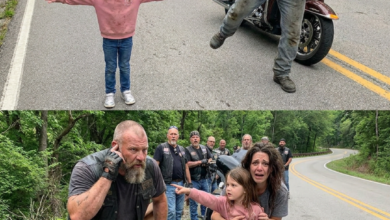
A Boy Lost His Wheelchair — Then Biker Engines Roared Through the Street
They didn’t steal his phone or his backpack — they took the one thing that allowed him to move, and left him crying in the middle of the street.
The afternoon traffic crawled through the downtown intersection, horns chirping impatiently as the light flicked from red to green and back again. Pedestrians clustered on the corners, checking watches, phones, anything but the ground in front of them.
That’s where Evan Miller, twelve years old, sat helplessly.
His wheelchair was gone.
One moment it had been right there — the familiar metal frame, the squeak of the left wheel he knew by heart — and the next it was being shoved away, disappearing into the crowd like it was just another abandoned object.
“Stop—!” Evan cried, his voice cracking.
He tried to push himself forward, palms scraping against the hot pavement. His legs didn’t respond. They never had.
People slowed. Some stared.
Some frowned.
Most kept walking.
A man muttered, “Probably staged.”
Another said, “Where are his parents?”
Evan’s hands trembled as he tried to sit upright. The street felt enormous without the chair — louder, harsher, unforgiving. A car rolled too close, the driver waving angrily for him to move.
“I can’t,” Evan sobbed.
Across the street, a motorcycle idled at the curb.
The rider had been watching — not dramatically, not rushing — just paying attention when others didn’t. Leather vest. Short sleeves. Tattoos faded by sun and years. Sunglasses hiding eyes that missed very little.
When the engine cut, the sound felt sudden.
The biker swung his leg over and stepped into the street.
No one yet knew why.
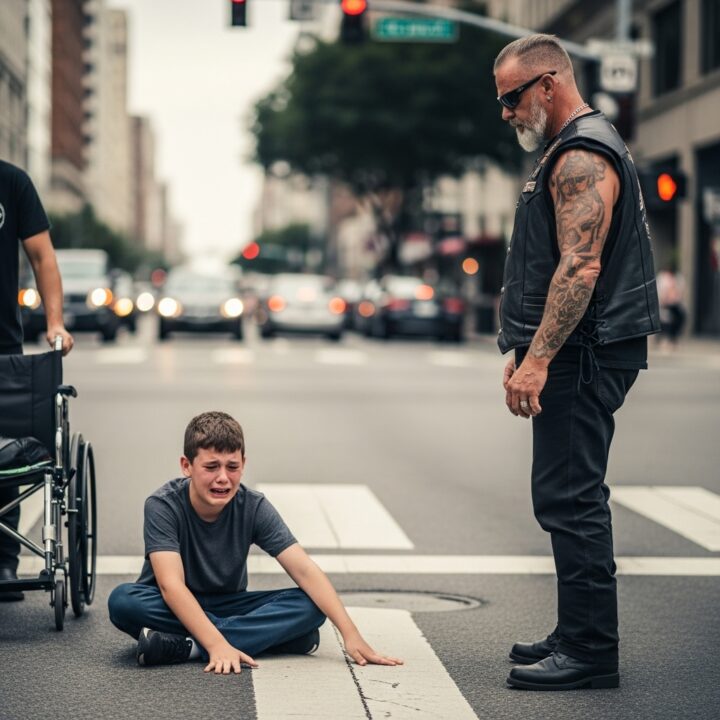
The biker moved fast — not reckless, but decisive.
He reached the boy first, kneeling down, placing one broad hand on the pavement to steady himself, the other hovering near Evan’s shoulder.
“Hey,” he said quietly. “You hurt?”
Evan shook his head violently. “They took it. They took my chair.”
The biker looked up.
His gaze locked onto the crowd.
“Who?” he asked.
A woman pointed vaguely. “That way. Two guys. Hoodie and a cap.”
Without another word, the biker stood.
And that’s when everything went wrong.
From a distance, it looked like a biker charging into the street. A man in leather stepping toward traffic. Toward people.
Someone shouted, “Hey! What’s he doing?”
Another yelled, “Call the cops!”
The biker raised his arm, signaling cars to stop. One driver slammed on the brakes, furious.
“You trying to get killed?” the driver screamed.
The biker didn’t answer. He was already moving — not running, but cutting through the chaos with purpose.
He spotted the wheelchair up ahead, being dragged clumsily, one wheel bouncing uselessly against the curb.
“Stop,” the biker said.
The word wasn’t loud.
But it carried.
One of the men turned, startled. “Back off, man.”
The biker stepped closer.
From the sidewalk, it looked like a confrontation.
Leather versus hoodies.
Muscle versus panic.
Phones came out.
Voices rose.
“He’s threatening them!” someone shouted.
The biker didn’t touch either man. He didn’t raise his fists.
He just stood there, blocking their path.
“That doesn’t belong to you,” he said.
One of the men laughed nervously. “You a cop now?”
The biker shook his head once. “No.”
“Then move.”
Instead, the biker reached into his vest.
A woman gasped.
Someone screamed, “Gun!”
The biker pulled out his phone.
Typed.
Sent.
Then he slipped the phone away and looked back at them.
“You’re not going anywhere,” he said calmly.
That was enough.
Someone dialed 911.
Sirens wailed faintly in the distance.
And suddenly, the biker was no longer seen as a helper — but as the threat.
Police arrived fast.
Two cruisers. Four officers.
The wheelchair sat between the biker and the two men, abandoned now, as if suddenly cursed.
“Hands where we can see them!” an officer shouted.
The biker lifted his hands slowly, palms open.
“I’m not armed,” he said.
“Turn around. Now.”
Behind them, Evan watched from the curb, tears streaking his dusty face. He felt smaller than ever — like a problem no one wanted to solve cleanly.
“That’s his chair,” Evan cried. “Please.”
One officer glanced at him, uncomfortable. Another focused squarely on the biker.
“Sir, step away.”
The biker didn’t argue. He stepped back — but he didn’t leave.
One of the men in the hoodie pointed. “He came at us. Threatened us.”
The biker said nothing.
From the outside, the story wrote itself: a biker escalating a street incident, intimidating civilians, obstructing police.
The officers moved to separate everyone.
Evan tried to crawl forward. An officer gently but firmly stopped him. “Stay there, kid.”
“I need it,” Evan whispered. “I can’t go home without it.”
The biker watched this, jaw tightening almost imperceptibly.
Then he did something small.
He reached into his vest again — slowly, deliberately — and pulled out his phone.
He made a call.
Spoke only one sentence.
“We need you,” he said.
Then he ended the call and slid the phone away.
An officer scoffed. “Calling backup?”
The biker met his eyes.
“No,” he said. “Calling witnesses.”
The sirens grew louder.
From somewhere down the street, a low mechanical rumble began to build.
Engines.
More than one.
The crowd turned.
The officers stiffened.
Evan lifted his head, eyes wide.
And in that suspended moment — before anyone could say another word —
the street waited.
The sound came first.
Not a scream.
Not a siren.
Engines.
Low. Even. Controlled in a way that felt deliberate, like a heartbeat finding its rhythm again.
Heads turned down the street.
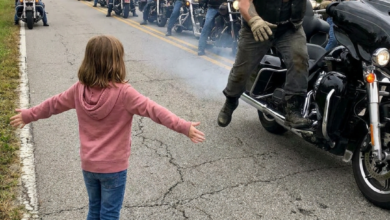
One motorcycle appeared at the corner. Then another. Then another. They didn’t rush the light. They didn’t weave through traffic. They rolled in as if time itself had slowed to make room for them.
Helmets came off. Gloves tucked away. Boots hit asphalt softly.
A dozen bikers now lined the curb—men in their fifties and sixties, white and European American, faces weathered by miles rather than anger. Sleeveless vests. Short-sleeve shirts. Tattoos that looked older than most of the phones recording them.
No one shouted.
No one posed.
They stood.
The officers glanced at one another, hands easing away from belts. Radios stayed silent.
An older biker stepped forward—early sixties, posture straight, eyes calm. He nodded once at the officers, a small courtesy that carried weight.
“Afternoon,” he said. “We heard there was confusion.”
The officer in charge cleared his throat. “This is an active situation.”
The older biker nodded. “So we noticed.”
He didn’t look at the crowd. He didn’t look at the two men who had abandoned the wheelchair. He looked at the boy.
Evan sat on the curb, dust streaking his cheeks, hands clenched in his lap like he was holding onto something invisible.
The older biker crouched—not looming, not crowding. “Son,” he said gently, “is that your chair?”
Evan nodded. “Yes, sir.”
The older biker stood and turned to the officers. “Then let’s put it back where it belongs.”
One officer hesitated. “Sir, we’re still sorting out—”
A second biker spoke up from behind, voice steady. “There’s nothing to sort.”
The street went quiet.
Not tense quiet. Listening quiet.
The officer exhaled. “Bring the chair back.”
One of the officers rolled it forward. The metal squeaked softly—a sound that suddenly felt far too loud.
The older biker guided it to Evan and locked the brakes with practiced ease. He didn’t ask how to do it. He already knew.
Evan’s hands shook as he pulled himself back into the seat. When he settled, his shoulders dropped, like a weight had finally been lifted.
The crowd watched—silent now.
The bikers hadn’t touched anyone.
Hadn’t threatened anyone.
Hadn’t said much at all.
And yet, everything had changed.
The two men in the hoodie and cap stood off to the side, eyes down, suddenly very small. No one defended them. No one filmed them anymore.
The officer addressed them briefly, quietly. Paperwork followed. Consequences arrived without spectacle.
The biker who had stepped in first—the one everyone had been afraid of—finally relaxed his shoulders.
He walked back to Evan and knelt again.
“You good now?” he asked.
Evan nodded hard. “Yes, sir.”
The biker reached into his vest and pulled out a folded bill. He slipped it into Evan’s pocket without ceremony. “For new tires,” he said. “They wear out faster than you think.”
Evan’s mother pushed through the thinning crowd, breathless, eyes wide with fear that hadn’t yet found a place to land.
She froze when she saw the bikers.
Then she saw her son.
In his chair.
Upright.
Safe.
Her hand flew to her mouth. “Oh my God.”
The biker stood and stepped back, giving them space.
“Thank you,” she said, voice breaking. “I don’t even—”
He shook his head once. “You don’t need to.”
The older biker gave a small signal. Engines turned over again—soft, respectful.
As they mounted up, Evan called out, “Mister?”
The first biker paused.
“Why did you help me?” Evan asked.
The biker thought for a moment, then smiled faintly. “Because wheels are freedom,” he said. “And nobody gets to take that.”
He pulled on his helmet.
The engines rolled away—not roaring, not claiming victory—just leaving.
Later, people would replay the videos and argue in comments about who was right. Some would admit they’d been wrong. Most would stay quiet.
But Evan would remember something simpler.
The feel of asphalt under his hands.
The moment his chair was gone.
And the sound—not of fear, but of engines arriving in order.
Because sometimes justice doesn’t shout.
Sometimes it idles patiently until it’s needed.
And sometimes, the loudest moment on a street
is the one where everyone finally goes silent.