Police Rushed Into My Laundromat After a Biker Locked the Door — Then a Little Girl’s Question Made the Officer Look Past Him at the Woman Who Was Filming
The police reached my laundromat just as a tattooed biker locked the front door, and the woman beside me raised her phone higher when a little girl cried from somewhere inside.
I had been gone twenty minutes.
That was how long it took to deposit the morning’s cash and buy a replacement mop across the street. When I returned, six people stood beneath our awning, rain ran along the curb, and a man in a motorcycle vest had his hand on my door.
My name is Marian Bell. I was fifty-seven, and I had owned that little laundromat in Tulsa long enough to recognize trouble by the way people stopped folding.
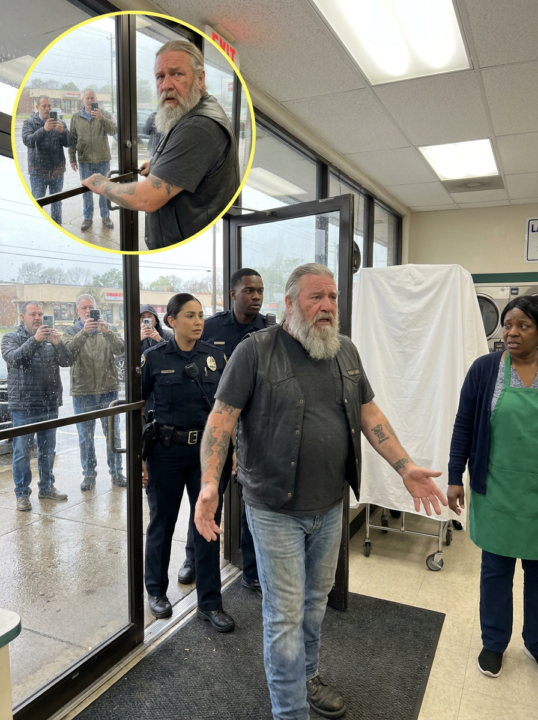
I recognized the biker too. Walt Mercer. Thursday customer. Big gray beard, old Harley, tattooed fingers that always counted his quarters twice. He washed his own work clothes and never left lint in a dryer.
That afternoon, he looked directly through the glass at the people outside, turned the lock, and pulled a rolling laundry rack across their view.
A white sheet hid the back of the room.
Someone said there was a child in there. Someone else said he wasn’t letting anybody through. A third person, already talking to her phone, announced that the police had finally arrived.
I couldn’t see Dana, my employee. I couldn’t see any child.
Two customers I knew were still seated by the dryers. Neither was trying to leave. One held an unfinished crossword, staring over his glasses at the people outside, and that small, ordinary detail didn’t fit the emergency being described beside me.
An officer moved past me and struck the glass with the heel of her hand.
“Police. Open the door.”
Walt’s head came up immediately. He unlocked it and stepped back with both hands open, but the officers entered fast, one moving toward him while the other looked beyond the hanging sheet.
I followed them inside.
The place smelled of wet pavement and hot cotton. Dryer six was still thumping with somebody’s sneakers. On the nearest table sat a small purple backpack, its zipper open, a paper rabbit sticking halfway out.
That backpack didn’t belong to any of my regulars.
“Where’s the child?” the first officer asked.
“In the back with Dana,” Walt said.
“Move away from the door.”
He did. No argument. He stayed beside the change machine, all six feet five of him trying to look smaller without moving suddenly.
Behind us, the woman with the phone took two steps inside.
Walt turned his head. “She doesn’t need to be in here.”
The officer told him she would handle it. His jaw tightened, but he stayed where she’d put him.
I wanted Dana to answer. I wanted someone to tell me why my front window was covered and why a little girl’s shoe was sitting beneath a folding table.
Then the child spoke again.
“Did they put it on there?”
Nobody in the entrance answered.
The woman raised her phone over another person’s shoulder, searching for an angle around the sheet. Walt didn’t touch her. He looked at the officer instead.
“That’s what I was trying to stop.”
It sounded like an explanation with the important part missing.
Dana called from the back, saying she needed a minute. Her voice was steady, but I knew her well enough to hear the effort underneath it.
The officer asked if the girl was hurt.
“No,” Dana said. “She’s with me.”
I went toward them. Walt stayed by the machine, water dripping from the bottom of his vest onto my freshly mopped floor.
He had called me once while I was at the bank. I hadn’t heard it.
Now I wondered what I had missed besides a phone call.
At the back doorway, Dana spoke to the officer quietly. The officer glanced at the purple backpack, then at the people still pressing toward the entrance.
Her expression changed.
Before anyone explained why Walt had turned that lock, the officer faced the crowd, lowered her voice, and gave an instruction nobody outside had expected.
Part 2 — The Mother Who Said She Would Be Right Back
The afternoon began with a washing machine that wouldn’t take quarters and a child trying to flatten the ears on a paper rabbit.
June was seven. I learned her name when her mother called her away from the vending machine, not from anything somebody posted later. Her mother, Megan, had brought two bags of laundry and a purse with a broken strap. She paid for the washers, counted what was left, and asked whether we could make change for a five.
Nothing unusual. Everybody counted money in my place.
Walt was at the next table sorting work shirts. He repaired commercial kitchen equipment, which meant his clothes arrived smelling of old fryer oil and whatever cleaner restaurants used after midnight. He was fifty-eight, broad through the chest, with a gray beard and tattoos that disappeared beneath the collar of his faded shirt.
He rode a Harley when the weather allowed it. He also owned a dented pickup and complained about both vehicles with equal affection.
I knew him as a man who folded towels badly but stacked them straight. Once, when a customer couldn’t afford the last dryer cycle, he’d put in his own quarters and then pretended he’d chosen the wrong machine.
He wasn’t saintly. He got impatient with the card reader, forgot names, and once snapped at Dana over a missing sock before returning with an apology and the sock he’d found inside his sleeve.
“Still my fault,” he’d said when she laughed.
That was why I trusted him around my business. Not because he never got things wrong. Because he came back and said when he had.
Megan told Dana she needed to collect an envelope from a temporary staffing office a short walk away. She said she’d be back before the washers finished. June had a coloring book, and the chair nearest their machines was dry and warm.
Dana answered that the shop would stay open. She did not agree to become a babysitter. Megan seemed to hear the answer she needed anyway.
June asked whether she should go too.
“Stay with the clothes. I’ll be right back.”
Those were the words Dana remembered. She repeated them to the officers later, carefully, without adding a promise nobody had made.
I had been in the supply room and hadn’t heard that exchange. By the time I came out, June was coloring and Megan was gone. I assumed she was using the restroom or fetching something from her car.
That assumption lasted until Dana told me otherwise.
I was preparing the bank deposit. I asked how long she’d been away. Not long yet. We agreed Dana would keep June in sight and find out more if her mother didn’t return soon.
I left my number on the counter, as I always did. An ordinary precaution on an ordinary day.
The weather changed while I was gone. A hard burst of rain struck the windows, turning the parking lot silver. The power blinked without going out, and three dryers stopped long enough for their owners to complain.
Dana reset the machines.
That was when June went to the entrance.
She had seen a woman with a bag on the sidewalk and thought it was her mother. She pushed outside before Dana could reach her. The woman kept walking. June followed a few steps, stepped into water gathering beside the curb, and stood there looking in both directions.
Walt was closer.
He held the door open and called, “Your things are still in here, kiddo.”
He didn’t grab her. Dana came out beside him and offered her hand. June took it and returned with rain dripping from her hair and both shoes soaked.
Everything after that reached me through Dana, Walt, and the officers, because I wasn’t there to see it myself. I won’t pretend I watched what I didn’t.
June started crying near the folding table. Quietly at first, then with the embarrassed effort children make when they’re trying to stop before anyone notices.
Dana asked if she knew a family phone number. June knew the beginning of her mother’s number but mixed up the last digits. There was an emergency contact card in her backpack, Dana discovered after asking permission to look.
She called the mother. No answer.
She called the aunt listed beneath her. That call went to voicemail.
Then she called for help.
By that point, nobody knew exactly where Megan was, how long she’d be gone, or whether something had happened to her. Dana reported a child without her caregiver, gave our address, and stayed where dispatch could reach her.
Walt fetched clean towels from the service counter with Dana’s permission. He asked June whether she’d like to sit on one rather than the cold plastic chair.
She nodded.
A man outside noticed the crying child and stopped under the awning. Another person asked what was wrong. Someone lifted a phone.
Rain had driven people together at the storefronts, and concern began changing shape.
One person wanted to know whether help was coming. Another wanted the girl’s name. A woman asked June to look toward her camera and explain where her mother had gone.
Dana stepped between them.
“She’s not doing an interview.”
Walt stood beside the open door holding an unused towel. He looked from June to the raised phones, then toward the little room behind our counter.
The washers finished their cycles.
Megan still hadn’t come back.
Part 3 — What the Officers Could See
By the time the police entered, two different stories had reached them.
One came from Dana: a young child had been left at the laundromat, her family couldn’t yet be reached, and she needed an adult to help establish what had happened.
The other came from outside: a large man had locked the door, obscured the windows, and kept a child somewhere out of view.
Both callers had described things that existed. Only one had stayed long enough to understand the order.
Officer Ruiz introduced herself after the first rush through the door. She was a compact woman with rain caught along the shoulders of her uniform. Her partner, Officer Grant, went toward Dana’s voice while she asked Walt to step away from the entrance.
He complied.
I told Ruiz I owned the business and that Dana worked for me. She asked whether I knew Walt.
“A customer,” I said. “I’ve known him three years.”
“Were you here when this started?”
“No.”
She nodded and continued asking questions. I was glad later that she hadn’t mistaken my familiarity for a complete account. Knowing someone folds towels on Thursdays doesn’t tell you everything about what happened on a particular Thursday.
The woman filming had come through behind me. Ruiz noticed her phone and told her to wait outside.
“I’m the one who called,” the woman said.
“We’ll speak with you.”
She kept talking. Grant moved a little farther into the aisle, then paused when Dana asked him to wait at the closed rear-room door.
“The girl is safe with me,” she said. “Please give us a moment.”
That request could have sounded suspicious too, from the wrong distance. The whole room had become a collection of gestures waiting for someone to assign them meaning.
Ruiz asked Walt why he’d locked the door.
He looked past her at the woman who had stopped just outside but was still holding her phone toward the entrance.
“I’ll explain,” he said. “Can we do it without her recording the kid?”
“The child is our concern.”
“Mine too.”
His voice was rougher than he intended. Ruiz watched his hands. He noticed and spread his fingers against his thighs, making no sudden movement.
For a moment, I thought his size would keep speaking louder than anything he said.
He had never looked especially large beside our industrial washers. Now, with the officer standing close and three people peering around her shoulder, he seemed to fill the narrow aisle.
I asked Ruiz if I could close the front door against the rain. She agreed, and I did, leaving it unlocked. The people outside could still see the front of the shop, but they could no longer hear every word.
The noise dropped by half.
Walt breathed out.
He explained that two people had followed Dana toward the back while recording. He had asked them to stop. One had backed away, but another kept trying to go around the hanging sheet.
He’d asked the people who weren’t doing laundry to leave. When they did, he’d secured the entrance against anyone coming back in.
“For how long?” Ruiz asked.
“I don’t know. Less than a minute before you knocked.”
“Did you tell anyone they couldn’t leave?”
“No.”
Mr. Abbott, our customer with the crossword, raised one hand from beside dryer four.
“He told us the other exit was clear,” he said. “Asked us to stay up here if we didn’t mind.”
Ruiz looked toward the side exit. Nothing stood in front of it. The laundry rack blocked a sightline, not a walkway.
That didn’t settle the question about June. But it mattered.
Grant called Ruiz toward the rear. Dana was standing just outside the small room now, with the door pulled nearly shut behind her. She said June wanted to know whether strangers could still see through the windows.
I hadn’t heard a child ask that in my business before.
The question seemed to take the air out of Walt.
I moved a folding chair away from the rear doorway so the officers could pass. Under it was one of June’s sneakers. I picked it up by the heel and found it heavy with water.
Dana asked me for the clean socks from our donation shelf.
I knew the shelf she meant. We kept plain clothes there for customers whose washing went wrong or whose belongings hadn’t survived the weather. Walt’s riding club had dropped off part of the last batch.
I fetched a sealed pair without asking Dana why she hadn’t already taken one. There were several things I could have done sooner that afternoon. This one didn’t need a discussion.
Ruiz spoke to June through the door in a normal voice. She gave her name, said she was there to help, and asked whether Dana could stay beside her while they talked.
June said yes.
Then she asked whether her mother would know she had gone outside.
Ruiz said they were trying to find her mother and would explain what had happened.
No promises about what she couldn’t know. No demand that June stop crying before anyone would listen.
At the front window, the woman with the phone changed positions. The glass reflected her face over the white sheet, and for a strange second it looked as though she were standing inside the space Walt had tried to protect.
He saw it too.
He turned toward Ruiz but didn’t move from the machine.
“Could you ask her to lower that?”
This time, Ruiz didn’t answer him immediately. Dana had said something quietly, and the officer was listening.
Her eyes moved toward the clean socks in my hand.
Then toward the wet shoe.
Then to the sheet.
The things we’d been treating as clues began fitting together differently.
Ruiz walked to the entrance, opened it just enough to address the people outside, and stood squarely in the gap.
“The child is with an employee and an officer,” she said. “Give her space.”
The woman protested that people needed to know she was safe.
Ruiz kept her voice level.
“You do not need a picture of her to know that.”
Part 4 — The Reason for the Sheet
Dana told me the whole sequence after June was comfortable and Officer Grant had stepped into the rear room with her permission.
The child had been wet, cold, and embarrassed. Dana had found clean clothes in the donation bins, but June wouldn’t move toward the back because people at the window were pointing their phones at her.
One woman had already come inside and asked her to repeat why she was alone.
“She thought she had to answer,” Dana said.
That was what Walt noticed before the rest of us.
June had pressed the towel against her shoulders and tried to speak clearly for a stranger’s recording. When Dana said she didn’t have to, the woman replied that she was only trying to help.
Dana asked her to stop filming. Walt asked her to step outside.
Neither request worked the first time.
The small room behind our counter had a solid door. June would change there privately, with Dana helping only as needed. No customer could see inside, and nobody was going to open that door to satisfy the people at the window.
But getting there meant crossing the open aisle. June looked at the phones, then at the floor.
She didn’t want another picture.
Walt asked Dana whether he could move the rolling rack. She said yes. He hung a clean sheet over it so June could walk behind it without an audience.
Two people moved to find a better angle.
One stepped around the end of the rack before Walt asked her firmly to leave. Another came through the entrance as soon as the first moved out.
Dana had a child waiting for dry clothes. Walt had a doorway that wouldn’t stay clear.
So he locked the entrance against the crowd, remained beside it, and left the shop’s exit routes unobstructed. When the officers identified themselves, he opened immediately.
He had been keeping the cameras out, not keeping June in.
All the frightening details had been real. The turned lock. The sheet. The child out of view. But the thing they added up to was a little girl’s chance to put on dry clothes without strangers making a record of her worst afternoon.
I looked toward the front window.
One of the people outside lowered his phone. Another continued recording the officer, apparently unwilling to go home without an ending.
Ruiz returned to Walt. Her voice had changed, not into warmth exactly, but into the tone people use when they can finally ask the right questions.
She wanted his account from the beginning. Dana’s too. They would speak to the customers and check what had happened before drawing conclusions.
Walt nodded. He didn’t demand that the first few minutes be erased because the explanation had become clearer.
“You had to find her,” he said.
Ruiz answered that they did.
He glanced toward the rear room. “Just didn’t want them finding a picture.”
I asked whether he needed a towel. His vest was still dripping.
“Later.”
I brought one anyway and set it beside him. He picked it up without looking at me.
June came out wearing a loose green sweatshirt, gray sweatpants, and clean socks. Her damp shoes stayed near the heater, not close enough to damage them. Dana carried her wet clothes in an opaque laundry bag.
That was the first time I saw her after returning from the bank.
She was fully dressed, holding her paper rabbit in one hand. Its ears had begun to dry crooked.
She noticed Walt by the machine.
“Did you get in trouble?”
He looked at Ruiz before answering, careful not to promise more than he knew.
“They’re asking what happened.”
“Because of me?”
“Because grown-ups needed to explain something.”
Dana pulled out a chair behind the service counter, beyond the window’s view. June sat there with juice and crackers while the officers worked on reaching her family.
She didn’t need to stand beside the biker for a photograph. She didn’t need to hug him. She asked if there was tape for her rabbit, and I found some.
Walt finally sat.
The little bandage on his thumb had come from catching it on the edge of a donation carton while looking for clothes. Dana had handed him the first bandage she found. He’d put it on and kept searching.
It wasn’t a wound that required a story. It was just another ordinary thing the cameras had made look mysterious.
Later, after the officers had finished his initial interview, I asked how he’d thought of the sheet so quickly.
He stared at the towel in his hands.
“My sister,” he said.
I waited.
When he was seventeen, a fire had driven his family out of their apartment. His younger sister had been photographed on the sidewalk while she cried, wrapped in something a neighbor had brought her. The picture had appeared in local coverage of the fire.
Nobody had meant to hurt her, Walt said. Some people had even sent money to help.
At school, though, the picture became the thing other children knew first.
“She couldn’t walk into a room without wondering who’d seen it.”
I asked whether she was all right now.
“She runs a hardware store. Argues with suppliers for a living.”
He almost smiled.
But she still didn’t like surprise photographs.
Walt hadn’t been the brother he wished he’d been back then. He’d been angry, embarrassed by their situation, and too busy trying to leave home to notice what she was carrying.
“I told her to ignore it,” he said. “Like that was a useful thing to say.”
He folded the towel once.
Across the room, June was instructing Dana about the correct angle for rabbit ears. She sounded impatient, which I found unexpectedly reassuring.
Walt listened for a moment, then looked back at me.
“This time I had a sheet.”
Part 5 — The Mother at the Door
Finding June’s mother took longer than settling what had happened at the door.
Her aunt, Ruth, returned Dana’s call first. She had been driving a school bus and couldn’t answer until she finished her route. She sounded startled, then frightened, then very careful about every question she asked.
Was June hurt? Was someone with her? Had anybody reached Megan?
Officer Grant took the phone and moved away from the child to speak with her. Dana stayed at the counter, helping June use tape without trapping her fingers in it.
June didn’t have to listen to adults calculate what might have gone wrong.
Ruth said she could come. The officer explained that they would need to confirm who she was and work out the next steps. I heard no shortcuts offered because she sounded kind, and no threats designed to frighten her into arriving faster.
While they spoke, I checked the security system.
Our cameras covered the entrance, register, and machines. There were none in the rear room or restroom. The recording showed Megan leaving, June waiting, and the people gathering outside later. It also showed Walt asking people to step back, the sheet going up, and the brief time between his locking the entrance and opening it for police.
It showed more minutes than the sidewalk video.
I saved the relevant footage for the officers. I didn’t send it to the woman outside. I didn’t post it with a triumphant caption about how wrong everybody had been.
The footage contained a child whose permission no one had asked.
By then, the first clip was already online. One of my regular customers showed me the opening frame: Walt’s hand on the lock, his face behind the glass, the white sheet in the background.
The caption supplied a crime the video couldn’t establish.
I handed the phone back.
Walt’s own phone started vibrating on the table. His riding friends were calling. Somebody recognized the shop. Somebody else had recognized him.
He answered one call and said he was all right.
“No,” he added after listening. “Don’t come down here.”
His voice wasn’t angry. It was tired.
Then Grant came back to say they’d reached Megan.
She hadn’t been in an accident. She hadn’t been taken to a hospital. There wasn’t a hidden emergency that made every decision that afternoon understandable.
She had collected her envelope, been sent to another office over a missing payment, and then boarded a bus toward an errand she did most Thursdays. Somewhere in that chain of frustrations and familiar movements, she had failed to return for June.
When Ruth finally reached her, Megan was several stops away.
She had left her child with an assumption instead of an arrangement, then allowed that assumption to disappear from her attention.
I learned those details from the conversations that followed, not from interrogating her across my counter. The officers needed answers. June needed safety. My curiosity wasn’t another need they had to meet.
Megan arrived before Ruth. She came through the door carrying no groceries, only her purse and a folded envelope damp from the rain.
June saw her and stood.
For one second, the mother looked as though she might run straight to her. Ruiz intercepted gently, explained that June was safe, and asked her to sit nearby while they clarified what had happened.
Megan kept looking at her daughter.
“I thought,” she began.
Then she stopped.
“I left her.”
It was the first useful thing she said.
She apologized to Dana, who answered that they needed to focus on June now. She apologized to me. I told her the officer would explain what happened next.
Nobody told her that being overwhelmed made leaving a seven-year-old alone acceptable. Nobody announced that one afternoon gave us the complete measure of her life.
Both would have been easier than staying with what we actually knew.
June asked whether her mother had seen the rabbit.
Megan looked at it.
“The ears got wet,” June said.
Her mother covered her mouth, then lowered her hand.
“I see.”
There was so much more that needed saying. But the child had offered something small enough to hold, and for once an adult didn’t force her to hold everything else.
Ruth arrived with a driver’s license, a spare jacket, and the expression of someone saving her anger for a room without a child in it. The officers spoke with her and Megan away from the counter.
A child-welfare worker was contacted. Plans were made and checked. The details weren’t mine to announce to customers, then or afterward.
What mattered in my shop was that June would not leave alone, and she wouldn’t be sent out with someone just because that person claimed a connection to her.
Before they left, Ruth asked whether June wanted her wet shoes in the bag.
June looked at Walt.
“Are they ruined?”
He examined them without touching them first.
“Think they’ll dry.”
“Will they be weird?”
“Shoes already are.”
She considered that answer, then put the rabbit in her backpack.
Megan approached Walt as he was gathering his work shirts. She started thanking him, her voice breaking on every other word.
He didn’t dismiss her. He also didn’t turn the moment into a speech about better parenting.
“She’s been watching the door a long time,” he said.
Megan looked toward the counter.
“Go sit with her.”
She did.
Part 6 — The Video That Wouldn’t Leave
By closing time, the sidewalk was empty and the video wasn’t.
That was the part I hadn’t understood about an afternoon becoming content. The real people went home. The small, unfinished version of them kept traveling.
A man called the shop to ask why we employed a kidnapper. Walt wasn’t my employee, and nobody had kidnapped June, but the caller hung up before I finished either sentence.
Another person asked whether the child was available for an interview.
I said no.
Walt came back the next morning for a load he’d forgotten in a dryer. His shirts were wrinkled. He stood there looking at them, then laughed once without much humor.
“All that folding for nothing.”
The officers had completed their conversations at the shop without arresting him. They had his account, Dana’s, the customers’, and the recordings I’d preserved. That didn’t automatically catch up with every copy of the clip.
One commercial client had seen it and asked Walt’s supervisor not to send him until the situation was explained. He didn’t lose his job. He did lose a service call he had counted on, and he hated having to stand in an office while someone looked from his face to a phone.
His riding club met that evening.
Walt invited me because several members wanted to organize something for the shop, and he didn’t want promises made on my behalf. We sat around folding tables in a garage that smelled of coffee and chain lubricant.
One man wanted me to release the entire security recording.
“Let people see what actually happened.”
I understood him. I had watched strangers accuse his friend of something monstrous. I wanted the easy correction too.
Then Walt asked whether June appeared in the footage.
“Yes,” I said.
“Then not the whole thing.”
The man frowned. He wasn’t cruel. He was angry on behalf of someone he loved, and anger had made the simplest solution look like the right one.
“We can clear your name.”
“Not by putting hers in more places.”
Another member asked whether a version without the child could be prepared. We discussed sharing only what was necessary, removing identifying details, and letting the officers handle the records they already had.
Nobody needed to see the rear room. Nobody needed June’s name, her mother’s workplace, or her aunt’s address.
Protecting Walt didn’t require exposing June.
The club put out a brief statement about their member cooperating with police. I posted a plain account from the business: we had helped a child, staff were present, and there had been no hostage situation.
I didn’t post her photograph.
Some people corrected themselves. One man who had been at the window came in to apologize to Dana, not to a camera. He said he’d thought recording would help prove what happened.
Dana asked him what he would have done if he’d put the phone down.
He stood thinking.
“Asked what you needed.”
She nodded.
There wasn’t much else to say.
The woman who had narrated from our doorway never came back. Her original post disappeared, though copies remained. I couldn’t promise June’s family that the internet had forgotten. I could only stop my business from adding another version.
Walt was quieter for a while.
He told me once that the hardest part wasn’t the strangers. It was explaining to his adult daughter why people were sending her the clip. She knew him, but she still had to see it.
Doing the right thing had not made the week painless.
His friends helped with that in ways nobody filmed. One rode with him to a job out of town. Another brought dinner. The man who’d wanted all the footage released called to apologize and stayed long enough to help change a tire.
They also asked what the laundromat actually needed.
Dana said a better arrangement for privacy.
We moved the donation shelf closer to the counter, stocked sealed socks and plain clothes in several sizes, and installed an opaque screen that could be positioned without narrowing an exit. I replaced the broken shade on the rear-room window and reviewed the layout with the people who maintained the building.
Walt helped assemble the screen.
No plaque. No child’s name painted across it. Just a sturdy frame that didn’t wobble when a laundry cart rolled past.
I paid for the hardware. His club supplied the clothes. Dana made sure the bins were easy to open.
We made the next ordinary act of help less difficult.
When the work was done, Walt stepped back and tested the screen with one finger.
“Better,” he said.
Then he went to dryer six and put in his quarters.
Part 7 — A Rabbit Nobody Needed to Photograph
June returned six weeks later with Ruth and her mother.
I won’t explain the family arrangements that brought them through my door together. There were adults doing work I wasn’t part of, appointments I didn’t attend, and decisions that didn’t belong in a laundromat conversation.
Megan had called ahead to ask when the shop was quiet. She wanted to pay for the clothes Dana had given June.
I told her there was no bill.
She brought a package of new socks anyway. I accepted it without announcing what the gesture meant. Sometimes socks were the right size for an apology; sometimes they were simply socks another person would need.
We put them on the shelf.
June wore dry sneakers and a yellow jacket. She paused when the bell above the entrance rang, then looked toward the windows.
The new screen stood folded beside the counter.
“Is that for laundry?” she asked.
“Sometimes,” Dana said. “Sometimes for somebody who needs a little space.”
June nodded. She didn’t tell us whether she remembered the old sheet.
Walt was there by coincidence, which is how most of the important things in my shop happened. He had a newspaper spread beside his basket and a pair of reading glasses halfway down his nose.
June noticed him before he noticed her.
“Your beard’s still big.”
He looked up.
“Been trying to negotiate with it.”
She smiled.
There was no running embrace. She stood beside Ruth until she decided to walk closer. Walt stayed in his chair and let her choose the distance.
He didn’t ask if she remembered what he’d done.
She had brought something in her backpack: a new paper rabbit, this one made from stiff green paper. The ears were even. On the back, she had drawn a washing machine with four tiny circles inside.
“For here,” she said, handing it to Dana.
Dana asked where she’d like it put.
June chose the shelf behind the counter, away from the front window.
We put it there.
Megan watched without interrupting. When June asked to use the restroom, her mother stood immediately and walked with her. Ruth waited by the folding table.
It wasn’t proof of everything being fixed. It was one attentive moment. I was glad to see it without asking it to stand for a whole future.
Walt took off his glasses.
“Good shoes,” he said when June returned.
“They’re the same shoes.”
“Thought they looked familiar.”
“They dried.”
He nodded gravely, as though she’d just delivered the result of an important experiment.
While Megan and Ruth talked with Dana, June asked me whether people could make pictures leave a phone.
I didn’t tell her yes.
I said we weren’t sharing pictures of her, and the adults helping her family knew about what had happened. She could ask them anything she needed to know.
She turned a zipper pull between her fingers.
“Do they know my rabbit?”
I looked toward the shelf.
“Not unless you show them.”
She seemed to like that.
Something still belonged only to her.
After they left, Dana returned to folding a customer’s sheets. Walt checked his dryer. I entered the sock donation in our stock notebook without attaching a family history to it.
The new rabbit leaned against a box of detergent behind the counter. Most customers never noticed it. Nobody asked us to bring it closer to the window.
Near dusk, a teenager came in with a basket balanced on one hip and asked whether there was somewhere private to change out of a wet work shirt.
Dana pointed toward the back.
Walt looked up from his newspaper, then went back to reading. I moved the screen into place.
The door stayed open.
The bell rang for the next customer.
Follow our page for more biker stories about people who quietly protect someone’s dignity, even when the world mistakes their kindness for something else.