Police Pinned a Biker Against a Hospital Wall After He Threw a Woman’s Phone—Then a Little Girl Asked What Would Happen to the Video
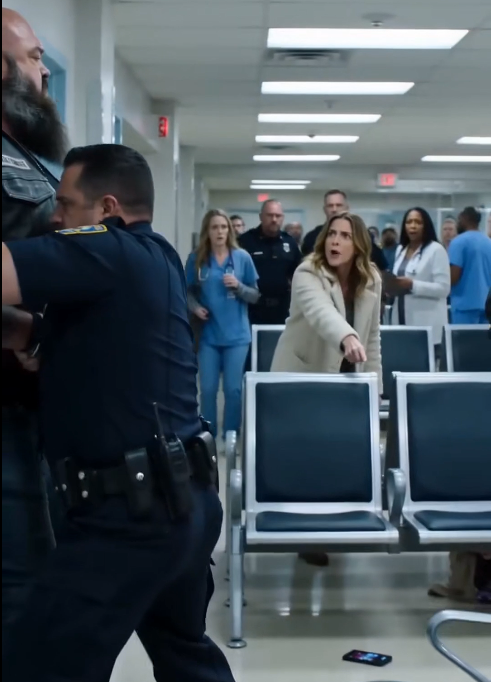
The officer had my wrist twisted behind my back when the woman shouted that I had attacked her, but the little girl hiding beneath the hospital chairs asked a question that made his partner stop reaching for her radio.
“Did he make it stop?”
Nobody answered her. The woman was pointing at her phone, which lay facedown beneath an empty row of chairs. One corner of the case had split. My right shoulder was pressed against the wall beside a framed watercolor of a lake, and somebody behind me kept telling everyone to calm down.
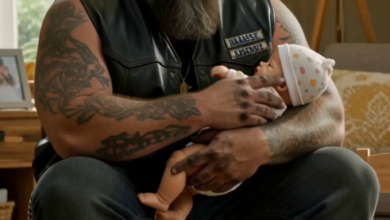
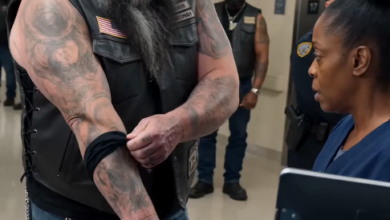
My name is Ray Dawson. I was fifty-six that winter, six-foot-four, almost two hundred eighty-five pounds, with a shaved head, a black-and-gray beard, and forearms that made strangers change checkout lines. I repaired diesel trucks outside Knoxville. On weekends, I rode a black Harley with men who had known me long enough to recognize when my silence meant trouble.
That afternoon, I had come to the hospital carrying clean socks for a friend.
Now a police officer was telling me not to move while a woman in a cream-colored coat demanded that somebody arrest me. Her voice carried over the television, the elevator chime, and the rubber squeak of a wheelchair passing through the doors.
“He ripped it right out of my hand.”
That part was true.
“He threw it.”
That was true, too.
The little girl was still under the chairs.
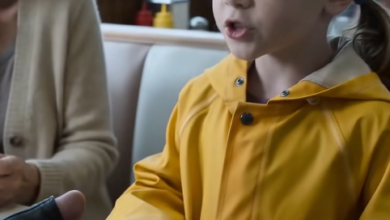
She wore purple sneakers with one lace dragging, a sweatshirt with a peeling silver moon, and a hospital bracelet that looked too large for her wrist. Her hands were clamped over her ears. A blue paper pinwheel lay beside her shoe, crushed flat where somebody had stepped on it.
I kept looking at the pinwheel.
“Sir, face forward,” the officer said.
“There’s a kid under there.”
“We see her.”
“Then somebody needs to get down.”
A nurse already was. She knelt slowly, leaving space between herself and the chairs, and spoke in a voice too quiet for me to hear. The child shook her head. Her eyes found mine through the metal chair legs, then dropped to the officer’s hand gripping my arm.
The woman saw that, too.
“Look what you did,” she told me. “You scared her half to death.”
I had spent most of my life being judged before I opened my mouth. Usually, I could live with it. A man shaped like me learns to hold doors from farther away and keep his hands visible when asking a stranger for directions.
But that sentence nearly pulled me off the wall.
The officer felt me tighten.
“Don’t.”
I stopped. The nurse looked up, and something in her expression warned me that the child needed one fewer loud adult, not another.
So I stood still.
The waiting area smelled of burnt coffee and disinfectant. My vest creaked every time I breathed. In my inside pocket, beneath my wallet, was a folded piece of paper I had carried for eleven years without showing anyone.
I could feel its edge against my ribs.
The woman began explaining herself to the second officer. She said she was helping. She said people needed to see what families went through. She said her followers cared.
Followers.
That word reached the little girl. Her shoulders climbed toward her ears.
“Please,” she said.
The nurse moved a portable screen between the chairs and the room. For the first time since I had entered, the child disappeared from everybody’s view.
My knees almost gave.
An older woman came through the treatment doors carrying a pink backpack and a clear bag of clothes. She saw the screen, the officers, and me against the wall. Then she looked at the woman in the cream coat.
“You promised me,” she said.
The woman stopped talking.
I watched the older woman set the backpack down with both hands, carefully, as if dropping it might break whatever she was still holding together.
Then she turned toward the officers and said, “Before you decide who frightened my granddaughter, you need to know why that woman was invited here.”
Part 2 — What Happened Before the Phone Hit the Floor
Twenty minutes earlier, I had been arguing with Boone about socks.
He had been in the hospital for two days after a procedure, and his wife had asked me to bring the bag he left on their kitchen table. Boone insisted the gray socks weren’t his. I told him that if he expected a fashion consultation, he needed a better friend.
He laughed, then winced and told me not to make him laugh.
It was an ordinary visit. I remember that because afterward people wanted the afternoon to have begun with some kind of warning. It began with socks, a parking ticket machine that wouldn’t read my card, and Boone asking whether the shop had finished his truck.
I left his room carrying an empty coffee cup.
Near the ground-floor elevators, I heard a child say, “Please don’t show that.”
There was a small family waiting area beside a corridor leading toward the emergency department. A woman in a cream coat stood near the chairs, holding her phone upright. The little girl sat beside an older woman who was speaking with a staff member.
At first, I thought the phone was a video call.
Then I heard the woman say, “For everybody just joining us, this is what the family has been dealing with.”
The older woman followed the staff member a short distance toward the doors. Before leaving, she touched the child’s shoulder and said she would be right back. The woman with the phone moved into the space she had left.
The girl turned her face toward the chair.
“Sweetheart, people want to help,” the woman said.
The child pulled her hood forward.
I slowed beside a vending machine. I didn’t know their relationship. The woman could have been her mother, aunt, somebody with every reason to be standing there. But the girl was sliding away from the phone, and the woman kept adjusting her arm to keep the child’s face in view.
“Give her a minute,” I said.
The woman glanced at me and kept talking to the screen.
“She’s overwhelmed right now. Her grandmother is trying to hold everything together, and we’re showing you the reality.”
The girl pressed both hands over her ears.
I stepped closer, keeping my palms open. “She asked you to stop.”
“This is a family situation.”
“Then let her breathe.”
A few people looked up. The woman turned the phone slightly, bringing me into whatever frame she was showing. I could see movement on the screen and little lines of text rising along one side.
“She has support,” the woman told her audience. “Unfortunately, some people don’t understand what we’re trying to do.”
I looked toward the desk and raised a hand. A clerk was helping someone in a wheelchair. She saw me and started to stand, but the woman had already crouched closer to the child.
The girl’s breathing had become fast and shallow. Her purple shoe scraped against the floor as she tried to get farther away.
“Please,” she said again. “I don’t want them.”
That was the sentence I heard.
Not a speech about privacy. Not a debate about whether somebody had meant well. A child saying she did not want strangers watching while she couldn’t get herself back together.
I stepped between them.
The woman stood and moved sideways.
“Sir, you are interfering.”
“Put it down.”
She lifted the phone higher, trying to film over my shoulder. I shifted with her. The clerk was coming around the desk now, calling toward somebody farther down the hall.
For perhaps two seconds, I did the useful thing. I stood there. I blocked the camera. Help was coming.
Then the girl slid off the chair, folded herself underneath it, and the woman lowered the phone to follow.
I reached.
I took it from her hand and threw it under the empty chairs across the aisle. It hit a metal leg before landing. The sound was sharp enough to turn every head in the room.
I wish I could tell you I calculated the direction and distance. I didn’t. I knew there was nobody sitting there, and I wanted the thing away from her. That was the whole thought.
The woman screamed.
Two officers who had been near the emergency entrance came through the corridor. One saw a large man in leather standing over a woman with an empty hand. He moved quickly. I started explaining while still pointing toward the child, and he told me to put my hands behind my back.
I did not do it fast enough.
That was how I ended up against the watercolor lake.
Later, people would call the throw brave. Some would call it necessary. The version they liked had a clean beginning and a satisfying sound at the end.
The child had heard that sound, too.
I had stopped one frightening thing by adding another.
Standing against the wall, I could see her watching me. I recognized the look because I had seen it eleven years earlier across my own kitchen.
My daughter, Emily, had been fourteen then. I had been sober for years, working steadily, proud of how far I had come from the man who lost whole weekends and made promises he couldn’t remember.
I thought being a better father meant I had become a safe one.
Then Emily had a terrible afternoon, and I put a camera in her face because I thought I could make her see how unreasonable she was being.
The folded paper in my vest came from the morning after.
I had carried it longer than I had carried that vest.
And until the little girl disappeared beneath those hospital chairs, I had managed to call it an old mistake.
Part 3 — The Woman Who Said She Was Helping
The grandmother’s name was Lorraine Mercer. The girl was eight. I would learn her name later, when Lorraine chose to tell me, but that afternoon she was simply a child behind a portable screen, trying to trust the nurse beside her.
Lorraine faced the woman in the cream coat.
“I said you could explain what happened. I did not say you could show her like that.”
“You knew I was going live.”
“You said outside. With me.”
The second officer asked them to lower their voices and speak separately. He wasn’t dismissing Lorraine. He was trying to pull a usable account out of a room full of people answering questions nobody had asked them.
The first officer loosened his grip slightly.
“Are you going to stay calm?”
“Yes.”
“Then turn around slowly.”
He kept me apart from the others while another staff member collected the phone. The woman insisted on seeing the damage. Lorraine kept looking toward the screen.
Everybody wanted something returned.
The woman wanted her property. Lorraine wanted the afternoon before the phone came out. I wanted the last thirty seconds back, so I could keep standing between the camera and the child until the clerk reached us.
Only one of those things was possible.
The nurse emerged long enough to speak with an officer. She had heard the girl asking for the recording to stop. The clerk had, too. Neither pretended to have seen every second.
The officers took names.
Nobody applauded. Nobody announced that I was a hero. I was asked whether I had taken the phone and whether I had thrown it. I answered yes both times.
Then the girl called from behind the screen.
“Grandma?”
Lorraine went immediately.
The woman in the cream coat stood beside the desk, rubbing the bare space where her phone had been. She looked younger now that she wasn’t addressing an audience. Late thirties, maybe. Tired around the eyes. Angry, embarrassed, still certain she had been wronged.
“I was raising money for them,” she said to nobody in particular.
Her name was Vanessa Cole. She ran a local social media page featuring struggling families, community drives, and people she described as everyday miracles. Lorraine had met her through a neighbor after her daughter, Claire, was injured in a car accident.
Claire was the little girl’s mother.
The family had lost income. Lorraine was missing shifts at the grocery store. Vanessa had helped organize meals and collect donations. That was why she was at the hospital. That was why Lorraine had trusted her to sit with the child for a few minutes.
She had been invited as help.
That detail complicated things in a way the short video never would.
Vanessa hadn’t wandered in searching for a stranger to exploit. She knew the family’s names. She knew which bills frightened Lorraine. She had brought groceries to their apartment.
And when the girl began to struggle, she kept filming.
“It helps people understand,” she told the officer.
He wrote something down. “What did the child ask you?”
Vanessa looked toward the screen.
“I already explained that she was overwhelmed.”
“What did she ask?”
For once, Vanessa had no speech ready.
I waited on a chair by the wall until the officers were finished with me. They told me how I would receive further information about the incident. I left with paperwork, a sore shoulder, and no belief that good intentions had erased what I had done.
Outside, my Harley sat where I had parked it, black tank shining under the garage lights. I put my helmet on the seat and called Boone’s wife.
“Got held up,” I said. “He got his socks.”
She heard something in my voice and asked whether I was all right.
“I will be.”
Before I could leave, Lorraine came through the sliding doors. She had the pink backpack over one shoulder and looked around until she found me.
“The nurse said you were still here.”
“How’s she doing?”
“She’s with someone inside. Better than she was.”
Lorraine stopped beside the motorcycle. For a moment, we stood listening to a shuttle bus idle at the curb.
“I don’t know whether to thank you or yell at you,” she said.
“You can do both.”
She nodded, accepting that.
Then she told me the child’s name was Lucy.
“She thinks she got you arrested.”
“You tell her she didn’t.”
“I did.”
“Tell her again.”
Lorraine rubbed the bridge of her nose. “She’s been asking everybody not to film her. Ever since the accident. Vanessa said people needed to see that she was getting through it.”
I looked down at my gloves.
“Was that helping?”
Lorraine gave a small, worn-out laugh. “There was rent money in it, Ray. Groceries. People saying nice things. I kept thinking we could take the help without taking the rest.”
She had been trying to keep the lights on.
I gave her the shop number and told her she could reach me there if the officers needed anything else. She thanked me for listening, then turned back toward the doors.
Halfway there, she stopped.
“Throwing it didn’t stop it, did it?”
I knew what she meant.
Somewhere, people had already watched. Somebody might have recorded the stream. The phone hitting the floor hadn’t reached into their houses and taken it back.
“No,” I said.
Lorraine stood still for a moment, then went inside.
By the time I reached the shop, a seventeen-second clip of me throwing the phone was waiting on three different men’s screens.
Part 4 — The Video That Would Clear My Name
The clip began with my hand already moving.
There was no child asking anyone to stop. No woman circling around my shoulder. No clerk leaving the desk. Just me taking a phone, throwing it, and turning as two officers approached.
The caption called me a violent biker who attacked a woman helping a family.
Travis, our youngest club member, held his phone out before I had taken off my gloves.
“We need to answer this.”
Inside the shop, the compressor kicked on. Somebody shut the office door so we could hear ourselves. On the other side of the glass, a customer stood beside his truck, pretending not to watch.
Boone called from his hospital room.
“Tell me what happened.”
I told him.
He listened, then said, “That throw was stupid.”
“I know.”
“What happened before it?”
I told him that, too.
He went quiet for several seconds.
“All right,” he said. “Now we work out what can be fixed.”
By morning, the clip had reached people beyond Knoxville. Two customers canceled appointments. A parts representative called to ask whether the man in the video was me. Somebody left a message saying men like us shouldn’t be allowed near children.
Travis wanted to post the whole story.
Marlene, who kept our club’s books and most of our common sense, asked whether Lorraine wanted her granddaughter discussed by thousands more strangers.
“We can blur her face,” Travis said.
“Can you blur what she sounds like?” Marlene asked.
He looked at me.
I understood why he was angry.
Travis worked at my shop. So did Luis and a mechanic with a new baby at home. If customers stopped coming, my decision wouldn’t land only on me. The club had a spring fundraiser approaching, and one business had already asked to remove its name from the flyer.
Protecting Lucy had become easy to say and expensive to keep saying.
That afternoon, Vanessa posted a longer statement. She said she had been documenting a family’s needs when an unstable man interfered. She did not name Lucy in that statement, but she linked back to earlier posts that did.
The comments divided themselves into teams.
A woman I had never met wrote that she had saved the original livestream. She sent it to the shop account, along with a message saying it proved I had been protecting the girl.
Travis downloaded it before I knew it had arrived.
“Ray,” he called from the office. “We’ve got it.”
I stood behind him while the video played.
There was Lucy, turning away.
There was her small voice.
There was me, telling Vanessa to lower the phone.
Then the camera moved closer, and Lucy’s breathing changed.
The proof was everything she wanted hidden.
Travis paused it on the frame before I reached for the phone.
“We show this, and it’s over.”
He meant the accusations. The canceled appointments. The strangers calling the shop. He meant that people would understand me.
I looked at Lucy’s face frozen on the screen.
Then I asked him to close it.
“Ray.”
“Close it.”
He swiveled in the chair. “They’re calling you dangerous.”
“I heard.”
“Luis heard, too. His wife heard. My mother called me asking if she should be worried about where I work.”
I had no answer that would make his fear foolish. It wasn’t.
Marlene stood in the doorway with her arms folded.
“We can keep the file for the people handling the incident,” she said. “That’s different from posting it.”
Travis looked between us.
“So he just takes it?”
“For now,” I said.
He pushed back from the desk hard enough that the chair hit a cabinet.
“You don’t get to decide everybody else takes it with you.”
He walked out.
The door didn’t slam. That almost made it worse.
I sat down where he had been. On the screen, the closed video had left a small square thumbnail. I turned the monitor off.
For several minutes, Marlene said nothing.
Then she asked, “What’s the paper?”
I looked at her.
“You’ve touched your pocket six times since you got here.”
I took it out.
The creases were soft from years of opening and refolding. There were only four lines, written in the rounded handwriting Emily had used before she started making her letters narrow and sharp.
Dad,
I knew I was being difficult.
I didn’t know you wanted other people to watch.
Please don’t send it again.
Marlene read it without taking it from my hand.
“What happened?”
I told her about Emily at fourteen, sitting on our kitchen floor after a school day that had gone badly in ways she couldn’t explain. I had demanded answers. She had covered her ears. I thought she was ignoring me.
So I recorded her.
Then I sent the video to our family group with a message asking if anybody else knew how to handle a teenager acting like that.
My sister forwarded it to somebody she trusted. A cousin showed another cousin. By Monday, Emily knew classmates had seen it.
I deleted my copy.
I thought deletion was the apology.
“What did you tell her?” Marlene asked.
“That I wasn’t trying to hurt her.”
“And?”
I looked at the paper.
That had been most of it.
I had spent eleven years keeping evidence that my daughter was hurt, while still defending the man who hurt her.
Marlene pulled another chair over.
“Does she know about the hospital?”
“I haven’t called.”
“Then she’s probably finding out from strangers.”
I took out my phone, but before I could open Emily’s number, a message appeared.
It was from her.
Please don’t post the girl to prove you’re good.
Part 5 — The Person I Had to Call
Emily answered on the fifth ring.
She lived two hours away and worked in a school office. We spoke on birthdays, exchanged photographs of ordinary things, and had developed the kind of relationship in which neither person asked questions likely to ruin an otherwise pleasant conversation.
“Hi, Dad.”
“Hi.”
I could hear dishes moving on her end. Then the sound stopped.
“I’m not posting it,” I said.
“All right.”
“I wanted you to hear that from me.”
“Thank you.”
There was enough distance in those two words to fit eleven years.
I looked at the folded note on the desk.
“I still have what you wrote.”
Emily said nothing.
“The morning after. I kept it.”
“Why?”
The question caught me. I had imagined she might be relieved, or moved, or at least surprised that the paper still existed.
“I didn’t want to forget.”
“You remembered it happened,” she said. “That isn’t the part I needed.”
Outside the office, somebody started a truck. The engine rattled briefly before settling. I watched the vibration move a loose washer across the desk.
There was nowhere useful to put my hands.
“I made you into a problem for people to look at,” I said.
Her breathing changed.
I kept going before I could retreat into explanations.
“You were fourteen. You needed your dad. I wanted witnesses that I had a difficult kid.”
“Yeah,” she said quietly.
“I’m sorry.”
This time, I stopped there.
I did not tell her I had been tired. I did not bring up the bills, the hours at the shop, or how little I understood what was happening to her. All those things were true. None belonged between the apology and the person hearing it.
After a while, Emily asked about Lucy.
I told her only what was mine to tell: that a child had asked for a camera to stop, that I had taken and thrown the phone, and that I was dealing with what came after.
“Did you scare her?”
“Yes.”
“Are you going to tell her that?”
“If her grandmother wants me to.”
Emily went quiet again. Then she said, “Good.”
It wasn’t forgiveness. It was the first conversation we had finished without moving carefully around that kitchen floor.
Two days later, Lorraine called the shop.
Lucy had asked whether the police still had me. Lorraine had explained that they didn’t, but the girl wanted to hear my voice. She also wanted to know if I was angry with her.
We arranged a short visit in a hospital family room, with Lorraine and a staff member present. Claire was still receiving care, and Lucy was spending part of each day with relatives while her grandmother managed everything else.
I left the vest in my truck.
Then I went back for it.
I didn’t want to walk in looking like a different man and pretend the one Lucy remembered had disappeared.
She sat at a table with markers spread in front of her. The crushed blue pinwheel was beside a cup of water.
“Grandma said you fix things,” she said.
“Trucks, mostly.”
She nudged the pinwheel toward me.
I looked at it without touching it. “Want me to try?”
She nodded.
The paper was torn near the center. I could straighten some folds, but I couldn’t make it new. I told her that before starting.
Lucy watched my hands.
“Did they put you in jail?”
“No.”
“Were they going to?”
“They needed to find out what happened.”
“Because of me?”
“Because I threw somebody’s phone.”
She pressed a marker cap into the table.
“But I said stop.”
“You did. You were right to say it.”
Lorraine’s eyes filled. She turned slightly toward the window.
I set the pinwheel down.
“I should have kept standing in front of the camera until the people at the desk got there. Throwing it made a loud noise. I’m sorry I scared you.”
Lucy considered that.
“I thought you were going to throw the chairs.”
The sentence went through me cleanly.
“No,” I said. “But you didn’t know that.”
She shook her head.
For a moment, I could see myself the way she had: enormous, angry, suddenly moving, followed by uniforms and shouting. My reason hadn’t made my body smaller.
I waited while she colored a square on her paper.
Then she asked the question Lorraine had already asked outside.
“Are they still watching me?”
I wanted to promise they weren’t.
Instead, I told her that the grown-ups were asking for the video to be taken down, and that I was not going to put it anywhere.
“Not even to tell them?”
“Not even then.”
She picked up the pinwheel and gave it a small blow. One bent blade moved.
“It used to go fast.”
“I believe you.”
She put it beside her markers, keeping it.
On my way out, Lorraine walked me to the door. She told me Vanessa had removed the original stream, but other copies remained. The family was receiving messages offering help, demanding explanations, and asking for an update about Lucy.
“They keep saying they care,” Lorraine said. “Then they ask to see her.”
She looked more tired than angry.
Later that afternoon, Vanessa requested a meeting through Lorraine. Lorraine did not want to attend. She said I could hear whatever Vanessa had to say as long as I did not speak for the family.
We met in a coffee shop.
Vanessa put her replacement phone facedown between us.
“I’ve gotten threats,” she said.
“I don’t want that.”
“Your people are doing it.”
“I’ll tell the people I know to stop. I won’t send anybody after you.”
She studied me, perhaps waiting for a condition.
There wasn’t one.
“I helped them,” she said eventually.
“I know.”
“People weren’t paying attention before.”
I looked at the phone.
“Lucy was paying attention. She told you.”
Vanessa’s eyes dropped. For the first time, she didn’t answer with what the audience needed.
She said, “I heard her.”
Part 6 — What We Could Do Without a Camera
Vanessa did not become a different person across that coffee-shop table.
She still explained how much work her page required. She still mentioned families who had thanked her. At one point, she asked whether I understood how quickly people stopped donating when there were no updates.
I told her I repaired trucks. I didn’t know her business.
But I knew Lucy had gone under a chair.
That brought us back to the part she kept trying to move around.
“I thought if they saw how hard it was,” she said, “they’d stay involved.”
“Then you kept going after she asked.”
“Yes.”
It was a small word. She had taken a long time to reach it.
Vanessa agreed to post a correction without showing Lucy or linking to the family’s older videos. She would ask people who had copied the stream to remove it. Lorraine would decide what contact, if any, continued between them.
There was no photograph of us shaking hands.
When I left, Vanessa was still sitting with her coffee untouched.
The correction helped some. It did not catch up with every version of the first clip. People who had been certain I was dangerous became certain I was a saint, which was another thing I couldn’t use.
Marlene helped me write a short statement. It said I had thrown the phone, that the incident was being handled, and that nobody should contact or harass the woman. It asked people to stop sharing footage of the child, including footage meant to defend me.
We did not attach proof.
At the shop, Travis barely spoke to me for two days.
Then I asked him to stay after closing. I told him he had been right about something: I had made a decision in a hospital, and other people were paying for it.
“I should’ve said that sooner.”
He leaned against a workbench.
“I wasn’t saying put the kid out there forever.”
“I know.”
“I just wanted them to stop calling.”
“I know that, too.”
We went through the schedule together. I showed him what the shop could cover if more customers canceled. I cut a planned purchase before anybody lost hours. None of that made the uncertainty disappear, but it made it something he could inspect.
He deserved more than a speech about doing right.
A week later, he came into the office holding his phone.
“A customer posted a picture of me working on her truck,” he said. “Kid’s in the back seat. You can see his school shirt.”
“What do you want to do?”
“Ask her to use the other picture.”
He shrugged as if the decision bored him.
I let it.
The club’s help for Lorraine began with a list she wrote on the back of an envelope. Grocery pickup. Two rides. Someone to look at a kitchen drawer that kept falling off its track.
Luis fixed the drawer. Marlene handled the grocery run. Travis drove Lorraine home one evening and spent twenty minutes finding the pair of slippers Claire wanted because nobody had explained that three nearly identical pairs existed.
He complained about that for a month.
Lucy never appeared beside a donation bucket. Nobody asked her to stand next to our motorcycles. When club members wanted to know how she was doing, the answer depended on what Lorraine had said we could share.
Sometimes the answer was simply, “They got through today.”
The matter over the damaged phone took longer than the online audience stayed interested. I answered calls, kept appointments, and paid the agreed cost of replacing what I had broken. There was no ceremony when the paperwork ended.
My shoulder healed first.
Claire came home gradually, with help arranged around the things she could manage and the things she couldn’t yet. Lorraine returned to more shifts. Lucy went back to routines that had nothing to do with hospital corridors.
Some days were easier.
Some days, Lorraine called to cancel a visit because Lucy didn’t want anyone around. We said all right. The first time that happened, she spent several minutes apologizing.
By the fourth time, she simply said they needed a quiet afternoon.
That felt like progress.
Emily and I began talking on Sunday evenings. Not always for long. She told me about a broken copier at work, and I told her Boone had finally admitted the gray socks were his.
One night, she asked whether I still had copies of the old kitchen video anywhere.
I checked what I could check. I contacted the relatives I had sent it to and asked them to delete any copy they still had, without forwarding it back to me. I told Emily what I had done and what I could not be certain about.
She thanked me.
Then she changed the subject.
I let her choose the next one.
Part 7 — The Picture She Asked For
In April, Lorraine brought Lucy and Claire to the shop on a Saturday after we closed.
Lucy had asked to see where I worked. Claire wanted to thank the men who had kept showing up with groceries and rides, though Marlene warned her that thanking them too formally would make them behave strangely.
She was right.
Luis suddenly needed to check something in a toolbox. Travis went looking for drinks we already had. Boone stood beside his truck and claimed he hadn’t done much, which was true enough to make everyone laugh.
Lucy carried a small cardboard box.
Inside was the blue pinwheel.
It looked better than it had in the hospital. Someone had repaired the tear with a tiny piece of clear tape and straightened the paper carefully. One blade still leaned farther back than the others.
“Mom fixed the middle,” Lucy told me.
“Good work.”
“She says it won’t be perfect.”
“It still turn?”
Lucy blew on it.
The blades made half a circle, stopped, then spun when she tried again.
She smiled at the second try.
We walked around the shop together. I showed her a wheel taller than her waist, the cabinet where we kept clean rags, and the little refrigerator Boone pretended nobody knew he stocked with orange soda.
She asked why the floor had stains if we cleaned it.
“Some things take more than once,” I said.
She accepted that more easily than I would have at her age.
Outside, the Harley sat near the office door. Lucy wanted to look at it, so I stayed beside her while she examined the wide seat and the reflections in the tank. The engine was off and cool. She touched one handlebar grip after asking.
“Is it loud?”
“Pretty loud.”
“Don’t start it yet.”
“All right.”
Behind us, Claire and Lorraine were talking with Marlene beneath the open garage door. Travis had finally found paper cups. The afternoon smelled of cut grass from the business next door and the faint oil smell that never completely left my clothes.
Lucy looked up at me.
“Can I sit on it?”
I asked Claire. Then I steadied Lucy on the seat while her mother stood on the other side.
She placed both hands on the grips, barely reaching.
For a few seconds, she looked down at the tank. Then she lifted her head.
“Mom, take a picture.”
The whole yard seemed to pause, though perhaps that was only me.
Claire took out her phone.
“Just for us?” she asked.
Lucy nodded. “And Grandma.”
Claire held it up, then lowered it slightly.
“Ready?”
“Wait.”
Claire waited.
Lucy straightened the pinwheel, which she had tucked into the pocket of her overalls. She looked at me and pointed to the space beside the motorcycle.
“You have to be in it.”
I crouched, my knee complaining. Lucy leaned one elbow against my shoulder.
“All right,” she said.
Claire took the picture.
Then she walked over and showed Lucy the screen. The girl studied it closely, checking her own face first and mine second.
“You look serious,” she told me.
“That’s my face.”
She laughed.
Claire asked whether she wanted another one.
Lucy shook her head. “That one’s mine.”
No one corrected her.
A little later, after they left, my phone buzzed. Claire had sent the photograph with a message saying Lucy wanted me to have a copy.
I saved it.
I did not post it to explain the hospital. I did not send it to customers who had canceled, or strangers who still thought they knew me. I didn’t place it beside a story about what kind of man I was.
On Monday, I printed it small enough to fit inside my locker.
The old note from Emily stayed in my vest. The photograph went behind the locker door, where I would see it when I arrived and when I put my gloves away.
In it, Lucy was sitting on a motorcycle that hadn’t made a sound, holding a repaired pinwheel against her chest.
Nobody was asking her to be brave.
That evening, Emily called while I was closing.
“How was your weekend?”
I told her Lucy had visited the shop.
“Did she like the bike?”
“I think so.”
“That’s good.”
I looked at the photograph before closing the locker.
“She asked for a picture.”
Emily was quiet for a moment.
Then she said, “I’m glad she got to ask.”
Outside, the streetlights were coming on. I put my phone in my pocket, locked the office, and walked toward the Harley.
Before starting it, I checked the sidewalk.
Then I waited for the family to pass.
Follow our page for more biker stories about family, second chances, and the quiet choices that matter after everyone stops watching.