Part 2: Only One Tattooed Biker Showed Up At A Lonely Vietnam Veteran’s Funeral. Then 300 Motorcycles Shook The Cemetery, And When The “Absent” Son Arrived To Claim Everything, The Will Named The Biker Instead.
Part 2 — Where Were You
Curtis stepped back from the casket like the dog had bitten him.
“Great. The dog’s senile too.” He turned to the funeral director, a young man from Hopkins Funeral Home who looked like he wanted to disappear into the grass. “After the service, that animal goes to the county shelter. Today.”
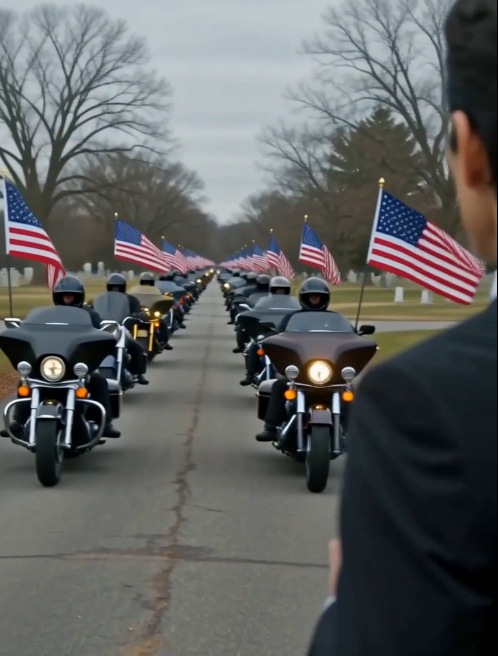
Danny rested a hand on Sarge’s back. The old Lab was still trembling, a low rumble stuck in his chest.
Around them, three hundred riders from the Freedom Road Riders stood in two long lines, holding American flags on poles. They’d come from Tulsa, Tahlequah, Fort Smith and Okmulgee after Danny posted six words on the escort group’s page at four that morning: Vet. No family showing. Fort Gibson. Most of them had never met Frank Mercer. They’d come anyway. That was what they did.
Curtis looked at the flags and the leather vests and the tattoos, and his mouth twisted.
“I appreciate the show,” he said, loud enough for the chaplain and everyone else to hear. “But let’s be clear. I’m Staff Sergeant Frank Mercer’s son. His only child. And this man”—he pointed at Danny—”is somebody my father picked up somewhere. A drifter. A truck driver.”
His wife, Lauren, stood beside him in a navy coat, holding a folder. She opened it and showed the funeral director a document with a county seal.
“Dad deeded me the house on Okmulgee Avenue in September,” Curtis said. “It’s recorded. It’s done.”
Then he stepped close to Danny and dropped his voice.
“Where were you, huh? When he was dying? I was paying his hospice bills. I was paying his taxes. Where were you?”
Danny didn’t answer.
He couldn’t.
On October 3rd, he’d been hauling lumber through Billings, Montana, when his phone buzzed with a voicemail. He didn’t listen to it until he stopped for diesel in Miles City.
“Danny. Son. It’s Pop.” Frank’s voice had sounded thin and tired. “Curtis came by with some papers. Said they were for the VA. Something about it sits wrong with me. Come by when you get back, alright? Garryowen.”
Danny had texted back: Back Saturday, Pop. Hang in there.
On Thursday, Frank went into hospice care, and he never woke up again.
Danny had been four hundred miles away, finishing a delivery, because the company would have docked him for turning around.
Maybe Curtis was right. Maybe Danny wasn’t family. Just a man Frank had been kind to once, who’d let that kindness become a habit he never had to pay for.
The chaplain finished. The honor guard folded the flag into a tight triangle and, after a moment’s confusion, handed it to Curtis.
Curtis took it without looking down.
When the crowd began to drift away, a small woman in a gray pantsuit walked across the grass toward Danny. She had silver-streaked black hair and a leather portfolio under her arm.
“Mr. Nguyen? I’m Beth Harjo. Frank Mercer’s attorney.” She held out a thick sealed envelope. Across the front, in big, shaky block letters, it said: FOR DANNY. READ AT PROBATE. NOT BEFORE.
“He told me you’d be the only one standing at this grave at dawn,” she said quietly. “He was right about that. He was right about a lot of things.”
Across the grass, Curtis had stopped walking. He was staring at the envelope.
What had Frank Mercer written that he wanted kept sealed until after he was buried?
Part 3 — Read It to Me, Son
In the summer of 2019, Frank Mercer’s eyes started to go.
The VA doctor at the Jack C. Montgomery hospital in Muskogee called it diabetic retinopathy. It was one of the illnesses the government had finally admitted came from Agent Orange. Frank called it “the jungle collecting its debts.”
He could still see faces, the road, and the dog. But print blurred into gray smudges. Medicine labels, bank letters, the newspaper — all of it.
So on Sunday afternoons, Danny read to him.
They sat on the porch of the white bungalow on Okmulgee Avenue, Frank in his recliner, Sarge asleep across both their boots, and Danny read everything out loud. Letters from the VA. Utility bills. The Muskogee Phoenix sports page.
“Read it to me, son,” Frank would say. “Every word. Don’t skip the fine print. That’s where they get you.”
Frank never signed anything he hadn’t heard read aloud. Never.
He had a little silver Sony microcassette recorder, older than Danny’s truck, that he kept in his shirt pocket. When somebody read him something important, he’d press record.
“So I can play it back later,” he said, tapping the pocket, “when nobody’s around to tell me what I heard.”
At the end of every visit and every phone call, Frank said the same word. It was the old 1st Cavalry battle song, the one his unit sang in the Ia Drang in 1965.
“Garryowen, son.”
Danny would roll his eyes and say it back.
He never asked why Frank called him “son.”
He figured it was just something old soldiers said.
Part 4 — The First Monday
Beth Harjo’s office sat above a bank on West Broadway in downtown Muskogee. The radiator clanked, and the windows looked out on the old Katy railroad depot.
Curtis came with Lauren and a lawyer from Tulsa in a charcoal suit. He sat across from Danny and folded his hands.
Beth opened the will and read it aloud. Everything to Danh “Danny” Nguyen: the house, the savings account, and Frank’s Purple Heart and Bronze Star.
The envelope marked READ AT PROBATE stayed sealed on the desk. Frank’s instructions said it was to be opened only in front of a judge.
Curtis didn’t raise his voice. He didn’t have to. His lawyer slid a binder across the table.
“Three years of bank statements,” Curtis said. “Every one of Dad’s property taxes, I paid. Eleven thousand dollars. His hospice co-pays. His hearing aids. Where’s this man’s name in there?”
It wasn’t there.
“And the deed?” Beth asked.
“Dad’s idea. He was worried about Medicaid clawing back the house after he died. We set it up properly. Notarized, recorded.” Curtis turned a page. “Now I’d like to talk about something else.”
He pointed to a highlighted column.
Cash withdrawals from Frank’s checking account at Armstrong Bank. Three thousand two hundred dollars, on the first Monday of every month for the past eighteen months. Fifty-seven thousand six hundred dollars in all.
“My father didn’t spend money,” Curtis said. “He bought the same Wranglers for thirty years. So where did fifty-eight thousand dollars in cash go?” He leaned forward. “Dad drove to Houston once a month. Every month, for as long as I can remember. He always said it was VA business. There’s no VA business in Houston that needs cash.” He looked at Danny. “Who do you have in Houston, Mr. Nguyen?”
The room went very quiet.
Danny’s mother, Mai, lived in a memory-care home in the Bellaire neighborhood of Houston. She’d lived there for twelve years.
Curtis’s lawyer smiled thinly. “A lonely, nearly blind veteran. A younger man who reads him his mail. A will that leaves everything to that younger man. And fifty-eight thousand dollars flowing to that man’s mother.” He closed the binder. “In Oklahoma, we call that undue influence. Possibly exploitation of a vulnerable adult.”
Danny walked out into the cold without a word.
He sat on his bike across from the depot and called the Bellaire home. His mother’s nurse, a kind Vietnamese woman named Hạnh, answered.
“Danny? Oh, I’m so sorry about Mr. Mercer.”
“Chị Hạnh. Who pays for Má’s room?”
A pause.
“Mr. Mercer did. Every month, in cash, for twelve years. He drove down himself and sat with her for an hour. She always called him ‘anh Frank.'” Another pause. “I thought you knew.”
He hadn’t known. He’d thought her care was covered by a church program Frank helped him find.
Why would Frank Mercer secretly pay for his mother’s care for twelve years and never say a single word?
Part 5 — Fine Print
Danny didn’t sleep. At six in the morning, he was knocking on Beth Harjo’s door with two coffees.
“They’re going to say I stole from him,” he said. “Maybe I did. Maybe he did it for me, and I never asked.”
“Frank chose where his money went, Danny. That isn’t theft.” Beth set down her coffee and pulled a stack of paper from a folder. “Curtis wants to talk about fifty-eight thousand dollars. Let’s talk about six hundred and twelve thousand.”
A VA award letter, dated August. Under the PACT Act, which Congress passed in 2022 to cover veterans exposed to toxic chemicals, Frank’s disability rating had been raised to one hundred percent, retroactive to 2019. Back pay: $612,400.
“He got that letter in August and asked me to read it to him over the phone,” Beth said. “He laughed and said he’d leave it to ‘both his boys.’ I didn’t know what he meant.”
Next came an Armstrong Bank form dated September 9th, adding Curtis Mercer as a joint owner of Frank’s savings account. The signature was a shaky scrawl.
Then a wire transfer dated September 12th: $500,000 from that account to an escrow account belonging to Mercer Wealth Partners, LLC. Curtis’s firm.
“And this is why,” Beth said.
A public notice from the Oklahoma Department of Securities. Mercer Wealth Partners was under investigation for losing $470,000 of client money in unauthorized trades. Four retired schoolteachers from Broken Arrow had filed complaints.
“He needed to make those clients whole before the state shut him down,” Beth said.
Danny felt sick.
“But Frank signed,” he said. “The deed. The bank form.”
Beth slid over one last document. It had come from Green Country Hospice under a records request, and it had been faxed to her office that morning.
RN note, T. Reeves. 9/12, 2:10 PM. Pt drowsy after 10 mg oral morphine. Son present with documents requesting pt signature. RN advised pt not competent to sign at this time. Son stated forms were “routine VA paperwork.” RN left room per son’s request.
The deed had been notarized that same afternoon, at 2:40 p.m. The notary was Kelsey Dunn, a mobile notary from Broken Arrow.
Beth had already looked her up. Kelsey Dunn was Curtis’s office assistant.
Danny thought about the voicemail. Curtis came by with some papers. Said they were for the VA. Something about it sits wrong with me.
Frank had known something was wrong. He’d called the one person who would read it to him. And that person had texted Back Saturday and kept driving.
His phone rang. It was Dale Wofford, his dispatcher at Red River Freight in Tulsa.
“Danny. I just got a call from a Muskogee police detective. You’re under investigation for exploiting an elderly man. Financially.” Dale sounded miserable. “Company policy, brother. I’ve got to park you. Effective now.”
Curtis hadn’t waited for the judge.
How much more could he take before anyone listened?
Part 6 — Parked
By noon, Curtis had posted on Facebook. There was a photo of him holding the folded flag at the graveside, looking wrecked.
My father was a war hero. In his last years, as his eyesight failed, a man he barely knew wormed his way into his life, read him his “mail,” and drained his accounts to support his own family. The police are now investigating. Please share. Elder abuse is real.
By evening, it had nine thousand shares. Somebody found Danny’s picture from a Toys for Tots run and posted it in the comments with the word PREDATOR.
Detective Ron Stidham of the Muskogee Police Department questioned Danny for two hours in a room with a humming fluorescent light.
“Fifty-eight thousand dollars to your mother, Mr. Nguyen. Help me understand why a man with no relation to you would do that.”
“I don’t know,” Danny said, and it was the truth, and it sounded like a lie.
The Freedom Road Riders sent him a polite email that night. The board had voted to suspend him from escort missions “until this matter is resolved, out of respect for the grieving families we serve.”
He understood. It still felt like being shot.
The next morning, Danny rode to the house on Okmulgee Avenue. The locks had been changed. Curtis’s Lexus was in the driveway. Frank’s recliner was sitting at the curb in the rain, next to a stack of cardboard boxes marked DONATE.
Frank’s old field jacket was on top, getting soaked.
Danny took the jacket. He didn’t touch anything else.
Then he rode to the Muskogee County animal shelter on South 32nd Street. The front desk clerk looked up Sarge’s file and wouldn’t meet his eyes.
“The owner surrendered him Tuesday. He listed the dog as aggressive and requested euthanasia.” She hesitated. “It’s scheduled for Friday at nine.”
“The owner?”
“Curtis Mercer.”
“That dog’s never bitten anybody in his life.”
“I’m sorry, sir. You’re not on the file. I can’t release him to you.”
Danny sat on his bike in the shelter parking lot until the lights went off. Then he stayed. The rain came harder, cold November rain that ran down the back of his neck. Through the chain-link fence, he could hear dogs barking, and somewhere in there, one low old voice he thought he recognized.
He had no job. No club. No house to go back to. A detective who thought he was a thief. And a dog with eighteen hours left.
At eleven that night, headlights swung into the lot. An old burgundy Buick stopped next to his bike.
Odessa Pryor climbed out under a black umbrella. She was seventy-four and had lived next door to Frank on Okmulgee Avenue for thirty-one years. She’d taught fourth grade at Sadler Arts Academy until she retired, and she still looked at everyone like they owed her a homework assignment.
“Danny Nguyen, get off that motorcycle before you catch your death.”
“Mrs. Pryor—”
She held up a sheet of paper in a plastic sleeve. “Frank transferred Sarge’s microchip to my name last June. I’ve got the paperwork. That dog was never Curtis’s to surrender, and I’ll have him out of there when they unlock the doors in the morning.”
Danny stared at her.
“And there’s something else.” She reached into her coat and took out a thick manila envelope, taped shut. “Frank gave me this last summer. He said, ‘Odessa, if my boy ever calls Danny a thief, give it to him. Not before.'”
What had Frank known was coming?
Part 7 — What Frank Carried
They read it at Odessa’s kitchen table at midnight, with a pot of coffee between them and the rain drumming on the roof.
Inside the envelope was a handwritten letter, printed in huge careful letters, the way a man writes when he can barely see the page. There was a faded color photograph. And there was the little silver Sony microcassette recorder, with a strip of masking tape on it that said SEPT 12.
Danny read the letter first.
Danny,
I have lied to you your whole life. Here is the truth, and it’s worse than you think.
In 1965 I was twenty years old in Quang Tri with the 1st Cav. I met a girl named Mai who sold oranges by the market. I loved her. You were born in April of ’66. I got my orders home before you were a month old. I told Mai I’d come back for you both.
I didn’t. Not for six years. I came home, met June, and married her. I let myself believe you were better off without a scared kid like me.
In 1972, on my second tour, the Easter Offensive hit Quang Tri. I went looking for Mai. I found you standing in a road full of people running south. Six years old. You had my ears. I picked you up and carried you nine miles to a truck headed for Hue. Mai wouldn’t leave her mother. I made a choice at that truck, and I’ve been making it every day since.
When you and your mother came over in ’88 under the Amerasian Homecoming Act, I sponsored you through my church and never put my name on it. I got you work. I taught you to ride. I watched you grow into the best man I know, and I let you believe I was just the soldier who carried you.
June died never knowing. Curtis grew up with a daddy who drove to Houston every month and came home quiet. He isn’t a bad boy, Danny. I made him hungry for a father I kept giving away to somebody else. Whatever he’s done, part of it is mine.
You’re my son. You always were. I was too much of a coward to say it to your face.
— Pop
P.S. The tape. I had a feeling.
The photo showed a skinny American soldier in fatigues, grinning, his arm around a young Vietnamese woman holding a basket of oranges. On the soldier’s left wrist, above his watch, was a tiny fresh tattoo: a horse’s head with a lotus inside it.
Danny sat without moving for a long time.
Sixty years. Every Sunday on that porch. Every “Garryowen, son.” Every time Frank said it, he’d been telling the truth, and Danny had never heard it.
He wanted to be grateful. He was also so angry his hands shook. Frank had been right there. He could have said it any day. Instead, he’d let Danny grow up believing his father had never come back.
“He was a good man who did a terrible thing,” Odessa said quietly. “Most of us are one or the other. He was both.”
Danny picked up the recorder. He pressed play.
A kitchen. A chair scraping. Then Frank’s voice, slow and slurred.
“Can’t read this print, Curtis. Read it to me.”
“It’s just VA paperwork, Dad. Routine. Sign by the little flags.”
“Danny always reads ’em to me. Every word.”
A pause.
“Danny’s not your son, Dad. I am. Sign it.”
The tape hissed on for a few seconds. Then it clicked off.
Danny called Beth at 12:40 a.m. She picked up on the first ring.
“Tomorrow’s Veterans Day,” she said. “The city is adding Frank’s name to the memorial wall at War Memorial Park. Channel 2 is covering it live.” A pause. “Curtis is giving the family remarks.”
Would Danny stand up in front of the whole town as the son Frank had never claimed?
Part 8 — The Batfish
November 11th came cold and bright. The World War II submarine USS Batfish sat in its grassy berth beside the Arkansas River, black and gray against a sharp blue sky. The ceremony stage was set up in front of the memorial wall. Four hundred people sat in folding chairs. A KJRH camera stood at the back, and a local Facebook page was streaming live.
The Freedom Road Riders came anyway.
They’d voted that morning to lift Danny’s suspension, twenty-two to nothing, after Beth sent the board the hospice note. Three hundred riders parked along Port Place and walked in silently, carrying flags. They lined both sides of the aisle, a flag every six feet. They didn’t speak.
Curtis stood at the podium in a dark suit with a small American flag pin. Lauren sat in the front row.
“My father was a hero,” he said. His voice caught in exactly the right places. “And I was with him to the very end. People have said terrible things this week. That he was confused. That he was taken advantage of. So let me be clear.” He gripped the podium. “Dad was sharp as a tack until his last day. He read every word of every paper he ever signed, himself, the way a sergeant does. Nobody fooled Frank Mercer.”
“He couldn’t read print, Curtis.”
Danny’s voice wasn’t loud. It didn’t need to be.
He walked up the aisle between the flags in his leather vest, with Frank’s old field jacket over his arm. Beside him, Odessa Pryor held Sarge’s leash. The old Lab walked with his head high.
“Diabetic retinopathy,” Danny said. “Since 2019. The Agent Orange took his eyes. He couldn’t read a pill bottle. That’s why somebody read him everything, every Sunday for six years.” He stopped at the foot of the stage. “It wasn’t you.”
Beth Harjo stepped up beside him and held a document toward the camera. “The VA disability rating. One hundred percent, with visual impairment listed.” She raised a second page. “And the Green Country Hospice note from September 12th. The nurse told you he wasn’t competent to sign. You sent her out of the room. Thirty minutes later, your own office assistant notarized the deed.”
Curtis’s face flushed. “He used a magnifier. I sat right there with him while he—”
Odessa lifted the small silver recorder.
A technician from the city, bewildered, held a microphone to it.
Frank’s voice filled War Memorial Park.
“Can’t read this print, Curtis. Read it to me.”
“It’s just VA paperwork, Dad. Routine. Sign by the little flags.”
“Danny always reads ’em to me. Every word.”
“Danny’s not your son, Dad. I am. Sign it.”
Silence spread across four hundred people. Even the river seemed quiet.
On stage, Curtis’s mouth moved without sound. Then he found his voice, and what came out was raw.
“That’s edited. That’s fake. You want to know who this man is?” He was pointing at Danny now, his finger shaking. “He’s a stranger. A stranger my father loved more than his own son!”
At the foot of the stage, Sarge growled. It was low and steady. It was the growl from the kitchen.
Danny unfolded the letter.
“I’m not a stranger, Curtis.”
Curtis stared down at him, suddenly afraid of something he didn’t have a name for.
“Then who the hell are you?”
Part 9 — Every Word
“I’m your brother.”
Danny held up the photograph. A skinny soldier. A girl with oranges. A tiny tattoo on a young man’s wrist.
Then he turned his own left wrist toward the stage.
Curtis looked from the photo to the tattoo and back again. Something in his face gave way. He sat down on the edge of the stage, in front of the camera and the whole town, and put his head in his hands.
The Muskogee County District Attorney charged Curtis Mercer in December with exploitation of a vulnerable adult and forgery. Kelsey Dunn, the notary, took a deal and testified. Nurse Tamika Reeves testified too. The Oklahoma Department of Securities revoked Mercer Wealth Partners’ registration. In March, Curtis pleaded guilty. The judge sentenced him to five years’ probation and ordered full restitution. The deed to the house on Okmulgee Avenue was voided, and the $500,000 went back into Frank’s estate.
Detective Stidham closed the case against Danny with one line: Payments were a gift from the decedent to the mother of his biological son.
The DNA test Beth ordered only confirmed what the tattoo had already said.
Danny inherited everything. He didn’t keep it all. He set aside half the VA money in a college trust for Curtis’s two teenage daughters, who had never done anything wrong except be born into a family full of secrets. He paid Mai’s care home five years in advance. He moved into the bungalow on Okmulgee Avenue, put Frank’s recliner back on the porch, and let Sarge sleep across his boots.
In April, he drove to Houston and sat with his mother. He told her, in Vietnamese, that Frank had kept his promise, just late. She didn’t understand much anymore. But when he said the name, she smiled and said, “Anh Frank,” and touched the tattoo on his wrist.
In May, the headstone at Fort Gibson was finally finished. The VA let families choose the words on the bottom lines.
Danny rode out on a warm Sunday morning with Sarge in a sidecar. When he pulled up, someone was already there.
Curtis stood by the grave in jeans and an old Oklahoma State sweatshirt. He looked ten years older. He glanced at Danny, then back at the stone.
Neither of them said anything for a long time.
“I read your letter,” Curtis said finally. “The one he left for me. Beth gave it to me in March.” His voice was rough. “He said he was sorry he gave me the worst of him.”
“He gave me the worst of him too,” Danny said. “Just in a different way.”
Curtis nodded slowly.
Sarge limped over and sniffed Curtis’s hand. After a long moment, he let Curtis scratch behind his ear. Not three slow circles. But close.
Danny took the little silver recorder out of his vest pocket. The SEPT 12 tape was in an evidence locker in Muskogee now. This one was new and empty.
He pressed record. Then he crouched in front of the headstone and read it aloud, slowly and clearly, the way he had read everything to Frank on that porch for six years.
“Franklin James Mercer. Staff Sergeant, United States Army. First Cavalry Division. Vietnam. Purple Heart. Bronze Star.” He paused. “Husband. Father of two sons.”
He looked up at Curtis.
“You always told me, ‘Every word, son. Don’t skip the fine print.'”
He clicked off the recorder and rested his hand on the warm stone.
“Garryowen, Pop.”
Beside him, after a moment, his brother said it too.