A Father Was Denied Access to His Child at the Hospital — Until a Biker Stepped In
They told him he wasn’t allowed to see his own child — not because of paperwork, but because he didn’t look like the kind of father they trusted.
The hospital lobby smelled of antiseptic and burnt coffee. Fluorescent lights reflected off polished floors that echoed every hurried footstep, every whispered phone call, every restrained sob.
At the reception desk stood Daniel Brooks, thirty-eight years old, hands trembling at his sides. His jacket was worn. His jeans still smelled faintly of oil and rain. He hadn’t slept.
“I’m here for my daughter,” he said, voice hoarse. “Room 412. She was brought in an hour ago.”
The nurse glanced at the screen, then at Daniel. Her eyes paused — just a second too long — on his clothes, his beard, the grease under his fingernails.
“Are you listed as the legal guardian?” she asked.
“Yes,” Daniel said quickly. “Her mother is—” He swallowed. “Her mother passed away last year. It’s just me.”
The nurse pursed her lips. “I’ll need to see identification.”
Daniel handed it over with shaking fingers.
She studied it, then typed something, then frowned. “I’m sorry. You’ll need to wait.”
“For how long?” Daniel asked.
“I’m not sure.”
A security guard had drifted closer now, pretending to look at his phone. Daniel noticed him anyway.
“My daughter was in an accident,” Daniel said, voice cracking. “She’s seven. She’s probably scared.”
The nurse avoided his eyes. “Sir, please lower your voice.”
Daniel’s breathing quickened. “I’m not yelling. I’m asking to see my child.”
A man behind him muttered, “Here we go.”
Another whispered, “They always cause scenes.”
Daniel clenched his fists, forcing them open again. Anger scared him more than fear did.
That’s when the lobby doors slid open.
A motorcycle helmet appeared first. Then leather. Then a man stepped inside and stopped.
He didn’t rush.
He didn’t stare.
He simply took in the scene — the desk, the guard, the father being quietly cornered.
The biker stood still, sunglasses on, arms relaxed at his sides.
No one yet knew why he was there.
No one yet knew this moment was about to become something else entirely.
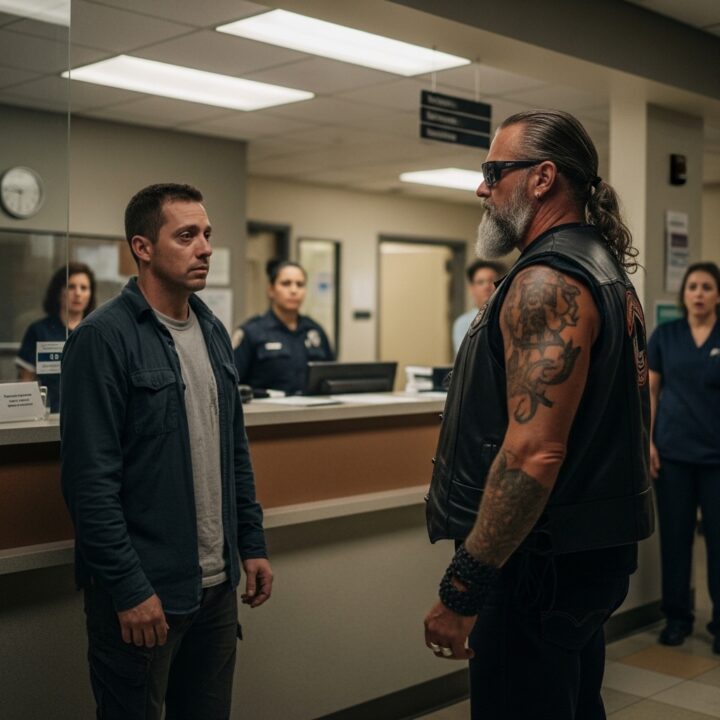
The biker approached the desk and stopped a few feet from Daniel.
Close enough to be noticed.
Not close enough to be aggressive.
“What’s the issue?” the biker asked.
The nurse stiffened. “Sir, this doesn’t concern you.”
The biker nodded once. “Didn’t say it did.”
Daniel turned, startled. “I don’t want trouble,” he said quickly. “I just need to see my kid.”
The biker looked at Daniel for the first time — really looked. The red eyes. The shaking hands. The fear a parent can’t hide.
He turned back to the nurse. “Why can’t he see her?”
The security guard stepped forward. “Sir, you need to move along.”
The biker didn’t.
“He’s agitated,” the nurse said. “We have to follow protocol.”
The biker tilted his head slightly. “Protocol says parents can’t see their children?”
The guard’s hand hovered near his radio. “Sir, step back now.”
Phones came out. A woman whispered, “Great, now there’s a biker involved.”
Someone else said, “This is going to get ugly.”
The biker folded his arms slowly. Tattoos stretched along his forearms, old ink faded by time rather than regret.
“He’s not causing a problem,” the biker said calmly. “He’s asking.”
“That’s not your decision,” the guard snapped.
The biker shrugged. “Then it’s not yours either.”
That did it.
The guard raised his radio. “I need assistance at the front desk.”
The nurse exhaled sharply. “Sir, you are escalating this situation.”
The biker finally looked around the lobby. Every eye was on him now — waiting for him to become exactly what they feared.
Instead, he did something else.
He reached into his vest.
A gasp rippled through the room.
“Hey!” someone shouted.
But he didn’t pull out anything threatening.
He pulled out his phone.
Typed one message.
Sent it.
Then he slipped the phone away and stepped back half a pace.
“We’ll wait,” he said.
And suddenly, the tension had nowhere to go but up.
Two more security guards arrived. One stood between Daniel and the desk now, effectively blocking him.
“You need to calm down,” one guard said to Daniel.
Daniel shook his head, eyes wet. “I am calm. I’m terrified.”
The biker watched silently.
A supervisor appeared — clipboard, tight smile, practiced authority. “Sir,” she said to the biker, “you’re not allowed to interfere with hospital operations.”
The biker nodded. “I’m not interfering. I’m standing.”
“That’s not how we see it.”
The supervisor turned to Daniel. “We may need to verify some information before allowing access.”
Daniel’s voice broke. “Please. She doesn’t have anyone else.”
The supervisor hesitated — just a fraction — then hardened again. “Rules are rules.”
The biker shifted his weight.
“Rules don’t raise kids,” he said quietly.
The supervisor stiffened. “Excuse me?”
The biker didn’t repeat himself.
He looked at the clock on the wall instead. Then at Daniel.
“You got a photo?” the biker asked.
Daniel fumbled with his phone, pulling up a picture — a little girl with missing front teeth, smiling too big for her face.
“That her?” the biker asked.
Daniel nodded.
The biker looked at the security guards. “You going to tell her her dad was here and you said no?”
Silence.
The supervisor opened her mouth, then closed it.
The biker reached into his vest again and made a call this time. He turned slightly away, lowering his voice.
“I’m at Mercy General,” he said. “Front lobby.”
That was all.
He ended the call.
One of the guards scoffed. “Calling backup?”
The biker met his eyes. “Calling someone who answers.”
Outside the glass doors, a low mechanical rumble began to roll through the parking lot.
Not loud.
Not fast.
More than one engine.
Daniel heard it and looked up, confused. “What’s that?”
The biker didn’t look away from the desk.
“They’re coming,” he said.
The lobby went quiet.
And in that quiet, every assumption people had made about who belonged here — and who didn’t — started to feel dangerously fragile.
The sound came first.
Not shouting.
Not sirens.
Engines.
Low. Steady. Controlled in a way that didn’t demand attention — it commanded it.
Every head in the lobby turned toward the glass doors.
One motorcycle rolled into view. Then another. Then another. They didn’t race into the parking lot. They didn’t rev. They moved slowly, deliberately, as if each rider understood this wasn’t a place for speed.
Helmets came off. Gloves were tucked away. Boots hit the ground in unison.
No one rushed inside.
They waited.
A man in his early sixties stepped forward first. His hair was cropped short, gray at the temples. His posture was straight — the posture of someone who had learned discipline long before it became a choice.
He entered the lobby calmly and nodded to the security guards.
“Evening,” he said.
The supervisor tightened her grip on the clipboard. “This is a restricted area.”
The older biker nodded. “So are hospitals everywhere. That doesn’t mean parents stop being parents at the door.”
The room went still.
The supervisor opened her mouth, then paused. “Who are you?”
The older biker glanced at Daniel — still standing there, shoulders sagging under exhaustion and fear — then back at her.
“Someone who shows up,” he said.
Another biker stepped in beside him. Then another. Not surrounding. Present.
The guards exchanged looks. Radios stayed quiet.
The older biker turned to the nurse at the desk. “What’s his daughter’s name?”
The nurse hesitated. “I—”
“Her name,” the biker repeated, gently but firmly.
“Emily,” the nurse said.
The older biker nodded. “Emily Brooks.”
Daniel flinched when he heard it — his daughter’s name spoken by a stranger.
The older biker turned to him. “She’s awake?”
The nurse glanced at the screen again, voice softer now. “Yes. She’s asking for her father.”
That sentence landed like a weight.
Daniel’s knees nearly buckled.
The supervisor swallowed. “We were just verifying—”
“Enough,” the older biker said quietly.
Not loud.
Not angry.
Enough.
He turned to the guards. “Step aside.”
For a moment, no one moved.
Then — slowly — one guard did.
Then another.
The path to the elevators opened without a word.
No one cheered.
No one argued.
The power in the room had shifted without force, without noise — simply because someone refused to let fear keep writing the story.
Daniel didn’t wait to be told twice.
He walked — then nearly ran — toward the elevators, the nurse finally moving with him instead of against him.
At the doors, he stopped and turned back.
He looked at the biker who had first spoken up — the one everyone had watched, judged, feared.
“I don’t even know your name,” Daniel said, voice breaking. “But I—”
The biker shook his head once. “Go.”
Daniel nodded and stepped inside the elevator. The doors closed.
Silence settled over the lobby.
The bikers didn’t linger.
The older one gave a small nod to the staff. “You did your job,” he said. “Just remember who it’s for.”
No accusation.
No lecture.
They turned and walked out together.
Engines started again — low, respectful — and the motorcycles rolled away as cleanly as they had arrived.
Later that night, a little girl would fall asleep holding her father’s hand, reassured not by machines or protocols, but by presence.
Daniel would sit in a plastic chair beside her bed, replaying the moment he almost wasn’t allowed inside — and the moment strangers decided he should be.
Back in the lobby, a supervisor would stare at the desk long after her shift ended. A nurse would hesitate the next time she judged a man by his clothes. A guard would think twice before stepping in front of a father.
And somewhere on the road, a biker would ride on — no thank-you collected, no credit claimed — knowing only this:
Sometimes protection doesn’t look like saving the day.
Sometimes it looks like standing still long enough for the truth to arrive.
And sometimes, the loudest thing in a hospital full of machines
is the moment everyone finally goes quiet — and lets a father through.