A Biker Brought a Pink Lunchbox to Our School Gate Every Morning — When I Asked Him to Leave It at Reception, His Daughter Asked One Frightening Question
The morning I asked the tattooed biker to stop waiting outside our elementary school, a little girl dropped her backpack and begged me not to make him take the pink lunchbox away.
She didn’t run toward him. That was the part I remembered afterward. She stood beside the gate with both hands open, as if moving too quickly might change what happened next.
My name is Claire Bennett. I was forty-two, teaching second grade at a small school outside Dayton, Ohio, and that September I had inherited morning gate duty along with a classroom whose pencil sharpener sounded like a lawn mower.
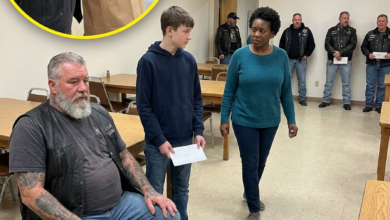
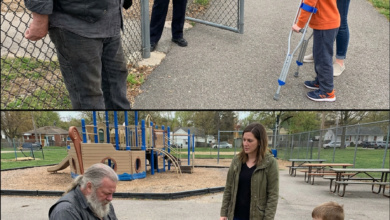
For eleven mornings, the man had appeared beside the same maple tree. He was enormous, with a gray-streaked beard, tattooed knuckles, and a black leather vest stretched across shoulders that made our gate look narrow. He parked his Harley legally across the street, killed the engine, and waited with a pink lunchbox dangling from one hand.
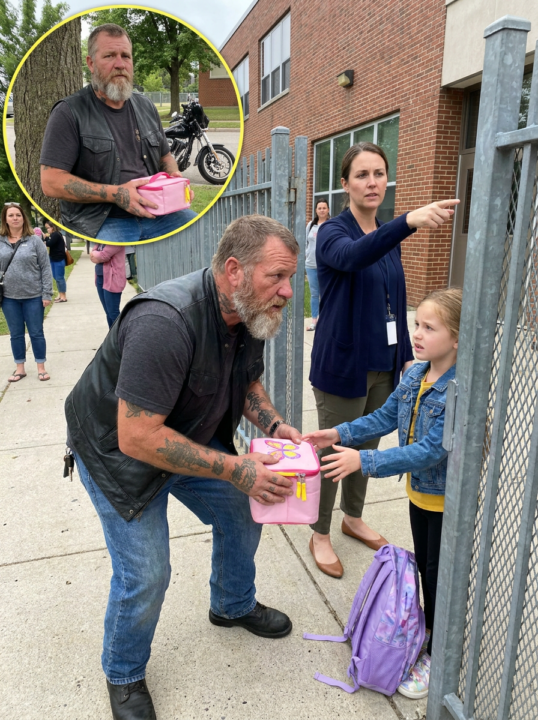
Not a cooler. Not a bag of tools. A little insulated box with a crooked fabric butterfly sewn near the handle.
He never photographed the children. He never approached anyone except Sophie Miller, a quiet eight-year-old in my class who liked drawing apartment buildings with gardens on every roof.
Each morning, Sophie came out of breakfast club with a staff member. The biker crouched, said something I couldn’t hear, and put the box directly into her hands. She opened it, looked inside, and closed it again. Only then did he leave.
I had checked his name with the office. Ray Dawson. Approved parent. Nothing improper about his being there. But the arrangement wasn’t on the duty sheet I’d received, and three parents had asked why a grown man stood outside the gate instead of using the front entrance.
One called him “the motorcycle guy.” Another said he made the school look unsafe.
I told them he was authorized. Still, I found myself watching him more closely than the fathers in company jackets. I wish that weren’t true.
On the twelfth morning, the office asked us to route all food deliveries through reception while we sorted out congestion near the side gate. It sounded ordinary. Sensible, even. Nobody was banning parents; we were changing where bags changed hands.
Ray listened without interrupting.
“I can bring it inside,” he said. “But can she meet me there?”
I told him the receptionist could take it to her classroom. His thumb stopped rubbing the butterfly’s loose wing.
“Could you check first?”
Behind me, Sophie had gone still. A bus hissed at the curb. Someone’s coffee lid clicked onto the pavement, and the smallest sound seemed suddenly much too loud.
“It’s only lunch,” I said.
Her backpack slid from her shoulder.
Ray’s expression changed, though not in the way I’d expected. No anger. No step toward me. He lowered the box until it rested against his knee and looked past me at Sophie.
“Nobody’s taking it away, bug.”
She asked whether she had done something wrong. I said no, of course not, but she kept looking at the box instead of my face.
I had watched her finish breakfast twenty minutes earlier. There were snacks in my classroom and hot meals in our cafeteria. Nothing about this should have felt urgent.
Yet Ray stood motionless, giving her time to cross the few feet between them, and I found myself stepping aside.
She checked beneath the lid. He waited.
“Today too?” she asked.
“Today too.”
Then she carried it inside with both arms, and the man everyone had been discussing stayed beside the gate until she disappeared around the corner.
He asked if we could talk somewhere she wouldn’t hear. Not to complain. Not to threaten a lawsuit. He wanted our counselor present, and he wanted to know exactly what I had told his little girl.
Before that conversation, I thought I understood why a parent brought lunch to school; afterward, I couldn’t look at the empty space beneath a child’s desk the same way.
Part 2 — The Butterfly With One Different Wing
Before there was a man at the gate, there was a pink rectangle on Sophie’s enrollment form. She had drawn it in the margin while her mother signed paperwork. Four uneven sides, a handle, and a butterfly so large its wings reached beyond the box.
I had asked whether it was a suitcase.
“Lunch,” she said, covering it with her hand.
Her mother, Lena, didn’t correct her manners or ask her to show me. She just shifted the crayons closer. I remember appreciating that. By September, I’d already heard too many adults instruct nervous children to perform happiness for strangers.
Lena worked early shifts at a rehabilitation center across town. Ray repaired heavy equipment at a garage near the interstate. Their schedules overlapped awkwardly, which was why Sophie attended breakfast club before my classroom opened. They had settled her enrollment before school started, met with our counselor, and arranged a supervised morning handoff. Somewhere between a staffing change and my taking over the gate, that detail had failed to reach me.
The permission existed. The explanation didn’t belong on a public clipboard.
I learned those things later. What I knew first was that Sophie loved bridges, hated being called shy, and wanted the classroom job of watering the plants. She could tell when our fern needed water by touching the soil, but she asked permission every time anyway.
One afternoon, I found her turning a broken crayon over in her palm. She hadn’t broken it. Someone else had left it beneath the table, and Sophie wanted to know whether putting it back counted as hiding something.
We taped the paper wrapper together. Then she used both halves.
Small things required enormous negotiations.
Ray came to curriculum night wearing the same black vest and carrying a notebook narrow enough to fit in his back pocket. He was fifty-six, with shoulders built by years of lifting things that should have required two men. There was an old burn mark near his wrist and a silver ring that clicked against the tiny classroom desk.
He sat without complaining about his knees.
When I described reading goals, he wrote them down. When I explained our homework routine, he asked how long a child should struggle before a parent stopped the assignment.
“Twenty minutes,” I said. “Then send me a note.”
“What if she thinks stopping means she failed?”
I offered the answer I’d given for years: tell her effort mattered more than getting everything right. He nodded, but I could see him searching for a way to turn that sentence into something usable at their kitchen table.
Lena asked whether incomplete work ever meant losing snack time.
“No,” I said. “Not in my room.”
Ray’s pen stopped. He looked up, then wrote that down too.
I assumed they’d had a bad experience at another school. I didn’t ask in front of the other families. That much, at least, I got right.
As the room emptied, Sophie showed Ray a drawing of our class garden. He didn’t tell her it was the best picture he’d ever seen. He asked why she had put a ladder beside the sunflowers.
“For the person who checks the top.”
“Important job,” he said.
She gave him a serious nod. He took her ideas seriously, which is a different thing from praising everything a child does. I liked him in that moment. I also noticed how quickly my feelings changed when I saw the same man standing alone outside the school.
Inside a classroom, he had a name tag and a child holding his sleeve. Outside, he had tattoos and a motorcycle.
That difference had nothing to do with him.
A week later, Ray brought in the permission slip for our walking field trip. He had circled the lunch instructions and written a question on a separate note: could Sophie carry her own lunchbox rather than put it in the shared bin?
I said yes. He thanked me as though I’d done him a favor.
The pink box was inexpensive, the kind sold beside school supplies in August. Its butterfly had been sewn over a torn patch by Lena. Sophie liked that the repair showed. When another child asked why one wing looked different, she said, “Because it got fixed.”
No embarrassment. Almost pride.
At home, Ray told me later, he practiced fastening the little zipper without trapping the lining. His hands were good with seized bolts and stubborn engine parts, but the corner of that lunchbox defeated him twice.
He replaced the zipper pull with a larger loop of cord. Sophie chose yellow.
He belonged to a riding club that met behind the garage on Thursday evenings. They knew him as a man who showed up early, brought the right tools, and left before anyone was finished talking if he had promised to be home. His friends complained that he had become difficult to schedule.
He told them mornings were already booked.
They assumed he meant traffic, school runs, ordinary family logistics. He let them assume it. Being her father didn’t give him permission to tell her story.
That was the man I knew when I stood at the gate and called his delivery “only lunch.” I had collected all those little details, noticed how carefully he listened, and still mistaken the most important part of his morning for something he could simply leave at reception.
Part 3 — The Door We Needed to Close
After Sophie went inside, the gate seemed too loud. Car doors slammed. Someone called for a missing water bottle. A father in a running jacket asked whether everything was “sorted,” and I realized he expected me to say that the problem had been the man with the lunchbox.
“Her father is authorized to be here,” I told him. “We’re clarifying a school procedure.”
Ray stood beside his helmet. He didn’t look grateful for that sentence, and he shouldn’t have had to. It was a fact I could have stated much sooner.
Our counselor, Marisol Vega, was already helping a child in another classroom. I asked Ray whether he could wait ten minutes. He checked his phone, stepped away to call work, and came back with his shoulders a little lower.
“I can wait.”
I offered to take him through the office. He asked whether Sophie would see him.
“She’ll be in class.”
“Could you tell her where I am?”
That request irritated me for one brief, ugly second. I had twenty-three children arriving, a stack of permission slips, and a day that was already slipping its schedule. Then I looked at him. He wasn’t demanding an audience. He was asking me not to let his daughter invent an explanation for his disappearance.
I went to my classroom first.
Sophie was at her desk with the lunchbox upright between her sneakers. She had taken out her reading folder, but her finger rested on the same page without moving. When I told her Ray was waiting in the office to talk with adults, she asked whether talking took a long time.
“Sometimes,” I said. “But nobody is in trouble.”
She watched my face.
I almost added, “If you settle down, everything will be fine.” The sentence came so easily that it frightened me afterward. It would have made calmness another task she had to complete before she could trust what I’d just told her.
Instead, I said where he would go next. Work. Then home. Lena would collect her after school, just as planned.
“Can he still go to work if he’s late?”
“I don’t know about his job,” I said. “That’s something he can handle.”
She nodded once. I had finally left an adult worry with the adults.
In reception, Ray was sitting with his helmet between his boots. Our assistant principal, Mr. Ellis, had joined him. He was a decent man trying to solve six problems before nine, and he explained the new delivery route in the voice people use when they believe a clear rule will make everyone comfortable.
Food could be left at the front desk. Staff would distribute it. Parents couldn’t expect individual routines at a busy entrance.
Ray listened, then asked whether the problem was the location or the handoff itself.
“The location, mainly.”
“Then let’s find another location.”
Mr. Ellis looked at me. I could see the solution sitting right there, small and practical, while we kept reaching past it for a bigger argument.
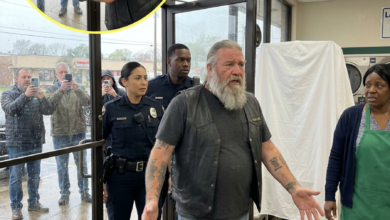
Before either of us answered, a parent leaned through the open office doorway with her phone held at chest height. I recognized her from the gate. She said she’d come to make sure the school understood why people were concerned.
Ray glanced at the phone.
“Is that recording?”
She said she had a right to know who was hanging around the children. He took a slow breath, and for an instant I thought he might finally give her the sharp reply she seemed prepared to receive.
He didn’t.
“My daughter doesn’t belong in your video.”
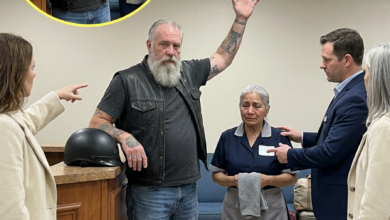
Marisol arrived behind her. She asked the parent to put the phone away and directed her questions to a separate office. No shouting. No applause. Just a closed door, which turned out to be exactly what that moment needed.
Ray stayed seated.
“I’m not asking to wander around the school,” he said. “I’m asking to give her what I brought.”
Mr. Ellis explained that there was food available all day. The cafeteria manager could prepare a backup lunch. Sophie would never have to go without because a parent was delayed.
Ray nodded again. “Good. Please keep that.”
Then he rubbed his hands together, not from cold. The skin across his knuckles was cracked in two places.
“But don’t make one thing replace the other before you know why we started.”
Marisol placed a folder on the desk without opening it. She asked Ray what he was comfortable sharing with us. That question changed the room. Until then, we’d been talking as though his family’s explanation was something the school could simply demand.
He thought about it.
“Enough to help her,” he said. “Not enough to make people look at her differently.”
Marisol nodded. She turned to me and asked about the previous afternoon.
I described a difficult writing lesson. Sophie had erased a sentence until the paper tore. When I offered a fresh sheet, she’d pushed the workbook away, then cried because she thought she’d been rude. We’d taken a break. She’d finished later.
“Did anyone tell her?” Ray began, then stopped.
I waited.
“Did anyone tell her she had to earn something back?”
“No,” I said. “But she asked me whether she’d been bad.”
He closed his eyes for a moment. Mr. Ellis reached toward the tissue box, hesitated, and left it within reach without pushing it at him.
Ray didn’t use it.
“She asked us that at dinner,” he said.
Only then did I understand that Sophie’s question at the gate had begun long before I’d changed the delivery instructions. Yesterday’s torn paper had followed her home. It had sat beside her through the evening and come back to school inside the pink box.
Marisol asked whether Ray wanted her to explain.
He shook his head, took his phone out, and placed it facedown on the desk.
“I can tell you,” he said. “But please don’t ask her to tell it again.”
Part 4 — What “Today Too” Meant
Ray told us Sophie had come to live with him and Lena eighteen months earlier. Her adoption had been finalized that spring. He said it plainly, without presenting the paperwork as proof that she belonged to him.
“She’s our daughter,” he said. “That’s the part you can say out loud.”
The rest he asked us to keep within the small group responsible for helping her at school. I did. What I describe here is what he later gave permission to share, with identifying details changed, because he wanted the routine understood without turning his daughter into a spectacle.
In the home where she had lived before, food had sometimes been withheld as punishment. Other times, the adults responsible for feeding her simply hadn’t done it. There had been long stretches when promises meant nothing and asking again made things worse.
Ray didn’t give us a list of incidents. He didn’t need to.
“She learned that a plate could disappear,” he said. “Even after somebody said it was hers.”
I thought of the snack Sophie had tried to return because she’d dropped its wrapper. The broken crayon. The second sheet of paper. All those little requests for permission I’d mistaken for unusually careful manners.
Marisol made no sweeping claims about what every child with Sophie’s history would do. She talked about Sophie: what her parents had observed, what the girl had chosen to tell her, and what we could change in an ordinary school day.
Her family was working with a therapist. Meals were regular. Food was available. Nobody required affection, good grades, quiet behavior, or a clean bedroom in exchange for eating.
That didn’t mean Sophie instantly believed it.
During her first month with Ray and Lena, she’d carried crackers from the kitchen in her pockets. Once, while helping her change the sheets, Lena had found a sealed snack tucked inside a pillowcase.
They hadn’t scolded her.
Ray said his first instinct had been to show her every full shelf in the kitchen. He wanted facts to be enough. Milk in the refrigerator. Bread in the drawer. Fruit on the counter. He could repair an engine by finding the failed part, and he kept searching for the one thing he could show her that would settle this.
“I kept giving her proof of groceries,” he said. “She was asking something else.”
He learned that slowly, with help and mistakes.
The pink box had been Sophie’s choice during an August shopping trip. She wanted one without a princess printed on it because, she told Ray, princesses never seemed to carry anything useful. Lena sewed the butterfly over a snag in the fabric. Ray fixed the zipper loop.
On the first morning of school, he packed it before breakfast and put it beside her backpack.
Sophie kept checking whether it was still there.
When Lena said it was time to leave for breakfast club, Sophie asked if lunch would still count if she got a bad note from her teacher.
Ray had been tying his work boots. He stopped with one lace hanging.
“Yes.”
“What if I forget something?”
“Yes.”
“What if you forget me?”
That was the question he couldn’t answer by opening a refrigerator.
He offered to bring the lunch himself before class. Not as a test, not as a reward. He would meet her with the staff member at the gate, put it into her hands, and let her check it.
She asked if he could do that tomorrow too.
With the school and her support team, they made it a temporary routine they could review as Sophie became more comfortable. Lena still packed food with her at home. Breakfast club still served breakfast. The lunchbox didn’t replace any of that.
It was one small promise Sophie could watch somebody keep.
“Today too?” meant: even after yesterday, even if the paper tore, even if I cried, even if I wasn’t easy to take care of?
Ray wasn’t bringing an extra sandwich to a child who had forgotten hers. He was coming back after a difficult day, with the same ordinary lunch and the same unaltered answer.
The man I’d thought might be making a performance of fatherhood was trying to make it predictable enough to become boring.
Mr. Ellis took off his glasses.
“We should have checked the existing arrangement,” he said.
Ray looked at me. I apologized for saying it was only lunch in front of Sophie. I didn’t add that I had meant well. I didn’t ask him to reassure me that I was a good teacher.
“I’ll explain my mistake to her,” I said. “Without asking her to make me feel better about it.”
His shoulders eased a little.
Then he told us the part that made the entire routine feel less like a heartwarming story and more like the difficult work it actually was: he worried about being late every single morning.
Motorcycles broke. People got sick. His shift couldn’t always move. He couldn’t promise a child that nothing would ever interrupt him, and he didn’t want the lunchbox to become another way the world could frighten her.
“We need a plan for when I can’t get here,” he said.
There was no heroic speech after that. We talked about doors and contact numbers.
The handoff moved to a marked waiting space beside the front entrance, away from traffic and always with a staff member present. Ray would sign in when necessary. Sophie could meet him there before class. If he was delayed, the office would tell her what it knew without guessing.
A backup lunch would remain available. Lena was the first alternate adult. Another person could help only if the family and school had already approved it.
Most importantly, nobody would describe a change as something Sophie had caused.
Before leaving, Ray asked for one more adjustment. If she wanted to carry her lunch in herself someday, we should let her. No celebration she hadn’t asked for. No pressure to prove she was getting better.
“This isn’t about needing me at a gate forever,” he said.
He picked up his helmet.
“It’s about her knowing I don’t stop being her dad when I’m not standing there.”
Part 5 — The Morning He Was Late
I apologized to Sophie that afternoon while the other children were choosing library books. We sat at the side table, close enough that she could still see her friends and leave when she wanted.
“I changed something without checking your plan,” I said. “That was my mistake. You didn’t lose your lunch, and you didn’t do anything wrong.”
She ran a fingernail along the edge of a picture book.
“Even if I was rude yesterday?”
“Even then.”
She considered that. Then she asked if I could help her find a book about bridges. She didn’t owe me a bigger moment.
For the next three weeks, the new entrance worked. Ray arrived. Sophie checked the box. Sometimes she opened it all the way; sometimes one glance was enough. Then she went to class, where she argued about whose turn it was to use the purple marker and complained about subtraction like any other second grader.
I stopped watching her eat.
That was a change I had to make deliberately. Once you know a child’s history, it’s easy to turn every ordinary action into evidence. I caught myself noticing whether she’d finished the strawberries, whether she’d saved a cracker, whether she’d looked toward the door.
Knowing more didn’t entitle me to stare.
October brought a cold rain that drummed against the classroom windows before dawn. Water pooled near the school entrance. Children arrived wrapped in jackets that squeaked when they moved.
At eight twelve, Ray wasn’t there.
Sophie stood beside the office aide beneath the covered entrance, holding the yellow loop of her backpack zipper. By eight sixteen, she had stopped asking whether she could see the road.
At eight eighteen, the aide brought her to my room. The office was trying Ray’s number, but his first call had gone to an unattended extension while the receptionist helped a child who’d been sick.
The backup plan existed. Now it had to work with real people inside it.
I told Sophie her father was delayed and that we were finding out more. She asked why. I said I didn’t know yet.
It would have been easy to promise he was around the corner. I wanted that sentence almost badly enough to say it.
Instead, I showed her where the backup lunch was waiting and told her it belonged to her whether she wanted it now or later.
She shook her head.
“Did he hear?”
“Hear what?”
“About the milk.”
At breakfast club, Sophie had knocked over a carton. The aide had helped wipe it up. Nobody had shouted. Nobody had taken her food. But Ray’s absence had found the old explanation before the new ones could reach her.
I sat in the chair beside her, not blocking the door.
“Your dad being late isn’t because you spilled milk.”
“You don’t know why he’s late.”
She was right. I knew the answer to one question, not the other. I told her that.
Marisol came to the classroom and offered Sophie a choice: stay with our reading group or wait in her office, where they could answer the phone together. Sophie chose the office. She took the backup lunch but didn’t open it.
At eight twenty-six, we reached Ray.
His motorcycle hadn’t started. He’d called the school, then arranged a ride with a friend from the garage. He was on his way, moving through the same wet traffic as everyone else.
He had not raced a storm to keep a promise. He had made calls, accepted help, and got into a car.
Marisol put him on speaker with Sophie’s permission.
“I know I’m late, bug.”
There was a pause.
“Are you still coming?”
“Yes. I’m in Luis’s car. We stopped at the light by the tire shop.”
“Did you bring it?”
“Right here.”
She asked him to describe the box. Pink. Yellow zipper loop. Butterfly with one wing shorter than the other. He didn’t laugh at the question or sound wounded that she needed to ask.
Then he added, “You can eat what’s there while you wait.”
She didn’t. Not yet.
Ray reached the entrance at eight thirty-four, wet across the shoulders from walking in from the parking lot. He apologized for the delay. He didn’t insist that a man who had come every other morning deserved more trust than this.
Sophie opened the box on the office table. Her sandwich was cut into rectangles because triangles had been “too pointy” that week.
He had remembered an absurd, ordinary preference.
That was when she started crying.
Ray waited until she leaned toward him before putting an arm around her. She told him about the milk. He said he was sorry her morning had felt so long.
“Do you want me to help with the lid?”
She nodded.
There was no line that fixed everything. She stayed unsettled through math. She asked me twice who was collecting her that afternoon. But at snack time, she ate the crackers from the backup lunch.
After school, we changed the contact procedure. One missed call shouldn’t leave a child waiting while adults assumed someone else had answered. We added a second office contact and practiced where messages would go.
Ray also left a written note for Sophie, one they had discussed together, to keep with the spare lunch: if he was late, grown-ups would sort out the reason; her food wasn’t waiting for permission.
I never read that note aloud to the class.
The next morning, he came in the car again. Sophie checked the box, then looked past him.
“Is your motorcycle still being annoying?”
“Deeply.”
She smiled, just a little, and went inside.
Part 6 — The People Who Moved Their Mornings
Luis brought Ray’s motorcycle back to the school parking lot on a trailer two afternoons later. It needed a part, not a miracle. Sophie inspected it from a safe distance and asked whether machines could get embarrassed.
“Only if you tell everybody,” Luis said.
She decided to keep its secret.
I met more of Ray’s riding friends that fall, usually when they were helping at school events or collecting their own children. They were an unremarkable assortment of complicated people: a warehouse supervisor with a bad back, a barber who rode only on weekends, a woman who drove a city bus and could reverse a trailer better than any of them.
Their help mattered most when it wasn’t visible.
I learned about one Thursday meeting from Ray much later. His garage had taken a large repair contract, and the crew needed someone to cover early shifts for several weeks. Ray had already used more flexibility than he liked asking for. He offered to take the late cleanup work in exchange.
One friend said he could just pack the lunch the night before.
“I do,” Ray answered.
“Then what’s the problem?”
Ray didn’t tell them Sophie’s history. He said there was a family routine he needed to protect for now, and he was trying to find a way that didn’t dump his hours onto somebody else.
The room went quiet. Not reverent quiet. People doing arithmetic quiet.
Luis had a physical therapy appointment on Fridays. Another man helped his mother on Tuesdays. The bus driver couldn’t take garage shifts, but she could help one member with an afternoon pickup that freed him to swap hours.
They moved names around a calendar. Ray took two evening jobs and covered a Saturday someone else had requested off.
Nobody rode to the school in formation.
There were no photos of a pink lunchbox lined up beside motorcycle helmets. The support looked like a coworker unlocking the garage before sunrise and another one staying late enough to finish an estimate.
When a friend suggested raising money online, Ray thanked him and declined.
“We need time,” he said. “Not an audience.”
I thought about the woman who had held her phone in our office. The school had answered her concern about access and supervision without explaining anything about Sophie. She hadn’t received a dramatic revelation that made her ashamed in public. The child kept her privacy. That was the better ending to that part of the story.
Winter shortened the handoffs. Ray wore a heavy jacket over his vest and drove when the roads were slick. He still crouched when his knee allowed it; when it didn’t, Sophie met him beside the entrance bench.
Some days she opened the box. Some days she only pulled the zipper halfway.
Once, she took it without checking at all.
I nearly commented. Marisol caught my eye, and I let the moment pass. Sophie went to class, which was what she had come to school to do.
Progress wasn’t a neat sequence after that. The next week, a substitute forgot where our snack basket belonged, and Sophie asked Ray to wait while she checked everything again.
He waited.
One morning in February, she arrived at my classroom with the lunchbox already in her backpack. Lena had walked her in from breakfast club.
“Dad’s going straight to work,” she announced. “I carried it.”
“Where would you like to put it?”
“Same place.”
That was all we said.
Ray stopped at the office later to deliver a form. He asked how the morning had gone, and I told him she’d wanted extra blue paper for a bridge project.
He stood there with nothing pink in his hands. For the first time, I saw how much he had to learn about a changed routine too.
“Good,” he said.
Then he smiled, awkwardly, and admitted he’d almost turned toward the gate out of habit.
She asked him to bring the lunch again the next morning. He did. A few days later, she carried it herself. Nobody kept a chart on the wall.
The choice stayed hers.
By spring, the box traveled both ways. Sometimes Ray brought it. Sometimes Lena did. Sometimes Sophie swung it beside her backpack, talking so fast about caterpillars that she forgot to mention who had packed the sandwich.
Ray was still present in all those mornings. He just wasn’t always the person holding the handle.
Part 7 — Everything Was There
On the last Friday before summer break, I arrived early to put the children’s bridge projects along the windowsill. Sophie had built hers from cardboard, string, and enough tape to hold together a small boat. Beneath it, she’d made room for cars, bicycles, wheelchairs, and a tiny paper dog.
There were no labels about courage. It was just a good bridge.
Outside, the maple tree had filled with leaves. The same stretch of sidewalk that had looked gray and exposed in September was striped with shade. I heard Ray’s Harley before I saw him, then the engine cut off across the street.
He came through the approved entrance and waited beside the bench. Plain vest. Worn jeans. Helmet resting near his boots.
No lunchbox.
For a moment, my stomach tightened with an old reflex. Then I saw Sophie coming from breakfast club, carrying two bags: her familiar pink box and a brown paper sack folded carefully at the top.
She had asked Lena to help her pack the second one.
I know because Lena had warned me at drop-off that there was a surprise, and because Sophie had spent much of the previous afternoon asking whether grown men liked apple slices if the peel stayed on.
Ray looked at the paper sack.
“What’s that?”
“Your lunch.”
He glanced toward Lena, who had stayed a few minutes later than usual. She nodded.
Sophie explained that she’d picked the fruit and put in a napkin. Lena had made the sandwich. There were crackers too, but not the kind with the seeds because he always said they got stuck in his beard.
She had noticed his ordinary preferences.
Ray crouched slowly. The leather across his back creaked.
“You didn’t have to do that.”
“I know.”
She said it easily, with a small shrug, and I felt the difference between a child trying to keep an adult pleased and a child enjoying a surprise she’d chosen.
Lena had been careful about that. Breakfast hadn’t become Sophie’s responsibility. Packing a lunch didn’t make her in charge of whether her father ate. This was a gift, not a job.
Sophie held out the sack.
Ray took it, then asked whether he was allowed to look inside. She rolled her eyes in a way that was becoming one of her newer skills.
“That’s what opening it is for.”
He unfolded the top. A sandwich, apple slices, crackers, a napkin. Nothing expensive. Nothing anyone would photograph for a magazine.
He looked inside a little longer than necessary.
“Everything okay?” she asked.
“Everything’s here.”
She seemed satisfied with that answer. Then she lifted her own pink box and told him she needed to go because our class was choosing which bridges could hold the most toy cars.
He stood, but she hadn’t finished.
“Will you be there after?”
Lena was collecting her, as usual, and Sophie knew that. Ray answered the question she had actually asked.
“At home? Yes.”
“What if my bridge breaks?”
“We’ve got tape.”
She grinned. There was room for something to break.
I won’t tell you she never worried about food again. That summer held unfamiliar places and changed schedules. Her parents still answered questions they’d answered before, and some evenings required more patience than any of us could see from a school gate.
But I remember that Friday because she didn’t wait to watch him leave.
She went inside beside a friend, holding her lunchbox in one hand and a cardboard repair kit in the other. At the classroom door, she stopped to argue that a paper dog should count as bridge weight.
Outside, Ray remained beside the bench for a moment. He wasn’t watching for danger. He was trying to fold the paper sack closed without crushing what she’d put inside.
The corners didn’t line up. He tried again.
Then he tucked his helmet under one arm and carried his lunch across the street.
He held it from underneath, with his other hand.
Follow our page for more biker stories about the quiet promises people keep, and the small moments that make someone feel remembered.