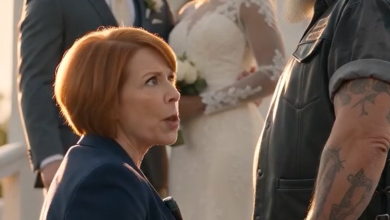
THE COORDINATOR POINTED A BIKER TO THE EXIT AT EMT GRADUATION, THEN HE OPENED HIS FIST AND THE GRADUATE STOPPED MIDSTEP
THE COORDINATOR POINTED A BIKER TOWARD THE EXIT AT EMT GRADUATION. THEN HE TOOK OFF ONE GLOVE, AND A GRADUATE STOPPED MIDSTEP.
On a Saturday in May, Abby Miller sat in the second row of a training center auditorium outside Chillicothe, Ohio. She was twenty-one, and the white collar of her uniform still had a fold from the package. Her mother, Ruth, had come straight from the bakery with flour on one shoe. When the instructor called Abby’s name, Ruth stood too soon and sat back down, laughing at herself.
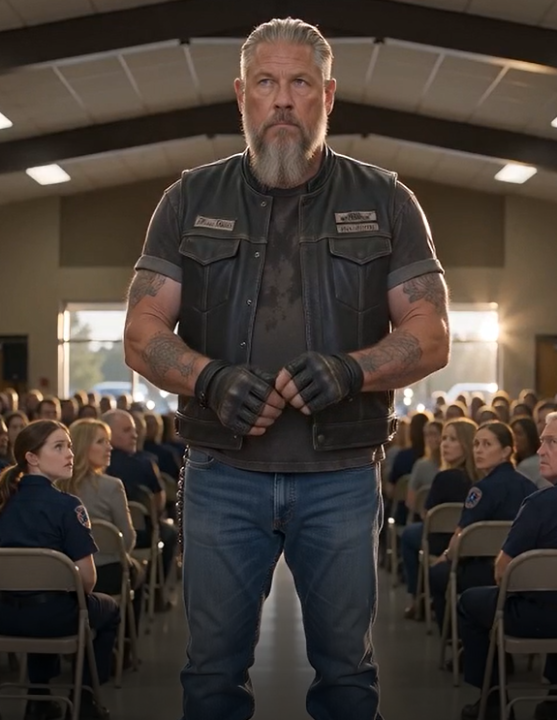
Then sixty motorcycles revved together outside, and the woman at the microphone lost her place.
A silver-haired man in a short-sleeved black leather riding jacket stepped in through the rear doors. Denise Carter, the ceremony coordinator, left her spot beside the stage and pointed him straight back toward the parking lot.
“Outside. This is a graduation, not a clubhouse.”
She said it loudly enough for the front row to hear. A few guests laughed. One man looked at the biker’s tattooed knuckles, then pulled his knees in to let Denise past.
The biker stopped on the mat. He was tall enough to see over everybody who had stood up, and broad enough that Abby could barely see the doorway behind him. His long gray beard was still flattened where his helmet strap had been. He held his helmet against one thigh and waited through the last uneven sputter of engines shutting down.
The silence made it worse.
Abby’s instructor, Matt Hayes, came down the stage steps holding a folded running order.
“He’s on my sheet,” he said.
Denise turned sideways, putting Abby back in her line of sight. “I told him to wait outside. He came in anyway. Look at her. He’s scaring her.”
Abby had been standing still because she couldn’t tell whether she was supposed to finish crossing the stage. Now she could feel people looking at her to confirm Denise’s version. She nearly nodded just to make it stop.
The biker set his helmet on the floor. Then he looked past Denise and up at Abby.
“Abby Miller?”
He said her name carefully. There was no question in the first half of it, only in the last. Abby had spent all morning hearing people say her name. This was the first time she forgot to answer.
Matt stopped beside the front row. Ruth lowered the phone she’d been using to film. Outside, the riders stayed in their rows, and through the glass Abby could see one woman take off her sunglasses and hold them in both hands.
“I brought something for you,” the biker said. “I can leave it here if you’d rather.”
Denise still had her arm out. From the stage, Abby could see the man’s right thumb move once against his curled fingers, as though he were making sure the thing was still there. He waited until Abby looked directly at him.
Then he worked the glove loose, finger by finger. His bare fist stayed closed for another beat. When he turned it over and opened his hand, a faded pink plastic-bead bracelet lay in his palm.
Abby stopped halfway across the stage.
Part 2
The first thing Abby recognized was the white bead she had colored pink with a marker because she’d run out of pink ones.
The ink had rubbed off except around the hole. Even from the stage, she could see the little ring of color. She had made that bracelet at a kitchen table covered in grocery flyers, and she’d worn it all summer because the elastic was too tight to share with any of her friends.
“How did you get that?” she asked.
The man curled his fingers just enough to stop the bracelet sliding. “You gave it to me.”
She looked at his face. Seven years ago, there had been a man on the pavement with one eye closed and his cheek pressed against the white edge line. He’d had dark hair at his temples. She remembered the smell of hot rubber and how hard he’d tried to lift his head when he heard her shoes.
She remembered leaving without knowing if he’d heard her say goodbye.
“You were on Thirty-Five,” she said.
“Yes.”
Abby looked down at her mother. Ruth’s hand had gone flat against the back of the chair in front of her. For years, when either of them drove that stretch of U.S. 35, Ruth had found something to say just before the old maintenance pull-off. Sometimes she asked Abby whether she wanted coffee. Once, on the way home from a dentist appointment, she had asked the same question twice.
Denise took a step between the biker and the stage.
“We can finish this privately,” she said. “Matt, please get the next name ready.”
“Wait,” Abby said.
She had meant to say it to the man. Denise stopped too.
When Abby was fourteen, she’d ridden a yellow activity bus home twice a week because Ruth worked afternoons. On the day of the crash, she’d been sitting up front so she could ask the driver if he’d drop her at the bakery. She had seen one motorcycle lying across the shoulder, then a boot beyond it. She remembered standing up while the bus was still moving and how loud her own voice sounded.
“Mr. Phelps, there’s somebody down.”
“Sit. I see him.”
“Can you stop?”
“I’m finding a place.”
Ed Phelps had pulled the bus into the maintenance turnout. Another driver had already stopped and was on the phone with dispatch. With traffic held away from the shoulder, Ed had walked Abby the few steps from the bus and stayed beside her. She’d been old enough to see the blood at the man’s temple and young enough to think she should keep him from seeing it.
“Do you remember what you said to me?” the biker asked now.
“I talked about my bus.”
“You did.”
“And my mom.”
“You told me how early she got up to make the rolls.”
The man had barely managed to tell her that he fixed motorcycles. He’d said the word fixed twice, like he wanted her to know there had been a time when people came to him for help. She had never known his name.
Abby came down one step. Her knees felt steadier when she had something to do with them.
“Tell me what happened after they put you in the ambulance,” she said.
He took a breath. “First I need you to know what happened before they got there.”
Part 3
“Eighteen minutes,” he said. “Ed kept the time.”
At fourteen, Abby had thought it was closer to five. She had spent some of those minutes trying to tell a stranger how to make cinnamon rolls from scratch, although all she knew about them was that her mother left the dough to rise before she went looking for her good apron. When she ran out of details, she started again with the butter.
“You said your mom made you scrape the bowl,” he said.
“She let me scrape it. That was the good part.”
His mouth moved a little. “I figured I was getting something wrong.”
Abby put a hand on the stair rail. She could hear his voice from the pavement now. He’d used whatever breath he had to ask short questions. What grade? What bus? What’s your name? She’d said Abby. She couldn’t remember if she’d said it once or three times.
“I didn’t know first aid,” she said. “I just held your hand.”
“You did what Ed asked. You sat there. You kept talking.”
Ed had put dispatch on speaker, and the voice on the phone had told them to stay with the man and tell her if anything changed. At one point Abby thought he’d stopped hearing her. She squeezed his fingers. When he squeezed back, she told him her name again. Then she slipped the bracelet over his knuckles.
“So you remember you’re supposed to live,” she’d told him.
She’d said it with the same certainty she used to tell her mother that nothing would happen if she stayed up an extra half hour. By the time the paramedics arrived, she didn’t know what to say anymore. She climbed back onto the bus and found the bag of pretzels she’d left open on her seat. All the salt had collected in one corner.
“How bad was it?” Abby asked.
“Bad enough that my sister got to the hospital before I came out of surgery.” He looked down at his open hand. “Afterward the doctor said you’d helped me stay engaged long enough to answer the crew’s first questions. They could use those answers. I used to think I remembered every minute, but there’s a stretch near the end I only know because Ed told me about it.”
For years Abby had been stuck with one picture of the man, all his weight on the pavement, his hand slack while the paramedics worked around her. Now there was a second picture beside it. He had made it to a hospital. Somebody had been waiting when he came out of surgery. At some point, somebody had brought him shoes to go home in.
“What’s your name?” she asked.
“Cal Mercer. At the shop they call me Wrench.”
“Are you still fixing bikes?”
“Most days. Takes me longer to get up off the stool.”
A couple of people laughed softly. Abby heard her mother let out a breath. She wanted to ask how he’d found her, and whether he’d kept the bracelet on all the way into surgery, and why he’d waited until she was wearing a uniform to come tell her.
Then Denise leaned toward Matt. “You can’t add a guest to a graduation without clearance.”
Matt unfolded the paper he’d been holding all this time.
“You gave him clearance,” he said.
Part 4
Matt held the running order where Denise could read it. From the stairs, Abby could make out the yellow stripe over her own name. Underneath it, in smaller type, were two lines Matt pointed to with the end of his pen.
“Guest entrance during Abby’s presentation. Riders remain outside,” he read. “Your initials are on the parking plan.”
“I approved a few bikes,” Denise said. “There are sixty out there.”
“Sixty was the number we gave you. The staging map had space for sixty.”
Denise looked past him toward the parking lot. The riders had left the middle lane clear. Abby had walked that lane with Matt on the day they practiced loading equipment into the training ambulance. He’d made everybody do it over after somebody left a bag where the rear doors needed to swing. Of course he had thought about where sixty motorcycles would go.
“I told him to wait,” Denise said again.
A woman near the back lifted her phone. Abby recognized her as the volunteer who had been counting guests at the entrance. She was wearing the same yellow cardigan she’d had on when she handed Ruth an extra program.
“I’ve got the arrival video,” the woman said. “I started recording when the last row pulled in.”
She walked her phone down to Matt and Denise. Abby stepped off the bottom stair to see. In the short clip, the phone bobbed from the parking lot to the open door. Denise was standing just inside. Her voice was clear over the nearest engines.
“When you hear her name, you can go in.”
Cal watched it with the rest of them. He had his helmet under his arm in the video and stood outside the threshold while Denise spoke. When the volunteer moved the phone, the shot caught him taking a small step backward to let a family with a stroller pass.
Denise handed the phone back.
“I changed my mind when I heard them,” she said. Her voice had dropped enough that the people in back could no longer hear her. “The hall went quiet. I looked at the front row and everybody was staring at me. I thought somebody was going to ask how I let it happen.”
Abby understood the impulse to have an answer ready. She’d nearly nodded when Denise told everyone she was scared. It would have moved the attention off her, even if it put the blame on a man she’d never seen raise his voice.
“You could’ve asked me how I felt,” Abby said.
Denise looked at her. “I could have.”
Matt asked the volunteer to save the clip and lower her phone. Cal picked up his helmet and moved it closer to the wall so nobody would trip over it. When he straightened, he looked at Abby first.
“If you’d like a minute, I can wait in the lot,” he said.
She shook her head. Now that she could see him up close, there was a small pale break in the line of his beard. She wondered if it had been there before the crash. She wondered how many questions she was allowed to ask a man she’d known for eighteen minutes and thought about for seven years.
“How did you know it was my graduation?” she asked.
Cal glanced at Matt. “Show her the picture I sent you.”
Matt took out his phone and found a photo. The bracelet lay across a folded shop rag with all four letter beads facing up. Abby saw her name. Then she saw the backward B.
“I put that one on wrong,” she said.
Matt nodded. “That’s what made me call him.”
Part 5
The club had a picture of that bracelet long before Matt had a student named Abby Miller. He told her about it beside the stage while the volunteer went to find the program director and somebody in the back got up to close one of the doors against the wind.
Cal had spent the first year asking at the wrong places. The hospital had no name for the girl. A public post got shared among riders and turned up two Abbys whose families thought the dates sounded close. One had been away at summer camp. The other had stopped at a different crash with her father.
“I quit asking people to send me names,” Cal said. “Folks started sending me pictures of their kids. It didn’t feel right.”
He’d left one old post up with a photo of the bracelet, the stretch of road, and a way to reach his shop. The picture had been taken by Matt. He and Cal rode with the same club, a local group that called itself the Iron Orchard Riders. Abby had known Matt as the man who wrote down every time a student forgot to replace a cap on a training kit. She had never seen him in leather.
“Your instructor rides?” she asked.
Cal nodded. “He’s the one who makes us do the parking diagrams.”
The bracelet photo had stayed in Matt’s phone. In March, he’d asked his class why they’d picked the job. Abby had planned to say she liked the work because it was different every day. She’d listened to the woman beside her describe waiting for help when her father fell in a grocery store, and when her turn came, the answer she’d rehearsed felt thin.
“I was fourteen,” she’d said. “I held a stranger’s hand on the highway and I didn’t know what else to do. I don’t want to feel that helpless again.”
She hadn’t said what the man was riding. She had told Matt after class, when he asked which highway. Then he’d asked whether she’d given the man anything.
“I remember thinking that was an odd question,” Abby told him.
“I wanted to hear your answer before I put an idea in your head,” Matt said. “You told me pink beads. Then you said the B was backward.”
“Did you know right then he’d lived?”
“I knew who it sounded like. I called Cal, then I called Ed. I wanted the date checked before I said anything to you.”
Abby remembered signing a guest permission slip the next week. Matt had said someone connected to the reason she’d shared in class wanted to attend. He’d told her she could keep any meeting private. She had expected Ed or one of the ambulance crew. She’d agreed to the introduction in the auditorium because she thought she’d get to thank whoever it was and go back to her seat.
“I figured you’d want him there,” Matt said. “I should’ve asked again once I knew how the entrance was going to work.”
Abby looked at the bracelet. “If you’d told me it was him, I would’ve spent a month trying to think of something to say.”
“What would you have said?” Cal asked.
“I don’t know. Probably the same thing I said just now.”
Cal looked down the aisle, past the glass. One of the riders had moved aside to let an older man with a cane through the door. The man stopped inside to straighten his jacket.
Abby knew that jacket. It had hung off the back of the driver’s seat on her activity bus.
“Did he tell you,” Ed called from the door, “who asked me to go back to the hospital?”
Part 6
Abby had assumed Ed had done what she’d done after the ambulance left. Go back to his route. Think about it when there was a stretch of road with nothing else to look at. Ed was carrying a plain envelope, bent at the corners where he’d held it in his jacket.
“Your mother,” he said. “She called me the next day.”
Abby turned toward Ruth.
“You asked me that night if I thought he was alive,” Ruth said. “I told you I didn’t know. I didn’t know how to leave it at that.”
Ed had been given the ambulance destination at the scene because he’d spoken to the crew. He went after his route the next afternoon and left a note at the desk. Cal was still in surgery when Ed first tried. On a later visit, Cal’s sister came downstairs and told him her brother had made it through. Ed called Ruth that evening.
“You knew?” Abby asked.
“By then you’d stopped asking me. I took that to mean you didn’t want to talk about it.”
“I stopped asking because I thought you’d tell me if it was good news.”
Ruth took that in. “Oh, Abby.”
Abby wanted to say it was fine. It was a reflex she knew from home, the way she used to say she didn’t need new shoes when she saw the bakery envelope on the table. She looked at her mother and tried to say the thing that was true instead.
“I wish you’d told me.”
“I wish I had too.”
Cal let the silence sit between them. He stood a little back, with the bracelet still in his palm. Abby found she was glad he hadn’t tried to make that part easier for either of them.
Ed handed her the envelope. Inside was a photocopy of a letter Cal had sent him months after the crash. Cal had asked him to pass along a thank-you. Ed had been told to give the letter to the family himself and let them decide what to do with it. By then Abby and Ruth had moved across town, and the phone number Ed had used no longer worked. He’d dropped another note at the bakery and never heard back.
“I went to the old location,” Ed said. “Your mom told me this morning they’d moved her to the grocery counter by then.”
There it was. A disconnected phone, the wrong bakery, a mother who thought a question had gone away. Abby read the first two lines of the letter. Cal had written in square mechanic’s handwriting that he was back at the shop for half days. He’d also written that when he couldn’t remember how to get through an hour of physical therapy, he tried to remember how she had gotten him through the next minute.
“Do you want me to read this here?” Abby asked.
“You can put it in your pocket,” Cal said. “I just wanted you to have it.”
She folded it carefully and slipped it into the inside pocket of her uniform. Onstage, the director was back by the microphone. The other graduates were still standing where they’d been told to stand.
Denise looked from Abby to the front row. “Before you finish,” she said, “I need to correct something where everybody can hear it.”
Part 7
Denise climbed the steps and waited until the microphone picked up her breathing. Abby watched her brace one hand on the lectern. Her other hand stayed down by her side, the one she’d used to point Cal toward the door.
“I told this room that Mr. Mercer came in against my instructions,” Denise said. “He followed the instructions I gave him. I also spoke for Abby when I should’ve asked her. Mr. Mercer, Abby, I’m sorry.”
A few people put their phones down. One of the men who had laughed looked at Cal and gave him a small nod. Cal returned it, then looked toward the stage, where the director was holding the folder Abby had been called up to receive.
“Can we finish her walk?” he asked.
Abby went up the steps. This time she walked all the way across. The director handed her the folder, and Ruth stood when everybody else did. Abby saw her looking down at her bakery shoes, smiling and pressing her lips together.
When the room settled, Abby turned to Cal.
“Would you come up here?”
He climbed the steps one at a time, favoring his right leg on the last one. Up close, Abby could smell leather warmed by the sun and the faint shop smell that clung to his cuffs. He’d kept her bracelet safe for seven years. She could see that he was still worried about dropping it on the stage.
“Can I put it back?” he asked.
She held out her wrist.
The elastic had been replaced. The original strand, Cal told her, had started to crumble the second winter. His sister had threaded the beads onto new cord while he held them in order on a towel. When Abby looked down, the B was still backward.
“You left it,” she said.
“That’s how it goes.”
Abby laughed once and then had to lower her head. For a while she could see only the pink beads and the white edge of her collar. Cal waited beside her with his hands down. She reached for his right hand. It closed around hers with the same small, deliberate pressure she remembered from the shoulder.
Cal asked the director if he could say something. At the microphone, he looked down at the first row.
“She was fourteen. She got off a bus and held my hand for eighteen minutes. She gave me that bracelet so I’d remember I was supposed to live.” He paused and looked at Abby. “She picked this work because she thought she’d been helpless out there. She didn’t know I’d lived.”
Through the glass, the riders stood beside their parked bikes. When Abby looked for the woman who had taken off her sunglasses, she saw her on the other side of the door with both hands folded around them.
“Is that your sister?” Abby asked.
Cal nodded. His sister had come to the hospital thinking she would have to go home with a bag of his belongings. Now she stood in the sun, waiting her turn to meet the person whose name she’d spent a winter looking for.
Matt went out to hold the door. The woman came in carrying a red medical response bag by both handles. She set it down beside the stage and looked up at Abby.
“You know what he made us promise before he’d let us buy this?” she asked.
Part 8
“That we’d take turns carrying it,” Cal’s sister said. “The first plan was to give it to you and let you do all the worrying.”
Her name was Linda. She had the same way of tipping her chin down before she said something serious. She held the zipper back so Abby could see what the club had bought. Gloves, dressings, and a couple of instant cold packs had been sorted into separate compartments. There was room left for supplies chosen by whoever was responsible for each ride.
“We heard you were finishing the course,” Linda said. “We thought it was about time we got people trained to go with the bag.”
Abby looked at Matt.
“Eight signed up already,” he said. “Cal’s on the list. He asked if he could take the same class twice.”
“Depends how I do the first time,” Cal said.
Linda asked if they could call Abby the club’s honorary nurse on ride days. Abby laughed. “Honorary is doing a lot of work there. I’m an EMT.”
“Then tell me what goes on the roster.”
“Emergency contact. And if I’m on shift, you’ll need a backup.”
Linda handed her a pen. Abby wrote down her name. When the county hired her later that summer, the same instruction stayed on the club’s ride sheet. Abby volunteered when her schedule allowed, and on the mornings she worked, somebody else checked the bag. The first time she saw it strapped down in the support truck, the tag on the handle had four different sets of initials from the people who’d checked it that month.
The training center director called Abby before her first county shift to ask whether the center could keep the volunteer’s arrival clip with the ceremony record. Abby said yes. The director confirmed that Denise had been removed from the next graduation assignment and that the center had corrected the account it had given to staff. Denise mailed Abby a short note. She wrote that it was easier to see what she’d done once she heard herself on the recording. Abby kept the note with Cal’s letter for a while, then took Cal’s letter out to read again.
The first time the county sent Abby down U.S. 35 in an ambulance, they were returning from a routine transfer. Her partner was eating crackers from the sleeve, and Abby could see the old turnout through the passenger window. She’d thought she’d recognize it by how she felt. Instead she recognized it by the short stretch of guardrail that always looked like somebody had measured wrong.
The next Saturday, she stopped at Cal’s shop. He was out front with his sleeves dusty and a paperback open beside a cup of coffee. It was the manual from Matt’s first-aid class. A flattened cinnamon-roll bag marked his page.
“You ate the roll before I got here,” she said.
“I brought two.”
He pushed a second bakery bag across the workbench. Abby reached for it, and a pink bead clicked against the wood. On shift she kept the bracelet tucked away. On Saturdays she wore it, and sometimes when she reached for something, she still expected to see the white bead with the missing color on the wrist of a man she was sure she would never see again.
Cal slid a shop rag under her coffee cup. She opened the bag and tore the roll in half.
The backward B rested against her wrist.
Follow the page for more stories like Abby and Cal’s.