A Little Girl Cut Off a Biker’s Seventeen-Year Beard in the Middle of a Playground—Then Everyone Heard Her Brother Gasp Beneath the Climbing Platform
My nine-year-old daughter grabbed a pair of steel scissors and cut through the biker’s seventeen-year beard while adults dragged her backward, never noticing that every strand she severed loosened the cord tightening around her little brother’s neck.
The sound was not what I expected.
Not a clean snip.
Hammer Dawson’s beard was thick, coarse and nearly long enough to touch the center of his chest. When Nia closed the scissors around it, the blades scraped, stalled and finally crunched through a handful of black-and-gray hair.
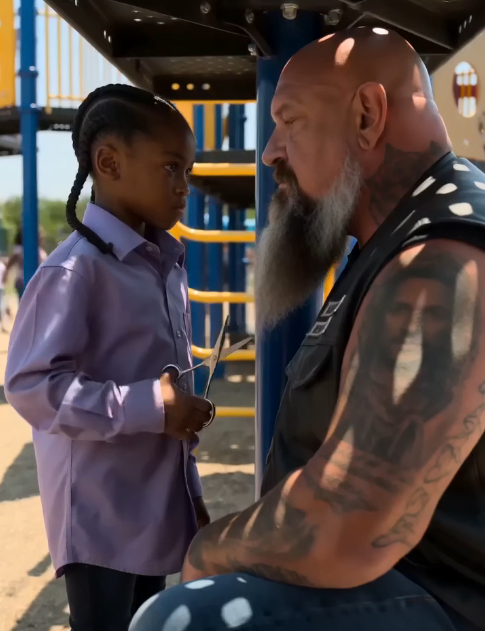
People screamed.
A woman at the craft table dropped a tray of paint. Two fathers ran toward my daughter. A young biker named Boone Mercer knocked over a folding chair as he charged across the rubber playground surface.
“Put those down!”
Nia did not.
She was nine years old, small even for her age, with tight braids, yellow sneakers and a purple T-shirt marked with finger paint. Her face had gone pale, but both hands remained wrapped around the scissors.
She cut again.
The biker did not stop her.
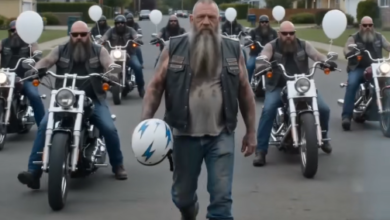
Ray “Hammer” Dawson was fifty-six, six feet four and close to 285 pounds. His head was shaved, his forearms and neck were tattooed, and the knuckles pressed against the playground decking were covered with old white scars. He wore faded jeans, heavy boots and a plain black leather vest without any name visible from the front.
He could have removed the scissors from Nia’s hands with two fingers.
Instead, he lowered his head.
“Closer to my chin,” he said.
Boone reached her first and grabbed her shoulders.
Hammer’s voice changed.
“Let her cut.”
Every adult stopped except me.
I was crawling beneath the climbing platform, searching for my four-year-old son.
“Caleb!”
He had disappeared less than a minute earlier. One moment he was following Nia through the low tunnel beneath the slide. The next, she came running toward the maintenance table, seized a pair of heavy scissors and sprinted back toward Hammer.
I thought she was attacking him.
So did everyone else.
What we could not see was Hammer’s left arm beneath the platform. He was holding Caleb’s weight against his chest while kneeling in an opening built for children. A damaged nylon retaining cord from the climbing net had dropped through a gap and looped beneath Caleb’s chin when he slipped from a foothold.
He was not hanging. Hammer had caught him before that happened.
But the cord remained tight.
Hammer’s long beard had become twisted into the same frayed knot while he tried to reach the fastening point. Every time he lifted his head to make room for his hand, his beard pulled the cord upward.
Nia saw it.
She saw her brother’s fingers clawing weakly at the nylon. She saw the beard wrapped through the knot. She saw that Hammer could not move without making the pressure worse.
Then she saw the scissors.
“Cut all of it,” Hammer told her.
Nia closed the blades again.
Boone released her.
A thick section of beard fell across Hammer’s leather vest, still tangled with the yellow nylon cord. The tension disappeared. Hammer lowered his chin, slipped two fingers beneath the loosened loop and pulled it away from Caleb.
My son drew one sharp breath.
Then another.
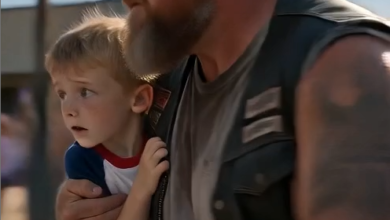
I reached them as Hammer crawled backward from beneath the platform. He emerged on one knee with Caleb held against his chest. My little boy’s eyes were open. His face was wet, and a red line crossed the skin below his chin, but he was breathing.
Hammer placed him into my arms.
“Keep his neck still,” he said. “Medics are coming.”
Nia stood beside us holding the scissors. Hair covered both her hands. A jagged half-beard remained on Hammer’s face, cut short on one side and hanging long on the other.
The crowd stared.
Seconds earlier, they had seen a child with scissors near a biker’s throat.
Now they saw the cord inside his severed beard.
Hammer gathered the fallen hair carefully. From among the strands, he removed a tiny faded blue thread tied near the end of an old braid.
His scarred hand began trembling.
Boone saw the thread and turned away.
“What is that?” Nia asked.
Hammer closed his fist around it. “Something my daughter tied there.”
Nia looked at the beard on the ground, then at the tears beginning to fill his eyes.
“I’m sorry.”
Hammer shook his head.
“You cut the right thing.”
That afternoon, the paramedics took Caleb to the hospital for evaluation. Hammer refused treatment for the cuts beneath his beard until my son had been loaded into the ambulance. Before I climbed inside, I watched him place every severed piece of hair into a clean medical bag.
On the front, he wrote two names.
NIA.
CALEB.
But the reason he had grown that beard for seventeen years—and what he eventually built to hold the piece my daughter cut—would change the way our family understood the frightening man beneath the playground.
Want to know why Hammer had never trimmed that braid and what he placed beside it inside the wooden box? Drop SCISSORS in the comments—I’ll share more soon.
Part 2 — The Biker Who Fixed Children’s Swings
My name is Jasmine Carter. I was thirty-six that summer, a Black American mother raising two children in Tulsa, Oklahoma, three miles from the apartment where I had grown up.
The playground sat beside an old stretch of Route 66 in the Red Fork neighborhood. It had a faded climbing tower, two plastic slides, a rope net and a rubber surface patched in five different shades of blue. Families liked it because the trees provided shade and the parking lot was close enough to carry sleeping children.
The Iron Lanterns had come there for a community repair day.
I almost left when I saw the motorcycles.
They arrived in a line shortly before nine, their V-twin engines rolling between houses and storefronts before going silent near the curb. Twenty-two riders dismounted carrying toolboxes, lumber, bottled water and grocery-store breakfast trays.
Hammer rode first.
He looked less like a volunteer than the man a cautious parent might expect volunteers to call for help removing. His long beard was braided near the bottom with faded blue thread. Tattoos covered both arms. A silver skull ring rested on one hand, and his boots had enough road dust to turn black leather gray.
Yet he spent the morning repairing a toddler swing.
He replaced cracked hardware, measured chain height twice and pulled against the seat with his full weight before allowing a child near it. When a father thanked him, Hammer pointed toward a city inspector.
“He signs it,” he said. “Not me.”
That detail mattered later. Hammer respected the line between helping and pretending to be qualified. The Iron Lanterns could sand benches, paint fences and carry materials. Certified contractors handled structural repairs.
The rope-net platform had been marked for professional work.
A yellow maintenance tag hung beneath it, warning that one retaining line showed wear. The city contractor had inspected the line two weeks earlier and scheduled replacement for Monday.
Saturday’s event was supposed to keep children away from that section.
Somebody removed the temporary barrier.
No one admitted doing it.
Nia and Caleb entered through a low tunnel on the opposite side, where the warning tag could not be seen. The line looked intact from above. Beneath the decking, however, its nylon sheath had split and several inner fibers hung loose.
My children were different in almost every way.
Nia noticed everything. She remembered where strangers parked, which teacher wore different earrings and whether a grocery cashier looked tired. Her school counselor called it hypervigilance. I called it what remained after their father left without saying goodbye.
Caleb noticed fewer things but felt them deeply. He had childhood apraxia of speech, which meant his thoughts often arrived faster than his mouth could organize words. At four, he used short phrases, gestures and a small communication card attached to his backpack.
Nia translated before anyone asked her.
She also watched him too closely.
I spent years telling her that she was his sister, not his second mother. She nodded and continued counting his breaths whenever he had a cold.
Hammer noticed their bond before I introduced myself.
Caleb had dropped a wooden train near the curb that morning. Hammer picked it up, but instead of approaching, he handed it to Nia.
“His?” he asked.
She nodded.
“Then you give it back.”
Nia studied him. “Why?”
“Because he trusts you.”
Hammer walked away.
Later, she told me she liked him because he did not speak to Caleb as if he were a baby. I told her liking strangers was not a reason to follow them.
She rolled her eyes.
At eleven, Hammer checked the rope-net platform and found the maintenance tag still attached. He told an organizer the barrier was missing. She promised to replace it after lunch.
Lunch arrived.
The warning did not.
Hammer returned to the area when he heard a sound beneath the decking. Not a scream. Caleb rarely screamed when frightened. It was a small repetitive knock—the wooden train striking a support post.
He knelt and looked through the opening.
Caleb had slipped between two low footholds. The damaged cord had dropped across his shoulder and under his chin. His feet still touched part of the structure, but he could not stand fully or move backward.
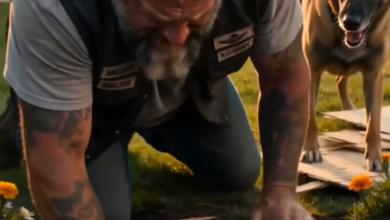
Hammer crawled in.
He did not pull the cord immediately because he could not see where it was anchored. Instead, he lifted Caleb from beneath the arms, taking the pressure off while calling for someone to contact emergency services.
Then his beard caught.
The same length that had become part of Hammer’s identity twisted into the frayed line. Blue thread, coarse hair and yellow nylon pulled into one tightening knot.
Hammer could support Caleb.
Or he could free his beard.
He could not do both.
Nia reached the opening before any adult understood what was happening.
She looked once.
Then she ran for the scissors.
Part 3 — Eleven Seconds Beneath the Platform
Security footage from the recreation center captured the entire rescue.
Eleven seconds passed between Nia seizing the scissors and Caleb’s first unrestricted breath.
The videos people posted online felt much longer. They showed my daughter racing toward a kneeling biker and lifting steel blades near his face. They showed Boone grabbing her. They showed adults screaming.
They did not show Caleb.
That was why the first reactions were so certain.
People believed Nia was out of control. Some thought she had been dared to cut Hammer’s beard. Others assumed she disliked bikers. One woman later admitted she believed my daughter had mistaken the beard for part of a costume.
The truth existed two feet below the camera’s view.
Hammer was folded almost double beneath the platform. His right knee pressed against rubber mulch. His left shoulder supported Caleb’s back while one hand cradled the base of the child’s head.
The damaged cord ran over Hammer’s beard, around a clump of hair and through a steel guide beneath the net. Pulling the loose end tightened everything.
Nia did not understand mechanical rigging.
She understood tension.
Her teacher had once shown the class how a loop tightened when both ends were pulled. Nia saw Hammer’s beard moving each time he shifted his head. She saw the cord pressing more firmly against Caleb.
“Cut him,” Caleb whispered.
Those were the first words anyone heard beneath the platform.
Nia did not mean to cut Hammer’s skin. She placed one hand between the blades and his chin, using her fingers as a barrier. The scissors came from the event’s first-aid table. They were sturdy trauma shears with a protected lower edge, left beside unopened supplies by an off-duty medic.
She positioned them around the beard.
Boone saw only steel near Hammer’s throat.
He ran.
Boone’s reaction came from more than club loyalty. Every Iron Lantern knew what Hammer’s beard represented. Nobody touched it. During charity events, children sometimes asked whether it was real, and Hammer allowed them to tug the end, but he never permitted adults to joke about cutting it.
Boone reached Nia after the first section fell.
He grabbed her shoulders.
The interruption made her lose the angle.
Hammer could feel the cord tightening again.
“Let her cut.”
Boone froze.
“Brother—”
“All of it.”
Hammer lowered his jaw until the blades rested near his chin. Nia cut through the second section. Then the third.
Hair fell across his chest. Some landed on Caleb’s wooden train. The final clump remained twisted around the nylon line.
Nia pulled it away.
The cord slackened.
Hammer slipped two fingers beneath the loop, but he did not yank it upward. He lowered Caleb’s body first, creating space, then eased the cord forward and away from the child’s neck.
Caleb inhaled.
The sound was faint beneath the crowd, but Nia heard it.
Her knees folded.
Boone caught her before she hit the ground.
Hammer crawled backward carrying Caleb. His uneven beard made him almost unrecognizable. One side remained twelve inches long. The other had been cut close to his jaw. A shallow nick marked his chin where the moving cord had dragged the scissors.
Caleb clung to his vest.
Hammer waited until I had both arms securely around my son before releasing him. Even then, Caleb kept one fist closed around a piece of the beard.
Paramedics arrived within minutes. They stabilized his neck and checked his breathing, circulation and responsiveness. He remained conscious. The red mark beneath his chin looked frightening but faded while we waited.
Hammer stood nearby with hair scattered across his boots.
One paramedic offered him gauze for the cut.
“Kid first.”
The medic nodded toward Caleb. “He’s being handled.”
Hammer accepted the gauze only after I told him to.
Police closed the play structure. A certified inspector arrived and photographed the cord, missing barrier and damaged retaining guide. The event organizer could not explain why families had been allowed near a restricted section.
The city announced an investigation.
None of that mattered to Nia.
She stared at the blue thread inside Hammer’s severed braid.
“I ruined it,” she whispered.
Hammer heard her.
“No.”
“It was your daughter’s.”
He looked down at the hair in his hands. The lower braid remained intact, held together by the faded thread. Nia had cut above it.
“You saved the part she tied.”
Nia shook her head. “I cut your beard.”
“You cut your brother loose.”
Boone turned away, rubbing both hands over his face. He had frightened Nia, delayed her and nearly pulled the scissors off course.
Hammer placed the severed braid into Boone’s palm.
“Bag it.”
Boone stared at him.
“Clean bag,” Hammer said. “Don’t lose the blue tie.”
That command gave Boone something useful to do. He found a sealed medical pouch and collected every section he could see. Other bikers searched the rubber surface, lifting wood chips and checking beneath benches for smaller pieces.
Adults who had shouted at Nia were now gathering a biker’s hair.
The scene would have looked ridiculous anywhere else.
At that moment, it felt ceremonial.
As paramedics wheeled Caleb toward the ambulance, he opened his fist. The piece of beard he had been holding lay across his palm.
He offered it to Hammer.
Hammer closed Caleb’s fingers around it again.
“Keep that one,” he said.
Caleb touched the uneven line along Hammer’s jaw.
“Fix?”
Hammer’s eyes filled, though no tears fell.
“Yeah, little man.”
Then he looked at Nia.
“We’ll fix it.”
Part 4 — Why the Beard Had Never Been Cut
Hammer’s daughter was named Grace Dawson.
She would have been thirty-two the year Nia cut his beard.
Grace was diagnosed with leukemia at fourteen. Before that, Hammer had kept his beard short enough to fit beneath welding masks. He worked construction, rode with the Iron Lanterns on weekends and drank more than he admitted.
Illness changed the measurements of his life.
Hospital rooms replaced bars. Medication schedules replaced club runs. He learned which vending machine accepted wrinkled bills and which night nurse allowed fathers to sleep in empty family rooms.
Chemotherapy took Grace’s hair.
She handled the first weeks with jokes. She wore hats, drew eyebrows with a marker and told Hammer his shaved head made them twins. Then one morning, she refused to look at herself in the bathroom mirror.
Hammer sat beside her.
“What do you need?” he asked.
“Grow enough for both of us.”
So he did.
Grace measured his beard every month with a paper ruler taped beside her hospital bed. When it reached three inches, she made the first braid. When it reached five, she tied blue embroidery thread around the end.
“Don’t cut it until I grow mine back,” she said.
Grace’s hair returned briefly during remission.
The cancer returned too.
She died seventeen years before the playground accident.
Hammer never cut the braid.
The Iron Lanterns understood that the beard was not fashion. It was a promise that had outlived the person who requested it. Boone had joined the club after Grace’s funeral and knew the story only through older members, but he treated that blue thread as if it were a patch earned in war.
Nia had severed the beard above Grace’s braid.
By chance, urgency or something Hammer refused to name, the blue thread remained untouched.
I learned this at the hospital while Caleb slept beneath a light blanket. Doctors found no serious injury, but they kept him for observation. Nia sat beside his bed, turning the closed trauma shears over in her hands.
Hammer waited in the hallway.
Someone had trimmed the remaining side of his beard enough to make it even, leaving him with a rough two-inch growth along his jaw. Without the long hair, his face looked older and more vulnerable. A pale scar crossed his chin. Deep lines bracketed his mouth.
He carried the medical pouch containing the severed beard.
I invited him inside.
Nia stared at the floor. “Are you mad?”
“No.”
“You should be.”
“Why?”
“Because your daughter can’t braid it again.”
Hammer sat in the chair beside her. The furniture creaked beneath his weight.
“No,” he said. “She can’t.”
Nia looked up.
Hammer placed the sealed pouch on the table. “That was true yesterday too.”
The words were not gentle, but they were honest. Grace’s memory had not lived inside hair. The beard had merely given Hammer something physical to protect when he could no longer protect his daughter.
Nia had forced him to choose.
He chose Caleb.
“I promised I wouldn’t cut it,” Hammer said. “Didn’t promise somebody else couldn’t when it mattered.”
Nia almost smiled.
Then she remembered Boone grabbing her. “Your friend thought I was hurting you.”
“So did your mother.”
I felt the sentence land.
Hammer glanced at me. “Both had reason.”
“I should have seen Caleb leave the tunnel,” I said.
“No.”
“I was right there.”
“So was I.”
“You found him.”
“Because he kept hitting a post with that train.”
Nia looked toward the toy on Caleb’s hospital tray. One corner had been scraped by the steel support.
Caleb had not called for help because speech failed him under stress. He used the object in his hand to create a pattern someone might notice.
Hammer noticed.
Nia understood.
Neither action alone would have saved him. Hammer supported Caleb but could not free the knot. Nia could cut the beard but could not lift her brother. Boone initially interfered, then gathered the severed pieces. Leon cleared space. Rosa guided paramedics to the structure.
The rescue belonged to several imperfect people.
Hammer removed the old blue thread from the braid and placed it inside his wallet. He left the hair inside the pouch.
“What will you do with it?” Nia asked.
“Build something.”
“What?”
“Don’t know yet.”
Caleb woke near sunset. He saw Hammer’s shortened beard and frowned.
“Gone.”
Hammer nodded. “Most of it.”
Caleb looked at Nia.
“Cut.”
She waited for accusation.
Caleb reached for her hand.
“Good cut.”
Nia began crying for the first time that day.
Hammer stood and walked toward the window, giving both children privacy. Beneath the glass, an ambulance crossed the hospital entrance with no siren.
His reflection showed a face he had not seen in seventeen years.
He touched the short beard once.
Then he let his hand fall.
Part 5 — The Video That Left Caleb Out
By Sunday morning, a video titled CHILD ATTACKS BIKER AT PLAYGROUND had passed one million views.
It lasted eight seconds.
The recording showed Nia raising scissors, cutting Hammer’s beard and Boone pulling her backward. Caleb remained invisible beneath the platform. The cord did not appear. The rescue occurred after the clip ended.
Comments blamed me.
They called Nia undisciplined. Some demanded police involvement. Others praised Boone for protecting Hammer from an “out-of-control child.”
A second video created the opposite lie. It showed Hammer kneeling close to Nia while adults surrounded them, and viewers accused the bikers of intimidating a little girl.
Context arrived slowly.
The recreation center released wider security footage after receiving permission from everyone involved. It showed Hammer entering the structure, Caleb slipping, Nia recognizing the tangled line and the beard falling as the cord loosened.
The city inspector’s report confirmed that the damaged retaining cord should have been replaced and the play section should have remained closed. The missing barrier became the focus of an administrative review.
People who insulted Nia began calling her brilliant.
She disliked that almost as much.
“I wasn’t brilliant,” she told a local reporter. “I had scissors.”
The reporter asked whether she had been afraid of Hammer.
Nia considered the question.
“Before or after?”
“Before.”
“Yes.”
“And after?”
She looked toward Hammer, who stood beyond the camera beside the repaired toddler swing.
“A little.”
Hammer laughed.
The Iron Lanterns received offers from manufacturers hoping to donate playground equipment in exchange for publicity. Hammer rejected any agreement requiring the club or children to appear in advertisements.
They accepted help from a local accessibility nonprofit instead.
The entire climbing structure was professionally removed. Certified contractors installed a lower platform with enclosed tension points, protected fasteners and clear inspection access. The design included sensory panels and a communication board for children like Caleb.
Club members handled permitted support work: hauling old material, repainting benches and preparing meals for volunteers.
Hammer worked without his vest because summer heat settled heavily over Tulsa. His newly shortened beard exposed a small tattoo beneath his jaw that read GRACE in plain letters.
Nia noticed.
She said nothing.
Boone avoided her for the first two workdays. On the third, he brought a new pair of trauma shears sealed inside a protective case.
Nia would not take them.
“I already have some.”
“These are mine,” Boone said. “I want you to hold them.”
“Why?”
“Because I grabbed you before I looked.”
Nia studied him with the severity only nine-year-olds can manage.
“You thought I was hurting your friend.”
“I did.”
“I thought Hammer was hurting Caleb until I saw his arm.”
Boone nodded. “Then you looked closer than me.”
She accepted the case.
Hammer had kept his promise to build something for the beard.
He used a section of oak salvaged from the old platform, though he refused to use any piece connected to the damaged cord. A local carpenter helped him construct a narrow wooden box with brass hinges and a clear protective lid.
Inside, he placed the severed braid, the faded blue thread and the small piece Caleb had held.
A metal plate rested on the lid.
NIA & CALEB CARTER.
Beneath their names were four words.
THEY BOTH HELD ON.
Hammer installed no lock.
When Nia asked why, he said, “Nothing in there needs protecting from you.”
The box went to the Iron Lantern clubhouse, where the three damaged sections of nylon line were mounted beside the inspector’s report. New prospects heard the story during safety orientation.
Not the version about a fearless biker.
The complete version.
Hammer had entered a restricted structure alone. He had not assigned someone to keep adults away from the scissors. Boone reacted before understanding. The missing barrier had been overlooked by multiple people.
Caleb survived because Nia saw the one thing every adult missed.
The beard was not merely caught in the cord.
It had become part of the knot.
That distinction changed the lesson. Sometimes the person who looks like the rescuer can also become part of the danger without meaning to.
Hammer never resisted that truth.
“Kid cut me loose too,” he said.
Part 6 — Saturday Braids
Hammer’s beard grew back.
Not to its old length. He trimmed it when it reached his collar, though the first haircut required Nia to sit in the barbershop with him.
He told no one he was nervous.
Nia knew.
She sat beside the chair holding Grace’s faded blue thread. The barber asked how short Hammer wanted the beard.
“Ask her.”
Nia frowned. “It’s your face.”
“Learning.”
She told the barber to leave enough for one small braid.
Afterward, Nia tied a fresh blue cord around it. Grace’s original thread returned to the wooden box.
Saturday visits became routine. The Iron Lanterns maintained benches and hosted first-aid classes through qualified instructors. Caleb tested every sensory panel at the rebuilt playground and informed workers, through gestures and short words, whenever something felt loose.
Hammer listened to him.
That mattered more than speaking perfectly.
Whenever a child disappeared beneath the climbing platform, adults could now see through open safety panels. The cords were enclosed. Inspection tags hung at eye level on both sides.
The city had changed the structure.
Hammer changed too.
He no longer guarded Grace’s memory by refusing every haircut. On the anniversary of her death, he opened the wooden box, touched the old braid and told Nia one story about his daughter.
Never more than one.
The first year, he told her Grace hated orange gelatin.
The second, he described how she cheated at checkers.
The third, he admitted she had named his first Harley Margaret because she said motorcycles deserved elderly-lady names.
Nia collected those details carefully.
Caleb preferred the beard itself. He twisted the short braid around one finger whenever Hammer carried him. Hammer complained that children had destroyed all dignity the club ever possessed.
Leon replied, “You wore a tea-party crown for Grace.”
“That was classified.”
It was not.
A photograph appeared on the clubhouse wall the following week.
Hammer wearing a paper crown.
Grace braiding his new beard.
Nia holding scissors far from everyone’s face.
Part 7 — The Second Ribbon
The rebuilt playground opened eighteen months after the accident.
Nia was asked to cut the ceremonial ribbon.
She refused unless Caleb held the scissors with her.
City officials positioned both children in front of the new climbing structure. Cameras waited. The Iron Lanterns stood behind the crowd rather than beside the podium.
Hammer remained near the toddler swings.
His beard had grown long enough for a single braid. Fresh blue cord tied the end. Grace’s original thread remained inside the wooden box at the clubhouse, resting beside the hair that had once tightened a dangerous knot and then fallen free.
Nia placed Caleb’s hands over hers.
Together, they cut the ribbon.
The blades closed cleanly.
Applause crossed the playground, but Caleb turned toward Hammer instead. He ran across the rubber surface and wrapped both arms around the biker’s leg.
Hammer lifted him.
Nia followed more slowly.
“You still have the box?” she asked.
“Clubhouse shelf.”
“Do you ever wish I hadn’t cut it?”
Hammer looked at the climbing platform, then at Caleb breathing comfortably against his shoulder.
“No.”
“Not even a little?”
“Miss the beard.”
Nia raised an eyebrow.
“Don’t miss the knot,” he added.
She accepted that.
Before leaving, Hammer knelt so Nia could tighten the blue cord around his braid. Her fingers moved carefully, separating strands without pulling. Caleb watched from beside her, holding the wooden train that had first alerted Hammer beneath the platform.
A photographer captured the three of them.
No scissors.
No cord.
No frightened adults reaching for a child.
Only a huge tattooed biker kneeling while a girl braided his beard and her little brother leaned against his leather-covered shoulder.
That photograph eventually hung above the wooden box.
Beneath it sat the trauma shears Boone had given Nia, still sealed in their case.
The Iron Lanterns started their motorcycles along Route 66. Hammer waited until every family had crossed the parking area before pulling away.
Nia waved.
Caleb touched the line beneath his chin, now faded almost completely, and called after him.
“Good cut!”
Hammer’s laughter carried above the engines.
Follow the page for more unforgettable biker stories about frightening misunderstandings, quick-thinking children and the quiet courage hidden beneath leather, scars and impossible first impressions.