An Eight-Year-Old Girl Pulled the Fiercest Biker Out of a Hospital Line and Whispered One Sentence—Then the Bracelet on Her Wrist Reopened His Daughter’s Final Months
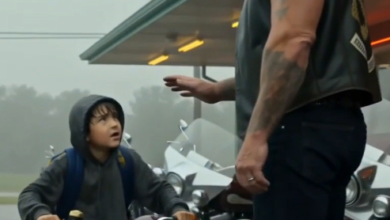
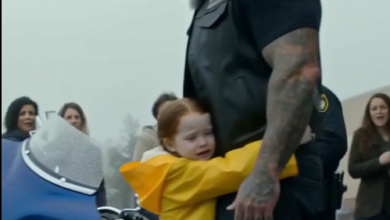
The little girl pulled me out of a crowded hospital line, looked at the tattoos covering both my arms, and whispered, “My mommy said you hate hospitals too.”
She was eight years old.
Maybe nine.
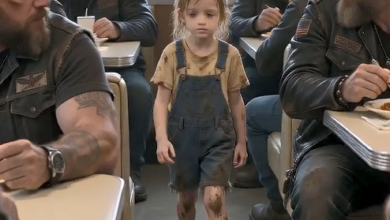
She wore purple sneakers, a yellow cardigan, and a hospital identification band around her left wrist. Her dark hair had been divided into two uneven braids, one tighter than the other, as if her mother had fixed them while thinking about something frightening.
I was fifty-six, six-foot-four, and almost 285 pounds. My head was shaved. My beard had gone gray around the chin, and both forearms were covered in old tattoos. A faded black leather cut rested over my shoulders, while heavy motorcycle boots made too much noise against Mercy Ridge Medical Center’s polished floor.
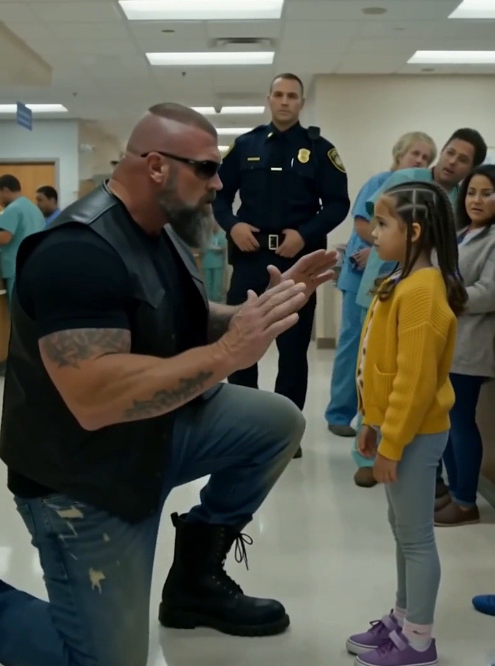
People had already been staring at me.
Then the child took my hand.
A security guard near the elevators immediately stepped forward. A nurse stopped pushing her supply cart. The parents standing in the admissions line looked from the little girl to me and formed the conclusion strangers always formed when they saw a frightened child beside a man who looked like trouble.
I released her hand at once and raised both palms.
“You know this man?” the guard asked.
The girl shook her head.
That did not help.
“My mommy knows him,” she said.
I looked across the lobby, but nobody waved. Dozens of patients crowded the registration desks. A woman in a green sweater sat near the pediatric corridor with her head lowered, but I could not see her face.
The guard asked the girl where her mother was.
She pointed toward that woman.
Then she turned back to me.
“You’re supposed to come with me.”
“I think you’ve got the wrong guy, sweetheart.”
“No.” Her voice softened. “Mommy said you would pretend that.”
Behind me, Boone muttered something under his breath.
Four members of my riding club had brought me to the hospital that morning because I had canceled the same appointment twice. A scan had found a shadow in my right lung. My doctor wanted a biopsy.
I wanted a highway.
The last time I had spent more than an hour inside a hospital, my nine-year-old daughter had died before sunrise.
That had been seventeen years earlier.
Since then, I had visited injured brothers in emergency rooms, delivered toys to pediatric wards, and sat beside families who needed another body in the room. But I never entered alone, never stayed after midnight, and never allowed anyone to close a hospital door behind me.
Hospitals remembered too much.
Boone knew I was looking for an exit. That was why he had positioned himself between me and the sliding doors.
The girl tugged my little finger.
“Mommy said there’s a quiet stairwell.”
“A stairwell?”
“When the hospital gets too loud, we go there. You can come too.”
It was not a request for help.
She believed she was helping me.
The security guard’s posture changed slightly. He still watched my hands, but he stepped aside when the girl led me toward the pediatric corridor.
I followed because refusing her felt cruel.
We made it six steps.
Then I noticed the bracelet.
It was woven from two faded blue cords and one yellow cord, knotted around a small silver motorcycle charm. Near the clasp sat a single red glass bead with a white scratch across its center.
My boots stopped moving.
The child nearly lost her grip on my finger.
“Where did you get that?”
She looked down at her wrist. “Mommy gave it to me.”
“Where did she get it?”
“I don’t know.”
I crouched until my knees cracked. The lobby blurred around her wrist.
Seventeen years disappeared.
I was back in a pediatric oncology room, sitting beside a child who had lost her hair but refused to remove her pink motorcycle bandanna. My hands had been too large for jewelry, so a nurse taught me how to braid embroidery cord.
I made two bracelets.
One for my daughter, Emily Dawson.
One for myself.
Emily wore hers during the final four months of her life. The blue cords represented my motorcycle. The yellow one was the color of the bedroom she wanted after leaving the hospital. The tiny motorcycle charm came from a necklace I had owned since I was sixteen.
The red bead had cracked when Emily struck it against a bedrail.
I knew that scratch.
I knew the uneven knot beside it because I had tied it badly and refused to redo it when she said imperfect things were harder to lose.
The bracelet disappeared the night Emily died.
I had searched her room, the laundry bag, her blankets, and every drawer. Nurses helped. My club brothers checked the family lounge and parking lot.
We never found it.
Yet it was now fastened around the wrist of a child who had not been born when Emily took her last breath.
I reached toward it but stopped before touching her.
“What’s your name?”
“Mia.”
“Mia, I need you to tell me your mother’s name.”
“Hannah.”
The name meant nothing.
Then Mia pulled a folded photograph from her cardigan pocket.
It showed two girls sitting together in a hospital bed. One was thin, bald, and laughing beneath a pink bandanna.
Emily.
The other was a teenage girl I only vaguely remembered.
On the back was a date from seventeen years earlier and one sentence in my daughter’s handwriting.
I could not read it because my vision had begun to shake.
“Mommy said you might get mad,” Mia whispered.
“I’m not mad.”
“Then why are you crying?”
I touched my face.
She was right.
Across the lobby, the woman in the green sweater stood. She was pale, perhaps thirty-two, with one hand braced against the wall. Her eyes met mine.
Recognition crossed her face.
Then fear.
She turned toward the pediatric corridor as if she intended to leave before I reached her.
I stood too quickly.
“Hannah!”
She stopped.
Every head in the lobby turned toward us.
Mia gripped my vest and whispered, “Mommy said the bracelet belonged to the bravest girl she ever knew.”
I looked at the silver motorcycle, the cracked red bead, and the knot my hands had made during the worst winter of my life.
Then Hannah spoke from across the lobby.
“Emily gave it to me,” she said. “And she made me promise I would return it when you were finally ready to hear what she couldn’t tell you.”
Before that day ended, the girl wearing my daughter’s bracelet would lead me back into the hospital room I had avoided for seventeen years—and reveal whom Emily had truly been trying to save.
Part 2 — The Daughter Who Made Me Learn Knots
Emily was six when she first asked why people stared at me.
We were outside a grocery store in Riverside, Ohio. She sat on my shoulders while I carried two bags and tried not to knock over a display of pumpkins.
A woman saw my tattoos and pulled her son closer.
Emily noticed.
“Does she think you bite?”
“Probably.”
“Do you?”
“Only vegetables.”
She considered that answer, then leaned forward and bit the top of my ear.
That was Emily.
Small. Fearless. Too curious for simple answers.
Her mother, Claire, used to say Emily had inherited my stubbornness without inheriting the sense to hide it. Claire and I had separated when Emily was four, but we lived ten minutes apart and managed parenthood better than marriage.
Every Friday, Emily waited on the porch with a purple backpack.
If the weather was good, I arrived on my blue Harley with a child seat mounted behind me. She wore a white helmet covered in star stickers and demanded that I circle the neighborhood twice before going home.
She called the motorcycle Bluebird.
At night, she slept with my old leather glove beneath her pillow because she said it smelled like me. Motor oil and road coffee were apparently comforting to a six-year-old.
Then she started bruising.
At first, Claire blamed playground falls. When Emily developed a fever that would not break, we took her to Mercy Ridge.
Blood tests became more tests.
A doctor asked us to sit down.
Leukemia.
I understood the word but not the sentence surrounding it. Claire cried immediately. I stared at the doctor’s tie and counted the tiny blue squares until the room stopped tilting.
The first months were treatment schedules, medication names, plastic chairs, and promises adults made because children were watching.
I fixed what I could.
A loose wheel on an IV pole. A squeaking bathroom hinge. A broken toy ambulance in the playroom.
Machines made sense.
Emily’s illness did not.
During one long admission, a nurse named Teresa brought embroidery cord into Emily’s room. The pediatric unit was making friendship bracelets to pass the hours.
Emily ordered me to participate.
“I don’t make jewelry.”
“You fix wires.”
“Wires don’t move.”
“String doesn’t move either.”
The first bracelet fell apart before I finished it. The second became a knot nobody could untangle. Emily laughed until her monitor alarmed, and Teresa had to calm both of us.
On the third attempt, I managed a braid.
Blue for Bluebird.
Yellow for the bedroom Emily planned to repaint after treatment.
She selected one red bead from the craft box because it reminded her of my motorcycle’s taillight. Then I removed the small silver bike charm from an old necklace and fastened it to the cord.
Emily held out her wrist.
“Make it tight.”
“Not too tight.”
“Tight things stay.”
I tied the final knot badly. One loop remained larger than the others.
“I can redo it.”
“No.” She turned the bracelet under the hospital light. “It looks like you made it.”
For four months, she never removed it.
That was when Hannah Vale entered the room across the hall.
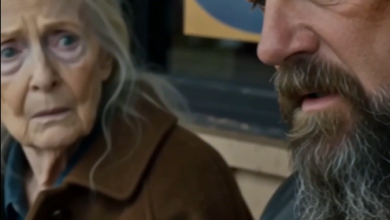
Hannah was fifteen and receiving treatment for a rare bone cancer. She was quiet, sharp-eyed, and angry at every adult who used the word brave when they meant trapped.
Emily liked her immediately.
She rolled her IV pole into Hannah’s room and asked whether teenagers were legally required to be grumpy.
Hannah told her to leave.
Emily returned the next day.
By the end of the week, they were sharing books, card games, and snacks. Hannah taught Emily how to draw horses. Emily taught Hannah how to make engine sounds with her lips whenever a doctor entered.
I saw Hannah often, but we barely spoke. I remembered her mother visiting twice, then disappearing. A social worker handled most of her care. I assumed there was family somewhere.
Emily never asked.
She understood that some questions make lonely people defend their loneliness.
Instead, she told Hannah about motorcycles. She described every road we planned to ride once she recovered. Lake Erie. Nashville. The Blue Ridge Parkway.
Hannah listened.
Sometimes she looked at me with an expression I could not read.
One evening, I found Emily sitting beside Hannah’s bed. Their hands were beneath the blanket. When Emily saw me, she smiled too quickly.
“What are you doing?”
“Nothing.”
That answer meant trouble.
A week later, Emily’s bracelet was gone.
She claimed it had slipped off in the laundry. I searched everywhere. Teresa contacted housekeeping. Boone checked trash bins because he did not know what else to do.
Emily watched us search without joining.
I should have understood.
But by then her treatment had stopped working, and I was too frightened to recognize anything that did not look like a medical emergency.
During Emily’s final night, I sat beside her bed with my head against the rail. She woke shortly before three and asked whether I still hated hospitals.
“I hate what happens in them.”
“Good things happen too.”
“Name one.”
“You made my bracelet here.”
“I lost your bracelet here.”
She smiled faintly.
“Maybe it isn’t lost.”
Those were nearly her final words to me.
After she died, I turned that sentence into an accusation. I blamed myself for failing to find the bracelet, as though recovering a circle of string could have changed the empty bed.
Claire moved to Oregon two years later. She could no longer drive past Mercy Ridge. We remained in contact, but grief had made ordinary conversation feel dishonest.
I stayed.
I became Hammer to the club and Mr. Dawson to everyone else. Ray belonged to people who knew me before Emily died.
Hospitals became territory I crossed only for other people.
When Boone had a motorcycle accident, I remained beside him for thirty-one hours. When Luis’s wife delivered twins, I waited downstairs. When Doc underwent heart surgery, I slept in the parking garage.
But I never attended my own appointments without an escort.
That morning, Boone and three brothers had practically surrounded me in the admissions line. The shadow in my lung might have been scar tissue. It might have been something worse.
I had already canceled twice.
Mia pulled me away before I could cancel a third time.
Now her mother stood ten yards away, holding the promise Emily had left between us.
I walked toward Hannah.
She did not retreat.
Up close, I recognized her eyes. The furious fifteen-year-old was still there beneath seventeen years of living.
“You had the bracelet,” I said.
“Yes.”
“All this time?”
“Yes.”
“Why didn’t you find me?”
“I tried.”
Her answer carried no defense.
She opened her handbag and removed a stack of returned envelopes. Every one bore my old address. Some had been mailed years apart. Others were recent.
“I didn’t know your club name,” she said. “I only knew you as Emily’s dad.”
I looked at Mia.
“Why bring her here?”
Hannah’s expression changed.
“We’re not here for me.”
Mia’s hand closed over the bracelet.
She was scheduled for a bone marrow test in less than an hour.
And Hannah was terrified that history had followed her daughter into the same hospital.
Part 3 — The Door Neither of Us Could Cross
Mia had been bruising for three weeks.
Her pediatrician found abnormal blood counts and referred her to Mercy Ridge for further testing. The doctors had explained that several conditions could cause the results, many treatable, but Hannah heard only the words that had defined her own adolescence.
Bone marrow.
Oncology.
Biopsy.
She had slept less than four hours in three days.
Mia knew something was wrong, though no one had told her what doctors feared. Children rarely need the full vocabulary to recognize terror. They hear it in whispered phone calls, see it in unanswered questions, and feel it in the grip of a parent’s hand.
Hannah had given Mia the bracelet that morning.
“Who is Emily?” Mia had asked.
“The girl who taught me hospitals don’t get the final word.”
Then Hannah saw me in the admissions line.
She recognized my face from the photograph and my vest from Emily’s stories. Age had changed me, but not enough.
According to Hannah, I looked as frightened as she felt.
That was why she told Mia, “That man hates hospitals too.”
She had not expected her daughter to walk over and retrieve me.
“I only meant he might understand,” Hannah said.
Mia frowned. “You said people who understand should sit together.”
Hannah closed her eyes.
“Apparently, she remembers everything.”
I almost smiled.
A nurse appeared and called Mia’s name.
The girl’s fingers locked around my leather vest.
“No.”
Hannah knelt. “Sweetheart, we talked about this.”
“I changed my mind.”
The nurse waited patiently. She explained that Mia could bring the bracelet and that her mother could remain until sedation began.
Mia shook her head.
“No room.”
“What do you mean?” Hannah asked.
“The room is full.”
The pediatric hallway around us remained nearly empty, but I understood.
The room in Mia’s mind was already occupied by every fear her mother had tried to hide.
I crouched.
“Want to see the stairwell?”
Mia studied my face. “Are you coming?”
“As far as they let me.”
The nurse hesitated. I was not family. I was not an approved guardian, and my sudden involvement with a child had already attracted security’s attention.
Hannah spoke first.
“He comes with us.”
The nurse led us through two locked doors. Boone and the others remained in the lobby, along with my own unfinished registration forms.
The closer we came to the procedure room, the harder Mia pulled against my hand. Her breathing quickened. Hannah tried counting with her, but her own voice began shaking.
I knew that sound.
Claire had made it during Emily’s final admission—the sound of a mother trying to build a bridge while drowning beneath it.
I stopped walking.
“Everybody sit.”
The nurse looked surprised.
I lowered myself against the hallway wall. Mia sat beside me. Hannah followed, folding her knees beneath her.
“What are we doing?” Mia asked.
“Waiting for our engines to cool.”
“I don’t have an engine.”
“Sure you do.”
I placed two fingers against the pulse in her wrist, carefully avoiding the bracelet.
“There.”
She felt it.
Hannah placed her fingers against her own pulse.
Three people sat on the floor of a hospital corridor, measuring fear in heartbeats.
I told Mia about Bluebird without telling her about the girl who named it. I explained that motorcycle engines became louder when riders demanded too much from them. Sometimes the right answer was to stop, breathe, and let the heat settle.
“How long?”
“Five breaths.”
“Then we go?”
“Then you decide whether you can take five more.”
She did.
Five became ten.
Then Mia stood.
At the procedure-room door, she removed the bracelet and held it toward me.
“Keep it until I wake up.”
I stepped back.
“No.”
Her eyes widened.
“That belongs with you.”
“But what if I lose it?”
I opened the small inner pocket of my leather cut.
“Then we put it here together.”
Mia placed the bracelet inside. I snapped the pocket closed.
“Safe?”
“Safe.”
The nurse allowed me into the preparation area but not beyond. Mia lay beneath a heated blanket while Hannah stood beside her. I remained near the door, large enough to look ridiculous among painted clouds and cartoon animals.
Mia watched me until the medication made her eyes heavy.
“My mommy was right,” she murmured.
“About what?”
“You do hate hospitals.”
Then she fell asleep.
The doors closed.
Hannah and I entered the waiting room.
Only then did Boone find us.
He pushed through the doorway holding my biopsy paperwork. Anger tightened his jaw.
“Your appointment was forty minutes ago.”
“I know.”
“They’re trying to fit you back in.”
“Later.”
“No.”
He looked at Hannah, at the pediatric signs, and at the closed procedure doors.
“You’re not using another kid to run from your own test, brother.”
The words landed hard because they were true enough to hurt.
I stood.
Hannah moved between us.
“He’s helping my daughter.”
“And avoiding his own doctor.”
“This isn’t your business.”
“It’s been my business since I watched him cancel twice.”
Boone and I had ridden together for twenty-eight years. He had never spoken about Emily unless I began. He understood that grief was not a door friends could kick open.
But he also knew my tricks.
Helping other people had become the cleanest disguise for neglecting myself.
“You promised,” Boone said.
“I’m not leaving Mia.”
“Doc is coming.”
“She asked me to stay.”
“And Emily asked you to live.”
The waiting room fell silent.
I grabbed Boone’s shirt.
He did not raise his hands.
He did not challenge me.
He simply looked into my face and said, “There you are.”
I released him.
My scarred fingers trembled.
A nurse stepped into the room and announced that Mia’s procedure was complete. She had tolerated it well, but preliminary answers would take time.
Hannah sagged into a chair.
That looked like the crisis ending.
The child had crossed the door. Her mother was breathing again. Boone had found an afternoon slot for my biopsy.
Then another nurse hurried toward us.
Mia had awakened disoriented, pulled out her IV, and was calling for the bracelet.
I reached into my vest.
The pocket was empty.
The snap remained closed, but the bracelet was gone.
For seventeen years, I had believed losing it once was the worst thing that object could do to me.
I was wrong.
Part 4 — The Promise Hidden in the Inner Pocket
We searched the hallway.
The nurse checked Mia’s blankets. Boone emptied the chairs. Hannah examined the floor between the waiting room and procedure door.
I turned my leather cut inside out.
Nothing.
Mia’s cries carried through the wall.
I remembered Emily asking for the same bracelet after a difficult treatment. I remembered searching beneath her mattress while she watched me with that secret smile.
Maybe it isn’t lost.
My chest tightened.
Boone saw it happen.
“Ray, sit down.”
“I’m fine.”
“You’re gray.”
“I said I’m fine.”
A familiar pressure spread beneath my ribs. It was not a heart attack. I knew that much. It was the old panic I had spent years disguising as anger.
The hallway narrowed.
The fluorescent lights grew louder.
I placed one hand against the wall and felt seventeen years collapse into one corridor.
Then Hannah reached inside my cut.
She found a slit in the lining near the pocket seam. The bracelet had slipped between the leather and fabric.
It was still there.
She worked it toward the opening and pulled it free.
The red bead caught the hospital light.
My knees weakened.
Hannah placed the bracelet in my palm, but she did not release it.
“There’s something you need to know before you give this back.”
I wanted to go to Mia.
“So tell me while we walk.”
We entered the recovery room together. Mia was sitting up, crying beneath a blanket while two nurses tried to calm her.
The moment she saw the bracelet, she reached for it.
I stopped beside the bed.
Hannah shook her head.
“Not yet, sweetheart.”
Mia looked betrayed.
“It belongs to Emily,” Hannah said. “And Emily gave it to me for a reason.”
That was when Hannah finally told the full story.
Seventeen years earlier, on the night before Emily’s condition worsened, the two girls had been awake after midnight. Hannah was scheduled for surgery the following morning. Her mother had not returned, and the social worker had gone home.
Hannah was frightened.
Emily rolled her IV pole across the hall and climbed into the chair beside her. She removed the bracelet from her wrist.
Hannah refused it.
“It’s your dad bracelet.”
“That’s why it works.”
“What does it do?”
“It reminds you somebody tied you to the world.”
Emily fastened it around Hannah’s wrist.
Then she made Hannah promise three things.
First, she would wear it into surgery.
Second, she would not return it until she had done something she believed she would never live long enough to do.
Third, if she ever saw my father inside a hospital looking like he wanted to run, she would give it back because he was more afraid than either of them.
Hannah survived surgery.
She completed treatment.
At twenty-three, she became a pediatric social worker. At twenty-four, she married a high-school history teacher named Marcus Vale. At twenty-five, she became pregnant with Mia.
Holding her newborn daughter, Hannah finally completed the impossible thing Emily had named.
She could have returned the bracelet then.
She tried.
Letters sent to my old address came back. Claire had moved. Mercy Ridge could not disclose information. The club I rode with in those years had disbanded, and “Ray Dawson” produced too many names.
Hannah kept searching intermittently.
Then Marcus died in a construction accident when Mia was four.
Grief narrowed Hannah’s world. The bracelet moved into a keepsake box. She could no longer chase a man who might not want to be found.
Until that morning.
She recognized me in the admissions line.
But why send Mia instead of approaching me herself?
“Because Emily made me promise one more thing,” Hannah said.
She reached into her handbag and produced a sealed envelope.
The front carried my daughter’s handwriting.
FOR DAD—WHEN HE COMES BACK TO THE HOSPITAL FOR HIMSELF.
My hands would not take it.
Emily had known me too well.
Even at nine, even while dying, she understood I might spend the rest of my life entering hospitals for everyone except myself.
Hannah had been instructed not to deliver the letter during another person’s emergency. Not when I visited an injured rider. Not at a charity event. Not while somebody else needed care.
Only when I returned for my own treatment.
“How did you know why I was here?” I asked.
Hannah nodded toward Boone.
“He was arguing with registration about your missed biopsy.”
Boone looked almost embarrassed.
Mia wiped her face.
“Mommy said you needed the bracelet more today.”
I sat beside her bed.
The child who might have been facing a serious diagnosis had walked across a crowded lobby because she believed a frightening stranger needed courage.
She had not pulled me from the line to prevent my appointment.
She had pulled me out so I would stop pretending I was not afraid.
I opened Emily’s letter.
The paper contained only six lines.
Dad, Hannah thinks she is going to die.
You think you have to save both of us.
You don’t.
You already made the scary part feel less lonely.
If you ever get sick, let somebody do that for you.
Stay in the room.
No farewell.
No accusation.
No demand that I be strong.
Just stay in the room.
I had spent seventeen years believing Emily’s final months were proof that I had failed. She had remembered them differently. She remembered the badly braided bracelet, the motorcycle stories, the repaired IV pole, and her father sleeping upright beside the bed.
I had not saved her life.
But I had stayed.
Mia held out her wrist.
I fastened the bracelet around it.
Then Boone handed me the rescheduled biopsy papers.
“Two-thirty,” he said.
I checked the clock.
Thirty-seven minutes.
I stood.
Mia caught my hand again.
“Do you want me to come?”
Children were not allowed in the procedure area, and she needed to recover.
Still, I answered honestly.
“Yes.”
She nodded as though the problem were simple.
“Then I’ll wait here.”
For the first time in seventeen years, somebody was waiting for me inside a hospital.
I went to my appointment.
Part 5 — The Day Two Families Waited
The biopsy required less than an hour.
Fear had stretched it into a lifetime before it began, but once I changed into the hospital gown, signed the forms, and lay beneath the machine, the process became ordinary.
That surprised me.
The room did not transform into the room where Emily died. The nurses did not become ghosts. The monitor above me belonged to my body, not hers.
A technician asked whether I wanted music.
“Engines.”
She thought I was joking.
I told her any recording of a Harley-Davidson V-twin would work. She found one on her phone and placed it near the counter.
The low rumble filled the sterile room.
I closed my eyes.
Bluebird.
Emily’s voice surfaced from memory.
Good things happen too.
When the procedure ended, I expected Boone alone.
Instead, the hallway held twelve members of Iron Harbor Motorcycle Club. They had arrived without revving engines or crowding staff. Each man sat in a plastic chair holding hospital coffee.
Hannah and Mia waited among them.
Mia had fallen asleep against Doc’s arm. The bracelet remained around her wrist.
Boone looked at me.
“Stayed in the room?”
“Stayed.”
“Good.”
That was all.
The doctors told me results would take several days. They also told Hannah that Mia’s preliminary tests did not confirm leukemia. More analysis was required, but several treatable conditions remained possible.
Hope entered carefully.
Nobody celebrated yet.
Hannah and Mia went home that evening. I rode behind them while Boone drove my Harley because sedation prevented me from riding. I sat in Doc’s truck, irritated by every bump and secretly relieved not to travel alone.
Three days later, my doctor called.
The lung mass was malignant.
Small. Localized. Treatable.
I heard only the first word.
Cancer.
The kitchen wall moved farther away. I sat at my table while the doctor explained surgery, additional imaging, prognosis, and timelines.
When the call ended, I stared at Emily’s letter.
Stay in the room.
My first instinct was to tell nobody until I had more information. That was how men like me often confused secrecy with protection. We imagined silence spared others, when it merely forced them to sense danger without understanding it.
I called Boone.
Then Claire.
Telling Emily’s mother was hardest.
Claire answered from Oregon. We had not spoken for six months.
When I explained, she became silent.
“You went for the biopsy?” she finally asked.
“Yes.”
“Without someone forcing you?”
“A little girl forced me.”
I told her about Hannah, Mia, and the bracelet.
Claire cried when she heard Hannah had survived. She remembered the angry teenager across the hall. She also remembered Emily spending hours making her laugh.
“I knew Emily gave somebody the bracelet,” Claire said.
“You knew?”
“She told me after you searched the laundry.”
“Why didn’t you say anything?”
“Because she asked me not to. It was hers to give.”
I wanted to be angry.
Then Claire added, “She thought you needed to believe you could still find it.”
That sentence hurt more gently.
For years, my searching had not been foolish. It had been one last task Emily allowed me to perform when every medical task was already beyond my control.
Two weeks later, I underwent surgery.
The club organized shifts, but hospitals limited visitors. Boone argued. Doc reminded him rules existed for reasons unrelated to leather vests.
Brotherhood was tested again.
Some riders wanted to fill the parking lot with motorcycles. I refused. The hospital was not a stage, and other families deserved quiet.
Instead, one brother remained in the waiting room at all times.
When visiting hours ended, another waited inside his truck.
Hannah brought Mia after school. Mia drew motorcycles on disposable cups and gave them to the nurses. She never asked whether I was dying.
She asked whether the hospital was still loud.
“Yes.”
“Did you find the stairwell?”
“Yes.”
“Good.”
The surgery removed the tumor. My doctors recommended follow-up treatment and frequent scans. There were no guarantees, but they used the phrase strong chance of recovery.
Mia’s final diagnosis came the same week.
Immune thrombocytopenia.
Serious, but treatable. Not leukemia.
Hannah called me from the pediatric parking lot and cried so hard she could not speak. I listened until she could breathe.
Then she asked whether I wanted the bracelet back.
“No.”
“It was meant for you.”
“It reached me.”
“But Emily—”
“Emily said return it when I needed it. You did.”
I looked through my hospital window at Boone asleep in a chair with his boots crossed beneath him.
“Now Mia needs to decide where it goes next.”
That choice came sooner than expected.
A seven-year-old boy named Carter lived two rooms down from me. He had undergone heart surgery and refused to walk the hallway. His father worked nights and could visit only before dawn. His mother had died the year before.
Mia saw him watching her bracelet.
She removed it.
Hannah stopped her.
“That’s precious.”
Mia nodded. “That’s why it works.”
Emily’s words again.
She fastened the bracelet around Carter’s wrist.
He walked eleven steps that afternoon.
The next morning, he returned it because another child might need it. Mia placed it inside a small cloth pouch and handed it to the nurses’ station with one rule:
The bracelet could never belong to the hospital.
It belonged to whoever was afraid.
Names were added to a card each time it changed wrists. Carter. Naomi. Lucas. Mrs. Grant from oncology. A young nurse before her first pediatric code.
The faded cords began fraying.
Ray the mechanic wanted to repair them.
Mia refused.
“Don’t make it look new,” she said. “Then people won’t know it worked before.”
So I reinforced the inner knots without replacing the visible strands.
The imperfect bracelet kept moving.
Part 6 — The Riders Who Learned to Wait Quietly
The idea started with twelve plastic chairs.
Mercy Ridge had a family waiting area beside the surgical wing where relatives often sat alone during long procedures. The coffee machine broke regularly. Phone chargers disappeared. After midnight, the room became a collection of people trying not to imagine the wrong ending.
Our club adopted it without using that word.
Every Tuesday and Thursday evening, two volunteers arrived with coffee, sealed snacks, charging cables, and blankets. They did not preach. They did not ask why anyone was there.
They simply waited.
Hospital administrators were skeptical at first. Large tattooed men in leather were not the image most facilities chose for family-support volunteers.
Doc handled the paperwork.
Every rider completed background checks, privacy training, and volunteer orientation. Anyone unwilling to follow hospital rules did not participate.
Boone complained about the identification badge.
“It ruins my image.”
“You don’t have an image,” I told him. “You have a beard and poor judgment.”
He wore the badge.
The program became known informally as Stay in the Room, though no sign displayed Emily’s name. I did not want my daughter turned into a symbol before people were allowed to meet her as a child.
Volunteers learned three rules.
Do not promise that everything will be fine.
Do not demand somebody’s story.
Do not leave a frightened person alone unless they ask.
Sometimes support meant buying coffee. Sometimes it meant charging a phone or finding a nurse. Often it meant sitting in silence while leather creaked and a clock moved too slowly.
The bracelet continued passing between patients.
Hannah maintained the card of names. Mia decorated its edges with tiny blue motorcycles. Each person wore the bracelet for minutes, hours, or days before deciding who should receive it next.
Claire returned to Ohio for the program’s first anniversary.
She had not entered Mercy Ridge since Emily died.
I met her outside beside Bluebird, the same Harley Emily once named. The paint had been replaced twice, but Claire recognized the small star sticker I had preserved beneath the passenger seat.
“You kept that?”
“I keep too much.”
“Sometimes.”
We walked inside together.
Hannah waited in the lobby. For several seconds, neither woman moved. Then Hannah crossed the space and embraced Claire.
No words covered seventeen years.
They did not need to.
Mia brought the bracelet from the nurses’ station. Claire held it against her palm and traced the cracked red bead.
“She gave you this?”
Hannah nodded.
“She made me live long enough to return it.”
Claire shook her head. “You did that.”
“Both can be true.”
That became the quiet language of our strange new family.
Emily died, and Emily helped someone live.
I failed to save her, and I made her final months less frightening.
Hospitals took something from us, and hospitals returned something we thought was gone.
Both could be true.
Mia grew taller. Her blood counts stabilized. Hannah returned to her work as a pediatric social worker, but she stopped hiding her own history from the families she served.
I completed treatment and attended every scan.
I still hated hospitals.
That never changed.
What changed was my belief that hatred required escape.
Sometimes courage was not entering without fear.
Sometimes it was knowing the exits and choosing to remain.
Part 7 — When the Bracelet Returned Again
Five years after Mia pulled me from the admissions line, I arrived at Mercy Ridge for another scan.
I was sixty-one. My beard had become almost entirely gray, and surgery had left a pale scar beneath my right shoulder blade.
The scan results had remained clear.
Boone still accompanied me because friendship did not stop simply because doctors became optimistic. He brought burnt coffee and complained about parking.
In the lobby, a teenage girl approached us.
Mia.
She was thirteen now, wearing the same purple sneakers in a larger size. Hannah followed several steps behind.
Mia held the cloth bracelet pouch.
“I thought it stayed at the nurses’ station,” I said.
“It did.”
“Who needs it?”
She looked at me.
I checked the clock. My appointment began in ten minutes.
“No.”
“You’re tapping your leg.”
“I always tap my leg.”
“You only do it fast in hospitals.”
Hannah smiled.
Some traps deserve admiration.
Mia opened the pouch and removed the bracelet. The blue and yellow cords had faded nearly gray. The silver motorcycle charm carried dozens of tiny scratches. The red bead remained cracked.
A new thread had been woven beside the original knot.
Purple.
“For me?” I asked.
“For everybody after me.”
She fastened the bracelet around my wrist.
It barely fit.
We entered the imaging corridor together. At the restricted door, Mia released my hand.
“You know where we’ll be.”
“The quiet stairwell?”
“No.” She pointed toward the main waiting room.
Through the glass, I saw twelve bikers, three nurses, Claire, Hannah, and several families from the Stay in the Room program.
Nobody cheered.
Nobody raised a phone.
They simply waited.
After my scan, the radiologist found no sign of recurrence. I received the news in a small consultation room with Boone beside me and the bracelet pressing against my pulse.
That evening, I returned it to the nurses’ station.
A five-year-old girl waiting for surgery reached toward the silver motorcycle.
Her father apologized.
I crouched beside her.
“You like bikes?”
She nodded.
“Are you scared?”
Another nod.
I opened the pouch and showed her how the imperfect knot had held for more than twenty years.
“This belonged to my daughter,” I said. “She loaned it to people who needed help staying in the room.”
The child held out her wrist.
I fastened it gently.
Her father wiped his eyes.
“What if we lose it?” he asked.
I remembered searching laundry bags, drawers, and empty hospital rooms. I remembered believing loss meant failure.
Then I remembered Mia taking my hand.
“Maybe it isn’t lost,” I said. “Maybe it’s finding somebody.”
Outside, evening settled across the parking lot. Bluebird waited beneath the hospital lights, carrying the same small star beneath its passenger seat.
I started the engine.
The V-twin sent one low rumble through the glass doors.
Inside, a frightened child lifted her wrist and smiled at the tiny silver motorcycle.
This time, I did not leave quickly.
I stayed until her doors opened.
Follow our page for more unforgettable biker stories about hidden grief, unlikely courage, and the quiet hands that help strangers endure.