An Elderly Woman Split Her Last Sandwich with a Biker She Mistook for Homeless—Then One Faded Photograph Brought Forty Riders Back to the Diner She Had Lost
The elderly woman sat beside the dirtiest biker at the Kingman bus station, mistook him for a homeless man, and quietly offered him half of the final sandwich in her paper bag.
I should have corrected her.
I should have told her that the blue Harley parked beneath the broken Route 66 sign belonged to me, that my wallet was inside its saddlebag, and that I had enough money to buy every sandwich in the station café.
But the woman’s hands were shaking.
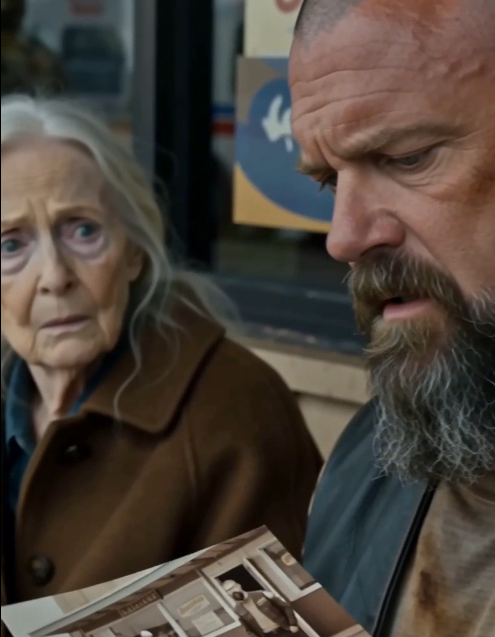
Her name, though I did not know it yet, was Eleanor Bell. She looked close to eighty, with silver hair pinned behind one ear, a rain-darkened wool coat, and shoes that had been repaired with two strips of gray tape. A canvas bag rested between her ankles. Everything she owned seemed to fit inside it.
I probably looked worse.
I was fifty-six, six-foot-four, and nearly 285 pounds, with a shaved head, a thick black-and-gray beard, tattooed forearms, and grease across my faded shirt. My leather cut was folded over the motorcycle seat because I had spent an hour lying beneath a stranger’s pickup, replacing a fuel hose while rainwater ran down my neck.
When I sat on the curb to rest, people gave me room.
Eleanor moved closer.
“You eaten today?” she asked.
“I’m all right, ma’am.”
“That wasn’t my question.”
She opened a brown paper bag and removed a sandwich wrapped in wax paper. White bread. Two slices of turkey. One piece of cheese. She divided it carefully, making sure my half was larger.
Then she placed it in my scarred hand.
“Nobody should look hungry beside a road,” she said.
Something in her voice struck a place I had kept locked for nearly forty years.
Still, I did not recognize her.
I ate because refusing would have embarrassed her. She chewed slowly, taking tiny bites and folding the wax paper between them as though she hoped the sandwich might last longer if she treated it gently.
A station employee watched us through the glass. He had already asked Eleanor not to sleep inside. Now he opened the door and called, “Ma’am, you can’t keep bothering passengers.”
“She isn’t bothering me,” I said.
His eyes traveled across my tattoos. “You waiting for a bus?”
“No.”
“Then both of you need to move.”
Eleanor immediately began gathering her things. She apologized to him even though she had done nothing wrong. That apology bothered me more than the order itself.
I stood.
The employee stepped backward.
That was the trouble with looking like me. Sometimes a man only had to stand for everybody else to invent what he might do next.
I kept my hands at my sides.
“We’ll move,” I said.
Eleanor touched my arm. “Don’t lose your temper over me.”
“I’m not angry.”
“You have angry shoulders.”
I almost laughed.
She carried her canvas bag toward the covered bench near the parking lot. One wheel on my Harley was still splashed with desert mud, and the air smelled of wet asphalt, old coffee, leather, and cooling metal.
Eleanor looked at the motorcycle.
“That yours?”
“Yes, ma’am.”
She glanced at the half sandwich in my hand and smiled without embarrassment. “Well, I guessed wrong.”
“You guessed I hadn’t eaten.”
“That part looked right.”
I offered to buy her something warm. She refused. I offered coffee. She refused that too. When I asked whether someone was meeting her, she said the county shuttle would take her to a motel before dark.
“What motel?”
“The Desert Lantern.”
I knew the place. Weekly rooms. Broken ice machine. A sign that lost three letters every winter.
“You live there?”
“For now.”
She reached inside her canvas bag for a bus schedule. A small envelope slipped out, struck the pavement, and spilled several photographs into a shallow rain puddle.
I bent to help.
The first picture showed a roadside diner with a white roof, a red neon arrow, and motorcycles parked along both sides. The colors had faded toward yellow. Men in denim and old leather crowded around a woman standing behind the counter.
A younger woman.
Eleanor.
My breathing stopped.
I picked up the photograph with both hands. Near the edge stood a nineteen-year-old boy with hollow cheeks, shoulder-length hair, and a jacket two sizes too large. His arms were folded because he did not know what else to do with them.
The boy was me.
The diner behind us was Bell’s Last Stop, seventeen miles east of Kingman. During the worst year of my life, that woman had fed me ninety-one times without once asking when I would pay.
She had fed dozens of other broke riders too.
Men with empty tanks. Veterans between checks. Runaways sleeping behind gas stations. Young mechanics who spent their last dollar on a spark plug and pretended they were not hungry.
At Bell’s, a rider with no money could order whatever was left in the kitchen. Eleanor kept no bill. She only pointed toward a dented coffee can beside the register and said, “Feed somebody when your road gets easier.”
The diner had closed twenty-two years earlier.
We had been told Eleanor sold it and retired comfortably.
We had been wrong.
I looked from the photograph to the exhausted woman who had just given a stranger half of her last sandwich.
“Where did you get this?” I asked.
“My husband took it.”
I turned the picture toward her and pointed to the skinny kid by the door.
“Do you remember him?”
Eleanor narrowed her eyes. “Should I?”
My throat tightened.
“He came in hungry,” I said. “Most nights, he had nowhere to sleep.”
She studied the young face, then looked up at the biker I had become.
Her lips parted.
Before she could speak, the canvas bag tipped over. A foreclosure notice, a bottle containing four prescription tablets, and an old metal key slid across the pavement.
The address on the notice belonged to Bell’s Last Stop.
The sale date was the next morning.
Eleanor snatched the paper, but I had already seen enough.
“You still own the diner?”
“Not after tomorrow.”
“Why didn’t you call anyone?”
She looked at the old photograph, at the motorcycles, and at the hungry young men she had once protected from their worst nights.
Then she said, “People shouldn’t have to repay kindness they never asked for.”
I reached for my phone.
Eleanor caught my wrist.
“Please,” she whispered. “Don’t turn an old woman into a charity story.”
I promised I would not.
Then I called the only men who could understand what that photograph meant.
By sunrise, forty bikers would return to a diner they thought was gone—and discover why Eleanor had chosen hunger rather than ask any of them for help.
Part 2 — The Diner Where Nobody Was Asked to Prove Hunger
I was nineteen the first time I entered Bell’s Last Stop.
It was March of 1989, cold enough for frost to form along the shoulder of Route 66. I had forty-three cents, an unreliable motorcycle, and a canvas roll containing two shirts, one wrench, and a photograph of a family that no longer wanted me home.
My father drank. I fought. By nineteen, neither of us could remember which problem had started the other.
The motorcycle was not a Harley. It was an old Honda with a cracked headlight and enough oil leaking from its engine to mark every place I stopped. Three miles outside Kingman, the chain came loose and wrapped itself around the sprocket.
I pushed the machine until my palms blistered.
Bell’s neon arrow appeared after midnight.
The diner was supposed to be closed, but a light remained above the kitchen. I knocked because I wanted water. Eleanor opened the door holding a mop and studied me through the glass.
Back then, she was thirty-eight. Her dark hair was tied in a red scarf, and flour marked one cheek.
“We’re closed,” she said.
“I know.”
“What do you need?”
“Water.”
Her eyes moved toward the motorcycle, then back to my face.
“Only water?”
“Yes, ma’am.”
She unlocked the door.
Ten minutes later, a plate containing meatloaf, mashed potatoes, and green beans appeared before me. I told her I could not pay.
She placed a glass of water beside the plate.
“I didn’t ask what you could pay.”
I ate too quickly. She put another slice of bread on the plate and told me the food was not running away.
Her husband, Walter, came from the kitchen carrying a toolbox. He repaired my chain while Eleanor refilled my coffee. Neither asked why I was traveling alone in winter. Neither demanded a convincing story.
That was what made Bell’s different.
Eleanor did not force poor people to perform their suffering.
If someone said they were hungry, she fed them. If they lied, that belonged to them. Hunger was not a courtroom, and she refused to make anyone plead a case before receiving eggs.
I returned the next night.
Then the night after that.
For almost four months, I slept in a storage room behind a repair shop and worked whatever jobs I could find. Eleanor fed me whenever my pockets were empty. When I had money, I paid double. When I did not, she pointed toward the dented coffee can.
On its lid, Walter had painted four words:
WHEN YOUR ROAD GETS EASIER.
Inside were index cards instead of cash. Customers wrote what they would do later: repair a widow’s fence, drive a veteran to Phoenix, buy diapers for a young mother, give another stranded rider a bed.
Eleanor called it the Later Can.
She never checked whether anyone kept a promise.
“Then what’s the point?” I once asked.
“The point is giving a person a direction.”
By the early 1990s, Bell’s Last Stop had become known among riders traveling across northern Arizona. There were no social media posts and no charity banners. Word traveled at gas stations and repair shops.
If your wallet was empty, ask for Eleanor.
If you needed work, ask Walter.
If the heat had beaten you down, there was cold water behind the counter.
If you had nowhere safe to sleep, an old storage room had a lock on the inside.
Dozens of us passed through.
There was Boone Mercer, a former Marine who later became my road captain. There was Luis Ortega, who arrived from New Mexico with a burned clutch and three dollars. There was Nathan “Doc” Williams, a Black Army medic who had not slept indoors for five months after returning from the Gulf.
Eleanor fed every one of us.
She did not call us broken. She called us travelers between addresses.
That language mattered.
A broken person expects the world to throw him away. A traveler expects another town.
When Walter suffered a stroke in 1997, riders came from four states to repaint the diner, repair its roof, and keep the grill running. Eleanor accepted the labor because Walter needed care, but she refused money.
After he died, she continued alone.
Then Bell’s closed suddenly in 2004.
A handwritten notice appeared on the door. The phone was disconnected. Eleanor vanished from Kingman. Rumors said she had sold the property to a hotel company and moved to California.
We wanted to believe that.
It allowed us to keep riding without asking whether the woman who had fed us might need something in return.
I drove Eleanor to the Desert Lantern that rainy afternoon. She sat behind me wearing my spare helmet and holding the canvas bag between us. My Harley’s V-twin rolled softly through town.
At the motel, she insisted I leave.
I rented the room beside hers instead.
“You said you weren’t homeless,” she told me.
“I’m not.”
“Then why are you sleeping here?”
“Company.”
She shook her head. “You were stubborn at nineteen too.”
That was the first sign she remembered.
I sat outside her door while the rain moved east. At seven, Boone arrived. At seven-twenty, Doc pulled in from Flagstaff. Luis came after eight, followed by riders from Phoenix, Prescott, Lake Havasu, and Bullhead City.
We parked across the street so the engine noise would not disturb Eleanor.
By midnight, twenty-three men had gathered in my motel room.
The air smelled of wet leather and bad coffee. Some carried the old Later Can cards they had kept for decades. Others brought photographs from Bell’s.
Boone placed his card on the bedspread.
It read: When my road gets easier, I will give somebody a job.
He had opened a construction company and hired seventeen veterans.
Doc’s card promised to help one person wake from a bad night. He became a trauma nurse.
Luis had promised to repair a stranger’s vehicle for free. He eventually opened three garages and required every apprentice to complete twelve free roadside repairs each year.
Eleanor’s kindness had multiplied quietly across thousands of lives.
Yet she was in the next room with four pills, half a sandwich, and a foreclosure notice.
Anger filled the room.
Boone wanted to call reporters. Luis wanted to confront the bank. Another rider suggested surrounding the auction.
I stopped them.
“She asked not to become a charity story.”
“We’re not charity,” Boone said. “We’re family.”
“Then act like family. Protect her dignity first.”
Doc examined the prescription bottle. Eleanor had been rationing heart medication that should have been taken daily.
The motel manager told us she had paid through Friday. After that, she had nowhere arranged.
The foreclosure documents showed nearly $86,000 in back taxes, penalties, and secured debt attached to Bell’s Last Stop. The diner had never been sold.
It had remained closed all those years.
At one in the morning, I returned the photographs to Eleanor. She was sitting on the bed, still wearing her coat because the heater did not work.
I asked why she had let us believe she was comfortable.
Her answer was simple.
“Because all of you were finally moving forward.”
She believed calling us back would have turned our progress into a debt.
What she did not understand was that the road beneath us had been built, in part, from the meals she refused to count.
Part 3 — The Truth Behind the Locked Diner
Eleanor would not tell us everything, so we went to the diner before dawn.
Bell’s Last Stop stood behind a chain-link fence seventeen miles east of town. The white roof had darkened. Wind had broken part of the neon arrow, and tumbleweeds had collected against the kitchen door.
I had not entered in twenty-two years.
The metal key from Eleanor’s bag still opened the side entrance.
Inside, dust covered the counter. Red vinyl booths had split along their seams, but the coffee mugs remained stacked on their shelves. Walter’s old clock had stopped at 2:17. A faded menu still advertised coffee for sixty cents.
The room smelled of old grease, dry wood, and desert air.
Then Boone found the Later Can.
It sat beneath the register, dented on one side and spotted with rust. Hundreds of index cards remained inside.
Some carried names we knew. Others contained only promises.
I will take my little brother somewhere safe.
I will stop drinking before my daughter learns to fear me.
I will finish nursing school.
I will feed the next rider.
I found my card near the bottom.
My nineteen-year-old handwriting was all sharp angles.
When my road gets easier, I will come back and pay for every meal.
Eleanor had written something beneath it in red ink.
Paid in full.
I had never returned to pay her.
At least, I did not think I had.
Boone found similar words on his card. So did Doc and Luis. Every promise carried the same red mark.
Paid in full.
“How?” Luis asked.
Nobody knew.
In the office, we discovered boxes of newspaper clippings. Eleanor had followed our lives for decades. Boone’s veterans’ housing project. Doc’s hospital award. My motorcycle club’s winter coat rides. Luis’s free repair program.
Whenever one of us helped someone, Eleanor marked the corresponding card paid.
She had been keeping track.
Not of money.
Of kindness moving forward.
That should have been the biggest revelation waiting inside Bell’s.
It wasn’t.
Behind the office desk sat six plastic storage bins filled with receipts, bank notices, and letters from former employees. They revealed why the diner had closed.
After Walter died, Eleanor mortgaged the property to cover his medical bills. She kept operating, but a kitchen fire damaged the electrical system. Her insurer paid only part of the claim, citing outdated wiring that Walter had planned to replace.
Eleanor borrowed again.
Then her younger brother, Frank, developed dementia. He had no children, no savings, and nowhere to go. Eleanor moved him into her apartment behind the diner and hired daytime care so she could keep working.
Costs climbed.
Bell’s Last Stop closed when Eleanor had to choose between restoring the kitchen and keeping Frank out of an overcrowded state facility.
She chose her brother.
For eleven years, she cared for him in a rented home outside Tucson. She sold nearly everything except the diner property, convinced she might reopen someday.
Frank died in 2015.
By then, Eleanor was seventy-two and deeply in debt. She returned to Kingman, but the building required more money than she could raise. Back taxes accumulated. She lived in inexpensive rooms and cleaned offices at night.
She never contacted us.
On the wall above the desk, we found the faded photograph that had fallen from her bag—only this copy was larger. Forty-seven riders stood outside the diner.
Beneath the frame, Eleanor had written their names.
Seven had died.
Five could not be located.
Thirty-five were still alive.
Boone touched the glass. “Call everybody.”
I shook my head. “Not yet.”
He stared at me. “Auction starts in six hours.”
“We need facts before noise.”
That answer nearly split the club.
Several brothers believed action mattered more than permission. They wanted to park outside the county building and show Eleanor she was not alone. Others worried that forty bikers arriving unannounced would look like intimidation and damage her chances.
Voices rose.
Leather shoulders pressed closer. Boots shifted on dusty tile. Years of loyalty strained beneath one question: Were we helping Eleanor, or satisfying our need to feel like rescuers?
Doc ended the argument.
“She gave people choices,” he said. “We don’t take hers away now.”
We agreed on three steps. A small group would examine the auction documents. Luis would assess the building. Doc would take Eleanor to breakfast and persuade her to refill her medication.
I returned to the motel.
Eleanor was gone.
Her room key sat on the nightstand beside a note.
Ray, thank you for remembering me. Please let the building go. It was never the walls that mattered.
I ran outside.
The county shuttle driver said he had dropped her near Bell’s an hour earlier.
By then, rain had returned.
We found Eleanor sitting behind the chain-link fence, facing the diner. She held the remaining half of her sandwich but had not eaten it.
“You shouldn’t be out here,” I said.
“Neither should thirty motorcycles.”
She had heard us arriving.
I sat beside her in the mud.
“The auction is at ten.”
“I know.”
“We can stop it.”
“No.”
“You fed us for years.”
“That wasn’t a loan.”
“I know.”
“Then don’t turn it into one.”
Her voice sharpened. She was not a helpless old woman awaiting rescue. She was the same person who once ordered drunk riders out of her diner and made them surrender their keys.
“You want to know why I didn’t call?” she asked. “Because I watched too many kind things become chains. People give somebody a meal, then expect gratitude forever. I never wanted my name sitting on your shoulders.”
“It isn’t.”
“Then let me leave.”
I looked through the fence at the diner.
“What happens after Friday?”
She said nothing.
“Where will you sleep?”
“That is my concern.”
“What about your medication?”
Still nothing.
Eleanor’s pride was not vanity. It was the final possession poverty had not taken from her. If we forced assistance on her, we would protect the building while injuring the woman.
So I made a different offer.
“Come to the auction,” I said. “If you still want us to walk away after you hear everything, we walk.”
“Everything?”
“The cards.”
Her expression changed.
“What cards?”
“The ones you marked paid.”
She looked toward the diner office.
I told her we had found the Later Can.
For the first time that morning, Eleanor appeared frightened.
Not because we knew she was poor.
Because we knew she had never stopped watching over us.
Part 4 — Forty Riders Entered Without Their Leather
The Mohave County auction room was smaller than expected.
Fluorescent lights hummed above six rows of plastic chairs. A clerk organized folders at the front. Most bidders wore business shirts and carried tablets.
We entered without our leather cuts.
That was Eleanor’s condition.
“No parade,” she said. “No frightening office workers.”
Forty riders came anyway, dressed in clean jeans, work shirts, jackets, and boots. Without leather and motorcycles, we looked less like a club and more like what we had become: mechanics, nurses, roofers, teachers, veterans, business owners, grandparents.
Eleanor sat between Doc and me.
A Phoenix development company planned to buy the diner parcel and build a truck-storage yard. Their representative had already inspected the property. With the liens and repair costs, nobody expected another bidder.
The opening amount was $86,400.
Luis had estimated that restoring the building safely would require another $140,000. Our club treasury could not cover both. Even pooling what everyone had brought, we remained nearly thirty thousand dollars short of a responsible bid.
Boone whispered, “We can raise the rest.”
“After purchase?”
“Somehow.”
That word had ruined many good intentions.
I would not save Eleanor’s diner by creating another crisis she would feel responsible for.
The auction began.
The development company offered the minimum. Boone raised our number by five hundred dollars.
Eleanor grabbed my sleeve.
“You promised to walk away.”
“I promised you would hear everything first.”
She looked behind her.
Each rider held an old index card.
One by one, they placed the cards on the empty chairs between us. Promises written decades earlier. Promises Eleanor had marked paid because she had seen the evidence of their lives.
Doc leaned close to her.
“You never asked us for money,” he said. “This isn’t repayment.”
“Then what is it?”
“Another direction.”
The bidding climbed.
Ninety thousand.
Ninety-five.
One hundred thousand.
The developer’s representative barely looked up as he responded. He knew the property’s future value. We were not bidding against a villain. We were bidding against numbers that made sense.
At $112,000, Boone stopped.
That was our limit.
The representative bid $113,000.
The clerk asked whether anyone would go higher.
Silence.
Eleanor exhaled.
“It’s all right,” she whispered.
It was not.
But we had promised not to destroy ourselves proving gratitude.
The clerk began closing the sale when a woman entered carrying a file box. She identified herself as Miriam Hayes, an attorney from Prescott representing the Walter and Eleanor Bell Community Trust.
Eleanor stared at her.
“I don’t have a trust.”
Miriam opened the file.
Walter Bell had created it three months before his stroke. He transferred a forty-nine-percent interest in the diner property into a charitable community trust, intending the building to continue feeding travelers after his death.
The documents had been prepared but never properly entered into county records because Walter was hospitalized before filing the final notice. The signed originals remained with the attorney who drafted them.
That attorney had died years earlier.
His daughter found the file while closing his practice and had been trying to locate Eleanor. She learned about the auction only after a title examiner flagged Walter’s name.
The clerk suspended the sale.
The development representative objected. His objection was reasonable; an unrecorded trust did not automatically erase liens or prevent foreclosure. More legal work would be required.
Still, the property could not be sold that morning.
We had time.
Eleanor did not celebrate.
She stared at Walter’s signature.
Her husband had been planning a future for the diner without telling her, just as she had tracked our promises without telling us.
Miriam gave her a letter found inside the file.
Eleanor opened it with trembling fingers.
Walter had written it from the hospital:
Ellie, if I don’t make it back behind the grill, don’t carry this place alone. The diner belongs to every person who ate here when life had emptied their pockets. If the road brings them back, let them help.
Eleanor stopped reading.
Her shoulders folded inward.
Doc placed a hand near hers but waited until she reached for it.
That mattered.
After several minutes, Eleanor looked at the forty men behind her.
“I don’t remember all your names.”
Boone smiled. “You remembered enough to mark our cards.”
“I only made sandwiches.”
“No,” he said. “You gave people somewhere to sit without shame.”
Eleanor looked at me.
The old pride remained. So did the fear of becoming somebody’s obligation.
“What happens if I say yes?”
“We make a plan,” I said.
“And if I say no?”
“We take you to lunch and leave the building alone.”
She studied our faces.
Then she placed Walter’s letter beside my index card.
“One condition,” she said.
Boone groaned softly. “You and Ray are made for each other.”
Eleanor ignored him.
“If Bell’s opens again, nobody puts my name on a donation wall. Nobody films hungry people. Nobody asks them to tell their worst story before they eat.”
“Agreed,” I said.
“And no one calls me an angel.”
Doc nodded. “You’re too mean.”
She laughed.
It was the first full laugh I had heard from her.
The auction had been stopped, but the diner remained burdened by debt. The trust paperwork still had to survive legal review. The roof leaked, the kitchen was unusable, and Eleanor had no place to live after Friday.
We had not saved anything yet.
We had only been given permission to try.
Then Miriam turned over Walter’s letter.
On the back was a list of forty-seven names—the same riders from the photograph.
Beside my name, Walter had written:
“Ray Dawson will come back. He just needs a longer road.”
Part 5 — The Debt No Bank Had Recorded
For the next four months, Bell’s Last Stop became the hardest project our club had ever undertaken.
Repairing a motorcycle is straightforward. The machine does not have pride. It does not refuse a new part because another engine might need it more.
Eleanor resisted everything.
She agreed to stay in Doc’s guest room for one week, then tried moving back to the Desert Lantern. She accepted her medication only after Doc labeled each bottle and convinced her she was helping him test a new reminder system.
She attended planning meetings but rejected any design that made the diner appear polished.
“Travelers don’t need marble counters,” she said. “They need clean forks.”
Luis led the restoration. The electrical system had to be replaced. The kitchen floor came up. Termites had damaged part of the office wall, and the roof required more work than expected.
Money became tight.
Offers arrived after word spread through biker communities, but we followed Eleanor’s rules. No photographs of her sleeping in a motel. No close-ups of empty prescription bottles. No posts presenting her as a helpless victim.
We told the truth without taking ownership of it:
A diner that once fed stranded travelers needed repair.
Contributions came in.
Five dollars from a retired truck driver in Oklahoma.
Forty dollars from a nurse in Nevada.
A new commercial stove from a restaurant owner in Tucson who remembered eating at Bell’s when he was seventeen.
An HVAC contractor donated labor. A widow sent Walter’s old pocketknife, which he had given her husband after fixing their car beside the diner.
The largest contribution came anonymously.
Thirty thousand dollars.
The receipt carried only four words: My road got easier.
Eleanor cried when she saw it.
Quietly.
She turned toward the unfinished kitchen until she could breathe again.
The legal problems took longer. Miriam proved Walter intended the property for charitable use, but liens remained valid. We negotiated with the county and the lender. Some penalties were waived. Others were not.
Then we found the red ledger.
It was hidden behind a loose panel beneath the old counter. At first, I thought it contained customer debts. Eleanor grabbed for it when Luis handed it to me.
“Burn that.”
Naturally, we opened it.
For thirty-one years, Eleanor had recorded every free meal. Not the recipients’ names—only dates, food, and the reason she believed someone needed help.
Young rider. Hands too cold to hold fork.
Mother with two girls. Counted coins three times.
Veteran. Could not sit near window.
Old man said he wasn’t hungry. Wrapped meal anyway.
Thousands of entries filled the pages.
Beside each was the cost.
The total exceeded $94,000, not adjusted for inflation. Eleanor and Walter had given away enough food to buy a house, yet they had never asked anyone to reimburse them.
Near the back, I found March 18, 1989.
Long-haired boy pushing broken motorcycle. Asked for water. Ate two plates. Angry at world, gentle with coffee cup.
Below it were ninety more entries.
My meals.
On the final one, Eleanor had written:
Boy found steady work. Paid double today. Still thinks money was the debt.
I closed the ledger.
“What did you think the debt was?” I asked.
Eleanor took it from me.
“Staying human after somebody gives you an excuse not to.”
That sentence explained the cards.
It explained why she had tracked our lives.
She was never counting meals. She was looking for proof that humiliation had not traveled forward through us.
Boone wanted to place the ledger behind glass. Eleanor refused.
“People aren’t museum exhibits.”
So we returned it beneath the counter, where only the staff would know.
The hardest conflict came two weeks before reopening.
Our club voted to place Bell’s under a nonprofit board so no single person could mortgage the property again. It was financially necessary, but Eleanor heard something else: the diner would no longer belong to her.
She walked out of the meeting.
I found her behind the building near Walter’s old grease barrel.
“You’re taking it,” she said.
“We’re protecting it.”
“Same words banks use.”
I did not argue.
She had surrendered control of almost everything in her life—her home, her income, her brother’s care, and finally her ability to buy food without checking each dollar. Asking her to trust a board required more than legal explanations.
“What do you want?” I asked.
“My key.”
She held up the old metal key from her canvas bag. New locks had already been installed, making it useless.
“You want that key to work?”
“I want one door nobody can lock me out of.”
The solution was not difficult.
Understanding the request had been.
We replaced the office lock with a cylinder fitted to her original key. The diner belonged to the trust, but Eleanor received lifetime residency in the renovated apartment and permanent authority over the meal program.
No board could remove her without a court finding of incapacity or misconduct.
Miriam wrote it into the governing documents.
Eleanor read every word.
Then she signed.
On reopening morning, forty-seven motorcycles were expected. More than three hundred arrived.
We parked them along the desert road without blocking traffic. Riders came from states Eleanor had never visited. Some had eaten at Bell’s decades earlier. Others had only heard what the diner represented.
Eleanor stood behind the counter in a red scarf.
She looked smaller than I remembered.
Stronger too.
The first customer was a teenage boy traveling with a backpack and sixteen dollars. He ordered coffee, then quietly asked what food he could afford.
Eleanor placed a full breakfast before him.
He looked at the plate. “I didn’t order this.”
“I know.”
“I can’t pay.”
She pointed toward the dented coffee can.
The boy lifted the lid and found a stack of blank cards.
“What do I write?”
Eleanor smiled.
“Something you’ll do when your road gets easier.”
Across the room, grown men lowered their heads.
The diner was open again.
But Eleanor had one more truth waiting for us beneath the counter.
Part 6 — The Names She Had Never Marked Paid
A week after Bell’s reopened, Eleanor asked me to arrive before sunrise.
No club. No motorcycles. Just me.
I found her seated in the corner booth with the red ledger and two cups of coffee. Dawn had barely reached the windows.
She opened the book to the final pages.
Seven names appeared there without the red words paid in full.
They belonged to riders from the old photograph who had died before Eleanor found evidence that their roads had become easier.
One was twenty-two-year-old Jimmy Cross, killed by a drunk driver outside Needles. Another was Calvin Reed, who died by suicide after returning from war. A third was Walter’s younger cousin, Tommy, who vanished during a winter ride.
Eleanor had carried their unfinished promises for decades.
“I kept thinking I failed them,” she said.
“You fed them.”
“Food isn’t always enough.”
“No.”
I would not comfort her with a lie. Sometimes kindness changes a life. Sometimes illness, violence, addiction, or despair remains stronger than the hand reaching toward someone.
That does not make the hand worthless.
I turned Jimmy’s card over. His promise was to teach a child how to repair a motorcycle.
“He showed me,” I said.
Eleanor looked up.
During my first weeks in Kingman, Jimmy had taught me to clean a carburetor and adjust a clutch cable. Those skills became my trade. I had trained dozens of younger mechanics since.
I took Eleanor’s red pen and wrote beneath Jimmy’s promise:
Paid in full.
Calvin’s card said he would help another veteran sleep through the night. Doc later told us Calvin had spent months talking him through panic attacks after the Gulf.
Paid in full.
One by one, we contacted families and old riders. Every unfinished promise had left some trace.
Tommy had given a stranded couple his final twenty dollars.
A rider named Annie Cole had sheltered two runaway sisters.
Walter’s former dishwasher had donated blood every eight weeks until illness stopped him.
The cards were not records of perfect lives. Some of those people had relapsed, divorced, disappeared, or hurt others after leaving Bell’s.
Yet each had created at least one interruption in somebody else’s suffering.
Eleanor marked the final card three weeks later.
Then she placed the red pen inside the Later Can.
“You done?” I asked.
“With counting.”
She continued feeding people.
Every Friday, she made turkey sandwiches and wrapped them in wax paper. One went into the diner refrigerator for whoever arrived after the kitchen closed. Another traveled in her canvas bag.
She said roads had inconvenient timing.
Sometimes I found her outside sharing that sandwich with someone who looked hungry. A trucker. A teenager. A tired mother. Once, a salesman whose rental car had broken down and who clearly possessed enough money to buy dinner.
Eleanor split it anyway.
She never asked for proof.
I began joining her.
Not because she needed protection. She did not.
I joined because sitting beside Eleanor reminded me who I had been before the beard, the tattoos, the club, and the reputation. A hungry nineteen-year-old asking for water while hoping someone might notice he needed more.
Sometimes people saw us together and assumed I was helping her.
That always made Eleanor laugh.
“They still guess wrong,” she would say.
She was right.
Part 7 — The Last Half
Eleanor ran Bell’s Last Stop for another six years.
She never retired in the way people expected. She reduced her hours, allowed younger cooks to control the kitchen, and finally accepted a chair behind the register.
But every morning, she unlocked the office with Walter’s old key.
Every evening, she checked the refrigerator for the emergency sandwich.
At eighty-five, her heart began failing.
Doc attended every appointment. Boone repaired the ramp outside her apartment. Luis installed a bell beneath the counter so she could call for help without standing.
She hated that bell.
Then a nine-year-old girl visiting with her mother decorated it with red tape, and Eleanor stopped complaining.
During her final winter, I ate breakfast with her every Sunday. She always placed the larger portion on my plate.
“You know I can buy food,” I reminded her.
“That has never stopped you from looking hungry.”
The last time I saw her conscious, she was lying in the apartment above the diner. The window had been opened slightly so she could hear motorcycles arriving below.
I brought the faded photograph from the bus station.
She held it against her chest.
“Did we save the diner?” I asked.
“No.”
I waited.
She looked toward the floor, where the rumble of several Harley engines traveled through the old boards.
“The diner saved itself,” she said. “We just kept opening the door.”
Her funeral was held on a Tuesday because she did not want Bell’s closed during a weekend.
The procession stretched for three miles.
There were no revving engines at the cemetery. Only low idling, leather moving in the wind, and boots settling into desert soil.
Afterward, we returned to the diner.
A teenage waitress found a brown paper bag inside Eleanor’s refrigerator. In it was one turkey sandwich wrapped in wax paper and a note addressed to the next hungry traveler.
Nobody ate it.
Not that day.
We placed fresh sandwiches beside it until one stormy evening when a young woman entered with two children and counted the coins in her palm three times.
The waitress saw her.
She removed Eleanor’s sandwich, cut it into three portions, and added bowls of hot soup.
The mother whispered that she could not pay.
The waitress pointed toward the dented coffee can.
Outside, I sat on my Harley and listened as the diner door opened behind me. The smell of coffee and toasted bread drifted into the cold desert air.
A child laughed.
Someone dropped coins near the register.
Then I heard Eleanor’s old metal key turning in the office lock. The young manager carried it now, not as ownership, but as a promise that no hungry traveler would be locked outside.
I started the motorcycle.
The V-twin rolled across Route 66, deep and steady.
Before pulling away, I looked through the window. A woman I had never met was dividing her meal with an old man at the next table.
The road had become easier.
Follow our page for more unforgettable biker stories about quiet kindness, hidden histories, and the strangers who become family along the road.