I Left My Family for Seven Years — and the Day I Came Back, My Son Looked at Me Like I Was a Stranger at the Wrong Door
The first time my son saw me after seven years, he held the door open and asked if I was there to read the meter.
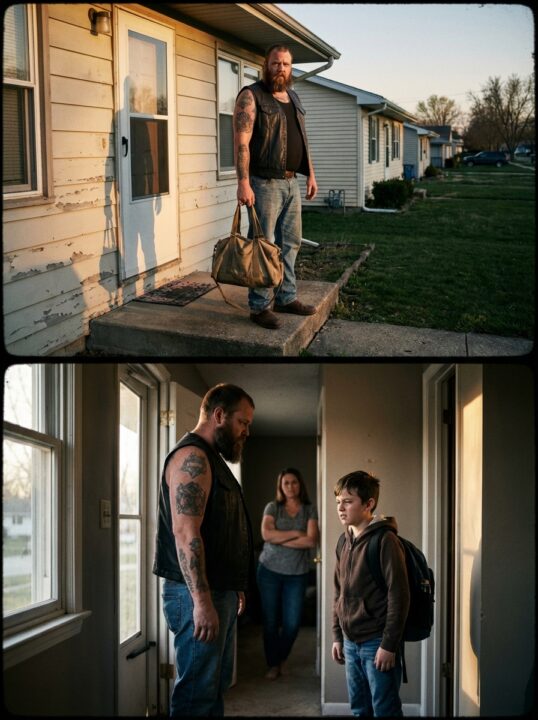
He was polite about it. That’s what got me. He had one hand on the doorframe, the other holding a dish towel, and he looked at me the way you look at a stranger you don’t want to be rude to — patient, distant, faintly helpful — and waited for me to explain myself.
I was wearing the same leather jacket I’d left in. Same boots. I had cut my hair shorter, lost some weight, picked up a scar above my right eyebrow from a low-speed tip-over outside of Amarillo. But I was still me. I was still his father.
He was twenty-three years old and he had his mother’s eyes and he did not know me.
I said his name. Just: “Eli.”
He tilted his head — the same way he used to when he was five and I was reading him something confusing — and something moved across his face. Not recognition. Not quite. Something slower and more complicated than that.
He said, “Can I help you?”
I had driven eleven hundred miles to get to that front porch. I had practiced what I was going to say somewhere around the Texas border, out loud, alone, engine running. I had a whole version of it worked out. Reasonable. Honest. Not asking for too much.
Standing there, I couldn’t find a single word of it.
The dish towel. He was still holding the dish towel. That was the thing that finally got to me — that my son was standing in his own kitchen, doing dishes, living a full and ordinary life, and I was the stranger at the door.
My name is Ray Cutter. I’m fifty-one years old, and I have been running from myself since I was roughly thirty-two.
That’s not an excuse. I’ve had enough years alone on enough roads to know the difference between a reason and an excuse, and what I did was an excuse wrapped in something that felt, at the time, like necessity.
Eli’s mother, Pam, and I had been together since high school. We had Eli when we were twenty-six. He was a good kid from the beginning — calm, curious, the kind of child who could entertain himself for an hour with a cardboard box. I was not a bad father, exactly. I was just absent in the way that some men are absent even when they’re in the room.
Then I lost my job at the plant. Then Pam’s mother got sick, and we moved to care for her, and the house we moved into was too small and too close and everyone was always in everyone’s way. I started riding longer. Weekends turned into five-day trips. I told myself I was coming back different. Better.
I came back the same. And then one summer I just didn’t come back at all.
I sent money when I had it. That’s what I told myself made it okay. I was still providing. Six hundred here, four hundred there, Western Union receipts I kept in a shoebox like evidence of something good. Pam never cashed all of them. I found that out much later, and I’ve thought about what that meant more times than I can count.
Seven years. Eleven hundred miles between us. And one front door I finally knocked on.
INCIDENT
I hadn’t called ahead.
That was deliberate, which I understand sounds worse the more I explain it. But I had started to call six or seven times over the past year and always found a reason to stop before the connection went through. Too early. Too late. What would I even say. Eventually I decided that if I drove there, I wouldn’t be able to talk myself out of it at the last second.
I pulled off the interstate at the Tifton exit around four in the afternoon, found the address Pam’s sister had given me — reluctantly, making clear with her silence that she was doing this for Eli, not for me — and sat in the parking lot of a Walgreens across the street for twenty-two minutes.
The house was a rental. Small, white, a garden along the front fence that hadn’t been there in Pam’s nature. Which meant it was Eli’s garden. Which meant he had grown into someone who planted things.
I didn’t know that about my own son.
I knocked. He answered.
And I’ve already told you how that went.
After the meter-reader moment — after I said his name and watched him try to place me — he stepped back from the door. Not inviting me in. Just processing. His jaw moved like he was sorting through something and not finding the right file.
Then he said, quietly, “Ray?”
Not Dad. Ray.
I said yes. He nodded slowly, the way you nod when something you expected to happen eventually has finally happened and you’re not sure whether to feel relieved or not.
He said, “Hold on,” and went back inside. The door stayed open.
In the entryway I could see a pair of work boots by the mat. A jacket on a hook. A framed photo on the wall that I couldn’t quite make out from where I stood. I didn’t move from the porch. I didn’t think I’d been invited past it.
He came back with two glasses of water and handed me one, and that gesture — that plain, courteous, utterly impersonal gesture — was the loneliest thing I had felt in seven years.
We sat on the porch. Not inside. On the porch.
He brought out a second chair from somewhere — a folding chair, the kind you keep in a closet — and set it at a distance that was polite but not close. I noticed he sat facing the street rather than facing me. He drank his water and I drank mine and neither of us said anything for a while.
I had the sense of being handled carefully. Not with warmth. With care. The way you handle something fragile that you’re not sure you want to keep.
He asked about the drive.
I told him. Eleven hundred miles, two nights in motels, rode through rain most of the second day. He nodded like he was listening to a neighbor’s vacation story.
I asked about him. He answered in the way people answer when they’ve decided how much to give: “I’m good. Work’s steady. I’ve got a place.” Small sentences. Doors opened just wide enough to show there was a room, then closed.
I noticed his hands. He had a mechanic’s hands — oil worked into the knuckles, a faint scar along the left thumb. He hadn’t had those when I left. He was sixteen when I left. He had been sixteen and doing homework at the kitchen table and I had said I was going for a ride and I hadn’t come back.
I didn’t say that. I didn’t say any of it. I sat on a folding chair on my son’s porch and looked for the boy I remembered inside the man who was watching the street.
At one point a truck slowed in front of the house, and Eli raised two fingers off his knee — a small wave, a neighbor probably — and the ease of it, the way it said I belong here, I know these people, hit me somewhere low.
He had built a life. A real one. Without me.
Then he asked, almost as an aside: “Did Mom know you were coming?”
I said no.
He nodded. Looked at the street. Said, “She moved to Savannah. Two years ago.”
I didn’t know that.
I hadn’t known that.
We sat outside until the light started to go orange.
He didn’t ask me why I’d come. I had expected that to be the first question — the hard one, the one I’d rehearsed for — but he didn’t ask it. And somehow that was worse. Because not asking meant he either already knew the answer, or didn’t think it mattered enough to ask.
Somewhere in the third hour he said, “I used to wait for you to call on my birthday.”
He said it the way you say something you’ve already processed and filed away. No anger in it. No accusation. Just information, shared the way you’d mention the weather.
“Every year until I was about twenty.” He paused. “Then I stopped waiting.”
I said I was sorry. It came out quieter than I meant it to.
He said, “I know.”
Not: it’s okay. Not: I forgive you. Just: I know. Which was honest, and which was the kindest thing he could have said, and which also told me everything about where we stood.
I asked about the framed photo in the entryway. He glanced toward the door.
“That’s me and Mom. At her nursing school graduation.”
Pam had gone back to school. Became a nurse. Was living in Savannah, presumably working, presumably fine — better than fine, by the sound of it.
She had rebuilt everything I’d walked away from and made it better without me in it.
I asked about the garden. His face changed for the first time — not much, just slightly less guarded. He said he’d started it two years ago, mostly tomatoes and peppers, he gave most of it away to the woman next door who was in her eighties and couldn’t get to the store easily.
That was his mother in him. I didn’t say that out loud.
He asked if I was staying somewhere local. I said I hadn’t planned that far. He looked at me steadily, not unkindly, and said “There’s a Days Inn on Route 7. It’s fine.”
Not: you can stay here. Not: let me figure something out. The Days Inn on Route 7. Directions given without cruelty and without invitation.
I stood to leave around seven.
He walked me to the porch steps, which was something. He had his hands in his pockets. The street was quiet. Someone down the block was running a lawnmower even though it was almost dark.
I was working up to something. I had a version of it ready — not the speech I’d practiced in Texas, something shorter, something real. About the birthday calls I didn’t make. About the reasons that were actually excuses. About the sixteen-year-old at the kitchen table.
Then he bent down.
It was a small thing. The most ordinary thing.
There was a potted plant at the bottom of the porch steps — a small ceramic pot, terracotta, with a little rosemary bush going slightly leggy from not enough sun. He crouched down and turned it a quarter rotation toward the light from the street lamp. Just repositioned it. Almost without thinking. The way you adjust something you’ve tended so many times it’s automatic.
He stood back up and looked at me.
And I thought: that’s who he is now.
Not the boy who waited for birthday calls. Not the child I’d left at the kitchen table. A man who, when he walks past a plant that needs more light, stops and turns it. A man who gives tomatoes to an old woman next door. A man who hands strangers a glass of water.
He had become that person entirely on his own.
I had nothing to do with it. And somehow that was both the worst thing and the most quietly beautiful thing I had ever understood about someone.
I didn’t give the speech.
I said: “You turned out well, Eli.”
He looked at me for a long moment. Then he said: “Mom made sure of it.”
I nodded. I couldn’t argue with that. I didn’t want to.
I walked to my bike. I heard the screen door close behind me — not slammed, just closed, the gentle mechanical click of something that fits its frame — and I sat on the seat for a moment before starting the engine.
There was no dramatic moment. He didn’t come back out. I didn’t look up at the window.
I just started the engine and went to find the Days Inn on Route 7.
The room cost sixty-eight dollars. It smelled like industrial cleaner and the AC unit ran loud all night, which I didn’t mind. I’ve slept in worse.
I lay on top of the covers in my jacket because I hadn’t brought anything in from the saddlebag, and I looked at the ceiling for a while.
I thought about Pam in Savannah. I thought about Eli turning a plant toward the light without thinking about it.
I thought about a boy doing homework at a kitchen table, looking up when a door closed, going back to his work.
In the morning I got coffee from the vending machine in the hallway — bad coffee, too hot, tasted like the cup — and I sat on the concrete step outside my room and watched the highway.
I wasn’t going to fix it. I understood that now, clearly, in a way I hadn’t before the porch and the folding chair and the glass of water. You can’t apologize your way back into time you didn’t spend. Some distance doesn’t close. It just becomes the shape of things.
But he had given me a glass of water.
He had brought out the folding chair.
He had turned a plant toward the light and let me watch.
That wasn’t nothing.
I drank my bad coffee. Watched the highway wake up. Let the morning be what it was.
Then I packed up, put on my helmet, and rode.