Her Only Dog Was Taken — And a Biker Crew Went Looking
They didn’t steal her wallet or her car — they took the only living thing that still came when she called his name.
It happened in broad daylight, outside a small grocery store in a quiet American town where nothing dramatic ever seemed to happen.
Margaret Lewis stood frozen on the sidewalk, her hands still gripping an empty leash.
Her dog was gone.
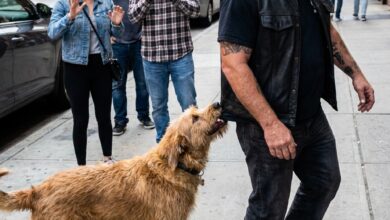
Buddy wasn’t big. He wasn’t dangerous. A mixed-breed with cloudy eyes and a limp in his back leg, the kind of dog people barely noticed. He’d been abandoned once before Margaret found him at a shelter six years ago, shaking and silent.
Since then, he had become her routine, her reason to wake up, her proof that she still mattered to someone.
“Buddy?” she called again, her voice thin, breaking in the middle.
A passerby shrugged.
Someone else said, “Maybe he ran.”
But Margaret knew better.
She’d tied the leash to the bike rack for less than three minutes. Long enough to grab milk and bread. When she came back, the leash had been cut clean.
Her knees buckled.
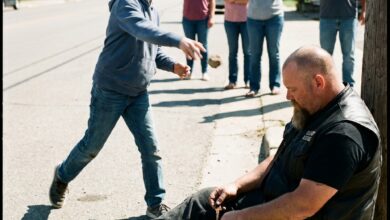
She sank down onto the curb, clutching the frayed end of nylon like it might still lead her somewhere.
People watched. A few whispered. No one moved.
That’s when the low growl of a motorcycle engine rolled across the parking lot.
Margaret looked up through tears.
A biker had just pulled in and shut off his engine.
She didn’t know it yet — but the worst day of her life had just collided with someone else’s reputation.
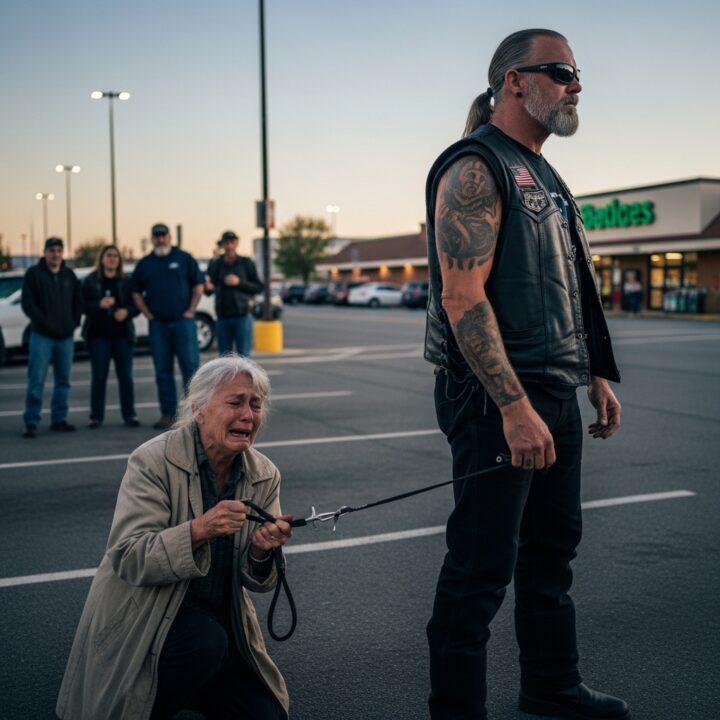
The biker walked toward her slowly.
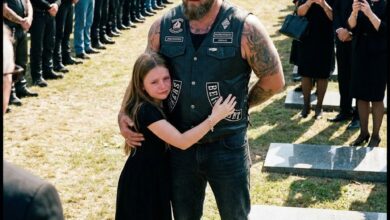
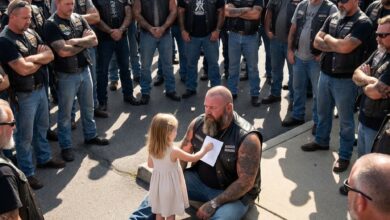
Leather vest. Short sleeves. Tattoos peeking out under sunburned skin. Dark sunglasses hiding his eyes. He looked exactly like the kind of man people crossed the street to avoid.
“Ma’am,” he said. “You okay?”
Margaret flinched.
She hugged the leash to her chest. “Please,” she whispered, “I don’t have anything.”
The biker stopped immediately, hands visible. “I’m not asking for money.”
People nearby stiffened.
A woman muttered, “What’s he doing?”
Another said, “Someone call security.”
Margaret looked up then — really looked — and saw something in the biker’s posture that didn’t match the fear in her chest.
“My dog,” she said. “They took my dog.”
The biker crouched down so he wasn’t towering over her. “Who’s they?”
“I don’t know,” she said, shaking. “He doesn’t bite. He doesn’t run. He comes when I call.”
The biker stood up and scanned the lot. “Anyone see anything?”
Silence.
A man near the entrance scoffed. “It’s just a dog.”
Margaret’s breath caught.
The biker turned sharply. “No,” he said. “It’s not.”
That was when the tension snapped.
Someone accused him of escalating things. Another told him to back off. A store employee stepped out and warned him to leave.
The biker didn’t argue.
He reached into his vest.
A collective inhale rippled through the crowd.
“Hey!” someone shouted.
But he didn’t pull out anything threatening.
He pulled out his phone.
Typed quickly.
Sent one message.
Then he looked back at Margaret.
“We’ll find him,” he said.
And for the first time since Buddy vanished, someone spoke with certainty — and the crowd didn’t like it.
The store manager came out, red-faced and annoyed. “Sir, you’re causing a scene.”
“I’m standing,” the biker replied calmly.
“You need to leave,” the manager said. “Now.”
Margaret tried to stand up, panic flooding back in. “Please,” she said to anyone. “He’s all I have.”
A few people looked away.
The biker didn’t.
He made a call this time, turning slightly so his voice carried just enough to be heard.
“Yeah,” he said. “Dog taken. Grocery lot on Main. Small, old, limping.”
That was it.
He ended the call.
“Who did you call?” the manager demanded.
The biker didn’t answer.
Across the street, another engine started.
Then another.
Heads turned.
The sound wasn’t aggressive. It was steady. Organized. Intentional.
Margaret’s heart pounded. “What’s happening?” she whispered.
The biker finally looked at her again.
“They’re coming,” he said.
The crowd shifted uneasily. Phones came out again — not to help, but to record.
From the far end of the street, shapes began to appear. Chrome. Headlights. Riders slowing as they approached.
No one knew what they would do.
No one knew why they cared about one old dog.
But suddenly, the question wasn’t if Buddy would be found.
It was who was about to be judged — and who would be proven wrong.