Fifty Bikers Surrounded a House Before Dawn — A Child Watched from Upstairs While Police Approached
Fifty bikers filled a quiet street before dawn and hammered on one house’s front door while a child’s face appeared behind the upstairs curtain, and every neighbor filming us thought a gang had come to settle a score.
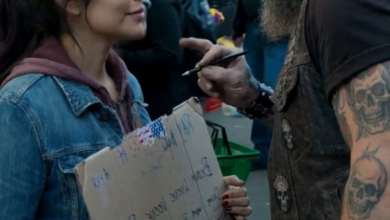
I was the one at the door. My name is Marcus Bell, fifty-six years old, a wide man with a beard gone gray in uneven patches and a leather vest that makes strangers choose another checkout line. At 4:18 that morning, my friend Sarah Vale had sent me eight words: “He took my phone. Mia is upstairs. Help.” She had borrowed a moment with the device while her husband was in the kitchen. When I called back, nobody answered. The unanswered call sounded louder than any engine.
Sarah had been my friend since we both worked at a tire warehouse outside Louisville, Kentucky. She knew I rode with the River Lanterns, but she had never asked me to bring the club to her home. She had once helped my mother sort a flooded basement and had refused gas money for the drive. Our conversations were mostly about work, her daughter’s school play, and the tomato plants neither of us knew how to keep alive. In the months before that message, she had grown careful about where she took calls. I had noticed. I had not asked enough.
I called 911 before I called Boone. I gave the dispatcher the exact message, Sarah’s address, the name of her husband, and the fact that a child was inside. I said I had no confirmation of injuries and did not know what was happening beyond the text. The dispatcher asked me not to force entry and said officers were being sent. Then I phoned our club’s president. “I need a witness at a house,” I said. Boone heard what I told dispatch and said he would come himself. The others had been preparing for a sunrise charity ride. Once riders heard that Mia might be inside with an angry adult, they started toward the neighborhood. Numbers traveled faster than instructions.
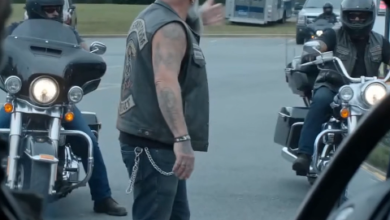
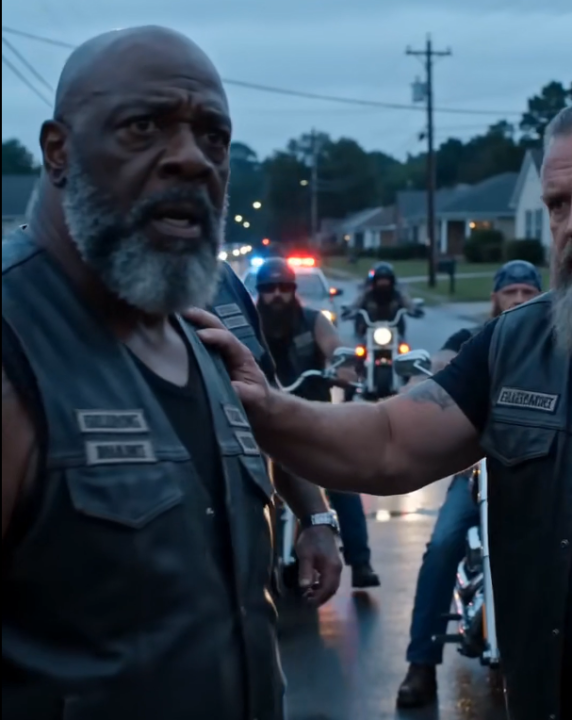
By the time I arrived, motorcycles lined both sides of the street. I made them park well away from the driveway and the corner, leaving space for patrol cars and an ambulance if one was needed. The headlights cast long bars over the wet pavement. Nobody revved an engine. Two men stood beside a neighbor’s hedge; most stayed near their bikes. From the windows, fifty leather vests still looked like fifty threats. Boone told every member to keep off the property unless police directed otherwise.
I knocked once, hard enough to be heard upstairs. “Sarah, it’s Marcus. Police are coming.” There was a noise from inside, a scrape against the hallway wall. I knocked again and called Mia’s name, then stopped because I could not know whether answering would place her at greater risk. Upstairs, the curtain moved. A small face appeared and vanished. My fingers went cold against the porch rail. A child knew we were outside. We had no idea if she was safe.
The door did not open. A neighbor stepped onto his balcony with a phone pointed at my back. “You’re terrifying them,” he shouted. Another person said the police had been called about a biker invasion. I told the first neighbor that I had already called police and that the street needed to remain clear. I did not tell him Sarah’s private message. The video would later begin with my fist striking the door. It would not show me holding the phone so tightly that the corner cut my palm.
Boone came up the walkway and touched my shoulder. “Step back,” he said. He was right. I had said we were waiting for police, and I was starting to pound with the impatience of someone who wanted the door to answer. He took me to the edge of the porch. A noise came from the side window, then a man’s voice called, “She’s fine. Get off my property.” It was Sarah’s husband, Grant. I knew him well enough to recognize his voice, and not nearly well enough to know what he might do next.
“Let Sarah tell the officer that herself,” I answered. My voice stayed low, though every part of me wanted to shout. We did not claim authority we did not have. We kept a route from the house to the street open. One rider handed Boone a flashlight, and Boone set it on the porch step without pointing it through a window. We were trying to be seen, not to take the house.
A police car turned the corner. Several bikers moved their machines to give it room. At that same instant the front door opened a crack. Grant appeared with one hand on the handle, his shirt buttoned wrong, and asked the officers why a crowd was attacking his family. Behind him I saw a small pink backpack lying on its side in the hall. Then, from upstairs, Mia called something I could not make out. Grant pulled the door toward him.
The officer said, “Sir, leave it open.” I saw Grant look up the stairs before he looked back at her. What had Sarah been trying to do when she sent the message?
Part 2
There are ways a person learns to make herself smaller without anybody announcing a rule. Sarah used to call from the warehouse breakroom and talk over the sound of a vending machine. After she changed jobs, her calls became shorter and carefully timed. If Grant walked into the room, she would say she had to go. She told me he was under stress, that he had lost a contract, that he disliked her old work friends. I believed those pieces because each had an ordinary explanation on its own. I should have noticed what they became when stacked together.
Three weeks before the message, I went to her house to return a cooler she had lent Carol. Grant met me at the door and said Sarah was sleeping. I offered to leave it on the porch. He said he would take it. As I handed it over I saw a drawing of a small house taped to the inside wall and heard Mia laugh from another room. I remember thinking that at least the child sounded happy. One child’s laugh was too little evidence to settle my worry. Still, I drove away because Sarah had not asked me to stay and I did not want my size or friendship to become another force controlling her front door.
That night Sarah sent a message saying thanks for the cooler and sorry she had missed me. Her words came much later than usual. I wrote that I would be around if she wanted to talk. She sent a single heart. I did not want to read a plea into an emoji. I also did not know how to ask directly without putting a dangerous question into a phone someone else might see. Carol suggested I invite Sarah and Mia to a public lunch with both of us. Sarah declined twice, saying weekends were difficult. We kept an empty place for them anyway.
The sunrise ride had been planned for months. Fifty members were gathering at the club garage to raise funds for a school breakfast program. I was at home tying my boots when Sarah’s text arrived. It was not an ambiguous hint. It said her husband had taken her phone, named her child, and asked for help. I called 911 before making any other move. The dispatcher asked whether Sarah had said she was being held against her will. I read the message exactly, including the order of the words. I could not answer the question with a certainty she had not given me.
I wanted to speed straight to her door. The dispatcher told me to stay on the line and described how to wait where officers could find me. I texted Sarah that police were coming, then remembered she no longer had her phone. I do not know whether Grant saw the message. My hands shook so badly I mistyped the address when I sent it to Boone and had to correct it immediately. A bad address would have been its own emergency.
Boone later said he had expected to bring three members. The riders at the garage heard him say “woman and child” and began reaching for helmets. He did not call them a rescue squad. He told them that anyone who came had to keep traffic clear, stay off the porch, and follow police directions. Ten could have done that. Fifty arrived because members wanted to be useful and because fear can look like an invitation to assemble. Once they were there, Boone had the job of preventing the crowd from becoming one more thing Sarah would have to survive.
At the house, we knew very little. The upstairs curtain had moved, and Grant said his family was fine. An officer was minutes away. We did not know where Sarah was or whether Mia could hear us without being punished for it. My instinct was to fill every second with noise so she knew I had come. Boone’s hand on my shoulder told me noise could cover the sound of Sarah trying to speak. I stepped back. For the first time I could hear a faint scrape against a window frame and the low wash of tires from the main road.
Part 3
Officer Price approached the porch with her partner, Officer Tran, several steps behind. Price was shorter than me and had the steady posture of someone who expected people to listen without measuring her shoulders. She had read my message to dispatch on the way over. I told her what I had heard through the door and where I had seen Mia. She asked Boone to move the riders farther from the house. He did it, though one member complained that backing away felt like leaving Sarah. “We can’t speak for her if she can’t see the officer,” Boone said. Distance was part of giving her an exit.
Grant opened the door enough to show his face and repeated that Sarah was sleeping. Price asked to speak with Sarah directly. He said she did not want to. Price told him there had been a specific request for help and that she needed to check on both her and Mia. She did not rely on the fifty men behind her for authority. I stood where she could call on me as a witness, not where I could push past her.
From somewhere inside the house, a woman said, “I’m here.” Grant tried to close the door. Price repeated her request. Tran moved to a position where he could see the hall without entering. I could hear Sarah’s voice again, quieter: “I need to come out.” I had imagined she might run straight into the yard when she heard motorcycles, but she was asking for space to choose her own steps. Grant looked over his shoulder. Then he stepped off the porch abruptly and accused me of teaching his wife to lie.
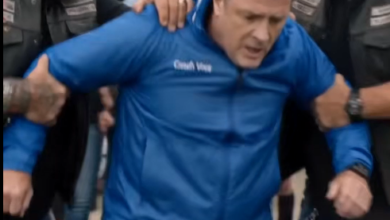
I kept my hands open. “Talk to the officer,” I said. He walked toward me, shouting about the message. Price told him to stop and stay where she could see him. He kept moving. Boone and I backed toward the sidewalk rather than draw him away from the officers. At the edge of the yard he swung an arm toward Boone and tried to shove past us toward the house again, where Sarah had appeared in the doorway. Boone caught his sleeve and held him there for a moment. It was messy and brief. Tran reached us almost immediately and took over. We held a line only until the people authorized to handle him arrived.
Grant was restrained by the officers after they assessed his conduct and spoke with Sarah. It was not a reward for us. The fact that I had called police did not make me a judge, and the fact that Grant was angry did not by itself explain everything that had occurred inside the house. Sarah’s statement, what officers observed, and the child welfare steps would matter. I moved away while Price spoke to Sarah separately. Mia came down the stairs carrying a backpack with one strap torn. She passed the doorway and went straight to her mother.
Sarah had a small bruise along her cheekbone and no shoes on. Price asked whether she wanted medical care and whether she had somewhere safe to go. Sarah said she wanted a nurse to examine Mia first because the child had been frightened and had slipped on the stairs. Mia said she had bumped her knee. The officers arranged a check. A neighbor tried to film the girl crossing the porch. I held a hand up to block his view without touching his phone. “Please give them privacy,” I said. He looked embarrassed and stepped back. A child’s fear was not the street’s footage to own.
The ambulance crew came in through the clear lane. That was why I was grateful Boone had moved two bikes after Price asked. The responders checked Mia and Sarah without a crowd hovering. Grant was taken for further questioning. I would later give a statement about the contact at the sidewalk and the number of riders present. At the time I was thinking about shoes. Carol had brought a pair of spare sneakers in her car because I told her Sarah might need somewhere to go. They were too big, but Sarah accepted them so she could walk to the ambulance without cutting her feet on the damp gravel.
Price asked Sarah whether she wanted Marcus involved. Sarah said yes, but she did not want to go to my house. Grant knew where I lived. It was her first decision after coming through the door, and I nearly ruined it by suggesting that fifty motorcycles could guard her there. I closed my mouth. Price gave her options through local advocates and explained what would happen next. Sarah chose a confidential place with support for Mia. The best help on that porch was accepting a plan I had not invented.
The video of us at the door reached the internet before the ambulance left. In its first seconds, it looked like an assault on a quiet home. In its last seconds, a child was visible near the officers. I asked the neighbor to take it down because of Mia. He said people needed to know what had happened. I said Sarah should decide what the public knew about her life. He lowered the phone, but the clip had already been shared. That was another mess that would have to be cleaned up after the urgent work was done.
Part 4
The next day Sarah called from a number I did not recognize. She and Mia were safe for the moment and had slept only a few hours. She asked me not to share the location with Boone, Carol, or anybody in the club. I told her I did not know it and would not ask. She was grateful we had come; she was also shaken by the motorcycles, the pounding, and the footage of her daughter. Both things were true. Gratitude did not cancel fear.
She told me what happened before the text. Grant had taken her regular phone during an argument about leaving the house. He demanded to know whom she had told about their marriage. Mia went upstairs because Sarah asked her to. When Grant went to the kitchen, Sarah took back the phone for a moment and sent the message to me. She had planned to text a local friend as well, but he returned and took it away. She said she had hoped one person would call police. She had not imagined fifty people outside, and she did not want them described as a private force she had summoned. “I asked my friend for help,” she said. I repeated that to Boone later because the wording belonged to Sarah.
At the station, I gave my account to the officers and handed them the original message. I also described every contact I had seen between club members and Grant. They collected the footage they needed, including a neighbor’s video that began before my knocking. We did not publish it to prove ourselves. The investigation involved a family and a child, not a public contest over whose camera angle won. Sarah met with an advocate and considered legal protections available to her. She did not need my advice about court orders; she needed rides to appointments when she asked and someone to believe what she said without answering for her.
Boone called a club meeting. Several men expected a celebration. He began by drawing the narrow street on a board and asking where an ambulance could have turned if a car had blocked the corner. The answer was uncomfortable. We had mostly kept the route open, but two motorcycles were too close to the intersection before Price told them to move. Next he asked who had knocked. Only me. Who had entered the house? Nobody. Who had held Grant? Boone for a few seconds when Grant moved toward Sarah after officers were on scene. We wrote those facts down. A crowd does not become careful by calling itself a family.
Our club offered to pay for a hotel. Sarah said the confidential placement was safer and she did not want us booking a room with her name. I had already started looking at rates on my phone. Her refusal stopped me from turning my guilt into a plan she would have to manage. We set aside the money anyway, without putting it in a photo or a fundraising post, and told her it was available if she later wanted it. She asked for something smaller: a ride for Carol to bring Mia’s school shoes to a contact point chosen by the advocate. Carol went alone. The bikers stayed at the garage.
The social media clip kept spreading. Some commenters insisted we had kicked in a door. The door was intact. Others wrote that fifty bikers should patrol every street where someone might be hurt. Sarah saw one post and said it made her feel as though her home had become a stage. I contacted the person who had filmed the porch and asked again for Mia’s face to be removed. I did not tell strangers where Sarah had gone or describe her injuries. Eventually the clip was taken down by its original poster, though copies remained. Once a child’s face is offered to a crowd, nobody can promise to collect every copy.
Sarah made a written statement when she was ready. Grant faced legal proceedings based on the officers’ investigation and her account; the details were handled in court. Neither the club nor I could guarantee the outcome. Sarah worked with advocates on a longer safety plan and on how Mia would return to school. She kept her job. She also kept the right to tell me I had overstepped. One evening she said, “You came because I asked. Next time let the police knock.” I said, “Yes.” I did not add that my fists had been shaking, or that I had pictured every terrible possibility behind the door. My fear explained my urgency. It did not outrank her voice.
Part 5
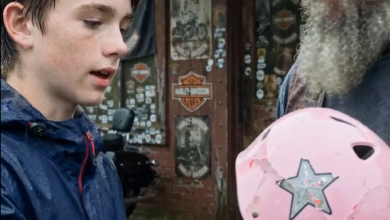
The first time I saw Mia again, she was choosing tomatoes at a small outdoor market with Sarah. I asked from several feet away if it was a good time to say hello. Mia nodded. Sarah said she had chosen the market because there were people around and she wanted Mia to have a normal Saturday. I bought a bag of bruised peaches and walked with them to the end of the stalls, leaving space when Sarah slowed to speak with a vendor. I wanted to ask a hundred questions about their recovery. Instead I asked Mia which tomatoes might survive on my porch. She inspected the tray, chose two small plants, and warned me that I watered too much. She was still a child with opinions about tomatoes.
She did not ask about the fifty bikers until we reached the sidewalk. “Were they mad at Dad?” she asked. I looked at Sarah, who gave a slight nod. “Some were frightened for you and your mom,” I said. “They should have stayed farther away from your house. The officers were there to help.” Mia considered that. “It was too loud,” she said. I told her I was sorry for the pounding. She said the knocking had let her know someone had found the address. Again, two truths in the same small voice. I tried not to force them into a single lesson.
Sarah began working with a counselor for herself and with support services for Mia. Some weeks went well; others were filled with appointments and paperwork. She kept her own bank card, chose how to handle communication about the house, and decided which friends knew her new routine. The club’s money paid for a few practical expenses after she asked to use it. Boone delivered the envelope to her advocate rather than posing with it on a clubhouse table. No one put her daughter’s story on a fundraising page. Help did not need a witness count.
Carol and I took a course at a local support organization about responding when someone tells you they are being controlled or hurt at home. The first thing the trainer said was that a person living with coercion may have weighed risks for months before sending a message. We should listen to what they need and avoid making promises about keeping them safe that we cannot guarantee. I thought about how quickly I had imagined my own house and fifty bikes as a fortress. Grant knew my address. I would have offered Sarah a place that was familiar to the man she was trying to get away from. The trainer did not need to know my case to make me feel the mistake land.
At the garage we changed our emergency rule. When someone asks for help, call responders, share the message accurately, keep a small number of witnesses available, and follow the person’s stated wishes whenever immediate safety allows. If many riders have already gathered, send most home rather than letting their size become a second problem. We wrote the rule after the crisis, when every word was easier to place on paper than it had been on the sidewalk. Boone made us practice saying, “What do you want me to do?” without adding a plan before the answer. It sounded simple until we tried to wait.
A member named Cal objected. “If it were my daughter, I’d break the door down,” he said. I understood the feeling. I told him my friend had asked for police, and the officers had arrived before any of us could know what was inside. Breaking the door might have harmed Sarah or Mia or given Grant another moment to use them against us. Cal leaned on the workbench and stared at the concrete. Later he said he did not like being told to stand back, but he could see that our job was to keep a clear path and provide information. There was no neat conversion. He had to keep doing it on ordinary days.
Mia’s backpack was repaired by a woman at Sarah’s new workplace who liked sewing. Sarah had declined Boone’s suggestion that the club buy a replacement. Mia loved the old one because the inside pocket hid drawings she made at school. When she showed me the repaired strap, she tugged it hard to prove the stitching held. I felt an absurd urge to tell the story of the torn strap to everyone who had watched the video. I did not. Her backpack belonged to her.
Months later, Sarah told me she had accepted a different apartment. She chose the street, the locks, the school bus route, and which friends could have the address. I offered to help carry furniture. She asked for Carol and me, not fifty riders. We brought a dolly, boxes, and lunch. Boone stayed away because he had not been invited. There was something healing in watching our club respect an ordinary boundary after having arrived in such extraordinary numbers. Sarah put Mia’s tomato plant on a windowsill and decided where the couch would go. I carried it there.
Part 6
Summer came slowly. Sarah learned which windows caught the evening sun. Mia made a friend who lived two doors away and asked for a bicycle bell that would sound like a bird. I found one at a shop and sent Carol the link, then waited for Sarah to say whether a gift was welcome. It was. At the club, the emergency rule lived next to a calendar of school breakfast deliveries. We kept riding to the same neighborhood projects we had planned before that dawn; the work had never needed a dramatic story attached to it.
The court process took longer than the internet’s attention span. Sarah had days when she wanted to talk and days when she answered no calls. We let her set the pace. I could not truthfully say she and Mia were suddenly free of fear. A loud knock on her new door once sent Mia behind the couch. Sarah told us about it afterward because she wanted to, and we listened. A safe address is a beginning, not a switch that turns memory off.
One afternoon Price stopped by the garage to ask Boone for a copy of our statement about the sidewalk contact. He gave it to her. She pointed to the space between the doorway and the curb on the drawing we had made and said it was helpful that riders had moved when asked. She also reminded us that the best witness at a scene is often the one who can give an accurate description without becoming part of the struggle. Her tone was practical. We appreciated it more than praise.
Sarah came to our charity breakfast only after Mia asked whether the club made pancakes. She wanted to see the room without engines or a line of men at a porch. Boone arranged a small table near the door and told the members not to ask her about the case. They complied, though Travis forgot himself once and asked if she was okay. Sarah said, “Today, mostly,” and then asked for another pancake. It was an answer complete enough for the moment.
I saw Mia examine the row of motorcycles outside after breakfast. She wanted to know why the engines had sounded so much louder near her old house. I told her walls and early morning made the noise carry, and too many of us had arrived at once. She asked if riding one bike alone would sound different. “Yes,” I said. She nodded. She did not ask to ride. She picked the blue bicycle bell from her pocket and rang it once, a bright chirp beneath the heavy motorcycles. Nobody laughed. They knew better than to turn it into a symbol for her.
Part 7
In September, Sarah invited Carol and me to Mia’s school play. Mia had a small role and one line about opening a window after a storm. We sat among other parents with our coats on our laps. Nobody there knew what had happened on the old street unless Sarah had chosen to tell them. I liked that she could keep some rooms free of us. A person’s life should be bigger than the day strangers saw her frightened.
Afterward we walked to the parking lot. Sarah asked whether I still rode by her former house. I said I avoided the street unless I had a reason to be there. She said she had driven past once with a friend and kept going. We stood beside a car while Mia described which classmate had missed a cue and how the teacher saved the scene. Her story was about a play, not about courage as adults like to define it for children.
I had spent months imagining that the sound of fifty engines proved we were loyal. What Sarah remembered most clearly was an eight-word message leaving her phone, one friend answering, and an officer asking what she wanted to do next. I would still answer her call. I would still call the police. I would bring Boone if I needed a witness. I would remember that the rest of the club could help by making room for her decisions instead of filling the street.
Mia reached for Sarah’s hand before crossing the lot. Sarah checked for cars, and the two of them walked toward their own front doors, their own evening, and a backpack with a repaired strap. I stood with Carol until they turned the corner. Then I went home. No one needed an escort that night.
Follow our page for more biker stories about showing up when someone asks, and learning to leave enough space for them to lead.