Part 2: Everyone Thought the Tattooed Mechanic Was Building Some Strange Machine Behind His Shop — Until a Double-Amputee Veteran Saw What Was Waiting
Part 2
My name is Nora Whitaker, and I run Whitaker Mobility & Repair out of a narrow brick storefront between a closed pawn shop and a tire place on Tulsa’s old Route 66.
We sell walkers, shower chairs, braces, scooter batteries, replacement wheels, and the kind of medical equipment people need but hate needing. That is the quiet truth of my business. Nobody dreams of buying a ramp. Nobody takes a cheerful selfie beside a commode chair. Mobility equipment is where pride meets necessity and tries not to flinch.
I have watched grown men curse at canes.
I have watched daughters pretend they were only browsing when they were really trying to figure out how to keep their mothers from falling in the bathroom.
I have watched veterans stare at price tags with faces harder than stone.
Marcus Bell came into my shop once, eight months before Forge ever saw the chair.
He was with his daughter, Junie, and his old power chair sounded sick before he reached the door. The motor clicked, whined, and stopped halfway over the threshold. Marcus pushed the joystick twice, then muttered something under his breath that made Junie giggle because children can still hear humor under pain.
I asked if I could look at it.
He said, “Just looking.”
That meant no money.
I knew the language.
Marcus was thirty-seven, Black, broad-shouldered, with close-cropped hair, a neat beard, and the posture of a man who had once stood taller than the chair allowed him to feel. He had lost both legs below the knee during his third deployment. He did not tell me that. Junie did, while looking at a basket of rubber cane tips.
“My dad was Army,” she said. “He can fix radios and pancakes.”
Marcus closed his eyes.
“Junie.”
“What? You can.”
His chair needed batteries, a controller, front casters, a seat cushion, and wiring work. Even used parts would cost more than he could manage that month. Benefits were delayed. Insurance had questions. The charity groups had forms. The world had hoops.
The chair had none of that time.
I gave him a temporary cushion and told him to come back.
He thanked me like it hurt.
That was the thing about Marcus. He was polite in a way that kept people at arm’s length. He did not want pity. He did not want applause. He wanted his daughter to stop pushing him up ramps before her childhood developed calluses.
Forge heard about him at Ruby’s Diner.
Not from me at first.
A waitress named Darlene told the story after Marcus’s chair died outside the diner and Junie tried to push him over the curb while two men pretended not to see. Forge had been sitting in the back booth with the Iron Wrench Brotherhood, black coffee in front of him, hands wrapped around the mug like he was warming old bones.
Darlene said, “Man served this country and can’t get a chair that works.”
Forge did not look up.
But Cruz told me later his hand stopped halfway to the sugar.
That was how it began.
Not with a speech.
With a big biker hearing one sentence and deciding not to sleep right for the next five weeks.
Part 3
The false climax came when the chair caught fire.
Not flames, exactly.
A sharp pop. a flash under the side panel. smoke curling up from the rebuilt control box. Enough to make every man in Forge’s garage step back and every old fear in him step forward.
It was a Tuesday night, close to midnight, rain ticking against the roll-up door. Forge had already logged two hundred and eighteen hours on the chair. He kept the count in chalk on the cabinet wall, not for bragging, but because he measured work the way some men measure prayers.
Hour 17: strip frame.
Hour 46: rebuild left motor.
Hour 103: seat pan.
Hour 161: hand control.
Hour 218: failed test.
I was there with two boxes of donated parts and a paper bag of burgers nobody had touched. Cruz was wiring new connectors. Preacher, a sixty-nine-year-old Black rider with a white beard and tired eyes, sat on an overturned bucket, pretending his knees did not ache. Miller, a white retired firefighter, had brought safety gear and too many opinions.
Forge hit the joystick.
The chair moved six inches.
Then it snapped.
Smoke rose.
Cruz cursed.
Miller grabbed the extinguisher, but Forge had already killed the power and yanked the battery lead with one scarred hand. The garage went silent except for the rain and the cooling tick of his Harley outside.
Forge stared at the chair.
His shoulders lifted once.
Not anger.
Worse.
Defeat.
The kind that comes after too many hours of trying to prove one thing can still be fixed.
“You need to stop,” Miller said.
Forge did not answer.
“You got rent due on the shop. You missed two paid jobs. Your hands are shaking, brother.”
Forge flexed his fingers.
They were shaking.
He curled them into fists to hide it.
Preacher watched him carefully.
“You building a chair,” he said, “or punishing yourself?”
That sentence landed hard.
Forge turned.
He was a huge man, and when he turned fast, the room remembered it. His scarred lip pulled tight. His eyes were wet but dry enough to deny it. Bikers like him do not cry easily. They turn grief into work and call it maintenance.
“Don’t start,” Forge said.
“I already did.”
Cruz stepped between them.
That was the first test of the brotherhood.
Not whether they would help.
Whether they would tell him the truth while he was still strong enough to hate them for it.
Forge pointed at the dead chair.
“He can’t get down his own ramp.”
“Marcus?” I asked.
Forge looked at me.
That was the first time he had said the veteran’s name in front of the whole room.
“How do you know him?” Miller asked.
“I don’t.”
“Then why this one?”
Forge walked to the workbench and picked up the photograph he always kept turned face down. For a second, I thought he would finally show us.
He did not.
He slid it into the inside pocket of his leather cut.
“Because somebody should’ve fixed one sooner.”
Then he went back to the burned control box and started taking it apart with hands that refused to steady.
By morning, half the brotherhood had chosen sides.
Some said Forge was doing holy work.
Some said he was drowning in another man’s chair.
Both were right.
Part 4
The truth came out on hour two hundred and seventy-six.
It was 3:40 a.m., the kind of hour when men say things they would rather weld shut in daylight. The garage smelled like burnt wire, black coffee, rubber, motor oil, wet leather, and the metal dust that clings to your throat after sanding.
Forge was rebuilding the joystick housing for the third time.
I was cleaning the seat frame.
Cruz had fallen asleep in a lawn chair with a torque wrench across his lap. Preacher was awake, because men like him have made peace with exhaustion.
The photograph slipped from Forge’s vest when he bent over.
It landed face up on the concrete.
Nobody moved for a second.
The picture showed an older white man in a wheelchair outside a small house, wearing a faded Army cap, one hand on the wheel, the other lifted toward the camera. Beside him stood a younger Forge, maybe twenty-two, thinner but already large, jaw clenched, eyes full of the anger young men mistake for strength.
On the back was a date from twenty-six years earlier.
Preacher picked it up gently.
“Your father?”
Forge kept working.
“Vietnam.”
“He use this chair?”
Forge’s wrench stopped.
The garage went still.
“Not this one,” he said. “Part of it.”
That was the twist.
The rebuilt chair for Marcus was not just a donated frame from my storage shed. The main seat bracket, the reinforced side rail, and the right caster fork had come from Forge’s father’s old wheelchair, a chair he had kept wrapped in canvas behind his shop for fourteen years.
His father, Earl Donovan, had come home from war with shrapnel pain, a bad spine, and pride sharp enough to cut anyone who tried to help. He spent his last year in a chair that stuck at thresholds and dragged left on sidewalks. Forge had promised to fix it.
He did not.
Back then, he was drinking, fighting, getting arrested, losing jobs, and blaming everyone alive for the sound inside his own chest. His father’s chair broke completely one August morning outside a grocery store. Earl fell trying to transfer himself. He was not badly hurt physically, but something in him closed after that.
“He stopped going out,” Forge said.
No drama.
Just fact.
“He died six months later.”
Preacher held the photo like it was a prayer card.
Forge finally looked up.
“I knew how to fix engines. Knew how to rebuild a transmission blindfolded. But I couldn’t fix the one damn thing that kept him in the world because I was too busy being trash.”
“Brother,” Preacher said softly.
Forge shook his head.
“No. Let it sit where it sits.”
That was his way. No comfort too quick. No absolution he had not earned.
The old caster wheel hanging from his keychain came from Earl’s chair. He touched it whenever the work got hard. I had thought it was a charm. It was a debt.
Cruz woke up halfway through the confession and did not pretend otherwise.
Miller came in at dawn with coffee and found us all quiet.
Nobody called Forge noble after that.
He would have hated it.
They just worked.
The brotherhood returned differently after the photo. The men who thought he was drowning stopped trying to pull him out by force and started holding the ladder steady. Rosa, a Latina rider with sharp eyes and a nurse’s patience, found pressure-relief padding through a hospital contact. Miller rebuilt the ramp brackets. Cruz redesigned the foot supports.
Preacher made one rule.
“No cameras.”
Forge nodded.
“And no speeches,” he said.
Preacher almost smiled.
“Wasn’t planning one.”
By hour three hundred, the chair was ready.
Black frame. deep cushion. rebuilt motor. quiet controls. smooth casters. armrests adjusted to Marcus’s height. foot supports shaped to protect what remained of his legs without making them the center of the machine.
On the underside of the seat, where no one would see unless they repaired it, Forge bolted a small old caster fork from Earl’s chair.
Not as decoration.
As a road continuing.
Part 5
Marcus did not want the chair.
That was the part people leave out when they retell the story too sweetly.
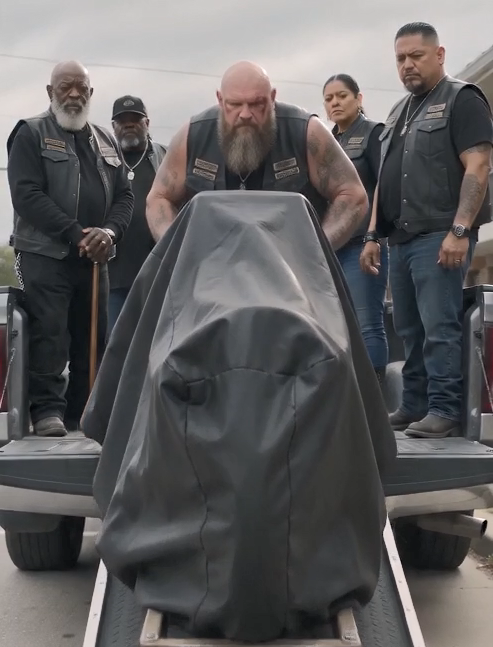
We arrived at his apartment on a Saturday morning under a sky the color of wet concrete. Forge rode in first on his Harley, engine low and controlled. Behind him came Cruz’s pickup and the small trailer. Preacher followed, then Rosa, Miller, and three other riders from Iron Wrench.
No patches you could read.
No flags waving.
No circus.
Just leather, boots, rain smell, and a covered chair on a trailer.
The neighbors came out anyway.
They filmed anyway.
Help looks suspicious when it arrives with motorcycles.
Marcus opened the door in his old manual chair, the left wheel bent just enough to make every push uneven. Junie stood behind him, both small hands on the handles, yellow sneakers planted like she was ready to move a mountain six inches at a time.
“I don’t know you,” Marcus said.
Forge stood at the bottom of the ramp. “No, sir.”
“You with the VA?”
“No.”
“Church?”
“No.”
“Then I’m good.”
Forge glanced at Junie’s hands on the chair.
He saw what all of us saw.
A child who had learned leverage too young.
Marcus saw him seeing it.
His face hardened.
“I said I’m good.”
Forge nodded.
He turned to Cruz. “Put it back.”
Everyone froze.
Cruz looked at him like he had lost his mind.
Forge’s voice stayed flat.
“He said no.”
That was dignity.
Not the restored motor.
Not the new seat.
Not the polished frame.
This.
A man being allowed to refuse help without being punished for having pride.
Junie made a small sound.
“Daddy.”
Marcus closed his eyes.
Forge did not move.
Rain began to spot his leather shoulders.
Preacher leaned on his cane and said nothing. Rosa looked at the ground. Miller stopped a neighbor from stepping closer with a look, not a hand.
Marcus opened his eyes again.
“What is it?”
Forge looked at him.
“A chair.”
“I can see that.”
“Runs smooth. Controls are light. Ramp-friendly. Seat won’t tear your skin up. Batteries are new. Wiring is clean. If it breaks, Nora knows how to reach me.”
“How much?”
“Nothing.”
Marcus’s jaw tightened.
“I don’t take charity.”
Forge nodded once.
“Good. I don’t give it.”
That sentence changed the air.
Marcus stared.
Forge touched the old caster wheel on his keychain.
“My old man served. He needed a chair that worked. I didn’t get it done in time.”
Marcus looked toward the trailer.
Forge kept his voice low.
“You served. You deserve to move through your own front door without your kid pushing you like the world forgot you.”
Junie’s eyes filled.
Marcus looked back at her hands on his chair.
That was the moment.
Not when he saw the rebuilt machine.
When he saw what the broken one had been taking from his daughter.
“Let me see it,” he said.
Cruz pulled the tarp away.
The chair sat there, quiet and solid, rain beading on the black frame. Not flashy. Not decorated. Built with respect instead of pity.
Marcus rolled down the ramp slowly in the manual chair. Forge stepped back, giving him room. When Marcus transferred, nobody rushed to help until he asked for one stabilizing hand.
He asked Forge.
Forge gave it.
One huge scarred hand gripping one veteran’s forearm, steady but not lifting too much. Marcus settled into the restored chair. His shoulders rose, then dropped.
He touched the control.
The chair moved forward.
Smooth.
No whine. no jerk. no grinding complaint.
Junie laughed once and covered her mouth.
Marcus rolled to the end of the walkway, turned, came back, and stopped in front of Forge.
His eyes were wet.
No tear fell.
Soldiers and bikers share some bad habits.
“How much did this cost you?” Marcus asked.
Forge shrugged.
“Three hundred hours.”
“That’s not nothing.”
“No.”
Marcus looked at the chair, then at the riders, then at his daughter.
“What do you want?”
Forge touched the old caster keychain again.
“Keep moving.”
Marcus held out his hand.
Forge took it.
No speech.
No hug.
No cameras close enough to make it cheap.
Just two men gripping hands in light rain while a little girl stood behind them with both palms free.
Part 6
The chair changed Marcus’s mornings.
That was how I measured it.
Not in big inspirational scenes. Not in newspaper headlines or viral clips or politicians suddenly remembering veterans exist. I measured it by the small, private victories people almost never film.
Marcus came into my shop two weeks later by himself.
No Junie pushing from behind. No strained shoulders. No apology at the door. He rolled in, stopped beside the counter, and placed a bag from Ruby’s Diner in front of me.
“Biscuits,” he said.
“For me?”
“For whoever kept telling Forge not to make the seat too hard.”
I took the bag.
He looked around my shop.
Then he said, “You got work?”
That became the echo.
Once a month, Marcus came to Whitaker Mobility & Repair and helped test chairs, scooters, brake handles, cushions, ramps, and repairs. He was not a mascot. He was not a poster. He was a man with lived knowledge and no patience for sloppy work.
“That armrest will tear skin.”
“That joystick is too stiff.”
“That ramp angle is trash.”
Forge loved him immediately.
Not softly.
Mechanic to mechanic.
The Iron Wrench Brotherhood started showing up on the first Sunday of every month. They called it Lift Day, though no one made shirts, no one asked for donations online, and no one allowed cameras without permission. They fixed walkers, tightened wheelchairs, replaced scooter batteries, built little wooden threshold ramps, and drank terrible coffee out of my back room.
Forge kept Earl’s photo on the garage wall after that.
Not hidden anymore.
Still not explained to every stranger.
Beside it, Marcus eventually taped a picture Junie drew of him in the restored chair. In the drawing, the chair had flames, wings, and what looked like rocket boosters.
Forge studied it.
“No flames,” he said.
Junie crossed her arms. “Maybe later.”
Marcus laughed.
That sound did more for the room than any thank-you note could have.
Every few months, Forge checked the old caster fork under the seat. Marcus pretended not to notice. I noticed both of them pretending. Some respect works best that way.
On the anniversary of Earl Donovan’s death, Forge rode his Harley out before dawn along Route 66. Not fast. Not dramatic. Just a low engine moving through a sleeping city, stopping at the cemetery long enough to wipe dust off a flat marker.
Then he rode to Marcus’s apartment.
He never knocked.
He only checked the ramp bolts, tightened one screw, and left before the curtains opened.
Marcus knew.
Of course he did.
The next morning, a diner biscuit waited on Forge’s workbench.
No note.
No need.
Part 7
People ask me why Forge did it.
They want the clean answer.
Because Marcus served. Because the chair was broken. Because veterans deserve better. Because bikers can be kinder than strangers expect. All of that is true, but truth usually has more grease under its fingernails.
Forge did it because a man he never met needed the repair his own father never got.
He did it because Junie’s hands were too small to be pushing the weight adults had failed to carry.
He did it because dignity is not a slogan on a bumper sticker.
Sometimes dignity is a battery that holds charge.
A cushion that does not split skin.
A ramp crossed without asking your child to lean into the handles.
A rebuilt motor humming quietly while a man leaves his own apartment without planning the whole day around broken wheels.
Last week, I saw Marcus roll past Ruby’s Diner with Junie walking beside him instead of behind him. She was eating fries out of a paper boat, talking too fast. Marcus was pretending not to steal any. The chair moved smooth over the cracked sidewalk.
Across the street, Forge sat on his Harley at the curb, one boot down, hands resting on the bars.
He did not wave big.
Marcus did not either.
Just two fingers lifted.
That was enough.
Forge touched the old caster wheel on his keychain, then started the engine. The V-twin came alive low and steady, not loud enough to rattle windows, just enough to announce a man going back to work.
Junie turned at the sound.
“Bye, chair guy!” she yelled.
Forge looked embarrassed.
Good.
Then he rode west on old Route 66, black leather cut heavy on his shoulders, scarred hands steady on chrome, his father’s photograph waiting on the garage wall, and another broken chair already lifted on blocks.
The engine faded.
The wheels kept turning.
Follow the page for more stories about the people we judge too quickly, and the quiet repairs that give someone their road back.