Everyone Called the Old Biker Cruel for Starting His Harley Beside a Terrified Girl Every Morning — Until Her Mother Revealed Why That Engine Was the Only Sound She Trusted
At 6:47 every morning, the most frightening man on our Kentucky road started the loudest motorcycle in the county—and my ten-year-old daughter, who hid from every unfamiliar man, ran toward the sound smiling.
Why did a child who trembled at the sight of a male delivery driver trust a six-foot-four biker with tattooed hands? And why was he starting that Harley when he never went anywhere?
The morning our neighbors tried to make him stop, I found out how little a person can understand while believing they have seen everything.
My name is Leah Turner. I was thirty-four then, raising my daughter, Ellie, in a rented farmhouse outside Pine Knot, Kentucky, where US 27 cuts through wooded hills and strangers become local news before their engines cool. Our house had peeling white siding, a rusted swing set and a wire fence separating our yard from Earl Maddox’s property.
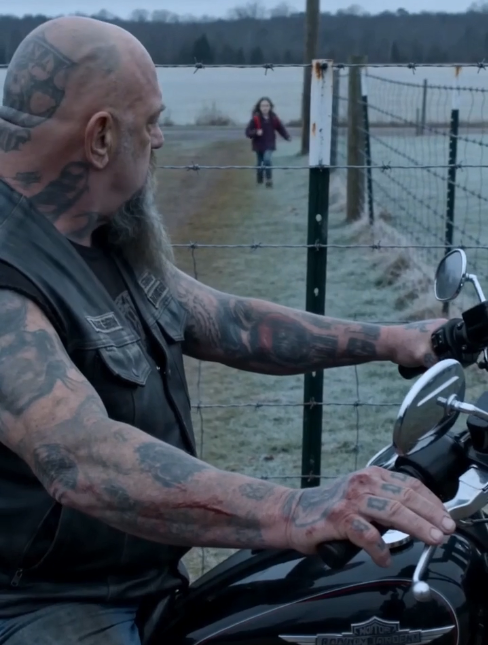
Everybody called Earl “Rook.”
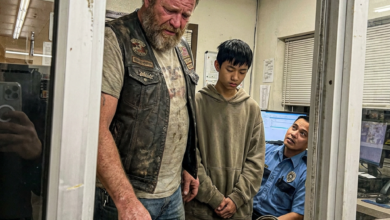
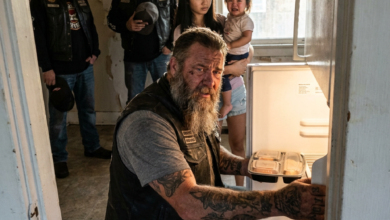
He was sixty, retired from repairing coal trucks, and built like a man who had spent forty years lifting things other men used machines to move. He had a shaved head, a long gray beard, tattoos across his neck, forearms and knuckles, and a cracked black leather vest that creaked when he breathed. A silver skull ring struck his coffee mug whenever he raised it.
Rook lived alone.
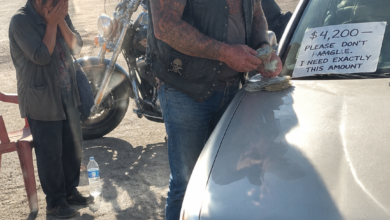
His black Harley rested inside an open-sided shed beside a red tool chest. Most mornings he rolled it onto the gravel at exactly 6:45, climbed onto the seat and pressed the starter.
The first explosion of that V-twin shook our kitchen windows.
Ellie always stopped whatever she was doing.
Then she ran outside.
She would stand behind our fence in her purple coat, school backpack hanging from one shoulder, and lift two fingers toward Rook. He answered with the same two-finger wave. Sometimes he let the Harley idle for thirty seconds. Sometimes two minutes.
Then he shut it off.
He never left.
That was the part people noticed.
What they did not notice was Ellie’s breathing becoming slower beneath the engine’s uneven rhythm. They did not see her unclench her fingers from the straps of her backpack. They did not know she could board the school bus without checking every parked car after hearing that motorcycle.
The complaints began in November. A neighbor said the noise woke his baby. Another said Rook was revving his engine to intimidate people. Someone reported that a tattooed biker was deliberately frightening a “troubled little girl” every morning.
A sheriff’s deputy arrived on a wet Tuesday.
Rook had just started the Harley. Ellie stood at the fence, smiling through the cold exhaust drifting between the yards.
The deputy stepped from his cruiser and raised one hand. “Kill the engine.”
Rook obeyed.
Silence fell across the road.
Ellie’s smile disappeared.
A white utility van was approaching behind the cruiser. It belonged to a repair company, but Ellie could not read the lettering from that distance. She saw only a man behind a windshield.
Her lunch bag dropped.
She backed away from the fence, struck the porch step and folded both arms over her head. By the time I reached her, she was shaking too hard to speak.
The deputy stared at my daughter. Then he looked at Rook.
“You see what your noise is doing?”
“It wasn’t the bike,” I said.
He turned toward me.
I had never told our neighbors why Ellie feared men arriving in cars. I had not told her school, except for one counselor. I had not even told Rook, although he seemed to understand more than I wanted him to.
Rook’s scarred hand remained on the Harley’s fuel tank. He did not start it again without my permission.
“Leah,” he said quietly. “Should I?”
The utility van slowed to find an address.
Ellie made a small sound beneath her arms.
“Yes,” I whispered. “Please.”
The Harley came alive.
Its thunder rolled across our yard, rough enough to rattle the porch railing—and beneath that enormous sound, my child finally uncovered her face.
The deputy believed he had come to stop a biker from terrorizing a frightened girl. He did not yet know the machine was the only thing telling her she was safe.
Neither did I know why Rook would soon begin starting it every morning, even through snow, sickness and the day a silver sedan appeared at the end of our driveway.
Part 2 — The Man Beyond the Wire Fence
Ellie had not always been afraid of men.
When she was five, she talked to cashiers, waved at road crews and once followed a gray-haired stranger halfway down a grocery aisle because she thought he was Santa without his red suit. The fear came later, after her father, Darren, began returning home angry.
His arrival always sounded ordinary.
Tires on gravel. A car door. Keys striking the kitchen counter.
That was what made the damage difficult to explain. There had been no monster’s roar warning us. There was only the soft ticking of a sedan cooling outside and a familiar man entering his own house.
I left Darren when Ellie was seven. It took me longer than it should have because fear can make a locked door look like shelter. A family advocate helped us obtain a protective order, and my cousin found the farmhouse outside Pine Knot, almost ninety miles from the life we had abandoned.
Ellie stopped asking about her father.
She also stopped trusting men who arrived inside cars.
A plumber came to repair our kitchen sink, and she hid in the linen closet until he left. A driver placed groceries on our porch, and she crawled beneath her bed. When a male school counselor approached her mother’s car during pickup, she kicked the door until the child lock cracked.
Men already inside buildings frightened her less. Men walking along the road made her cautious. But a man emerging from a vehicle meant danger had chosen our house.
Therapists called it an association. Ellie called it nothing.
Then we met Rook.
On our second afternoon in the farmhouse, his Harley turned into the neighboring driveway with a deep, uneven rumble. I saw the shaved head, the black leather and the dark ink climbing from his collar. I locked our front door before he removed his helmet.
Ellie pressed her face against the window.
She did not hide.
Rook noticed us but did not approach. He carried two grocery bags into his house, returned for a sack of dog food, then remembered he had no dog. I learned later that he bought it for an old hound living behind the abandoned feed store.
The following morning, he appeared at our fence holding a piece of cardboard.
WELCOME. WELL WATER TASTES LIKE PENNIES. DON’T DRINK FROM THE OUTSIDE SPIGOT.
He did not come through the gate. He rested the sign against the fence and backed away.
Ellie watched from behind my leg.
“You write big,” she said.
Rook glanced at his block letters. “Eyes are old.”
“You’re loud.”
“Bike is.”
“Are you?”
“Sometimes.”
That was their first conversation.
He never asked her to shake his hand. He did not call her sweetheart, tell her to smile or say he was harmless. Adults who announced they were harmless usually made Ellie more frightened.
Rook allowed distance to do its work.
For three weeks, their friendship consisted of two-finger waves. Then Ellie noticed the small brass bell hanging beneath the Harley’s frame and asked what it was.
“Road bell,” he said.
“Does it make the motorcycle safe?”
“No.”
“What does?”
“Paying attention.”
She considered this, then pointed toward his skull ring. “That looks mean.”
“Cheap too.”
She laughed.
The sound surprised all three of us.
Rook’s motorcycle club visited one Saturday. Nine Harleys rolled into his yard, their engines shaking rainwater from the gutters. The riders wore weathered leather, heavy boots and enough tattoos to make our church deacon close his curtains.
Ellie ran to the fence.
The bikers saw her and began removing helmets. Rook lifted one hand, and every rider stopped where they stood. Nobody approached the child. Nobody filled the silence with friendly questions.
A Black woman in her fifties with silver braids crouched beside her motorcycle from fifteen yards away.
“My name’s June,” she called.
Ellie remained behind the fence. “Is that your real name?”
“Nope.”
“What is?”
“Not telling.”
Ellie smiled. “Then I’m not telling mine.”
“Fair.”
The club called itself the Cumberland Ravens. Rook had ridden with them for seventeen years, but his vest carried fewer patches than the others. One rectangular space on the left side was darker where something had been removed.
I asked June about it while Ellie watched the riders leave.
“That belongs to Rook,” she said.
“What was there?”
“Something he stopped believing he deserved.”
Before I could ask more, she fastened her helmet.
The Ravens departed in pairs. Rook remained behind, watching the empty road long after their taillights disappeared.
That evening, I noticed a stack of unopened letters through the window of his shed. Every envelope carried the same Albuquerque return address.
He caught me looking.
“My daughter,” he said.
“You should open them.”
“You should mind your fence.”
It was the first unkind thing he ever said to me.
The next morning, a delivery driver turned into our yard before sunrise. Ellie screamed from her bedroom. Rook heard her through two walls, fifty yards and a hard Kentucky rain.
He did not come running toward our house.
He started the Harley.
Ellie stopped screaming before I reached the stairs.
Part 3 — The Question Rook Should Not Have Asked
I told myself the timing was accidental.
Rook often worked in his shed early. He could have needed to test the battery. He might have planned a ride and changed his mind when the rain worsened.
But the same thing happened four days later.
A cable technician arrived in a white van. Ellie saw him through the kitchen window and wedged herself between the refrigerator and the wall. Rook looked over from his shed, rolled the Harley into the open and started it.
He did not rev the throttle.
He let the engine settle into its lopsided idle.
Potato-potato. Pause. Potato-potato.
Ellie listened.
Her shoulders came down.
“Mr. Rook is home,” she whispered.
That was the first time she explained what the motorcycle meant.
To Ellie, the sound was not merely different from a car. It placed a known adult on the other side of our fence. Rook never entered our home without permission. He never blocked a doorway. He never touched her unexpectedly. If his Harley was running, he was close enough to hear her.
The noise mapped safety.
I did not tell Rook immediately. Shame stopped me. The truth about Darren felt like a stain other people would search for on my parenting, asking why I had stayed, what I had missed and how much Ellie had endured before I acted.
Rook never asked those questions.
He asked a different one.
It happened after a man from the electric company came to inspect a damaged pole. Ellie fled our porch, but instead of running into the house, she ran toward the fence. Rook stood on the far side holding a socket wrench.
He lowered himself onto one knee. Even kneeling, he looked enormous.
“Why me?” he asked.
Ellie stared at his boots.
“Why doesn’t the bike scare you?”
I crossed the yard before she could answer. “That’s enough.”
Rook stood. “Wasn’t pushing.”
“It sounded like pushing.”
He nodded and returned to his shed.
Ellie watched him go. “He didn’t do anything.”
“I know.”
“Then why are you mad?”
Because anger felt cleaner than humiliation. I could direct it at Rook instead of at the years when I had explained away Darren’s temper, believed apologies and mistaken quiet days for change.
That night, I walked next door.
Rook was seated beside the Harley, cleaning dirt from the cooling fins with an old toothbrush. The shed smelled of fuel, coffee and wet leather. A radio played quietly beneath the metallic ticking of the engine.
“I owe you an answer,” I said.
“No.”
“You asked.”
“Shouldn’t have.”
I remained by the door. He did not invite me farther inside.
“Her father drove a gray sedan,” I said. “Every time he came home, she watched it pull into the driveway. If he had been drinking, she could tell by how close he parked to the porch.”
Rook stopped moving the toothbrush.
“He hurt her?”
I could not say yes aloud.
My silence did it for me.
His right hand closed around the toothbrush until the plastic bent. His scarred knuckles whitened. For one second, I saw the man our neighbors believed he was—a man who could answer cruelty with something heavier.
Then he placed the toothbrush on the workbench.
“Where is he?”
“Not your concern.”
“Wasn’t asking so I could ride there.”
“That is exactly what I thought.”
Rook looked toward the dark road. “Fair.”
I told him about the protective order, the therapy and Ellie’s fear of men stepping from cars. Then I repeated what she had said that morning.
“She knows you ride a motorcycle. Nobody on a motorcycle ever hurt her. When she hears your Harley, she knows you’re home.”
Rook lowered his head.
The chain on his wallet clicked against the stool. His beard hid most of his face, but not the movement in his jaw.
“To her, that engine is safe,” I said.
He stared at the motorcycle as though I had changed what it was.
The next morning, the temperature dropped below freezing. I woke at 6:40 and found Ellie dressed for school, sitting beside the window with her backpack on.
At 6:47, Rook’s Harley started.
Ellie smiled.
Through the glass, I saw Rook sitting on the machine in a thermal shirt, jeans and boots. Frost silvered his beard. He held the idle for ninety seconds, raised two fingers toward our window and shut it down.
He did not ride anywhere.
He did it again Wednesday.
And Thursday.
On Friday, sleet covered the road. School was canceled, but at 6:47 the Harley still came alive.
I pulled on my coat and crossed the yard.
“You don’t have to do this.”
Rook kept both boots on the ground. “Battery needs exercise.”
“You disconnected the headlight.”
“Saves power.”
“You’re freezing.”
“Been cold before.”
I stepped closer. “Rook, she isn’t going to school today.”
He looked toward our kitchen window. Ellie stood there with her hand raised.
“She woke up, didn’t she?”
He answered her wave.
That afternoon, I called June and asked what had happened between Rook and his daughter.
June went silent long enough for me to regret the question.
Finally, she said, “He tried to protect her the wrong way.”
“What does that mean?”
“It means the first person that engine may be saving isn’t your little girl.”
Before she hung up, June told me to look inside the left pocket of Rook’s vest if he ever gave me permission.
“Why?”
“Because that’s where he keeps the reason he never knocks on your door.”
Three days later, the county deputy arrived with the first noise complaint.
Part 4 — The Silver Sedan at the Mailbox
Deputy Harris expected an argument.
He found Rook standing beside a silent Harley while Ellie shook on our porch and the utility van searched for an address. When I asked Rook to restart the engine, the deputy’s face changed.
He watched my daughter uncover her ears.
That seemed to confuse him most. Ellie was not blocking the noise. She was listening through it.
The utility van continued down the road. Rook shut off the Harley, and Ellie’s breathing remained steady.
Harris removed his hat. “Someone reported he was targeting the child.”
“He was helping her.”
“With that?”
“Yes.”
Rook wiped one hand on his jeans. “I can start later.”
“No,” Ellie said from the porch.
It was the first word she had spoken to the deputy.
Harris looked at her. “You like the motorcycle?”
She shook her head.
Rook almost smiled.
“I don’t like it,” Ellie explained. “I know it.”
The deputy wrote no citation. He asked Rook to avoid revving, which Rook already did, and suggested he shorten the idle. Then Harris returned to his cruiser.
Ellie’s fingers locked around my coat when the car door opened.
Rook saw it.
He started the Harley once more and kept it running until the cruiser left.
After that morning, the ritual became precise. At 6:46, Rook rolled the Harley out. At 6:47, the V-twin caught. Ellie stood at the fence or watched from the window. At 6:49, he shut it down after her school bus appeared beyond the bend.
He did not follow the bus.
He did not claim credit.
Most people still believed he was a lonely old man making noise because nobody could stop him. Rook allowed them to believe it.
In December, the Cumberland Ravens invited him on a charity ride to Lexington. Twenty-three riders gathered at a diner before dawn, but Rook did not join them. The departure time conflicted with Ellie’s school bus.
June confronted him beside the shed.
“You helped plan this ride.”
“Plans change.”
“We need our road captain.”
“Use Boone.”
“You’ve missed four rides.”
Rook checked his watch. “Three.”
“Christmas hospital run made four.”
He looked toward our dark kitchen window.
June followed his eyes. Her anger softened, but it did not disappear. The Ravens had raised money for children’s winter coats, repaired roofs and escorted funeral processions through storms. Brotherhood mattered to Rook. Showing up had always been his language.
Now he was choosing one child behind a wire fence over them.
June removed one glove. “Tell Leah to record the engine.”
“No.”
“A speaker would make the same sound.”
“No, it wouldn’t.”
“How would she know?”
Rook’s answer was quiet. “Because I wouldn’t be here.”
June stared at him for a long moment. Then she nodded.
The club changed its departure time.
At 6:47 the following morning, twenty-four Harleys waited silently along our road while Rook’s engine idled alone. The riders did not start theirs until Ellie boarded the bus.
The thunder that followed sent birds from every bare tree in the hollow.
Ellie laughed so hard she missed the first step of the bus.
For several weeks, she improved. She remained wary, but she could stay in the kitchen while a male plumber worked beneath the sink. She learned to ask delivery drivers to leave packages beside the gate. Her therapist taught her to identify five things she could see, four she could touch and three she could hear.
The third sound was often Rook’s Harley.
Then, on January 18, the motorcycle did not start.
The starter clicked once.
Nothing followed.
Ellie stood at the window wearing her red backpack. Rook tried again. The engine turned halfway and died.
He removed the seat, checked a cable and swore under his breath.
The school bus appeared around the bend.
“Is he home?” Ellie asked.
“Yes.”
“But I can’t hear him.”
“You can see him.”
“That isn’t the same.”
I was preparing to keep her home when Rook walked to our fence. He stopped six feet away and placed his cracked black vest on the top wire.
From the left pocket, he removed a small brass key attached to a faded blue shoelace.
He set it beside the vest.
“What’s that?” Ellie asked.
“House key.”
“Why are you giving it to us?”
“If the bike doesn’t start and you need to know I’m home, your mom can use it.”
“To come inside?”
“To open the shed. Light switch is on the right.”
Ellie looked toward his dark house. “What if you’re sleeping?”
“Wake me.”
“What if you’re mad?”
“Wake me anyway.”
He left the key on the fence.
The gesture frightened me more than it comforted me. Rook guarded his privacy like a wounded animal guarded its last piece of ground. Yet he had just given us a way through his locked door.
The Harley needed a new battery. June brought one that afternoon. While they worked, an unopened envelope fell from Rook’s vest.
The Albuquerque address was on the front.
This time, the envelope had been opened.
Inside was a photograph of a woman in her thirties standing beside a teenage girl. On the back, someone had written: Mara turns sixteen next month. She asks about you.
Rook took the photograph from my hand.
“Your granddaughter?” I asked.
His eyes stayed on the girl.
“Never met her.”
“Why?”
“Because her mother remembers what I become when I think somebody needs protecting.”
Before I could ask what he meant, the rumble of a car climbed our road.
A silver sedan stopped beside our mailbox.
Ellie saw the driver before I did.
Her glass of milk struck the kitchen floor.
The man inside the sedan had not seen his daughter in nearly three years, but I recognized the way he leaned over the steering wheel, studying our house as though every locked door still belonged to him.
Darren had found us.
Rook was holding a wrench beside the Harley. June stood near the shed. Both looked toward me.
“Inside,” I told Ellie.
She could not move.
Darren opened the car door.
Rook did not walk toward him. He did not reach into his vest, lift the wrench or call the Ravens.
He climbed onto the Harley.
The engine started on the first turn.
Ellie gasped.
Rook kept his eyes on her, not on Darren.
Potato-potato. Pause. Potato-potato.
“Mr. Rook is home,” she whispered.
Then she took my hand and ran inside.
Part 5 — What the Engine Could and Could Not Do
I locked the door and called 911.
Outside, Darren shouted my name. He said he only wanted to talk. He claimed the protective order had expired, although it had been renewed six weeks earlier. He took two steps toward our porch.
Rook remained on his property.
The Harley idled beneath him, loud enough to fill the spaces Darren’s voice usually occupied. June stood beside the shed with her phone raised, recording the license plate and every movement.
Darren pointed at Rook. “Shut that thing off.”
Rook did not answer.
Darren crossed the edge of the road.
Rook’s boots stayed planted.
No threat. No charge. No heroic swing of a tattooed fist.
That restraint may have been the hardest thing he had ever done.
Deputy Harris arrived seven minutes later. Another cruiser followed. Darren was detained for violating the protective order and refusing repeated instructions to remain beside his car.
When the handcuffs closed, Ellie did not watch.
She sat on our kitchen floor, matching her breaths to the motorcycle through the wall.
Rook kept the engine running until the silver sedan was towed beyond the bend. Then he shut it off and remained seated, both hands gripping the handlebars.
I crossed the yard after the officers left.
June stood several feet behind him. She shook her head when I tried to approach, warning me to wait.
Rook’s shoulders were trembling.
Not from cold.
“I could’ve crossed that road,” he said.
“But you didn’t.”
“I wanted to.”
June answered before I could. “Wanting isn’t doing.”
Rook climbed off the Harley. His right knee buckled, and he caught himself against the tank.
That was when Ellie appeared at our gate.
I told her to stay back, but she slipped past me. She walked to the fence and placed both hands around the wire.
“Did you make him leave?”
“No,” Rook said.
“Who did?”
“Your mom called the people whose job it was.”
Ellie studied him. “You didn’t fight him?”
“No.”
“Were you scared?”
Rook glanced at Darren’s tire marks beside the mailbox.
“Yes.”
She seemed relieved.
Children who have lived with violent adults recognize false fearlessness. They know that people claiming never to be afraid are usually hiding the moment when fear becomes anger.
That evening, Rook finally opened the remaining letters from Albuquerque.
I did not know this until June came to our house two days later carrying his vest. Rook had collapsed in the shed shortly after midnight. He had ignored chest pressure for hours, believing it was anger from Darren’s visit. June found him after he failed to answer his phone.
He was taken to a hospital in Corbin.
The Harley stood silent the following morning.
At 6:47, Ellie waited by the window.
I explained that Rook was sick but alive. June offered to start his motorcycle, then admitted he would skin her if she touched it without permission.
Instead, she parked her own Harley beside our fence.
Its engine was smoother and higher than Rook’s. Ellie listened, then shook her head.
“That’s not him.”
“No,” June said. “But he asked me to be here.”
Ellie considered this.
“Will he come back?”
“Hard man to get rid of.”
For five mornings, June started her Harley at 6:47. On the sixth, three Ravens came. Each remained at a distance. They rotated because the January roads were icy and most had jobs.
The sound was never quite right.
But the presence was.
Ellie began to understand that safety did not belong to one machine or one man. Rook had given her a doorway; the Ravens were holding it open while he was gone.
On the seventh afternoon, I drove Ellie to the hospital. A male nurse entered the room as we arrived. She froze beside the door, but Rook was sitting upright in bed, his beard combed badly and an oxygen line beneath his nose.
He tapped two fingers against the bedside rail.
Two beats. A pause. Two more.
Ellie crossed the room.
“You look small,” she told him.
“Bed’s big.”
“June touched your motorcycle.”
Rook’s eyes narrowed. “Where?”
“She didn’t. But your face looked funny.”
He grunted.
Ellie placed the brass house key on his blanket. “You have to come home. Your engine sounds wrong when somebody else does it.”
The nurse adjusted Rook’s monitor. Ellie watched his hands but did not retreat.
Rook looked at me. “Tell her.”
I did not know what he meant.
“The pocket,” he said.
June had brought his leather vest. I reached into the left inner pocket and found a photograph folded around a small court document.
The picture showed Rook twenty-two years younger, standing beside a girl with his same dark eyes. She wore a hospital bracelet and held one arm against her chest. Rook’s knuckles were split.
The document was a judgment from McCreary County.
Earl Maddox had served eighteen months in prison for aggravated assault.
Ellie looked from the paper to him. “Did you hurt somebody?”
“Yes.”
“Was he bad?”
Rook’s jaw worked before the answer came.
“He hurt my daughter.”
“Then you saved her.”
“No.”
The word filled the hospital room more completely than his Harley ever had.
“I hit him,” Rook said. “Then I went away. She had to attend court alone. Had to move alone. Had to learn safe alone.”
The daughter in the photograph was Claire. At nineteen, she told Rook her boyfriend had been controlling and hurting her. Rook promised to handle it.
He handled the man.
He did not handle Claire’s fear.
While Rook served his sentence, Claire moved to New Mexico with her mother. She wrote for years, but every letter from her made him face the difference between revenge and protection. He stopped opening them.
The missing patch on his vest had once read ROAD CAPTAIN.
Rook removed it after Claire asked him a question during their last phone call twelve years earlier.
How can men trust you to lead them home when your own daughter could not trust you to stay?
He had no answer.
Then a frightened ten-year-old moved next door.
Part 6 — The Sound He Had Been Practicing For
Rook returned home with medication, a diet he disliked and strict orders not to ride for six weeks.
The first morning, he walked into his shed at 6:46.
“You’re not supposed to ride,” I called from our fence.
“Not riding.”
“You’re not supposed to strain.”
“Pressing a button.”
“You had a heart attack.”
“Small one.”
June stepped from behind the shed. “Doctor didn’t call it small.”
Rook glared at her.
At 6:47, he started the Harley.
Ellie stood beside me, her backpack resting against the fence. When the engine settled, Rook closed his eyes. His right hand remained away from the throttle. June watched the color in his face, ready to shut everything down.
Ninety seconds later, he killed the engine.
Ellie boarded the bus.
Rook sat motionless until the yellow vehicle disappeared.
Then he handed June the keys.
For the next six weeks, she started his Harley while he stood beside it. He wanted Ellie to hear the right engine, but he also needed to learn that someone else could create the sound without stealing its meaning.
Claire called in February.
Rook nearly let the phone ring out. I was delivering soup when he looked at the Albuquerque number and set the phone facedown.
“Answer it,” I said.
“Mind your fence.”
“I am. You gave me a key.”
He stared at me, then answered.
The first conversation lasted four minutes. Rook said fewer than thirty words. Mostly, he listened. Afterward, he sat inside the shed with the phone against his chest and the Harley cold beside him.
Claire called again the following Sunday.
In March, Rook opened a video message from Mara, the granddaughter he had never met. She was sixteen, wore black nail polish and wanted to know whether his motorcycle was as loud as her mother remembered.
He recorded the engine for her.
Ellie heard him doing it and marched across the yard.
“A recording isn’t the same,” she reminded him.
Rook looked at the phone. “That’s what I said.”
Claire and Mara visited Kentucky in April. Their rental car turned into Rook’s driveway shortly after noon.
Ellie saw it from our porch.
A strange woman stepped out first. Then a teenage girl. A man from the rental office had followed them in another vehicle because of a paperwork mistake.
Ellie backed toward our door.
Rook noticed.
He had been waiting beside the Harley in a clean shirt with his beard trimmed. For one moment, he looked torn between the daughter crossing his yard and the child retreating behind him.
Claire saw it too.
“Start it, Dad,” she said.
Rook’s hand moved to the ignition.
The V-twin thundered awake.
Ellie stopped backing away. Mara covered her ears and laughed. Claire stood in the gravel with tears moving silently down her face.
Rook shut off the engine.
He did not rush toward his daughter. He waited.
Claire crossed the remaining distance and embraced him first.
That was the day I understood June’s warning. The engine had been helping Rook as much as Ellie, but not because he needed to feel powerful. Every morning gave him another chance to protect a frightened child without choosing violence, deciding for her or demanding gratitude.
He had spent twenty-two years confusing action with presence.
Ellie taught him the difference.
Claire stayed for three days. Before leaving, she opened the stitching on Rook’s vest and placed something inside the dark rectangle where the ROAD CAPTAIN patch had been removed.
It was not the old patch.
It was a plain strip of black leather with one word stitched in gray:
HOME.
Rook tried to remove it.
Claire stopped his hand. “You finally learned how to stay.”
He wore it after that, although he kept his beard long enough to hide most of the word.
The neighbors never learned the full story. They knew the noise complaints stopped and that Deputy Harris occasionally parked at the end of our road to drink coffee with Rook. They knew the Cumberland Ravens timed some rides around a school bus.
They did not know why.
That belonged to Ellie.
Part 7 — The Only Lullaby She Trusted
The morning ritual continued for two years.
Rain, frost or Kentucky heat, the Harley started at 6:47. Sometimes Rook rode afterward. Often he shut it off and returned inside to make coffee.
Ellie gradually needed the sound less.
At twelve, she could accept packages from a male driver if I stood nearby. At thirteen, she entered a car driven by her science teacher for a supervised school trip. Before closing the door, she looked toward Rook’s shed.
He raised two fingers.
No motorcycle was running.
She went anyway.
On her first morning of high school, Ellie waited beside the fence with no backpack because she had forgotten it on the kitchen table. Rook rolled the Harley out, but she lifted her hand before he touched the starter.
“You don’t have to.”
He studied her face. “Sure?”
She nodded. “I know you’re home.”
Rook left the motorcycle silent.
The school bus arrived. Ellie climbed aboard, took a seat beside the window and gave him the two-finger wave they had shared since she was ten.
After the bus disappeared, Rook remained beside the Harley.
“Battery needs exercise?” I asked.
“Probably.”
He did not start it.
Darren never returned to our road. The court extended the protective order, and he eventually accepted a plea related to repeated violations. Ellie was never asked to forgive him. She was never told that healing required making his choices easier to carry.
Rook did not become her father.
That mattered.
He was her neighbor—a scarred, stubborn man who kept his gate unlocked at the right times, stood on his side of the fence and never confused being needed with owning a place in her life.
Years later, when Ellie left Kentucky for college, she chose an apartment above a motorcycle repair shop. I thought the noise would bother her.
She sent Rook a video on her first morning there.
An engine started beneath her window. The camera turned toward her face.
“Sounds wrong,” she said. “But I know somebody’s home.”
Rook watched the video three times. Then he placed his phone inside the left pocket of his vest, beneath Claire’s photograph and the black HOME patch.
He was seventy when he finally sold the Harley.
The buyer arrived in a pickup truck and asked why an old biker would part with a machine he had maintained for nearly three decades.
Rook looked toward our fence.
“Finished its job.”
Before the buyer loaded it, Ellie came home for the weekend. She climbed onto the stationary motorcycle, rested both hands on the grips and asked Rook to start it one last time.
The V-twin rolled across the hollow.
Windows shook. Birds lifted from the trees. A neighbor’s dog barked twice.
Ellie closed her eyes.
Not hiding.
Listening.
To most people, it was still the loudest, roughest and most frightening sound on our road. To one little girl, it had been something else entirely: proof that a trusted man was nearby, that the fence would remain a boundary and that nobody had to break a door to stand guard outside it.
Rook shut down the engine.
The sudden silence felt gentle.
Follow our page for more biker stories about misunderstood riders, quiet protection, second chances, and the lives changed by those who simply choose to stay.