A Ten-Year-Old Set Fire to a Biker’s Priceless Route 66 Map — Then Thirty Riders Learned What Every Red Mark Truly Meant
The ten-year-old boy struck a match beneath the oldest thing I owned, and by the time thirty bikers realized my Route 66 map was burning, half its red markings had already disappeared.
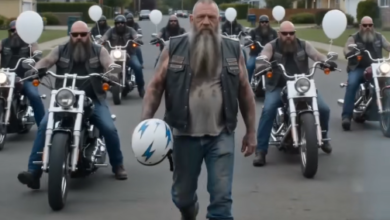
My name is Ray Dawson, though the men in the Iron Lanterns call me Hammer. I was fifty-six years old, six feet four inches tall, and close to 285 pounds, with scarred knuckles, tattooed forearms, a shaved head, and a beard that had turned gray faster than I cared to admit.
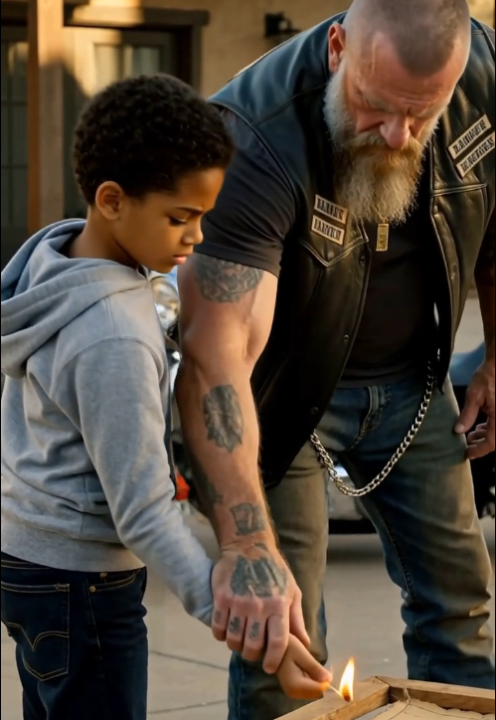
The boy’s name was Noah Carter.
He stood alone in the courtyard behind our Flagstaff clubhouse, holding the match beneath the lower corner of a hand-drawn road map mounted on yellowed canvas. It had been printed in 1957, long before interstates redirected traffic away from the motels, diners, and desert towns that once depended on Route 66.
Collectors had offered me thousands for it.
I refused every time.
The map had belonged to my younger sister, Grace. Her handwriting covered its edges. Black dates followed county lines. Blue circles surrounded schools, motels, shelters, and ordinary houses. Twenty-seven red marks had been drawn over addresses from California to northern Arizona.
Only five people knew what those marks meant.
Noah was the sixth.
The flame moved quickly across the dry canvas. It curled one corner inward and turned the first red mark into a black hole.
Boone Mercer saw the smoke.
He ran across the courtyard, knocking over a chair. His boots struck concrete. Leather snapped against his back. Other bikers followed, their voices rising as they recognized what Noah held.
“What are you doing?”
“Put it down!”
“Get the extinguisher!”
Thirty large men surrounded a ten-year-old boy.
Noah froze.
The match fell from his fingers, but the fire had already taken hold. It traveled along an old fold toward Grace’s handwriting while Boone reached for the map.
I caught his wrist.
“Leave it.”
Boone stared at me. “Hammer, that’s Grace’s.”
“I know.”
“You kept that thing through three floods and a clubhouse fire.”
“I know.”
“He’s destroying it.”
“No,” I said. “He’s finishing it.”
The courtyard went silent except for the dry crackle of burning canvas and the distant ticking of cooling Harley engines.
Noah looked at me. His face was pale, but he did not cry. He had learned too early that crying sometimes made adults demand explanations children could not safely give.
“Do I keep going?” he asked.
“Yes.”
Boone pulled his hand from mine. “You told him to do this?”
“I did.”
Noah lifted the burning map with metal tongs and placed it inside a steel fire bowl we had prepared. Leon Brooks moved the extinguisher close enough for safety, then stepped back.
The other riders did not.
They formed a circle around the boy as red marks vanished one by one.
Some had helped carry children’s belongings from those addresses after licensed caseworkers obtained emergency orders. Some had sat outside motels while frightened families slept behind locked doors. Some had driven toys, medication, clothing, and documents to new placements without ever learning the children’s full names.
Most had believed the map was a memorial.
It was not.
It was a countdown.
Each red mark represented a residence connected to a child or sibling group our partner advocates had helped move away from danger. The map was never an official case record, and no evidence depended upon it. Names, reports, photographs, and legal documentation remained secured with child-protection professionals and law enforcement.
Grace’s map held only roads, dates, coded marks, and promises.
Never visit a marked house alone.
Never confront anyone without authorities.
Never photograph a child.
Never call a relocation a victory until the child says they feel safe.
The final red mark had belonged to Noah’s former foster home.
That afternoon, his younger sister and the last family connected to our private working map had reached a confidential, licensed placement beyond Flagstaff. Their official files were secure. The dangerous address was under investigation. The bikers’ work there was finished.
Noah watched the final red mark collapse into ash.
Then a line written on the back of the canvas appeared through the flame.
Boone read it aloud.
“When the last child is safe, let one of them destroy the road back.”
My sister had written those words sixteen years earlier.
But she had placed another mark beneath the sentence—one I had hidden from the club since the day she died.
It was the address where Grace and I had once been separated.
Want to know why Grace created the map and what Noah placed in the empty frame after the fire? Drop MAP in the comments — I’ll share more soon.
Part 2 — The First Red Mark
Grace was eight when the state separated us.
I was thirteen.
Our mother had died six months earlier, and our father had disappeared long before that. We bounced between relatives until a county worker placed us in the same foster home outside Kingman, Arizona.
For three weeks, I believed staying together meant we were safe.
I was wrong.
I will not describe everything that happened in that house. Children should not have to surrender the worst details of their lives before adults decide their fear deserves attention.
What mattered was that Grace stopped speaking at meals.
She hid bread in her pillowcase. She slept fully dressed. Whenever a car entered the driveway, she counted footsteps until she knew which adult had returned.
I tried to protect her with the skills of a thirteen-year-old boy.
I stayed awake. I took blame. I lied to teachers because the adults inside that house warned us separation would be worse. I believed them until the night Grace handed me a torn page from a road atlas.
She had circled the bus station.
“Take me there,” she whispered.
We did not reach it.
A patrol officer found us walking along the highway before sunrise. I shouted at him. Grace remained behind me, gripping my belt. The officer called a caseworker, and for reasons I did not understand, the system separated us the following afternoon.
I went to a group home in Prescott.
Grace went south.
No one told me the address.
That became the first location marked on her map.
Not the foster home we escaped.
The place where she had been taken without me.
For years, I thought the worst address in our lives was the one where adults frightened us. Grace believed the worst address was the one where she discovered I could no longer follow.
We found each other again when I was twenty-one.
By then, I had spent time in juvenile detention, worked construction, joined the Army, left after an injury, and learned to repair trucks because machines offered problems that could be named.
Grace had moved through seven placements.
She was sixteen before she lived anywhere longer than eleven months. A high-school counselor helped her apply for college, where she studied social work and child advocacy. She became the kind of adult we had needed—patient, stubborn, and unimpressed by people who mistook authority for wisdom.
The map came from an antique shop in Winslow.
Grace bought it because the old Route 66 alignment connected nearly every town where either of us had lived. She marked our first placement with a red dot and the bus station with a blue circle.
“Red is where someone should have listened,” she said. “Blue is where someone finally did.”
The system was changing, but not quickly enough. Caseworkers carried impossible caseloads. Foster families willing to care for sibling groups were scarce. Emergency placements happened at midnight. Children sometimes moved with their belongings stuffed into trash bags.
Grace founded a small nonprofit called Safe Mile.
The organization did not investigate abuse, remove children, or decide where they should live. Those responsibilities belonged to trained authorities and courts. Safe Mile handled the spaces between official decisions: transportation support, emergency clothing, hotel rooms for safe caregivers, storage, meals, and help moving possessions after legal relocation orders were issued.
I repaired their vans for free.
Then one night, a caseworker called because a vehicle had failed outside Gallup with three children inside.
My Harley was the only machine in the shop ready to move.
I rode supplies out while Leon followed in his pickup. We delivered blankets, food, and a replacement alternator. The children never saw my face because Grace kept us away from the vehicle until the caseworker said it was appropriate.
That was my first Safe Mile run.
When I returned, Grace placed a second red mark on the map.
“You didn’t save them,” she said.
“I know.”
“You helped the people responsible for their safety do their jobs.”
“I know.”
“Good. Never confuse those things.”
That rule shaped everything the Iron Lanterns later became.
Part 3 — The Club That Had to Learn Restraint
Bikers are good at movement.
Ask thirty riders to carry beds, boxes, clothing, food, and furniture across Arizona before sunrise, and they will arrive early with extra straps.
Ask them to remain outside while someone else handles the crisis, and you discover which men understand discipline.
The Iron Lanterns struggled at first.
Some members wanted addresses. They wanted names. They wanted to know what had been done and who deserved punishment. Their anger came from decent instincts sharpened into dangerous shapes.
Grace refused.
“You are not investigators,” she told them during our first official Safe Mile meeting. “You do not question children. You do not confront caregivers. You do not appear at homes unless a licensed professional requests logistical support and authorities have cleared your presence.”
Boone raised his hand.
“What if we know someone hurt a kid?”
“You report what you know.”
“And then?”
“You let trained people build a case that survives court.”
“What if they take too long?”
Grace looked at thirty men capable of lifting motorcycles from ditches.
“Then you help the child survive the waiting without becoming another danger around them.”
That ended the discussion.
Our club learned.
We transported sealed boxes without opening them. We assembled beds inside new placements only after caregivers invited us. We stationed riders near courthouse entrances when advocates feared harassment, but we remained on public property and followed police instructions.
The motorcycles served one useful purpose beyond transportation.
Sound.
A child moving into a new home could hear us leave.
The engines started one at a time, then rolled away. No one remained parked outside. No leather-clad strangers lingered for photographs or demanded gratitude.
We delivered.
We left.
Grace added marks to the map only when a relocation was complete and the receiving professionals confirmed the family had reached safety. Red identified the place left behind. Blue represented the new beginning, though locations connected to active cases were coded rather than precisely marked.
Every official document stayed elsewhere.
The map was private.
It carried no full names. No allegations. No photographs. No details that could identify a child to a stranger. It was not evidence and could not replace a case file.
For Grace, it was a way to measure distance.
The red marks multiplied.
Kingman. Gallup. Holbrook. Barstow. Flagstaff. Small towns where everybody knew everybody, and cities where a child could disappear inside an apartment building with fifty doors.
Then Grace became ill.
Ovarian cancer moved faster than any of us expected. She continued working through treatment until fatigue forced her to remain home. Caseworkers called her from parking lots. Advocates brought documents to her bedside. She answered questions while pretending the pain did not exist.
I hated the map during those months.
Each new red mark seemed like another child Grace had carried while her own body failed. I asked her to stop.
She refused.
“You ride because roads connect things,” she said. “This is the same.”
“No. Roads don’t ask you to die for them.”
“Neither do children.”
“You’re doing it anyway.”
Grace leaned back against her pillows. “I’m dying near the work. That isn’t the same as dying because of it.”
She made me promise to continue Safe Mile after she was gone.
I promised badly.
I nodded while staring at the floor, believing love could substitute for preparation. When she died, I locked the map inside the clubhouse office and stopped accepting calls.
For three months, the Iron Lanterns did nothing.
Brotherhood failed quietly.
No argument. No betrayal. We simply allowed grief to make inaction feel respectable.
Leon finally broke into the office.
He carried the map into the club meeting and spread it across the table.
“Grace didn’t mark your feelings on here,” he said.
I nearly hit him.
He did not move.
Boone stood between us, not to protect Leon, but to keep me from becoming a man Grace would not recognize.
The next morning, we answered Safe Mile’s phone.
Part 4 — Noah’s Last Address
Noah Carter entered our story through a cardboard box.
We did not know his name. We knew only that a sibling placement required clothing, two mattresses, school supplies, and a lockable cabinet for medication. The official request came through Rebecca Chen, Safe Mile’s licensed program director.
Rebecca was a forty-four-year-old Chinese American social worker who had worked with Grace. She possessed the rare ability to make thirty bikers feel immature without raising her voice.
“This is logistics,” she told us. “No contact with the former placement. No independent questions. No social media. The children’s identities remain confidential.”
We agreed.
The receiving home belonged to Noah’s aunt, Tasha Carter, who had completed emergency kinship-placement requirements while authorities investigated conditions at the foster residence. She lived in a small house outside Flagstaff with limited furniture and a working furnace that sounded like a toolbox falling downstairs.
The Iron Lanterns repaired the furnace.
We replaced a broken window, carried in beds, stocked the kitchen, and left before the children arrived.
I noticed the map code on Rebecca’s request.
Twenty-seven.
The final blank space on Grace’s map.
After her death, Rebecca and I agreed the map should end at twenty-seven. Grace had written that number beside an unfinished line, though neither of us knew why. Perhaps she had been tracking a grant cycle or counting active referrals.
I suspected something else.
Grace knew she was dying. She chose a number that seemed reachable so I would not keep turning pain into an endless sentence.
Noah and his six-year-old sister, Mia, were scheduled to reach Tasha’s house on Friday evening.
They did not arrive.
A court document had been delayed. Then the former placement challenged the emergency move. None of us knew more, and Rebecca refused to speculate.
The club became restless.
Boone wanted to park across from the courthouse. Cutter suggested sending riders near the foster home. Another man had discovered the address through a relative and believed watching the property might help.
I ended the meeting.
“No one goes near that house.”
“What if they move the kids?” Boone asked.
“Then law enforcement handles it.”
“What if law enforcement misses something?”
“Then our anger still doesn’t make us authorized.”
“They’re children, Hammer.”
“That is why we follow the plan.”
It was the hardest order I gave that year.
Three riders turned in their temporary Safe Mile volunteer credentials rather than accept it. One accused me of choosing paperwork over children.
Rebecca heard about the argument.
“Good,” she said.
“You wanted members to quit?”
“I want volunteers who can obey boundaries when they’re furious.”
On Monday, authorities approved the move.
A caseworker and two deputies transported Noah and Mia. Safe Mile provided a van for their belongings. The Iron Lanterns remained at a warehouse six miles away, loading supplies without knowing the route.
At 4:38 p.m., Rebecca called.
“They’re safe.”
That should have been enough.
It was not enough for Noah.
He arrived at the clubhouse two weeks later with Tasha and his therapist. He wanted to meet the riders who had assembled his bed. Rebecca approved the visit because Noah had requested it repeatedly and professionals believed the controlled meeting could help him connect the frightening motorcycles he had seen from a distance with the ordinary people behind them.
Noah entered quietly.
Thirty bikers appeared enormous around him. He kept one hand inside his hoodie pocket and counted exits.
I recognized that habit.
Grace had done the same.
We showed him the workshop, allowed him to sit on a stationary motorcycle with the key removed, and gave him the choice to leave whenever he wanted.
Then he saw the map.
It hung behind glass in the meeting room. The red marks drew his attention immediately.
“What are those?”
I looked toward Rebecca.
She nodded.
I explained only what was appropriate: each mark represented a place children had safely left, not the children themselves.
Noah stared at code twenty-seven.
“That’s our house.”
No one confirmed the exact location.
He knew anyway.
“Why do you keep it?”
I gave him the answer I had used for years.
“So we remember.”
Noah shook his head.
“They already remember us.”
The room changed.
“What do you mean?” I asked.
“If you keep their house on your wall, they still get to be part of where we go.”
No adult had ever challenged the map that way.
Grace called it a record of distance.
Noah saw a chain.
Part 5 — The Fire Inside the Circle
I removed the map from its frame that evening.
Before doing anything else, Rebecca confirmed again that no official record or evidence depended upon it. Case documentation remained secured with authorized agencies. Safe Mile’s operational files were stored according to law and professional policy.
Grace’s map contained only coded marks and memories.
I photographed her handwriting.
Then I deleted the image.
That surprised Rebecca.
“You don’t want a copy?”
“I’d keep staring at the old road.”
The following Saturday, I asked Noah whether he still wanted the map gone.
“Yes.”
“Destroyed?”
“Yes.”
“You understand we can’t destroy official records?”
“That isn’t what this is.”
“No.”
“It’s yours.”
“It was Grace’s.”
“Then why do I have to burn it?”
The question struck deeper than I expected.
Because Grace had written the instruction. Because Noah was connected to the final mark. Because I thought giving him the flame would return control adults had taken from him.
Those answers sounded noble.
They were incomplete.
I wanted Noah to do what I had been unable to do.
I told him so.
“My sister and I were once connected to the first mark. I’ve carried that address longer than you’ve been alive.”
Noah looked toward the clubhouse.
“So you want me to burn yours too?”
“Yes.”
“That doesn’t seem fair.”
“No.”
He considered this with the seriousness children develop when adults have forced them to measure consequences too early.
“I’ll burn the map,” he said. “But you hold the frame.”
We prepared the steel fire bowl in the open courtyard with extinguishing equipment nearby. Tasha, Rebecca, Noah’s therapist, and two designated adults supervised. I believed the club knew.
They did not.
Leon had told them only that Grace’s map would be moved. When Noah struck the match, Boone saw a child destroying the object that had guided sixteen years of work.
His reaction came from loyalty.
It was still wrong.
He rushed.
The others followed.
Noah’s shoulders folded inward as thirty bikers surrounded him. For one instant, our attempt to return control created the same old picture: a small child beneath the anger of larger people.
I caught Boone.
“Leave it.”
The words stopped him, but not his fear.
“That’s Grace’s map.”
“I know.”
“You asked him?”
“I did.”
The fire moved across the canvas.
I carried the empty wooden frame as promised.
Grace’s sentence emerged on the reverse side: When the last child is safe, let one of them destroy the road back.
Noah read it silently after Rebecca spoke the words aloud.
Then the hidden mark appeared.
Our childhood address.
Grace had drawn a red circle around it rather than a cross. Beside it, she wrote two initials.
G + R.
Grace and Ray.
I had never shown the club because every strong man keeps one room locked inside himself, and that address occupied mine.
Noah looked at me through the flames.
“You were a kid there?”
“Yes.”
“Did somebody come get you?”
“Eventually.”
“Did bikers help?”
“No.”
“Then why did you become one?”
I looked at the men surrounding us.
“I didn’t know how to be alone quietly.”
Leon lowered his head.
Boone stepped backward.
The fire reached Grace’s initials. The ink darkened, curled, and disappeared.
My hands tightened around the empty frame.
Noah noticed.
“You can put it down,” he said.
I did.
For sixteen years, I had believed the map proved we remembered every child. Noah understood remembrance did not require preserving the shape of the cage.
When the fire ended, he waited until the metal bowl cooled. Then he placed one small object inside the empty frame.
A blue paper house.
No address.
No name.
Only an open door.
Part 6 — The Map of Places That Said Yes
The empty frame remained in the clubhouse.
Noah’s blue paper house stayed at its center. Around it, children and families supported by Safe Mile began adding places that represented safety without identifying private residences.
A library card.
A drawing of a school cafeteria.
A motel key sleeve with the room number removed.
A bus ticket.
A picture of a dog asleep beside a child’s bed.
A grocery receipt from the first dinner prepared in a new kitchen.
We stopped marking places children had escaped.
We marked the places that said yes.
Safe Mile continued its work, but the system changed. Case records stayed locked with professionals. Volunteers received stricter privacy training. Every biker renewed credentials annually and signed clear boundaries regarding contact, photographs, transportation, and confidentiality.
Three riders who had quit returned.
Rebecca did not welcome them immediately.
She required the full training again.
“That includes me?” Boone asked.
“Especially you.”
Brotherhood survived because it accepted correction.
Noah visited the clubhouse several times that year. He learned basic bicycle repair in the workshop, though Hammer-sized tools made his hands look even smaller. He never discussed the former foster home unless he chose to.
Mia preferred drawing.
She added a yellow sun above the blue paper house and insisted the rays extend beyond the frame. Boone complained that she had drawn on the wall.
Leon handed her another marker.
The map’s ashes were not kept.
I considered placing them in a jar, then understood that would create another relic I could refuse to release. We scattered nothing ceremonially. After the fire, Rebecca disposed of the cooled remains according to the safety plan.
Ordinary.
Final.
Sometimes closure required less theater than grief demanded.
On the anniversary of Grace’s death, I parked outside the clubhouse before dawn. The Harleys were silent. The frame hung above the meeting table, crowded now with paper, fabric, tickets, photographs without faces, and objects stripped of identifying details.
Noah’s blue house remained visible.
I touched one corner.
Then I started the coffee.
Part 7 — No Road Back
Five years later, Noah stood beside me at the Flagstaff courthouse.
He was fifteen, taller than Grace had been when I found her again, and impatient with adults who still introduced him through what had happened at ten.
He was not the boy from the red mark.
He played trumpet. He hated mushrooms. He wanted to study architecture because, in his words, too many houses were designed without asking children where they felt safe.
Tasha had become his permanent guardian. Mia was eleven and had developed the unsettling ability to win arguments by waiting until everyone else became tired.
Safe Mile was celebrating its twentieth year.
The Iron Lanterns arrived without forming a dramatic wall. We parked where courthouse staff directed us, shut down the engines, and carried folding tables inside.
Noah approached my Harley.
“Do you miss the map?” he asked.
“Some days.”
“Do you regret burning it?”
“No.”
“That answer was too fast.”
I looked at him.
He had learned that from Rebecca.
“I regret needing it,” I said. “I don’t regret letting it end.”
Noah handed me a rolled sheet.
It was a new map of Route 66.
There were no red crosses.
Blue marks identified public libraries, community centers, diners participating in meal programs, licensed family shelters, legal-aid offices, and other public resources whose information was already meant to be shared. No confidential homes. No children’s names.
“What’s this?” I asked.
“A map forward.”
He had placed one mark beside the Iron Lanterns clubhouse.
Beneath it, in small handwriting, he had written:
Loud outside. Safe inside.
“That is insulting,” I said.
“It’s accurate.”
We hung the new map beside the old empty frame.
At sunset, the club prepared to leave. Engines started across the parking lot, each V-twin answering the next. Noah and Mia stood beside Tasha while blue evening light settled over Route 66.
I looked once through the courthouse doors.
The frame held a paper house with no address.
The new map held roads without cages.
Then I pulled on my gloves.
The Iron Lanterns rolled west, their taillights shrinking into the desert dusk until the road became quiet again.
Nothing red remained behind us.
Follow our page for more powerful biker stories about misunderstood protectors, tested brotherhood, second chances, and the quiet moments when letting go becomes the bravest road forward.