A Blind Man Struck a Harley’s Fuel Tank With His Cane — Then One Hollow Note Stopped Thirty Bikers From Entering the Mountain Pass
The blind man struck my Harley’s fuel tank seven times with his white cane before thirty bikers surrounded him, and the strange thing was that he never once apologized or stepped away from the motorcycle.
I was standing beside the gas pumps outside Tucumcari, New Mexico, when the first metallic knock rose above the idling engines. The second sounded deliberate. By the fourth, every member of the Iron Lanterns had turned toward the noise.
The man striking my motorcycle appeared to be in his late sixties. He was Black, lean, and dressed in a faded Army field jacket over a buttoned work shirt. Dark glasses covered his eyes. A collapsible white mobility cane rested between his weathered hands, and its hard rubber tip kept landing against the left side of my fuel tank.
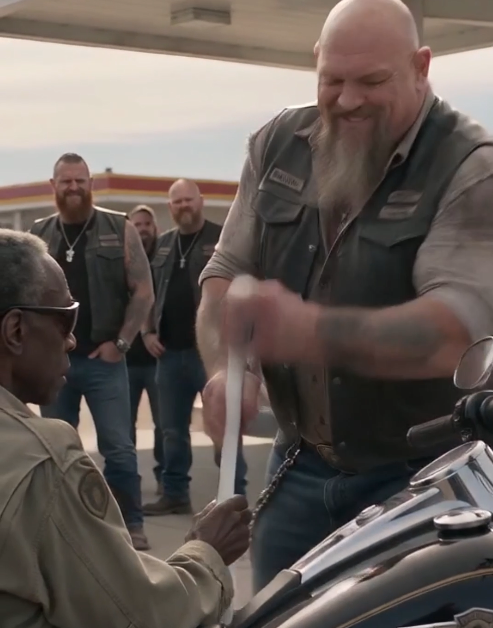
Tap.
Tap.
Tap-tap.
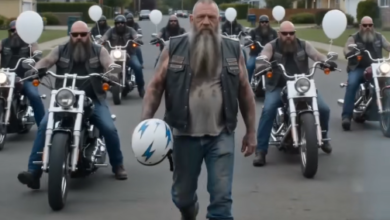
Thirty Harleys were preparing to leave on a charity run along old Route 66. Their V-twin engines shook the cold morning air. Leather creaked. Chains rattled. The parking lot smelled of gasoline, road coffee, and hot exhaust.
Yet the blind stranger kept hitting my bike.
Boone Mercer reached him first. Boone was younger than most of us, broad through the shoulders, tattooed from wrist to elbow, and loyal enough to become dangerous whenever he thought one of his brothers was being threatened.
He grabbed the cane.
“What the hell do you think you’re doing?”
The old man did not struggle. He simply tilted his head toward my Harley as if Boone’s anger were less important than whatever sound remained trapped beneath the chrome.
“Let go of the cane,” he said.
Boone tightened his grip.
Three more bikers moved closer. Men waiting near the convenience store began filming. A woman pulled her son behind a parked truck. From twenty feet away, it probably looked as though a motorcycle club was about to beat a blind veteran for touching the wrong machine.
I pushed through the circle.
“Boone. Let him go.”
“That’s your tank, Hammer.”
“I can see that.”
The stranger angled his face toward my voice. “You the owner?”
“My name is Ray Dawson.”
“Did you authorize anyone to work beneath that tank?”
The question stopped me.
“No.”
“Then nobody starts this motorcycle again.”
A few brothers laughed. Not because it was funny. Because men sometimes laugh when a stranger says something too strange to accept.
Boone released the cane but did not move away. “You can tell all that by beating on painted steel?”
The man held the cane horizontally, then tapped the tank once near the filler cap. The note rang clean and bright. He moved the tip several inches lower.
The second note came back dull.
He repeated the comparison.
Bright.
Hollow.
Bright.
Hollow.
“Those two areas should answer almost the same,” he said. “They don’t.”
My Harley had run perfectly when I rode into the station. No warning light. No fuel smell. No loose wiring that I had seen during the pre-ride inspection. I had checked the tires, controls, lights, oil, brakes, and fasteners before sunrise.
We were minutes from entering a narrow mountain route where all thirty riders would travel in staggered formation behind me.
“You a mechanic?” I asked.
“Used to be.”
“What kind?”
“Army aviation systems. Fuel, vibration, wiring, whatever kept machines in the sky. I lost my sight later. I didn’t lose the training.”
Boone muttered that a motorcycle was not a helicopter.
The old man turned toward him. “Metal doesn’t care what badge you put on it.”
Then he crouched beside the Harley and moved his cane slowly beneath the tank without touching the engine. The rubber tip found something hidden behind the frame. His expression tightened.
A faint electronic chirp answered from somewhere no factory component should have been.
Every engine in the parking lot went silent.
I removed my gloves, knelt beside him, and felt along the underside of the tank until my fingers touched a smooth object secured inside the recessed tunnel. It was smaller than my palm. A thin wire disappeared toward the main electrical harness.
It did not belong to me.
The blind man rose and folded his cane.
“Move everyone away from the motorcycles,” he said.
Police later determined the object was not an explosive, but what it could do while my Harley was moving frightened the investigators more than any dramatic threat written on a note.
Before that morning ended, they found two more altered motorcycles in our convoy—and the quiet blind man knew which bikes to examine because someone in the parking lot had made one mistake only he recognized.
Want to know what the hidden devices could do and why the blind veteran had come to hear our convoy leave? Drop HOLLOW in the comments — I’ll share more soon.
Part 2 — The Man Who Listened Before He Touched
My name is Ray “Hammer” Dawson. I was fifty-six that winter, six feet four, almost 285 pounds, with a shaved head, a black-and-gray beard, and enough faded ink across my arms to make nervous strangers check whether the nearest door was unlocked.
People usually noticed the leather first.
The plain black vest. The heavy boots. The chain wallet striking my thigh. The scarred knuckles resting on the bars of a touring Harley that sounded like distant thunder when the engine settled into idle.
They rarely noticed the inspection card tucked inside my vest.
Every Iron Lantern carried one. Tires. Controls. Lights. Fluids. Chassis. Stands. We checked our motorcycles before every organized ride because thirty men traveling together could turn one ignored defect into thirty grieving families.
The Tucumcari run mattered more than most.
We were carrying winter supplies and donated building materials to Ellis House, a transitional home outside Santa Fe for veterans and their families. The place helped men and women leaving military service find work, manage medical appointments, and keep their children under one roof while they rebuilt their lives.
Our trailers held blankets, heaters, canned food, tools, and nearly fourteen thousand dollars raised by diners, repair shops, church groups, and people who dropped wrinkled bills into jars along Route 66.
The ride had been planned for six months.
I was road captain. That put my Harley first.
Boone rode behind me. Leon Brooks, a fifty-two-year-old Black biker with a short gray beard and a voice that could settle most arguments before they became fights, held the rear position. The other riders formed three groups between us, separated far enough to prevent one problem from becoming everybody’s problem.
At least, that was the plan.
The blind man’s name was Walter Ellis.
He told us only after a patrol officer asked for identification. Walter removed an old leather wallet and handed over a veteran identification card. The officer read the name aloud.
Several riders looked toward our supply trailer.
ELLIS HOUSE appeared in large blue lettering along its side.
Walter heard the change in our breathing.
“Yes,” he said. “Same name.”
“You connected to the place?” I asked.
“I asked you a mechanical question, Mr. Dawson.”
“And I’m asking a personal one.”
“Then we’re both waiting.”
He had a dry way of speaking. No wasted words. No attempt to make himself likable.
I respected that.
The police established a perimeter around my Harley and called a state vehicle investigator. While we waited, Walter stood beside the curb with his cane folded against his chest. The people who had filmed the confrontation lingered at the edges of the gas station, disappointed that no one had been punched.
Boone paced.
“You believe him?” he asked me.
“I believe something is under my tank.”
“Could’ve put it there himself.”
“You watched him walk in from the highway.”
“I saw him near your bike.”
“You saw him tapping it.”
“Same thing.”
“No. It isn’t.”
Boone’s jaw tightened. His father had taught him never to ignore a threat, but he had learned the lesson without learning how easily fear could turn the wrong person into the threat.
Leon approached Walter with two cups of coffee.
“Black?” he asked.
“Can’t see the color.”
Leon smiled. “That joke work every time?”
“Only on nervous people.”
Leon placed the cup carefully against Walter’s fingers and described its position before letting go. Walter thanked him. The exchange took five seconds, but it showed more respect than all our loud claims about brotherhood.
I sat on the curb several feet away.
“How did you hear it?” I asked.
Walter raised his coffee toward my motorcycle. “Your engines were shutting down one by one. Yours stopped last. After the rumble faded, I heard a high electrical tone beneath the tank.”
“Most people didn’t hear anything.”
“Most people weren’t listening for it.”
“And the cane?”
“A quick comparison. I wasn’t trying to dent your paint.”
“You nearly caused thirty men to tackle you.”
“That would have made the paint problem seem small.”
I asked again about his training.
Walter had served twenty-two years as an Army aviation maintenance technician. He had worked around helicopters in heat, dust, rain, and darkness. Technicians sometimes compared vibration and resonance while tracing faults, though Walter stressed that he had not diagnosed the device merely by striking the tank.
The altered note told him something was attached where nothing should have been. The faint chirp confirmed an electronic component. Experience supplied the warning.
Blindness had not given him magical hearing.
Training had taught him what mattered.
Walter lost most of his sight to glaucoma eleven years after leaving the Army. By then, he was teaching maintenance apprentices at a community college in Albuquerque. He continued teaching for six more years, adapting diagrams into raised-line models and making students explain systems aloud rather than relying only on what they saw.
“People trust their eyes too much,” he said.
I glanced toward Boone.
“So I’ve noticed.”
Walter heard that too.
Before I could ask about Ellis House, the investigator arrived. She was a compact Latina named Elena Ruiz, dressed in a heavy jacket and carrying a case of diagnostic equipment. She inspected the underside of my Harley without disturbing the object, then requested the fire department and a wider perimeter.
Her face remained calm.
Her voice did not.
“Cancel the ride,” she said.
The words landed harder than Walter’s cane.
Some riders objected immediately. The supplies were expected. Families were waiting. Snow was forecast for the following night. If we delayed, the mountain route might close.
I told everyone to stand down.
“We ride when the machines are cleared.”
A veteran named Cutter shook his head. “Thirty bikes because of one black box?”
“Thirty brothers because of one black box.”
Brotherhood was being tested before we left the parking lot, and the first test was simple: could we accept caution without treating it as cowardice?
Not everyone passed quickly.
But nobody started an engine.
Part 3 — Three Motorcycles That Should Have Sounded the Same
The investigator removed the first device after disconnecting the Harley’s battery and documenting its position. She did not explain every component, and I did not ask her to. The important facts were plain enough.
It was not factory equipment.
It had been attached recently.
It could transmit location data, and it had been connected improperly to a circuit associated with the motorcycle’s fuel and ignition systems. Whether the connection was meant to interrupt the engine or merely steal power remained uncertain, but the splice could fail under heat and vibration.
“At highway speed?” I asked.
Elena looked toward the entrance ramp.
“At any speed.”
My Harley would have led thirty riders into a series of climbing curves bordered by rock on one side and a steep slope on the other. We rode with safe spacing, but an unexpected engine loss in the lead position would still force every rider behind me to react.
Braking.
Swerving.
Looking at the fallen motorcycle instead of the road.
One failure could become a chain.
That was enough.
The device itself was not a dramatic movie bomb. There was no clock, blinking red light, or bundle of colored wires. It was an ordinary-looking electronic module mounted where a casual inspection would not reveal it.
Danger often looked boring.
Elena asked whether my Harley had recently been left unattended.
The entire club had parked outside a fundraising dinner two nights earlier. The motorcycles had stood in a roped section behind the VFW hall while we helped carry tables and supplies. A volunteer security team watched the entrance, but the rear lot faced an alley.
Walter had attended that dinner.
Not as a guest. He had remained outside near the bus stop for almost twenty minutes before leaving in a paratransit van. One of our prospects remembered seeing him.
Boone remembered too.
“You were near the bikes that night,” he said.
Walter stood motionless beside the curb.
Leon moved between them. “Watch your tone.”
“I’m asking.”
“No,” I said. “You’re accusing.”
Boone’s face flushed. “We’ve got a device under Hammer’s tank and a man who knew exactly where to find it.”
Walter unfolded his cane.
For a moment, I thought he would walk away. Instead, he crossed the parking lot slowly until he stood near Boone’s motorcycle.
“Start it,” he said.
Elena objected, but Walter shook his head. “Not this one. The red touring bike three positions behind it.”
That belonged to Cutter.
“How do you know?” Boone asked.
“I don’t. Yet.”
Cutter started his Harley while the investigator watched from a safe distance. The V-twin settled into its uneven rhythm. Walter stood several feet away, head lowered. Then he asked Cutter to shut it down.
As the engine stopped, a faint descending tone lingered for less than a second.
Walter turned toward Elena. “Check that one.”
Cutter swore.
The investigator inspected the bike and found a second unauthorized module beneath a side panel. This one had not been wired into the fuel system, but it was transmitting.
The parking lot changed.
Suspicion moved away from Walter and entered every motorcycle.
No one spoke for several seconds. Then engines began starting and stopping one at a time under Elena’s supervision. Walter listened from a consistent position. He did not claim certainty. He merely identified sounds requiring further inspection.
The third device was found on Boone’s Harley.
His face emptied when Elena held up the evidence bag.
The motorcycle he had been ready to ride into the mountains had been marked too.
Boone sat on the concrete base of a light pole. His hands shook, and he shoved them beneath his arms before anyone could notice. I noticed anyway.
Walter walked toward him.
The cane tapped lightly over the pavement until its tip reached the edge of Boone’s boot.
“You were right to question me,” Walter said.
Boone looked up. “I grabbed your cane.”
“Yes.”
“I thought you did this.”
“Yes.”
“I could’ve—”
“But you didn’t.”
“Because Hammer stopped me.”
Walter nodded toward my voice. “Then you have a road captain worth following.”
Boone lowered his head.
“I’m sorry.”
Walter waited.
It was not enough. Boone knew it.
“I’m sorry I treated your cane like it was mine to take,” he said. “And I’m sorry I decided what you were before I knew anything.”
Walter extended his hand.
Boone took it.
The police questioned every rider, event volunteer, vendor, and bystander still at the station. Security footage from the VFW hall showed a man wearing a maintenance jacket moving between parked motorcycles during the dinner. The jacket carried the logo of a temporary event contractor.
The image was poor, but the man had a habit Walter remembered.
“He drags his right foot,” Walter said.
Everyone turned toward him.
“You heard that at the dinner?”
“I heard him behind the bikes. Tool case in his left hand. Right heel scraping. Metal zipper striking the case.”
“Why didn’t you report him?”
“Because a person carrying tools near motorcycles at a biker fundraiser isn’t a crime.”
Fair answer.
Elena asked whether he had spoken with the man.
Walter had. The stranger asked which motorcycle would lead the convoy. Walter told him he did not know. Then the man asked where the club planned to stop overnight.
Walter refused to answer.
“That bothered you?” I asked.
“It does now.”
Police obtained a clearer image from the convenience store camera. The same man was standing beside a white service van across the highway. When officers approached, he drove away.
The chase lasted less than ten minutes. He abandoned the van behind a warehouse and fled on foot, but officers detained him nearby.
Inside the van were tools, electronic modules, blank keys, and photographs of motorcycles taken at charity events across three states. Investigators believed the devices were part of a theft operation. The trackers identified valuable motorcycles and predictable overnight stops. The questionable wiring on my Harley may have been intended to disable it later.
Or it may simply have been careless.
Either possibility could have put riders on the pavement.
By early afternoon, the police had cleared the remaining motorcycles. The three altered bikes were held for evidence, including mine.
The charity ride was over.
That should have been the end of the crisis.
Instead, twenty-seven engines started.
Boone handed me the key to his replacement truck. “We still have supplies to deliver.”
I looked toward the trailers.
Leon grinned. “Nobody said the blankets care how they get there.”
We loaded the motorcycles we could not ride onto a secured transport trailer, hitched the donation cargo behind pickups, and reorganized the convoy. No formation. No pride. Just trucks, vans, and riders sharing seats.
Walter stood near the bus stop again.
“You coming?” I asked.
“I didn’t ask for a ride.”
“I didn’t ask if you asked.”
He hesitated.
Then he turned his face toward the trailer bearing the name Ellis House.
“That place,” I said. “It was named after your son, wasn’t it?”
Walter’s cane stopped moving.
The entire parking lot seemed to wait.
“Yes,” he said.
Part 4 — The Name Painted on the Trailer
Staff Sergeant Isaiah Ellis had been Walter’s only child.
He joined the Army at nineteen despite his father’s objections. Walter had spent his career repairing military aircraft and knew too much about the distance between a machine leaving the ground and every family waiting for it to return.
Isaiah went anyway.
“He said I had spent his whole childhood teaching him that service mattered,” Walter told me from the passenger seat of Boone’s truck. “Then I acted surprised when he believed me.”
The other vehicles followed behind us along Interstate 40. We avoided the mountain pass and used a longer route cleared by state crews. Snow clouds gathered over the horizon, turning the afternoon light the color of old steel.
Walter kept one hand on his folded cane.
Isaiah had survived two overseas deployments. After returning home, he struggled with injuries that did not announce themselves with casts or bandages. Crowds exhausted him. Sudden noises pulled him into places no one else could see. He slept in short bursts and kept his boots beside the bed.
Walter did what many fathers did when they wanted to help but did not know how.
He tried to repair the problem.
Appointments. Schedules. Advice. Lists.
Isaiah did not need another technician.
He needed his father.
They argued. Isaiah left Albuquerque and spent several months moving between friends’ couches, cheap motels, and his truck. Eventually, a veterans’ outreach worker found him and connected him with transitional housing.
The program gave him a room, a job placement, and enough time to become himself again.
Isaiah later helped establish a similar home near Santa Fe. He died four years afterward when a driver crossed the center line on a rain-slick road.
Ellis House was named for him.
Walter had never entered it.
“You opposed the name?” I asked.
“I opposed making my son easier to praise after he was dead than he had been to help while he was alive.”
The words sat between us.
He had attended fundraisers but remained outside. He listened to speeches through open windows and left before anyone recognized him. Photographs of Isaiah appeared on brochures, banners, and donation pages. Walter did not object to the work. He objected to grief becoming decoration.
“Then why come today?”
“I wanted to hear the motorcycles.”
“That’s all?”
“Isaiah loved them.”
I waited.
Walter exhaled. “He rode an old Sportster. Too loud. Terrible seat. He kept promising to fix both and did neither.”
For the first time, affection softened his voice.
“He used to say thirty motorcycles sounded like weather coming down the road. I wanted to hear that once.”
Instead, he heard the electrical tone beneath my fuel tank.
The reverse of what everyone believed had happened in the parking lot became clear. Walter had not approached my Harley to damage it. He had come close because he wanted to hear the machines his son loved.
The sound brought him near.
His training made him stay.
When we arrived at Ellis House, residents and volunteers waited beneath the covered entrance. Children held handmade signs. Staff members carried empty carts toward the supply trailers. They had expected a dramatic motorcycle arrival and received a muddy line of pickups instead.
No one complained.
A woman named Dr. Melissa Grant met Walter near the entrance. She had worked with Isaiah during the home’s earliest planning stages.
She did not introduce him publicly.
She simply touched his arm and said, “Your room is ready whenever you are.”
Walter’s expression hardened. “My room?”
“Isaiah designed a workshop.”
She led us around the side of the building to a large garage. Inside were benches, locked tool cabinets, adaptive equipment, and donated engines used for vocational training. One wall held raised diagrams and labeled mechanical components for veterans with visual impairments.
Walter stopped in the doorway.
He reached toward the nearest bench but did not cross the threshold.
“Who built this?” he asked.
“Isaiah drew the original plan,” Melissa said. “He wanted you to teach here.”
Walter’s fingers closed around his cane.
“He never told me.”
“He tried.”
She opened a cabinet and removed a battered envelope. Walter’s name was written across it in Isaiah’s handwriting.
The letter had been found among old planning documents after Isaiah’s death. Melissa had contacted Walter twice, but he had refused every invitation to visit. She kept the envelope because she would not mail something that personal without knowing whether he wanted it.
Walter did not open it.
Not then.
He placed it inside his jacket and asked where the supplies belonged.
That was his way.
Bikers carried boxes. Residents unloaded heaters. Boone repaired a loose wheel on a utility cart. Leon assembled shelves with two veterans who argued cheerfully about every instruction.
Walter stood beside the workshop door and listened.
Wrenches clicked. Cardboard tore. Boots crossed concrete. Somewhere near the back wall, a young veteran struggled to start a training engine. The starter turned, stopped, and turned again.
Walter tilted his head.
“Battery connection,” he called.
The young man looked toward us. “What?”
“Clean the ground and tighten it.”
The student did.
The engine started.
Walter’s mouth moved into the smallest smile I had ever seen.
Part 5 — The Letter He Refused to Read Alone
We delivered the supplies before dark, but the storm closed the highway behind us. Ellis House opened its dining hall to the club for the night. Cots lined the walls. Wet gloves dried near portable heaters, and the building filled with the mixed smell of coffee, chili, leather, and damp wool.
Walter sat alone in the workshop.
I found him at a bench with Isaiah’s envelope resting beneath both hands.
“You need help reading it?” I asked.
“I have an app.”
“All right.”
“It keeps making his handwriting sound like a machine.”
I pulled out the chair beside him.
“You want me to read it?”
“No.”
I waited.
After nearly a minute, he pushed the envelope toward me.
The paper inside had been folded twice. Some words were smeared by water damage. Isaiah had written the letter during the first year of planning Ellis House.
Dad,
I know you think I stopped listening. I didn’t. I heard every lesson. Check the simple thing first. Respect the warning you can’t explain yet. Never sign off on work because someone is tired of waiting.
I also heard what you didn’t say.
You taught hundreds of soldiers and students how to keep machines alive, but you never believed people could be repaired without hiding the damage. I learned otherwise because strangers gave me a room before I knew how to ask for one.
The workshop is for people who need their hands to remember they still know something useful.
I want you to teach here someday.
Not because you owe me.
Because you are good at it.
Your son,
Isaiah
Walter did not cry. Not in the way people expected grief to look.
His breathing changed. His shoulders lowered. One thumb moved slowly over the crease in the paper.
Then he asked me to read the letter again.
I did.
The second time, Boone stood quietly in the doorway. He had come to apologize once more, but Leon stopped him from interrupting. Boone heard enough to understand that Walter had spent years standing outside a building his son had designed partly for him.
When I finished, Walter folded the page along its old lines.
“I told him hands could remember,” he said.
“Sounds like he listened.”
“He always did. I was the one who needed things repeated.”
Boone stepped inside.
“Mr. Ellis?”
“Walter.”
“I’ve got something to show you.”
He led us to the three motorcycles secured inside the transport trailer. Investigators had removed the suspicious devices, but the affected wiring still needed professional repair before the bikes could return to service.
Boone had spent the evening creating tactile diagrams from cord, tape, and cardboard. He wanted Walter to confirm how the wiring routes should be explained to the technicians who would repair them.
Walter ran his fingertips over the raised lines.
“This junction is wrong,” he said.
Boone adjusted it.
“So is this one.”
Another adjustment.
They worked for almost an hour.
The man who had grabbed Walter’s cane now described every connector and waited for Walter’s hands to approve the layout. No speech. No ceremonial apology before the club. Just correction, patience, and the sound of two people learning how to trust each other.
The next morning, Walter entered the Ellis House workshop.
He did not agree to become a full-time instructor. He made that clear before anyone could turn the moment into a promise.
“I’ll teach one class,” he said.
Melissa smiled. “One.”
The first class had four students. Two were veterans. One was the spouse of a disabled Marine. The fourth was a nineteen-year-old who had aged out of foster care and wanted to become a motorcycle technician.
Walter placed three metal panels on the workbench.
He asked the students to strike each one lightly with a rubber-handled tool and describe the difference.
They answered with visual guesses.
“This one looks thicker.”
“That one has a dent.”
Walter shook his head.
“Close your eyes.”
They did.
“Now listen.”
The room became quiet.
Tap.
Ring.
Tap.
Thud.
Tap.
Buzz.
Walter did not teach them to imitate what he had done at the gas station. He taught them a broader lesson about inspection: sight was useful, but no single sense, instrument, checklist, or person should carry the entire responsibility.
“Machines speak through change,” he told them. “Your job is to notice what changed.”
I watched from the doorway.
For years, Walter had believed his working life ended when his sight failed. Isaiah had left him a room where experience mattered more than appearance. The hidden devices brought him through the door, but his son had built the path long before that morning.
Later, police confirmed the suspected thief had targeted motorcycles from several charity events. He used tracking modules to identify storage locations and attempted crude electrical connections on selected bikes. Investigators recovered stolen motorcycles and enough evidence to connect him with multiple thefts.
The news reports called Walter a hero.
He disliked the word.
“I heard a bad note,” he said. “Then thirty bikers finally got quiet enough to hear it too.”
That version was closer to the truth.
Part 6 — The Three-Tap Rule
The Iron Lanterns changed our pre-ride routine after Tucumcari.
We kept the inspection cards, but no rider checked only his own motorcycle. Partners switched bikes and performed a second walk-around. We documented unfamiliar accessories, examined areas that were easy to overlook, and stopped treating a delayed departure as an insult to our pride.
The club called it the Ellis Check.
Walter objected.
So we stopped saying it around him.
Before every major ride, the road captain asked one question: “What changed?”
A new vibration. An unfamiliar mark. A wire routed differently. A bag that had been opened. A sound present today that had not existed yesterday.
Most answers meant nothing dangerous.
That was fine.
Caution did not become foolish merely because the warning ended safely.
Walter taught at Ellis House twice a month, despite promising only one class. He claimed the students required supervision because they kept buying terrible coffee. Melissa claimed he arrived early enough to make the first pot himself.
Boone drove him from Albuquerque whenever paratransit scheduling became difficult. During those trips, they argued about music, carburetors, electronic diagnostics, and whether modern motorcycles had replaced too much craftsmanship with sealed components.
Walter usually won.
Once my Harley was released from evidence and repaired, I brought it to the Ellis House workshop. Walter stood beside the tank with his cane folded.
“Want to check my paint?” I asked.
“I told you I never damaged it.”
“There are seven marks.”
“Road captain that sensitive about scratches shouldn’t own a motorcycle.”
He placed two fingers against the tank while I tapped it lightly with a padded inspection tool.
The note rang clean.
We moved lower.
Clean again.
Walter nodded. “Now start it.”
The V-twin turned over. Its rhythm filled the workshop, bounced from the concrete walls, and traveled through the soles of our boots. Walter rested one hand on the back of a chair, feeling the vibration rather than pretending sound alone could tell him everything.
After I shut it down, he listened through the fading mechanical ticks.
“Better,” he said.
That became our ritual.
Not seven strikes. Not a dramatic performance. One careful comparison before the annual charity run, followed by Walter standing beside the road as the motorcycles started.
The first year, he listened from outside Ellis House.
The second year, he rode in Leon’s sidecar.
He complained about the seat for eighty-three miles.
Isaiah would have approved.
Part 7 — The Sound at the Front of the Convoy
Five years after Walter stopped our ride in Tucumcari, Ellis House opened a second workshop in Gallup. Former students helped build the benches. Boone installed raised labels beneath the storage drawers. Walter inspected every surface with his hands and rejected two tables because they moved when pressure was applied.
“Nobody learns precision on a wobble,” he said.
The annual charity convoy grew from thirty motorcycles to seventy-two, but the club stopped measuring success by engine count. Some supporters arrived in trucks. Others brought vans full of food. One elderly veteran drove a dented sedan carrying six handmade quilts.
Everyone traveled together.
On the morning of the fifth ride, Walter stood beside my Harley outside the original Ellis House. His Army jacket had grown softer with age. The cane rested against his leg. Snow from the previous night remained along the edges of the parking lot, though the road was clear.
Boone handed him the padded inspection tool.
Walter tapped once near the top of the tank.
Ring.
Once near the lower seam.
Ring.
Then he placed his palm against the steel while I started the engine.
The Harley settled into its familiar rhythm.
Around us, seventy-one other engines remained silent. No one hurried him. No one laughed. No one treated the pause as weakness.
Walter lifted his hand.
“Clean,” he said.
The convoy started from the rear forward. One V-twin. Then another. Then ten. Then fifty. The sound gathered against the building until it resembled weather rolling across the desert.
Walter stood in the center of it.
Melissa brought him Isaiah’s old helmet, restored but no longer approved for riding. Walter held it against his chest and listened as each motorcycle came alive.
When only mine remained idling at the front, I walked back to him.
“Sidecar’s open.”
He shook his head. “I’m not riding this year.”
“You sick?”
“No.”
“Tired?”
“No.”
“Then why?”
Walter turned toward a young woman waiting near the workshop door. She was one of his first students, an Army veteran who had lost part of her hearing and believed her mechanical career was over until Walter taught her to inspect through sight, touch, instruments, and disciplined comparison.
She carried the padded tool.
“She does the check next year,” Walter said.
The young woman looked surprised. “You never told me that.”
“I just did.”
He handed her the tool.
There was no ceremony. Walter disliked ceremonies. He simply placed the responsibility in another person’s hand and stepped away.
I returned to my Harley. Boone moved into formation behind me. Leon waited at the rear, his engine answering through the cold air.
Walter raised one hand.
Seventy-two motorcycles rolled forward.
In my mirror, I watched him become smaller beside the workshop his son had imagined. He held Isaiah’s helmet beneath one arm while the young technician stood beside him carrying the tool.
The engines faded along Route 66.
But the listening stayed behind.
Follow our page for more powerful biker stories about misunderstood strangers, tested brotherhood, quiet courage, and the people who hear danger before the rest of the world stops to listen.