The Biker Ripped the Handcuffs Off a Teen and Pulled Him Away — And the Crowd Turned Against Him
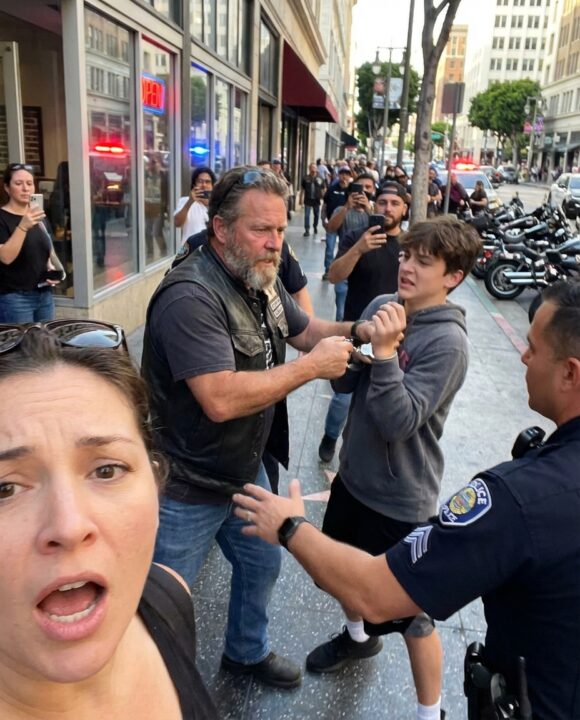
When the biker grabbed the handcuffs mid-click and yanked the teenage boy out of the officer’s grip, the entire street gasped like they had just witnessed a crime unfold in broad daylight.
The metal hadn’t even locked yet.
One cuff hung loose from the boy’s wrist.
The officer stumbled half a step forward.
“Sir! Step back!”
The teenager—skinny, maybe sixteen—looked stunned. Hoodie pulled halfway over his head. Hands shaking. A scraped knee from being forced down onto the pavement.
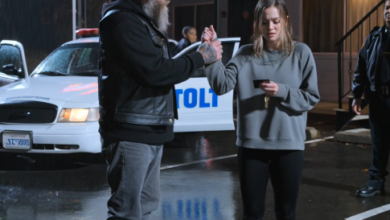
A patrol car door stood open.
Red and blue lights spun lazily over storefront windows.
Someone yelled, “He’s resisting arrest!”
Phones shot into the air.
A woman near the bus stop screamed, “That man just assaulted a cop!”
The biker didn’t look like a rescuer.
He looked like escalation.
Late fifties. Broad-shouldered. Worn leather vest. Tattoos crawling down both arms. Gray beard cut close. Heavy boots planted firmly between the officer and the boy.
He didn’t shout.
He didn’t curse.
He simply held the loose cuff in one hand and placed himself squarely in front of the teenager.
“Enough,” he said, calm and low.
The officer reached for his radio.
“You’re interfering with an arrest.”
The crowd thickened.
Outrage moved faster than facts.
“This is insane!” someone shouted. “Lock him up too!”
The teenager’s breathing came in sharp bursts.
“I didn’t steal anything,” he whispered, but no one was listening.
All anyone saw—
was a biker pulling a kid away from police.
And it looked like a scene straight out of chaos.
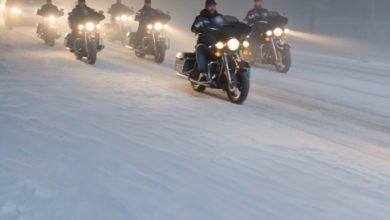
Until three more motorcycles turned the corner.
And everything felt like it was about to tip.
The officer recovered quickly.
“Sir, step back now.”
The biker didn’t.
He kept his body angled protectively toward the boy, one arm subtly blocking him from view.
“That’s not him,” the biker said evenly.
The officer’s jaw tightened. “We have a description. Witness ID.”
“That description is wrong.”
“You don’t get to decide that.”
The boy’s voice cracked. “I was at school.”
No one asked which school.
No one checked the time.
All eyes stayed on the leather vest and inked forearms.
To the crowd, it was simple: a biker interfering with law enforcement.
“Back up!” a second officer barked, stepping closer.
The biker didn’t raise his hands in surrender. He didn’t square up either. He simply reached down, removed the loose cuff from the boy’s wrist, and set it gently on the hood of the patrol car.
That small action sent the crowd into fury.
“He just took police property!”
“Arrest him!”
Phones zoomed in closer.
A man livestreamed loudly. “You’re watching a biker attack an officer downtown!”
The officer grabbed for the boy again.
The biker stepped into that space.
Not violently.
But firmly.
A wall, not a weapon.
“Don’t make this worse,” the officer warned.
“It already is,” the biker replied.
The second officer moved to restrain him.
He didn’t resist physically.
He didn’t swing.
But he did not step aside.
“Sir, you are obstructing.”
The word echoed.
Obstructing.
The crowd loved that word.
It justified everything they were seeing.
The teenager looked smaller by the second.
His hoodie sleeve rode up, revealing a hospital wristband.
No one noticed.
No one cared.
The officer reached for the boy’s other arm.
The biker leaned close and said something too quiet for the crowd to hear.
The boy nodded faintly.
“Sir, this is your last warning,” the officer said.
The biker inhaled once.
Then reached into his vest pocket.
The movement electrified the air.
Hands tightened around phones.
Officers’ posture shifted.
He pulled out his phone.
Typed three words.
Sent.
And slipped it back inside.
He looked directly at the first officer.
“You’ve got the wrong kid.”
“Step back or you’re going in cuffs too.”
The biker gave a slow nod.
“If that’s how this ends,” he said.
Behind him—
engines approached.
Not roaring.
Arriving.
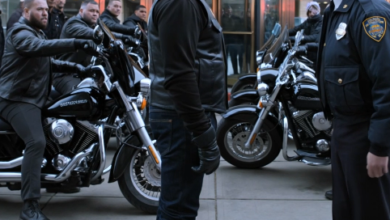
Within minutes, five motorcycles lined the curb.
Not blocking traffic.
Not circling dramatically.
Just present.
The officers radioed for backup.
The crowd thickened into something restless.
“This is getting dangerous,” someone muttered.
The boy’s face had gone pale.
“They said it was a blue hoodie,” the first officer insisted to his partner. “Car theft suspect fled north.”
The biker spoke calmly. “Ask what school he attends.”
“That’s not relevant.”
“It is.”
The officer hesitated.
Then snapped, “You his father?”
“No.”
“Then what are you?”
The biker paused.
The question hung heavy.
He didn’t answer.
Instead, he looked at the boy.
“Tell them where you were.”
The boy swallowed. “Lincoln High. Biology exam.”
The officer scoffed. “Convenient.”
The biker remained steady.
“You can verify that.”
The crowd’s outrage simmered.
“He should let police do their job!”
“Bikers think they run the city!”
One of the new riders stepped forward but stopped several feet back, arms relaxed at his sides.
No threats.
No chants.
Just presence.
The first officer tried to regain control. “Sir, step aside. Now.”
The biker met his eyes.
“I’ve been following this case for three weeks.”
That sentence landed differently.
The officer blinked. “What case?”
“The stolen Honda. Wrong suspect. Wrong timeline.”
The second officer frowned.
“Sir, if you know something, bring it to court.”
The biker shook his head slightly.
“He won’t make it to court if you book him on this.”
The boy’s knee trembled visibly.
A squad car turned the corner.
The air felt like a stretched wire.
The biker stepped back half a pace—not retreating, just giving space.
Then he did something unexpected.
He held out both hands.
Palms open.
Not surrendering.
Showing emptiness.
“I’m not here to fight you,” he said quietly.
The officer hesitated.
“What are you here for?”
The biker’s phone buzzed.
Once.
He glanced down.
Then looked up again.
“Check the security footage from 8:42 a.m. at Lincoln High’s east entrance.”
The officer frowned. “How would you—”
“Just check.”
The second officer exchanged a look.
The boy stared at the pavement.
The crowd’s energy wavered.
Confusion crept in.
But outrage is louder than doubt.
“He’s trying to distract them!” someone shouted.
Another yelled, “Lock them both up!”
Backup officers stepped out of the arriving car.
For a second—
it looked like the biker was about to be tackled.
And then—
from the far end of the street—
more engines rolled in.
Not fast.
Not aggressive.
Just steady.
And disciplined.
The line of leather grew longer.
The tension shifted.
Not from threat.
But from scale.
The biker stood still in the center of it all.
Like he’d planned for this moment.
And no one yet knew why.
The engines didn’t roar.
They rolled in like a low tide.
One after another, motorcycles lined the curb—precise, measured, deliberate. No revving. No shouting. No raised fists. Helmets came off slowly. Boots hit pavement in unison.
The crowd’s anger faltered.
This didn’t look like a gang ready to riot.
It looked like something organized.
The lead biker—the one who had stepped between the handcuffs and the boy—didn’t turn around. He didn’t acknowledge the riders behind him. He kept his focus on the officers.
But the presence at his back changed the balance.
Backup officers stepped out of their patrol car, assessing the situation. One of them glanced at the line of motorcycles and muttered, “This is turning into a show.”
The captain arrived seconds later.
Mid-forties. Clean uniform. Sharp eyes.
He took in the scene: a frightened teenager, a gray-bearded biker standing firm, officers tense but not escalating, a crowd bristling with accusation.
“What’s happening?” the captain asked.
The first officer explained quickly. Suspected auto theft. Matching description. Attempted arrest interrupted.
The captain turned to the biker. “You’re obstructing an arrest.”
The biker didn’t argue.
“I’m preventing a mistake.”
“That’s not your call.”
The biker met his eyes calmly. “It will be if you book him.”
The captain studied him more closely now. Not just the leather vest. Not just the tattoos. The composure.
“You said something about footage?”
The biker nodded. “Lincoln High. East entrance. 8:42 a.m. He walked in on camera.”
“How would you know that?” the captain asked.
The biker hesitated for the briefest moment.
“I requested it.”
“Requested it from who?”
He didn’t answer.
Instead, he reached into his vest again.
Officers tensed automatically.
He pulled out a folded document.
Not a weapon.
Paper.
He handed it to the captain.
The captain unfolded it slowly.
The heading read: Public Records Request — Lincoln High Security Access Log.
The captain’s eyes narrowed.
“You’re involved in this case?”
“I’ve been tracking it.”
“Why?”
The biker didn’t respond immediately.
He looked at the boy.
“Because someone misidentified him last week. And no one followed up.”
The captain glanced toward one of the officers. “Did we verify school attendance?”
The officer hesitated.
“Witness ID was strong.”
“That’s not what I asked.”
Silence.
The captain looked back at the biker.
“And you are?”
The man straightened slightly.
“David Mercer.”
The captain’s expression changed almost imperceptibly.
“Attorney?”
The biker gave a small nod.
“Bar number’s on the document.”
A ripple moved through the officers.
The crowd didn’t hear that part.
They only saw tension.
The captain handed the paper to another officer. “Call Lincoln High. Now.”
The officer stepped aside, dialing.
The street grew strangely quiet.
Even the crowd seemed unsure.
Within minutes, the officer returned, lowering his phone slowly.
“He was there. Checked in. 8:42 a.m.”
The captain exhaled.
The first officer’s jaw tightened.
The captain turned to the boy. “You’re free to go.”
The words hung in the air.
The handcuffs remained on the hood of the patrol car.
Unlatched.
Unused.
The crowd’s outrage had nowhere to land.
The captain faced the biker again.
“You could’ve handled this differently.”
The biker didn’t smile.
“I tried.”
Behind him, the line of motorcycles remained silent.
Not victorious.
Just present.
Power hadn’t shifted through force.
It shifted through patience.
The crowd dispersed in pieces.
Phones lowered.
Livestreams ended mid-sentence.
Some people walked away muttering. Others pretended nothing had happened.
The narrative had flipped too fast for comfort.
Moments ago, they’d watched what looked like a reckless biker attacking law enforcement.
Now they were watching a man quietly collect a folded document and slip it back into his vest.
The boy—Ethan, seventeen—stood frozen.
“You’re not in trouble,” the captain told him.
Ethan nodded, but his shoulders still shook slightly.
David Mercer—the biker—turned toward him.
“You okay?”
Ethan swallowed. “I thought… I thought I was going to jail.”
“You weren’t,” David said gently. “Not today.”
One of the other riders stepped forward, offering Ethan a bottle of water.
No grand gestures.
No speeches.
Just steadiness.
The captain approached David one last time.
“You should’ve identified yourself sooner.”
David shrugged slightly.
“I did.”
“You said you were following the case.”
“That was enough.”
The captain studied him. “You ride with them?”
David glanced back at the motorcycles lined neatly along the curb.
“I ride with whoever believes in showing up.”
There was no triumph in his voice.
Only fatigue.
As the officers returned to their cars, the boy looked at David again.
“Why did you help me?”
David hesitated.
“When I was nineteen,” he said quietly, “I was misidentified in a bar fight I wasn’t part of. No one stepped in. I carried that record for years.”
Ethan stared at him.
“I don’t like watching history repeat.”
The engines started one by one.
Not roaring.
Just alive.
Ethan adjusted his hoodie.
“What happens now?”
David pointed down the street. “We walk to my office. You’ll meet a paralegal. We’ll clear your name properly.”
Ethan nodded slowly.
As they began walking, the motorcycles rolled alongside at idle speed.
Not escorting.
Not parading.
Just keeping pace.
The handcuffs remained on the patrol car hood until an officer finally retrieved them.
Metal that never closed.
Metal that almost defined a life.
Across the street, a woman who had shouted earlier stood quietly, watching.
She didn’t apologize.
She didn’t need to.
The silence said enough.
David didn’t look back.
He didn’t bask in vindication.
He simply walked beside the boy, boots steady on pavement.
Because sometimes—
the loudest accusation dissolves in the presence of quiet proof.
And sometimes—
the man in leather isn’t running from the law.
He’s been reading it all along.