An Old Man Shoved a Biker’s Harley Onto the Railroad Tracks as the Club Charged Him — Then the Biker Hugged Him Before Watching His Motorcycle Die Beneath the Train
The old man was pushing Hammer Dawson’s Harley onto the railroad tracks when twelve bikers came running, and none of us could see the school bus trapped beyond the curve—or understand why he kept shouting, “It has to touch both rails!”
I was forty-nine years old, road captain of the Iron Lanterns, and foolish enough to believe I understood danger when I saw it.
My name is Mason Reed, though the club called me Mack. That September morning, we had stopped beside Miller’s Crossing outside Flagstaff, Arizona, because Boone’s rear tire felt soft. The air smelled of hot pine, brake dust, and the rain that had passed over the mountains before dawn. Twelve Harleys stood along the gravel shoulder, their cooling engines ticking beneath the low rumble of a freight train somewhere west of us.
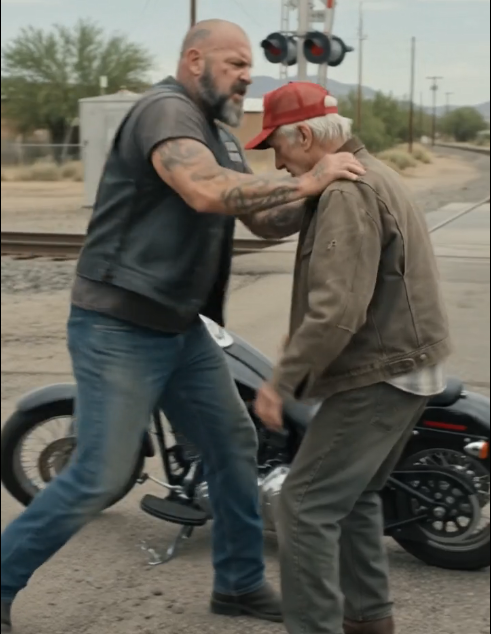
Hammer’s motorcycle was closest to the tracks.
It was a black 1998 Harley-Davidson Road King with a cream stripe along the tank, wide steel crash bars, and more than 190,000 miles on its frame. Hammer had refused offers worth twice its market value. He had rebuilt that bike beside his teenage daughter, Abby, before leukemia took her, and a tiny crescent-shaped mark from her wrench remained beneath the left fuel cap.
Nobody touched it without permission.
Especially not a stranger.
The stranger was seventy-six, thin as fence wire, wearing brown work pants, a faded railroad jacket, and one hearing aid. I first saw him gripping Hammer’s handlebar with both hands while the motorcycle leaned against his narrow hip.
“Hey!” I shouted.
He looked at us, looked toward the bend, then shoved harder.
The Road King rolled off the gravel and bumped across the first rail.
Leather creaked behind me. Boots struck stone. Three brothers began running before Hammer even turned around.
The old man dropped the bike.
Chrome hit steel with a violent crack. The Harley fell sideways across the tracks, one crash bar against the near rail and the rear frame resting inches from the far one.
To us, it looked deliberate.
Boone yelled that the man had lost his mind. Cruz reached him first and grabbed the back of his jacket. I caught the old man’s right arm as he tried to crawl beneath the fallen motorcycle.
“Let me go!” he shouted. “It isn’t touching!”
“You just destroyed his bike.”
“It has to bridge the rails!”
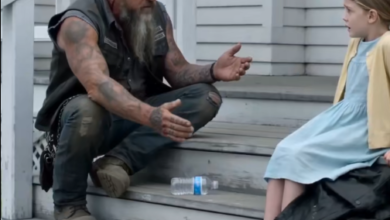
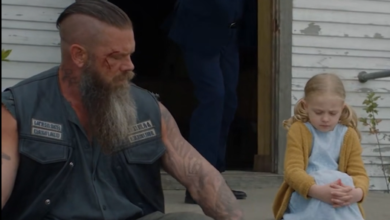
Hammer came through the others without running. At fifty-six, he stood six-foot-four and weighed nearly 285 pounds, with a shaved head, a thick black-and-gray beard, tattooed forearms, scarred knuckles, jeans, boots, and a plain black leather cut. His face was hard enough to frighten people before he spoke.
The old man looked up at him.
“Help me push it farther.”
Behind us, the crossing bell began ringing.
Red lights flashed.
The gates descended across an empty road.
Everyone stopped.
There was no train close enough to trigger them. We could still hear the distant horn, faint beyond the pines, but the rails beneath our boots had begun to hum.
The old man pointed around the tree-covered bend.
“A bus stalled on the next crossing,” he said. “Twenty-three children. The driver’s radio is dead.”
Hammer stared toward the curve. From where we stood, we could see only wet rails vanishing between pine trees and a thin ribbon of yellow hidden beyond them.
Then the wind shifted.
Children were screaming.
Hammer dropped beside his Harley and helped the old man drag its crash bar against the second rail. A blue spark snapped beneath the frame. Somewhere inside a gray signal cabinet, a relay slammed shut.
The crossing lights changed their rhythm.
The distant train horn became one long, desperate blast.
Boone asked the question none of us wanted answered.
“Will it stop?”
The old man watched the rails tremble.
“It’ll get the warning,” he said. “Stopping is another matter.”
Hammer looked once at the crescent mark Abby had left beneath the fuel cap. Then he put both arms around the old man—not because the Harley had been saved, but because he finally understood why it had been chosen.
Seconds later, a locomotive burst from the curve.
Want to know why the old man recognized Hammer’s motorcycle, what the emergency signal actually told the engineer, and where the train finally stopped? Drop CROSSING in the comments—I’ll share more soon.
Part 2 — The Motorcycle Nobody Was Allowed to Touch
To understand what Hammer surrendered that morning, you need to understand that the Road King had never been just another machine parked outside Dawson Cycle Repair.
Hammer bought it in 1998, when Abby was eleven and he was nine months sober. Back then, he had no club, no repair shop, and no reputation for doing anything useful. He had a felony assault conviction, a rented room behind a tire store, and hands that shook whenever he walked past a liquor aisle.
The Harley came to him in milk crates.
Its previous owner had struck a deer north of Sedona and decided the bent frame was not worth saving. Hammer paid eight hundred dollars for the wreck, hauled it behind a borrowed pickup, and spread the pieces across the concrete floor of the unfinished garage where he sometimes slept.
Abby came every Saturday.
She was skinny, pale, and already accustomed to hospitals, though none of us knew what was coming. Her mother allowed the visits because rebuilding a motorcycle seemed safer than letting Hammer invent promises he might break. Abby labeled bolts in sandwich bags, cleaned carbon from old parts with a toothbrush, and asked questions until her father learned patience.
She painted the cream stripe herself.
It was crooked beneath the seat.
Hammer never corrected it.
Three years later, leukemia took Abby at fourteen. The Road King was unfinished. For almost six months, Hammer left it beneath a canvas sheet and refused to enter the garage. Walter Hale—an old pump mechanic who later helped form the Iron Lanterns—eventually pulled away the cover and placed Abby’s wrench on the workbench.
“Finish what she started,” Walter told him.
Hammer did.
He rode that motorcycle to Abby’s grave on the first Sunday of every month. He used it to deliver groceries after winter storms, carry medicine to men too proud to ask for help, escort soldiers without families to burial services, and take children from the oncology ward around the hospital parking lot at walking speed.
The odometer rolled past 190,000 miles, but Hammer replaced only what failed. The scratched tank stayed. The crooked stripe stayed. So did the little wrench mark beneath the fuel cap.
The bike had wide custom crash bars because Abby had worried it might fall on him.
“You’re too old to lift it,” she had teased when he was thirty-two.
At fifty-six, Hammer could still lift it.
That morning, the Iron Lanterns had been riding from Flagstaff to Winslow for a veterans’ housing fundraiser. Rain had moved through before sunrise, leaving black patches across the pavement and a greasy sheen on the rails. We stopped near Miller’s Crossing at 8:06 because Boone felt his rear tire drifting.
The crossing sat on a lonely county road used mostly by ranch trucks and forestry crews. Half a mile east, beyond a grove of ponderosa pines and a shallow curve, an access road crossed the same tracks beside an abandoned timber-loading yard.
That second crossing had no gates.
It was supposed to be locked.
It wasn’t.
A school bus had taken the access road because a fallen pine blocked the normal route to Pine Ridge Elementary. The substitute driver, Carla Ruiz, followed a county detour sign someone had turned in the wrong direction during the storm. When she reached the tracks, she realized the road beyond them had washed out.
She tried to reverse.
The bus stalled with its rear wheels against the outer rail.
Twenty-three children, ages six through eleven, were inside.
Carla called dispatch on the bus radio. Static answered. The hills blocked her cell signal, and the rain had damaged a repeater that served the eastern side of the county. She sent two older children toward the front of the bus to help keep the younger ones calm, then ran down the track looking for a signal box.
That was where she met the old man.
His name was Earl Whitaker.
Earl lived alone in a weathered trailer near the timber yard. For forty-two years, he had worked signals for the railroad, first repairing mechanical relays and later supervising electronic crossing systems. Retirement had taken his keys, his radio, and the authority that once made engineers listen when he spoke.
It had not taken his knowledge.
Earl heard the children before he saw the bus. He ran toward it, climbed aboard, and found Carla cycling the ignition while the starter clicked uselessly. The bus’s front wheels had sunk into soft gravel. Its rear axle was wedged against the crossing plank.
“Get them off,” Earl said.
Carla opened the emergency door.
The youngest children began climbing down, but wet ballast shifted beneath their shoes. One boy used forearm crutches. A seven-year-old girl froze halfway through the rear exit. Another child had an asthma attack when the first train horn rolled through the valley.
Carla counted the distance by sound.
The train was still miles away.
Maybe.
Earl ran to an old trackside telephone box. The handset was gone. Copper thieves had stripped the line years earlier, leaving only a rusted bracket and two severed wires.
Then he remembered Miller’s Crossing.
After a fatal collision in 1989, that crossing had received an experimental obstruction-detection circuit. It was designed to warn the dispatcher when a large conductive object bridged both rails inside the crossing zone. The system was old, imperfect, and
TITLE: An Old Man Shoved a Biker’s Beloved Harley Onto the Railroad Tracks as His Club Charged Him — Then a School Bus Appeared Beyond the Curve
SEO DESCRIPTION: A biker watches an old man sacrifice his Harley on railroad tracks—then discovers a school bus full of children trapped ahead.
Part 1 — Teaser: The Old Man Who Stole Hammer’s Harley
The old man shoved Hammer Dawson’s Harley onto the railroad tracks while seventeen bikers ran toward him, and when the crossing bells began ringing, I thought we were about to watch a thief die beside the motorcycle he had stolen.
My name is Mason Reed, though the men in the Iron Lanterns call me Mack. I was forty-eight that October morning, road captain of a motorcycle club outside Flagstaff, Arizona, and I had spent enough years around angry men to recognize the sound a crowd makes just before somebody gets hurt.
Boots struck gravel. Leather creaked. Men shouted.
Hammer did not.
Ray “Hammer” Dawson was fifty-six, six-foot-four, and close to 285 pounds, with a shaved head, a thick black-and-gray beard, tattooed forearms, scarred knuckles, and the kind of silence that made strangers step aside. His 1998 Harley-Davidson Road King was the only machine in our club nobody touched without permission.
The paint was dark blue beneath twenty-eight years of scratches. A small silver handprint had been sealed under the clear coat on the left side of the fuel tank. Hammer polished around it but never over it.
That morning, we had stopped beside the abandoned Red Butte feed mill after a charity ride delivering winter coats to children in Winslow. The crossing ahead looked empty. Beyond it, the railroad curved behind the mill, disappearing between rusted grain hoppers and a sandstone cut.
Then an elderly man stepped out of a battered pickup.
He was thin, perhaps seventy-eight, wearing brown work pants, a faded railroad jacket, and one hearing aid that kept whistling. Before anyone understood what he was doing, he walked straight to Hammer’s Harley, released the parking brake, and began pushing.
“Hey!” Boone shouted.
The old man did not stop.
The Road King rolled off the gravel shoulder. Its kickstand scraped. The front tire bumped over the first rail while the man strained against nearly eight hundred pounds of steel.
We thought he was stealing it.
Then he turned the handlebars, dragged the motorcycle sideways, and dropped it across both rails.
That looked worse.
Cruz sprinted first. I followed, certain we were about to pull a confused old man away before an approaching train turned him and Hammer’s bike into pieces.
The crossing lights awakened.
Red lamps flashed against the feed mill. Bells hammered the cold air. Far beyond the curve came a locomotive horn—low, long, and close enough to tighten every muscle in my back.
The old man dropped to one knee beside the Harley and shoved its steel crash bar against the second rail.
“Leave it there!” he yelled.
Cruz grabbed his jacket.
“You trying to kill somebody?”
“I’m trying to stop it!”
Hammer reached us last. His face changed when he saw the Harley lying across the tracks. That bike had survived prison, sobriety, his daughter’s funeral, and twenty years of Arizona highways. I had watched him refuse forty thousand dollars for it.
His right hand closed.
The old man looked up at him, breathing hard. Blood—not much, but enough—ran from a scrape along his palm.
“Please,” he said. “You can hit me afterward.”
The locomotive horn sounded again.
Then a child screamed somewhere beyond the grain cars.
Hammer looked past the old man. We all did.
Through a gap beside the mill, perhaps four hundred yards down the line, I saw the yellow rear corner of a school bus. It was angled across a private service crossing, its back wheels buried in soft gravel and its front door jammed against a bent gatepost.
Small hands struck the windows.
The bus was full.
Hammer released the old man’s jacket before I realized he had grabbed it. He looked at the flashing signal box, then at his Harley lying across the rails, and finally toward the train hidden by the curve.
“Will this stop it?” he asked.
The old man shook his head.
“Not by itself.”
Those three words chilled me more than the horn.
The Harley had awakened an obstruction sensor connected to the railroad dispatcher, but no one knew whether the warning had reached the locomotive soon enough. The train might brake. It might not. Moving the motorcycle now could cancel the only emergency alarm standing between thirty-one children and several thousand tons of freight.
Hammer knelt beside the old man.
Not to hit him.
He put one massive arm around the stranger’s shoulders and held him there as the rails began to sing beneath our boots.
The club scattered. Teachers pulled children through the bus’s rear exit. The locomotive burst around the sandstone curve with its brakes screaming, and Hammer never looked away when the front of it struck the Harley he had protected for almost three decades.
The motorcycle vanished under steel.
What none of us knew was why that old man recognized the crossing system, whose tiny handprint Hammer had preserved beneath the blue paint, or why the school bus driver began sobbing when she saw those two men holding each other beside the wreckage.
Want to know why the old man chose Hammer’s Harley and whose handprint survived on its tank? Drop CROSSING in the comments—I’ll share more soon.
Part 2 — The Handprint Beneath the Blue Paint
Hammer bought the Road King in 1998, four days after leaving prison.
He did not buy it because he deserved something beautiful. Those were his words, not mine. He bought it because the halfway house stood nineteen miles from the pump-repair shop willing to hire him, and the county bus stopped running before his night shift ended.
The Harley was already used. Its previous owner had dropped it on both sides, bent one crash bar, and painted the tank with a blue that appeared black after sunset. Hammer paid in cash earned from unloading livestock feed and slept on a cot behind the repair shop until he could afford a room.
He had served three years for aggravated assault.
Hammer never softened that history. He never claimed self-defense or blamed whiskey, though whiskey had been involved. He said he kept hitting a man after the man stopped fighting, and that one fact belonged to him no matter how many decent things he did afterward.
Most employers heard the conviction and closed the door.
Walter Hale did not.
Walter owned the pump shop. He gave Hammer a wrench, a leaking irrigation motor, and six hours. When Hammer completed the repair in four, Walter made him redo the wiring because one connection looked careless.
That was the beginning.
By the time I met Hammer twelve years later, he had been sober for eleven years, owned a small motorcycle garage, and helped form the Iron Lanterns. We were not saints. Boone had spent time for burglary. Cruz had once collected debts for men whose names he no longer used. I had lost my commercial driver’s license after my second DUI.
The club gave us rules because some men need visible lines.
No riding after drinking. No violence in club colors except to protect someone from immediate harm. No leaving a brother alone at a hospital, cemetery, police station, or roadside breakdown. If a child needed food, heat, medicine, or a safe ride, the treasury opened before anybody asked how much remained.
Hammer wrote that last rule.
His daughter’s name was Annie.
She was six when he went to prison and nine when he came home. Her mother, Denise, allowed him supervised visits at first. Hammer never complained. He arrived early, brought no gifts he had not cleared with her, and sat at a public park while Annie decided whether the large, bearded stranger with scarred hands still counted as her father.
During the third visit, she asked for a ride on his Harley.
Denise said no.
Hammer agreed with her.
Instead, he placed Annie on the parked seat and let her hold the handlebars while he made terrible engine noises with his mouth. Annie laughed until she nearly slid off. Before leaving, she pressed her paint-covered hand against the fuel tank. She had been making blue and silver stars at an art table, and the print remained on the metal.
Hammer tried to wipe it away.
Annie stopped him.
“That means I was here.”
The next week, he paid a body-shop painter to seal it beneath clear coat.
For seven years, father and daughter rebuilt the Harley together. Annie learned to change oil before she learned to drive. She labeled parts with masking tape because Hammer pretended he could never remember where they belonged. At sixteen, she painted a tiny white star beneath the seat where no one would see it unless the bike was taken apart.
Then a drunk driver crossed the center line on Interstate 40.
Annie was not riding with Hammer. She was returning from a school debate competition in a teacher’s car. The crash killed her and injured two other students.
Hammer did not drink.
That surprised people who understood neither addiction nor grief. He locked his garage, placed the Road King under a cover, and slept beside it for three nights. On the fourth morning, Walter Hale arrived with coffee and sat on the concrete without speaking.
The Harley returned to the road six months later.
From then on, it carried Annie’s silver handprint beneath every layer of dust. Hammer replaced the engine, transmission, wheels, wiring
TITLE: An Old Man Shoved a Biker’s Harley Onto the Railroad Tracks as the Club Charged Him — Then Hammer Saw the Children Trapped Beyond the Curve and Hugged the Man Before the Train Destroyed His Bike
SEO DESCRIPTION: A biker club mistakes an old man for a thief—until his desperate sacrifice stops a freight train from reaching a trapped school bus.
Part 1 — Teaser: The Old Man Who Put Hammer’s Harley on the Tracks
The old man shoved Hammer Dawson’s Harley across two railroad rails while twelve bikers charged toward him, yet he never ran—he only pointed beyond the curve and screamed, “That motorcycle is the only thing big enough to save them.”
I was one of the men chasing him.
My name is Mason Reed, though every brother in the Iron Lanterns called me Mack. I was forty-eight, a former tow-truck driver with a damaged left knee, a short temper, and enough ink on my arms to make nervous people move their children to the other side of a diner.
Hammer was worse to look at.
Ray “Hammer” Dawson stood six-foot-four and weighed close to 285 pounds. His shaved head was crossed by an old white scar. A thick black-and-gray beard covered his throat, faded tattoos wrapped both forearms, and the silver skull ring on his right hand clicked against everything he touched. He wore a plain black leather cut, jeans, heavy boots, and the expression of a man who had spent years learning how not to hit first.
The Harley the old man was stealing was a black 1998 Road King.
Hammer had owned it for twenty-seven years.
He had rebuilt its engine twice, replaced the frame after a wreck, and refused every offer to buy it. Beneath the left side of its fuel tank, almost hidden by the seat, was the faded blue handprint of his daughter Abby, pressed there when she was nine years old.
She never lived long enough to see ten.
That Sunday morning, we had parked beside Miller’s Crossing outside Flagstaff, Arizona, while Boone repaired a loose battery cable on his bike. The air smelled of hot pine, creosote, gasoline, and the coffee we had carried from a truck stop six miles back. Somewhere past the trees, a freight locomotive sounded its horn.
Then the old man appeared.
He was thin, maybe seventy-eight, wearing brown work pants, a pale railroad jacket, and a red cap darkened by sweat. He limped straight toward Hammer’s Harley, raised the kickstand, and began pushing.
At first, I thought he was confused.
“Sir,” I called. “Step away from that motorcycle.”
He pushed harder.
The Road King weighed more than seven hundred pounds. Its tires dragged through gravel while his arms shook beneath the jacket. He nearly fell twice, yet he kept forcing it toward the crossing.
Boone shouted.
The club moved.
To twelve bikers, it looked like an old stranger had chosen the most valuable motorcycle in the line and was deliberately rolling it into the path of an approaching freight train. Phones came out at the roadside diner across the highway. A woman screamed for someone to call the police.
I reached him first and seized the back of his jacket.
He swung a steel lantern at my face.
It missed by inches.
“Let go!” he shouted. “The bus is stuck!”
I saw no bus.
Only tracks, pines, a signal cabinet, and the bend where the rails disappeared behind a red wall of sandstone. The train horn sounded again, deeper now. Closer.
Hammer stepped past me.
The old man looked into his face and said something that should have sounded insane.
“I need your steel.”
Then he kicked Hammer’s Harley onto its side across both rails.
Chrome struck iron. The crash bars wedged against one rail while the exhaust touched the other. A red light began pulsing on the signal cabinet.
Hammer could have hit him.
Instead, he froze.
Beyond the sandstone curve, children began screaming.
The front half of a yellow school bus appeared through the trees, crooked across a second section of track less than four hundred yards away. Its rear wheels had sunk into broken asphalt. The crossing gate was trapped beneath its chassis. Twenty-two children crowded the windows while their driver fought a door that would not open.
Then the locomotive came around the opposite bend.
Its brakes screamed.
Hammer looked at his Harley, at the bus, and at the old man still clutching the lantern with both trembling hands. He did not ask what the motorcycle was worth. He did not ask whether the train would stop.
He pulled the old man against his chest.
“Hold on, brother.”
The locomotive struck the Road King hard enough to tear the fuel tank away.
Black metal spun through red dust. The blue handprint vanished beneath the wheels. Behind us, twelve bikers stood in absolute silence while the train continued toward the bus.
We thought we had just watched Hammer lose the last thing his daughter had touched.
We did not yet know why the old man understood that signal, what had happened at Miller’s Crossing thirty-one years earlier, or why Hammer would later refuse every offer to rebuild the motorcycle.
Want to know why that Harley triggered the emergency system and what Hammer found beneath its crushed tank? Drop CROSSING in the comments—I’ll share more soon.
Part 2 — The Motorcycle Nobody Was Allowed to Touch
Hammer bought the Road King used in 1999, before the Iron Lanterns existed and before most of us knew his real name. Back then, he worked nights repairing irrigation pumps behind a feed store and slept in a room above a tire shop that smelled of rubber even in winter.
He had been out of prison eleven months.
Hammer never disguised that part of his life. At twenty-seven, drunk and angry, he had beaten a man outside a bar after the man stopped fighting. The sentence cost him three years. The shame cost him longer.
“I wasn’t defending anybody,” he once told me. “Don’t clean it up.”
After his release, garages turned him away as soon as they saw the conviction. Walter Hale, an older pump mechanic, finally offered him work because Hammer could identify a damaged bearing by sound.
Walter did not call it a second chance. He called it Tuesday.
Hammer saved for eight months and bought the black Harley from a county auction. The windshield was cracked, the saddlebags did not match, and the engine knocked when hot. He rebuilt it in Walter’s shed while his wife, Claire, sat nearby with their daughter.
Abby was seven when the motorcycle first ran.
She was small for her age, with red hair, a gap between her front teeth, and a habit of leaving blue fingerprints wherever she painted. When Hammer finished the fuel tank, she pressed one paint-covered hand beneath its left edge.
He pretended to be angry.
She laughed until she hiccupped.
Two years later, doctors found leukemia.
The Road King carried Hammer between work, the hospital, and home through fourteen months of treatment. He taped Abby’s paper bracelets inside the windshield. After she became too weak to ride, he rolled the motorcycle beneath her hospital window and started it once—only once—so she could feel the V-twin pulse through the glass.
She raised one hand from her bed.
Hammer raised his.
Abby died the following morning.
He stored the Harley for nearly four years. Dust covered the tank, but he wiped around the blue handprint without touching it. Walter visited every Thursday, brought bad coffee, and sat beside the silent machine until Hammer began speaking again.
The Iron Lanterns formed slowly after that. First, five mechanics started delivering prescriptions to older residents stranded after a winter storm. Then came wheelchair ramps, funeral escorts, food runs, and emergency rides for families whose cars had quit between towns.
Hammer never made speeches about helping people.
He showed up.
By the time I joined, the club had twelve patched members and two prospects. Hammer had become president because he was the one man who could silence an argument by lowering his voice.
His Road King remained off-limits.
New prospects were warned not to lean against it, wash it, or move it without permission. Hammer performed every repair himself. If someone admired the paint, he nodded. If anyone reached toward Abby’s handprint, his whole body changed.
That Sunday, we were riding to deliver a rebuilt wheelchair ramp to a retired nurse outside Winslow. Hammer chose the old highway because he disliked interstate traffic during tourist season. Boone’s battery cable loosened six miles north of Flagstaff, so we turned into the gravel beside Miller’s Crossing.
The crossing looked ordinary unless a person knew where to look. Two rails cut through the pine woods, then curved behind red sandstone. A small silver cabinet stood beside a striped gate. Mounted above it was a red lamp behind a steel cage.
The lamp was dark.
Across the highway sat a weathered diner called Roscoe’s. A few customers had walked outside when they heard our motorcycles. Some watched with curiosity. Others watched the way people watch a storm they hope will pass.
We had been parked for seven minutes when I noticed the old man.
He stood beside a faded Ford pickup near the diner, staring at the tracks. His name, we later learned, was Earl Whitaker. He was seventy-nine, lived alone in a trailer near Bellemont, and had worked for the railroad for forty-two years.
At that moment, he looked like a frightened stranger.
Earl raised an old maintenance radio to his ear, although no sound came from it. Then he looked toward the sandstone curve, checked his wristwatch, and began walking quickly.
He did not come toward us.
He went to the signal cabinet.
Earl pulled the handle. Locked.
He struck the door with his palm, searched the gravel, and spotted a yellow school bus through a narrow gap between the pines. None of us could see it from where we stood.
He could.
The bus had taken an unofficial detour after a wildfire crew closed the county road. Its driver, Denise Caldwell, followed temporary signs toward Miller’s Crossing, unaware that floodwater had hollowed the pavement beneath the far rail.
When the bus crossed, the asphalt collapsed.
Its rear axle dropped.
The engine stalled.
Denise tried restarting it while the crossing arm descended behind her and became trapped under the bus frame. The folding door jammed against a bent roadside post. The rear emergency door faced a steep drainage ditch, making evacuation slow and dangerous for the youngest children.
She radioed dispatch.
Static answered.
The locomotive was eleven minutes away.
Earl knew because he had checked the freight schedule that morning, just as he had every Sunday for three decades. He also knew Miller’s Crossing had an experimental obstruction alarm installed after an earlier accident. A large conductive object spanning the detection zone could send an occupied-crossing warning directly to the dispatcher.
The signal cabinet included a manual emergency switch.
It was locked.
Earl looked at the cars outside Roscoe’s. Too light, too far, or parked without keys. He looked at his pickup, but its transmission had failed; a tow truck was already on its way.
Then he saw the Road King.
Heavy steel crash bars. Low exhaust. Wide frame.
Enough metal to span the insulated detection plates.
Earl ran toward the only machine that might make the railroad believe something was blocking the track.
He never stopped to explain.
That mistake nearly cost him the seconds he was trying to save.
Part 3 — Eleven Minutes Until the Freight Train
Earl reached Hammer’s motorcycle as Boone tightened the battery terminal on his own bike. The first train horn rolled through the pines, distant enough that nobody felt immediate danger.
Earl did.
He gripped the Road King’s handlebars and pushed.
The front wheel moved six inches before the weight pulled him sideways. He planted both boots, leaned his shoulder against the windshield, and tried again.
I thought he was stealing it.
That seems foolish now. A seventy-nine-year-old man was not going to outrun twelve bikers while pushing a seven-hundred-pound Harley. But people do not reason cleanly when they see someone touching the thing they have been trained to protect.
“Sir,” I called. “Step back.”
Earl glanced toward me, then toward the curve.
“No time.”
Boone stood up. “That bike ain’t yours.”
“I know.”
That answer sounded like contempt.
Earl forced the Harley down the gravel shoulder. The kickstand struck a stone and folded. He caught the bike against his hip, tearing his jacket on the clutch lever.
I ran.
So did Boone, Cruz, Noah, and three other Lanterns. Boots hammered gravel. Leather cuts creaked. Somebody at Roscoe’s shouted that we were attacking an old man.
Earl reached the wooden crossing panels.
The Road King’s front tire struck the first rail and stopped. He pushed until his knees trembled, but rubber could not climb polished steel at that angle.
I grabbed his jacket.
He spun with the lantern.
The steel frame passed beside my cheek and crashed into my shoulder. Pain shot down my arm. I twisted his wrist and tore the lantern away.
“What the hell is wrong with you?”
“The school bus!”
“What bus?”
“Past the rock!”
The second train horn interrupted him.
Closer.
Earl pointed toward the signal cabinet. “That red lamp has to come on.”
Boone caught the Harley’s handlebar before it fell. “You’re done.”
“No!” Earl shouted. “Put it across both plates.”
Two club members pulled him backward. He fought them with a strength built from panic, not muscle. His cap fell. White hair clung to his damp forehead.
Hammer walked through us.
He did not hurry. He rarely did. Yet every man released Earl when Hammer raised one hand.
Hammer looked at his motorcycle, then at the old man.
“You want my bike?”
“I need its steel.”
“For what?”
“To shunt the obstruction loop.”
None of us understood.
Hammer did.
He had repaired pump systems near rail yards and knew enough electrical work to recognize the word. His eyes moved toward the small black plates mounted inside the crossing panels.
“How long?”
“Freight’s due now.”
“Will it stop?”
“If the alarm reaches dispatch.”
“If?”
Earl swallowed. “System’s old.”
A child appeared between the pines.
Only her upper body was visible through the rear window of the bus. She struck the glass with both palms, disappeared, then returned beside another child.
Everything changed.
Hammer seized the Harley’s rear frame.
“Boone. Front end.”
Boone stared at him. “Brother—”
“Move.”
We lifted.
The Road King crossed the first rail. Its front wheel dropped between the tracks. Earl directed us with his hands, telling Hammer to turn it sideways.
Cruz still did not understand. “We can roll it off once the light comes on.”
Earl shook his head. “It has to stay.”
Hammer heard that.
His gaze went to Abby’s blue handprint beneath the tank. He rested his thumb over it for less than a second.
Then he shoved.
The Harley fell across the rails.
Steel struck steel. The left crash bar rested on one detection plate. The low exhaust landed against the other rail, but the red lamp remained dark.
Nothing happened.
The train horn sounded a third time.
Earl dropped to his knees. He dragged the exhaust pipe across the rail, scraping chrome until bare metal showed. The obstruction detector needed continuous conductive contact, and twenty-seven years of paint, rubber mounts, road grime, and corrosion interrupted it.
“Help me!”
Hammer knelt beside him.
Together, they forced the crash bar down. A spark snapped beneath the frame.
The red lamp blinked once.
Went dark.
Blinking again.
Then it stayed on.
A buzzer sounded inside the locked cabinet.
Across the tracks, the school bus driver had managed to force the folding door open six inches. A biker named Noah ran toward it, but Earl grabbed his vest.
“Not along the track. Train’s coming blind.”
Noah pulled free. “Kids are in there.”
“So get off the rail bed!”
We split into two groups and ran through the drainage ditch beside the tracks. Pine branches tore our arms. Loose stone rolled beneath our boots. Hammer stayed with Earl and the Harley because neither knew whether the contact would hold.
I reached the bus first.
Denise Caldwell was forty-one, a Black mother of two with a yellow safety vest over a blue uniform shirt. Blood from a shallow cut marked her temple, but she remained calm enough to pass children through the narrow front door one at a time.
“Twenty-two students,” she said. “Three need help climbing.”
“Noah!” I shouted.
He waded through the ditch and lifted a six-year-old boy down. Cruz took a girl with leg braces. Boone climbed through a side window to open the rear door from inside.
Then the rails began singing.
It started as a thin metallic vibration under the shouting. Every railroad worker knows it. Every child close enough felt it through the bus floor.
The locomotive came around the northern curve.
Its headlight filled the trees.
Hammer stood beside his Harley with Earl, one huge hand gripping the old man’s shoulder. The red warning lamp still burned, but the train was moving too fast to appear stopped.
The emergency brakes screamed.
Sparks tore beneath the freight cars. The horn became one continuous blast, flattening every other sound.
Hammer could have pulled the Harley away. He had perhaps twenty seconds. Maybe less.
Earl saw him look toward it.
“If we break contact, dispatch loses the alarm.”
Hammer nodded.
He did not touch the bike.
Instead, he removed his leather cut and wrapped it around Earl, protecting the old man from flying debris. Then he turned his back to the rails and pulled Earl against his chest.
“Hold on, brother.”
The locomotive hit the Road King.
The windshield exploded. One saddlebag tore free and spun across the gravel. The front wheel folded beneath the pilot. Black paint and chrome vanished under thousands of tons of moving steel.
The blue handprint disappeared.
For a moment, Hammer’s face looked empty.
Then a child cried from the bus.
He released Earl and ran toward us.
The train kept coming.
Part 4 — The Red Light Earl Built After Losing a Child
Freight trains do not stop like cars. Even under emergency braking, steel wheels can travel more than a mile before the final car becomes still.
The locomotive had already slowed before reaching Miller’s Crossing.
We did not know that yet.
The obstruction signal from Hammer’s Harley had reached the regional dispatcher fifty-one seconds after the red lamp illuminated. The dispatcher contacted the engineer and triggered a restrictive command through the railroad’s safety system. The engineer had already reduced speed for the curve, then placed the train into emergency braking when the alarm identified a blocked crossing.
Rain two nights earlier had left residue on the rails.
The wheels slid.
The locomotive destroyed the Harley at approximately thirty-eight miles per hour and continued toward the school bus, slowing with every yard but still carrying enough force to tear it apart.
We had sixteen children clear.
Six remained.
Boone pushed open the rear emergency door from inside, but it faced the drainage ditch. The drop was nearly six feet. Cruz and I stood below while he lowered children into our arms.
One.
Two.
Three.
The fourth child refused to move without her backpack.
Denise tore it from beneath a seat and threw it out the door. The girl followed.
The fifth was a nine-year-old boy named Christopher who had frozen beneath a bench. Noah crawled between the seats and dragged him backward by the straps of his jacket.
The locomotive was less than two hundred yards away.
Hammer climbed into the bus.
I remember seeing his tattooed hands close around the last child, a small Asian American girl with a hearing aid and one shoe missing. Her name was Lucy Tran. She had wrapped both arms around a seat post and could not understand the shouted instructions over the horn.
Hammer did not pull.
He crouched until she saw his face, pointed to himself, then toward the rear door. He waited for her to nod.
That patience consumed three seconds we did not believe we had.
Lucy released the post.
Hammer carried her down the aisle. Boone climbed out first. Hammer passed Lucy to me, then jumped into the ditch as the locomotive reached the crossing.
The train struck the bus.
Not squarely.
By then, the engine had slowed to less than seven miles per hour. Its steel pilot hit the empty front corner, rotated the bus away from the rails, and pushed it into the broken asphalt. Windows shattered. Yellow metal folded around the hood.
Nobody was inside.
The locomotive stopped sixty-three feet beyond the crossing.
Silence did not follow. Children cried. Air brakes hissed. Metal ticked. Adults at Roscoe’s ran toward us carrying blankets, water, and phones.
Yet I remember Hammer standing alone beside the ditch.
He looked back toward the pieces of his Harley scattered along the track. The engine case rested upside down near the signal cabinet. One handlebar hung from a cable. The fuel tank had been flattened and torn open.
There was no blue handprint.
Earl walked to him.
The old man had a bleeding lip and a purple mark where I had grabbed his jacket. Hammer’s leather cut still hung around his narrow shoulders.
“I’m sorry,” Earl said.
Hammer turned.
For a second, I feared grief might overtake judgment. Hammer’s hands closed. His jaw tightened. Every man in the Iron Lanterns knew what the Road King had carried through the years.
Then Earl said, “I chose the only bike that could reach both plates.”
Hammer looked toward the children.
He hugged him.
Not a brief slap on the back. Hammer wrapped both arms around Earl and held the old man upright while Earl’s knees buckled.
“You chose right,” Hammer said.
That should have been the end of Earl’s mystery.
It was only the beginning.
A railroad investigator arrived and recognized the name stitched above the pocket of Earl’s old jacket. He stopped several feet away, removed his hard hat, and called him Mr. Whitaker.
The engineer climbed down from the locomotive. He was a sixty-three-year-old Latino man named Luis Ortega. When he saw Earl, his face lost its color.
“You came back here?” Luis asked.
Earl looked at the damaged bus.
“Every Sunday.”
Hammer released him slowly. “Why?”
Earl turned toward the red obstruction light he had forced the Harley to activate.
“Because I built that alarm after another bus got stuck here.”
The accident had happened thirty-one years earlier.
Earl had been the signal maintainer responsible for Miller’s Crossing. A church bus carrying eleven children lost an axle on the rails during a winter storm. The driver sent someone to the signal box, but the crossing had no obstruction detector and the nearest emergency telephone had failed.
Earl was seven miles away repairing a relay.
His twelve-year-old granddaughter, Emily, was on that bus.
The freight train stopped too late.
Luis Ortega had been the junior engineer in the locomotive cab.
Three children died, including Emily.
Earl spent the next four years pressuring the railroad, county, and state transportation board to install a crossing-obstruction system. Officials rejected two designs because of cost. He built a third prototype in his garage using detection plates, a dedicated circuit, and a direct alarm to dispatch.
Miller’s Crossing received the prototype.
No other crossing in the county did.
Earl retired after the installation. Yet every Sunday, when the scheduled freight passed, he drove to Roscoe’s and watched the red lamp remain dark.
For thirty-one years.
That morning, when the school bus became trapped, Earl found the manual cabinet locked with a newer key. His radio had been decommissioned. His truck could not move. The club believed he was attacking us because he did not have time to explain the worst day of his life.
Hammer listened without interrupting.
Then he looked at me.
The bruise on Earl’s shoulder carried the shape of my fingers.
Part 5 — What Survived Beneath the Crushed Fuel Tank
I apologized beside the tracks.
Earl did not make it easy for me.
“You grabbed me before you looked,” he said.
“Yes, sir.”
“You heard me say bus.”
“I did.”
“And you still held me.”
“Yes, sir.”
He studied my face, perhaps deciding whether my honesty changed anything. Then he picked his red cap from the gravel and brushed away the dust.
“Help the children.”
That was all.
The Iron Lanterns stayed until every student had been reunited with family. We gave up our shirts for bandages, used our cuts as blankets, and formed a wall between the children and strangers recording videos.
Hammer asked people to stop filming.
Most did.
One did not.
A man from the diner kept his phone raised while Hammer carried Lucy toward an ambulance. Boone stepped between them, but Hammer told him to let it go.
“Today ain’t about our faces.”
Three children had minor cuts. Denise needed six stitches. Christopher was treated for shock. Lucy refused to release Hammer’s beard until her mother arrived.
When Mrs. Tran ran toward them, she stopped short at the sight of a massive tattooed biker carrying her daughter.
Lucy signed something with one hand.
Her mother began to cry.
Later, she told us Lucy had signed, Big man waited for me.
The county sheriff questioned Earl, Hammer, and the club. Technically, Earl had moved and sacrificed property that did not belong to him. Hammer could have pressed charges.
He refused before the deputy finished asking.
Railroad officials were less certain. The Harley had triggered a real emergency alarm and helped initiate braking, but it had also been placed deliberately on active tracks. Lawyers began using words like unauthorized interference and civil liability.
Earl listened until Hammer stood.
“You want somebody?” Hammer said. “Take me.”
The investigator frowned. “Mr. Dawson, you didn’t move the motorcycle.”
“My key. My bike. My choice.”
“You did not make the initial decision.”
“I made the one that left it there.”
The club stepped behind him.
That was our old reflex—close ranks, protect the patch, give outsiders one wall instead of twelve separate men. But Earl shook his head.
“No.”
Hammer looked at him.
Earl removed Hammer’s leather cut from his shoulders and handed it back.
“I made the first decision. Don’t steal that from me just because you’re better at looking guilty.”
Hammer almost smiled.
The railroad ultimately filed no complaint. The recorded alarm, locomotive data, dispatcher logs, and video from the diner showed the Harley had bought crucial braking distance. The county quietly repaired the crossing and unlocked a public emergency panel that should never have required a railroad key.
While officials argued, we gathered pieces of the Road King.
The frame was twisted beyond repair. The engine cases had cracked. The front cylinder was missing. Boone found part of the speedometer beneath a freight car. I recovered the skull-shaped mirror from the drainage ditch.
Hammer searched for the fuel tank.
He walked nearly half a mile along the track before seeing a strip of black metal beneath pine branches. The tank had split in two. One half was crushed flat and scraped to bare steel.
The side carrying Abby’s blue handprint was gone.
Hammer sat beside the rails.
None of us approached at first. He held the metal across his thighs and rubbed dust from it with his sleeve. His eyes shone, but he did not cry. Hammer rarely allowed tears where another person might feel required to comfort him.
Earl lowered himself beside him.
“I had a photograph of Emily in my wallet,” he said. “Carried it twenty-two years until the picture wore blank.”
Hammer kept looking at the tank.
“Were you scared you’d forget her face?” Earl asked.
“Still am.”
“I did forget pieces.”
Hammer’s fingers stopped.
“The space between her front teeth,” Earl continued. “The exact sound of her laugh. I hated myself for it. Thought forgetting one detail meant I was losing her again.”
“What changed?”
“Nothing. I forgot more.”
Hammer finally looked at him.
Earl pointed toward the families gathered beside the ambulances. “But every time that red light worked, I knew what Emily had changed. Different thing from remembering. Maybe stronger.”
Hammer lowered his head.
A railroad worker called from farther down the line. He had found something caught beneath a broken plastic saddlebag: a curved section from the underside of the fuel tank.
Blue paint marked its edge.
Not the entire handprint.
Two small fingers remained.
Hammer took the fragment with both hands. The paint was scratched but visible. Abby’s index finger and thumb rested on black metal no larger than a paperback book.
Boone released a breath.
I expected Hammer to clutch it to his chest.
He did not.
He carried it to Denise and the children waiting for a replacement bus. Lucy stood beside her mother, wrapped in a silver emergency blanket.
Hammer knelt and showed her the blue marks.
“My little girl put those there,” he said.
Lucy touched her own fingertips together, then signed through her mother.
“What happened to her?”
Hammer understood only after Mrs. Tran interpreted.
“She died.”
Lucy considered that. Then she pointed toward the crushed Harley and signed again.
Mrs. Tran’s voice broke as she translated.
“Did her motorcycle save us?”
Hammer looked at Earl.
“Yeah,” he said. “It did.”
Part 6 — The Club That Rebuilt Everything Except the Harley
Within a week, offers arrived from motorcycle shops across Arizona. People had seen the diner video. They wanted to donate frames, engines, paintwork, chrome, and labor.
One dealership offered Hammer a new touring motorcycle.
He declined.
Boone proposed rebuilding the Road King around a replacement frame. The club could recover the serial plates, use another engine, recreate every missing piece, and mount Abby’s surviving blue fragment beneath the tank.
Hammer declined that too.
“Why?” Boone asked.
Hammer set the warped fragment on his workbench. “Because that bike finished.”
No one argued.
We cleaned every recovered piece and arranged them inside Dawson Cycle Repair. Hammer kept only the blue fragment. The remaining metal went to a vocational welding class at Flagstaff High School, where several of the children from the bus would eventually study.
The students turned the crash bar, bent spokes, exhaust pipe, and pieces of frame into a bench. The seat faced the railroad crossing but stood safely behind a new steel barrier.
A small plaque carried no biker club name.
It read:
TWENTY-TWO CHILDREN WENT HOME.
Earl objected when the county asked to place his name beneath it. Hammer objected when they suggested adding his. For once, two stubborn men agreed without discussion.
The Iron Lanterns began meeting Earl at Roscoe’s every Sunday.
At first, we came to watch the freight pass with him. Later, we came because Earl knew more about electrical systems than all of us combined and because he could insult a man without raising his voice.
He called Boone’s wiring “a fire waiting for a witness.”
He told Cruz his chrome was “polished evidence of poor priorities.”
When he inspected my motorcycle, he stared for almost a minute before saying, “Did you assemble this during an earthquake?”
It was the first time I heard Hammer laugh after losing the Road King.
Earl also taught us the railroad emergency numbers posted at every crossing. He showed us how to identify a crossing by its blue identification sign, how to report a stalled vehicle, and why nobody should ever attempt to push a vehicle clear when a train is visible.
“Call the number first,” he said. “Get people out. Machines are replaceable.”
He glanced at Hammer after saying it.
Hammer touched the blue metal fragment inside his vest.
“Some are harder than others.”
Earl nodded. “Still replaceable.”
The railroad replaced Miller’s old obstruction system with modern equipment. The red lamp Hammer’s Harley had activated was removed from the cabinet and given to Earl.
He brought it to Dawson Cycle Repair.
Hammer mounted it above the garage door.
The lamp was no longer connected to an emergency circuit. Yet every Sunday morning, before we rode to the crossing, Earl switched it on.
Red light spread across the concrete floor.
Then twelve engines started.
Part 7 — The Sound That Came After the Train
A year after the accident, the twenty-two children returned to Miller’s Crossing with their families.
The bus company brought an empty yellow bus, but it stopped fifty yards from the tracks. Denise Caldwell had returned to driving after months of therapy. She parked, opened the door, and let the students walk toward the metal bench.
Lucy was first.
She carried a small square box.
Hammer arrived on a used gray Harley with mismatched saddlebags and faded paint. It ran well, but he had refused every offer to make it beautiful. No blue handprint appeared on the tank.
He parked beside Earl’s Ford pickup.
The old truck had finally received a new transmission.
Families thanked Hammer. He redirected them toward Earl. They thanked Earl. He redirected them toward Denise and Luis Ortega, the engineer who had come to the anniversary on his day off.
Nobody accepted the center.
That seemed right.
Lucy opened the box and removed a blue-painted metal handprint made by her school’s art class. Twenty-two children had pressed one fingertip around its edge. In the center were two bare spaces shaped like the surviving marks from Abby’s hand.
Hammer looked at it for a long time.
“You made this for my bike?” he asked.
Lucy shook her head.
Her mother interpreted her signs.
“For the red light.”
The handprint was mounted beneath the old emergency lamp in Hammer’s garage. Abby’s original fragment remained inside his vest, not hidden as a shrine but carried close enough to touch whenever he needed to remember what the motorcycle had become.
Earl’s health weakened over the next two years. He still visited the crossing, though one of us drove him when his hands became too stiff. Hammer usually took the job.
They traveled in Earl’s pickup.
Hammer never tried putting a seventy-nine-year-old railroad man on the back of a Harley. He claimed it was for safety. Earl claimed Hammer was afraid the truck would fall apart without supervision.
On the third anniversary, the freight passed at 9:17 a.m. Luis gave two short horn blasts from the locomotive cab.
Earl raised his red cap.
Hammer raised one scarred hand.
The metal bench vibrated as the cars rolled by, carrying freight toward New Mexico. Children were not gathered there that year. No cameras watched. No officials gave speeches.
Only two old men sat beside the pieces of a motorcycle that no one had rebuilt.
After the final car disappeared, Earl looked at Hammer.
“Still miss it?”
“Every day.”
“Would you stop me if it happened again?”
Hammer studied him.
“I’d help you push sooner.”
Earl nodded once.
That was enough.
When Earl died the following winter, the Iron Lanterns escorted his pickup instead of a hearse. Hammer drove. The old red maintenance lamp rested on the passenger seat, glowing from a temporary battery.
At Miller’s Crossing, twenty-two young people stood behind the safety barrier.
Some were nearly grown.
As the procession passed, they raised blue-painted hands.
Hammer slowed but did not stop. Twelve Harleys followed him, their engines settling into the deep, uneven rhythm Earl used to hear every Sunday outside Roscoe’s.
The Road King was gone.
Its sound remained.
Follow our page for more powerful biker stories about misunderstood riders, tested brotherhood, quiet sacrifice, and the lives protected beneath the leather.