An Eleven-Year-Old Girl Shoved a Biker Off His Harley Before Her Father’s Memorial Ride — Then a Cut Brake Line and a Sealed Letter Revealed Whom She Was Really Protecting
Part 2 — The Man Daniel Owed a Second Life
Hammer did not begin by checking his scraped hand.
He checked Lucy.
He placed both scarred palms on her shoulders, looked for blood on her face and arms, then asked whether the motorcycle had touched her. She shook her head. Only after that did he allow Doc Freeman, our sixty-two-year-old club medic, to examine the swelling around his wrist.
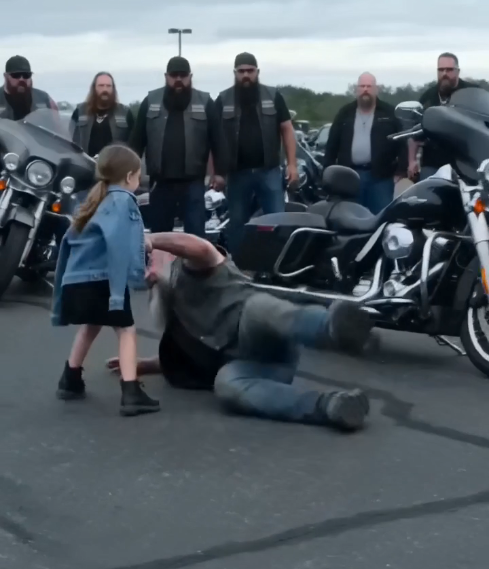
That was Hammer. Strangers saw his beard, tattoos and the pale scar crossing his throat. Those of us who knew him watched where his hands went first.
Sarah wanted Lucy inside the funeral home. Lucy refused.
“Dad said I stay with Ray,” she told her.
The words hurt Sarah. I saw it. Her husband had left instructions with their daughter that he had apparently never shared with his wife, and now those instructions seemed connected to an attempt on another man’s life.
Hammer heard the pain beneath her silence.
“Kid stays with her mother,” he said.
Lucy tightened her grip on the envelope. “You didn’t read it.”
“Your mom comes first.”
“My dad said you would say that.”
For the first time that morning, something close to fear passed through Hammer’s eyes.
Daniel Brooks had known him well.
Eight years earlier, Hammer found Daniel upside down inside a burning pickup on Interstate 17. Daniel had been thirty-seven, recently divorced, six months behind on child support and drunk enough to believe he could drive from Phoenix to Prescott after midnight.
He never made the first climb.
The pickup struck a guardrail, rolled across two lanes and landed on its roof. Fuel spread beneath the engine. Three drivers stopped, but nobody approached after flames appeared beneath the hood.
Hammer did.
He was returning from a welding job with a fractured rib and a suspended driver’s license he had not told the club about. He used a tire iron to break the passenger window, crawled through smoke and cut Daniel’s seat belt.
Daniel outweighed him by only thirty pounds, but an unconscious man has no balance. Hammer dragged him through shattered glass, tearing open his own forearm, then carried him far enough from the pickup that the heat no longer burned their faces.
The fuel ignited thirty seconds later.
When Daniel regained consciousness beside the highway, the first thing he did was fight the paramedics. Hammer sat on his chest until he stopped swinging.
“You’re alive,” Hammer told him. “Try earning it.”
Daniel hated him for that sentence.
Then he remembered it.
He spent four months in rehabilitation, got sober and began attending recovery meetings in the basement of a Methodist church. Hammer drove him to the first nine sessions because Daniel’s license was gone and everyone else had stopped believing his promises.
Lucy was three then. She knew Hammer only as the huge man who arrived every Thursday wearing a leather vest and carrying chocolate milk for her father. She hid behind the couch during his first visit.
By the fifth, she was waiting at the window.
Daniel rebuilt transmissions before alcohol cost him two jobs. After rehab, Hammer persuaded the Iron Lanterns to let him work in the club garage, even though several brothers believed he would steal tools or disappear with the first week’s cash.
Daniel did neither.
He repaired motorcycles with a patience he had never given his marriage. He labeled every bolt, returned borrowed tools cleaner than he received them and refused to work on any bike after taking cold medicine because he no longer trusted anything that softened the edges of his attention.
Within two years, he became the only mechanic Hammer allowed to touch the Road King.
That motorcycle carried history. Hammer and his son Luke had begun restoring it before Luke died in a cycling accident at twelve. Daniel learned this slowly, one removed panel at a time. He never asked why two child-sized red handprints were painted beneath the fuel tank.
He simply worked around them.
The friendship between the men was not gentle. Hammer called Daniel a stubborn fool. Daniel called Hammer an oversized courthouse gargoyle. They drank bad coffee in the garage, argued over torque settings and sat through long silences without trying to repair them.
When Daniel was diagnosed with pancreatic cancer, Hammer attended the first appointment because Sarah could not get off work.
The doctor gave Daniel perhaps eight months.
He lived fourteen.
During those months, Daniel kept working whenever his body allowed it. He also began watching people more closely. He photographed invoices. Copied numbers. Asked questions about the club’s charity account that nobody considered important at the time.
Three weeks before his death, he gave Lucy the sealed envelope.
“He made me promise not to open it unless you rode first,” she told Hammer in the parking lot. “He said if everything was safe, I should burn it after the memorial.”
Hammer stared at the handwriting.
“Safe from what?”
Lucy looked toward the circle of bikers surrounding us.
“He said somebody might try to turn your brothers against you.”
Behind the funeral home, one engine abruptly stopped.
Then another.
Within seconds, all forty-seven Harleys were silent.
Part 3 — The Cut That Divided the Club
Officer Marisol Vega arrived with two Prescott patrol cars and an evidence technician. By then, photographs of Lucy shoving Hammer were already spreading online.
The shortest video showed a grieving child charging through a funeral procession and knocking its leader from his motorcycle. It ended before anyone saw the severed brake hose.
People supplied their own ending.
Some called Lucy disturbed. Others claimed Sarah had used her daughter to protest the biker club. One post said Daniel must have feared the Iron Lanterns and that Lucy had tried to keep his ashes away from them.
Grief became spectacle before we left the parking lot.
Hammer handed his phone to Doc without reading the comments. Then he stood beside Lucy while Officer Vega interviewed her.
Lucy had noticed a clear drop beneath the front wheel while placing a paper flower beside the headlight. Daniel had taught her to identify leaks during afternoons at the garage. Engine oil was dark. Coolant often carried color. Fresh brake fluid looked almost like water but felt slippery between the fingers.
She had not touched it.
She followed the wet line upward and saw a bright edge in the black hose. The cut was still narrow then, almost hidden. When Hammer squeezed the brake lever before starting, another drop formed.
Lucy tried to tell me.
The engines started.
She tried to reach Hammer from the side, but riders closed the gap. Then the procession began moving, and Daniel’s final instruction returned to her.
Move Ray first. Explain second.
So she pushed.
Officer Vega asked whether she had seen anyone near the motorcycle. Lucy remembered several people. Doc had placed Daniel’s memorial ribbon on the mirror. I had checked the route sheet inside Hammer’s windshield pouch. Sarah had touched the fuel tank while saying goodbye to her husband.
Another man had crouched beside the front wheel.
Gordon “Bishop” Hale.
Bishop was our vice president and Daniel’s closest friend before Hammer entered his life. He was fifty-eight, lean, silver-haired and so calm that judges, pastors and angry wives trusted him within minutes. A thick silver ring bearing a bishop chess piece never left his right hand.
He said he had been fastening a loose memorial ribbon.
Lucy remembered the ring tapping the brake caliper.
Bishop smiled when Officer Vega questioned him. “Kid’s been through hell. Memories bend.”
Hammer’s jaw tightened.
“Not hers.”
That was the first fracture in the brotherhood.
Bishop had ridden with us for nineteen years. He negotiated hospital bills for injured members, delivered groceries to widows and slept beside Hammer’s bed after Luke died. If Lucy had accused a stranger, we would have closed around her.
Instead, she had named one of us.
Several riders defended Bishop. Others backed away from him. A prospect named Kenny muttered that grief had confused the girl, and Hammer crossed the pavement before I could stop him.
He did not strike Kenny.
He removed his leather cut, folded it and placed it across the younger man’s arms.
“If her age makes truth smaller,” Hammer said, “you’re not old enough to wear that.”
Kenny stared down at the cut as though it weighed a hundred pounds.
Officer Vega searched Bishop with his consent. She found no knife, no cutters and no brake fluid on his clothes. His motorcycle had arrived after Hammer’s, and no funeral-home camera covered the side lot where our bikes were parked.
There was suspicion.
No proof.
The evidence technician examined the hose and confirmed the cut was clean, angled and recent. Whoever made it knew not to sever the line completely while the bike stood still. A partial cut would hold pressure once or twice, then open after heat, vibration and repeated braking.
The plan had not been to stop Hammer in the parking lot.
It had been to send him downhill.
Doc rolled Hammer’s Harley into an empty hearse bay and checked the entire braking system. He found the rear brake reservoir cap loosened and the rubber diaphragm disturbed. Enough fluid had been removed to make the rear pedal lose pressure after several hard applications.
Both brakes had been compromised.
Hammer sat on a folding chair while Doc reported it. His injured wrist had begun swelling beneath a temporary wrap. Lucy stood beside him, still holding the letter.
“This wasn’t a warning,” I said.
“No,” Hammer answered. “It was a funeral.”
Sarah demanded that the ride be canceled. A few brothers agreed. Others said canceling would allow whoever cut the line to control Daniel’s final day.
Bishop was the loudest voice against ending it.
“That’s what the coward wants,” he said. “We repair the bike. We finish for Danny.”
Hammer studied him.
“You’re in a hurry.”
“I’m trying to honor our brother.”
“Then let him speak.”
Hammer nodded toward Lucy’s envelope.
Sarah asked her daughter to hand it over. Lucy hesitated, then passed it to her mother. The paper had softened where sweat from her palm reached the corners.
Inside were three folded pages, a small brass key and a photograph.
Sarah unfolded the first page. Daniel’s handwriting wandered downhill, the result of pain medication and hands that had once held tools more steadily.
She read the opening aloud.
Lucy, if you are reading this, Ray is in danger, and the man responsible may be wearing the same patch.
Nobody moved.
Bishop’s face did not change.
His right hand closed around the silver ring.
Then a motorcycle started behind the funeral home.
We turned toward the sound.
Bishop’s bike was gone.
Part 4 — What Daniel Hid Inside the Headlight
Bishop had not fled.
One of the prospects had moved his motorcycle to clear the hearse bay, unaware that every engine sound now felt like an alarm. Bishop remained beside the wall, watching us realize how quickly suspicion could turn ordinary movement into guilt.
He opened both hands.
“Read it all.”
Sarah continued.
Daniel wrote that six months before his diagnosis, he had noticed inconsistencies in the Iron Lantern Relief Fund. The fund paid rent, utilities and medical expenses for families of injured riders. Nobody drew a salary. Every dollar came from poker rides, diner collections and quiet donations left in a dented steel box at our garage.
Bishop managed the account.
At first, Daniel believed the errors were ordinary. Two fuel receipts had been recorded twice. A widow’s rent payment appeared one month late. Cash collected at a children’s hospital ride did not match the deposit.
Then he found replacement invoices.
Parts purchased for club motorcycles were billed to the relief fund at three or four times their actual cost. Some parts never arrived. Other payments went to a small supply company registered under Bishop’s sister’s name.
Over four years, nearly sixty-three thousand dollars had disappeared.
Hammer already knew part of it.
Daniel told him three weeks before entering hospice. Hammer wanted to bring the records to Officer Vega immediately, but Daniel asked for time to verify every payment. He feared a false accusation would destroy the club and leave families without help.
Bishop had saved Hammer during the worst night of his life. Hammer needed certainty before accusing him of stealing from dead and injured brothers.
Daniel found certainty.
He also discovered Bishop knew he was looking.
Twice, the lock on Daniel’s toolbox had been disturbed. A folder disappeared from the garage office. Someone searched his truck outside the hospice center, leaving the passenger door slightly open.
Daniel moved the original records.
The brass key in the letter opened a narrow steel compartment he had built inside Hammer’s headlight housing while restoring the Road King. The compartment was invisible unless the chrome nacelle was removed in the correct sequence.
Hammer looked toward the motorcycle.
Daniel had hidden the proof inside the machine Bishop intended to send over the mountain.
Officer Vega stopped Sarah from reading further and secured the letter as evidence. She then asked everyone to step away from the Harley.
Bishop laughed once, but no humor reached it.
“You’re believing the dying man’s imagination?”
Hammer answered quietly. “I believed yours for nineteen years.”
That hurt him more.
Doc began removing the headlight housing under the evidence technician’s supervision. Each screw landing in the metal tray produced a small, exact note. Nobody spoke above it.
The hidden compartment appeared behind a wiring bracket.
Inside was a waterproof memory card, photocopies of bank statements, three forged invoices and a digital voice recorder wrapped in one of Lucy’s old purple socks.
The sight of that sock broke Sarah.
Daniel had hidden evidence while living in a house crowded with medication, hospice supplies and a frightened child. He had chosen something nobody would mistake for club property. Lucy recognized the sock immediately.
“I thought the dryer ate it,” she whispered.
Hammer nearly smiled.
Nearly.
Officer Vega played the recorder. Daniel’s voice filled the hearse bay, weak but careful. He listed dates, amounts and account numbers. Then another voice entered the recording.
Bishop’s.
The conversation had occurred at Daniel’s bedside nine days before his death. Bishop asked where the original documents were. Daniel claimed he had destroyed them.
“You’re trying to protect Ray,” Bishop said.
“I’m trying to protect everybody you stole from.”
“You tell him, he’ll come at me.”
“No,” Daniel replied. “He’ll call the law. That’s why you’re afraid of him.”
Bishop’s recorded voice became colder.
“Ray still rides first?”
Daniel did not answer.
The recording ended.
Every rider turned toward Bishop.
He stepped backward once.
Then the brotherhood failed its first test.
Kenny moved toward him with both fists closed. Two riders followed. Men who had called Bishop brother moments earlier began surrounding him with the kind of silence that often comes before violence.
Hammer stood.
His right wrist could barely bend, but he walked between Bishop and the club.
“Back off.”
Nobody listened.
Hammer raised his voice once. The word cracked across the bay.
“Enough.”
He faced men who would have followed him into fire and told them that touching Bishop would turn Daniel’s evidence into a biker feud. It would make Lucy the child whose father’s memorial ended in blood. It would give Bishop the defense he needed: intimidation, retaliation, contaminated witnesses.
“This goes to the law,” Hammer said.
Bishop stared at him. “After Luke, I sat with you for three nights.”
“I remember.”
“I kept that club together when you couldn’t stand.”
“I remember.”
“You owe me.”
Hammer glanced at Lucy.
“No. That’s why you thought I’d stay quiet.”
Officer Vega asked Bishop to turn around.
He did not.
Instead, he looked toward the open side door where his motorcycle waited twenty yards away. Jonah—me—stood closest to that path. For nineteen years, Bishop and I had taken the same roads, slept beside the same campfires and carried each other’s damaged machines onto trailers.
I stepped into the doorway.
Bishop’s shoulders dropped.
Officer Vega handcuffed him beside Daniel’s empty hearse.
Lucy watched the silver ring disappear behind his back.
Only then did Sarah unfold the final paragraph of Daniel’s letter. It was addressed not to Lucy, but to Hammer.
Ray, you saved me when I had done nothing to deserve another morning. If Lucy protects you today, don’t praise her for being brave. Teach her that she should never have needed bravery because grown men were afraid of the truth. Then finish the ride. She needs to see her father reach the mountain.
Hammer closed his eyes.
He opened them dry.
“Fix another bike,” he told Doc.
Part 5 — The Memorial Ride That Began Without a Leader
Hammer’s Road King became police evidence. The cut hose, loosened rear system and hidden compartment meant nobody could touch it until investigators completed their work.
Doc offered him his Harley.
Hammer refused.
I offered mine.
He refused that too.
“Your wrist is hurt,” Sarah said. “Daniel would understand.”
Hammer looked at the urn in her hands. “Danny understood too much.”
In the end, the memorial ride continued without a motorcycle at its head.
Hammer climbed into Daniel’s old red service truck. Sarah sat beside him with the urn. Lucy sat between them, still wearing her father’s jacket. I led the motorcycles while the truck followed directly behind me.
Forty-six engines started.
The empty space where Hammer’s Road King should have been felt larger than a missing motorcycle. Every rider knew one of our own had tried to use that machine as an execution tool.
The procession moved through Prescott slowly. People on sidewalks removed hats. A waitress outside Daniel’s favorite diner held a coffee mug against her chest. Construction workers stopped beside a torn-up intersection as the sound of our engines rolled between brick buildings.
Online, the misunderstanding continued.
The video of Lucy’s shove reached hundreds of thousands of views before anyone uploaded the brake line. By noon, strangers had identified her school. Someone posted Sarah’s address. A radio host called Lucy “the child who attacked a funeral biker,” then spent ten minutes guessing whether grief had caused a breakdown.
Hammer listened to none of it.
At the first stoplight, Lucy asked if he was angry that she had pushed him.
“Yep.”
Her face fell.
“You could’ve been hurt,” he continued.
“You would’ve gone down the mountain.”
“Still don’t shove a running bike from the front.”
“What should I have done?”
“Kill switch. Clutch hand. Yell in the rider’s left ear.”
“The engines were loud.”
“Then pull my beard.”
Lucy stared at him.
Hammer touched his thick beard. “Emergency equipment.”
That was the first time she laughed after Daniel died.
The sound lasted less than a second, but Sarah turned toward the window because it almost resembled the child who existed before hospitals and hospice beds entered their home.
We reached the overlook shortly before noon. The highway curled below us through red rock, juniper and high-desert shadow. Hammer would have approached three tight turns before reaching that point. With both braking systems failing, the Road King could have carried him through a guardrail before anyone understood why he was not slowing.
Lucy saw the same road.
Her hand slipped into Hammer’s.
He looked down at their joined fingers but said nothing.
At the overlook, the Iron Lanterns formed a wide circle. There were no speeches from officers. No club slogans. Daniel disliked ceremonies that tried to make dead men sound simpler than they had been.
Sarah opened the urn.
Wind took the first ash before she was ready. Lucy held the container with her, and together they released Daniel over the hillside. Gray dust moved above the highway, vanished, then briefly returned in a rising current.
Hammer stood behind them.
When the urn was empty, Lucy took her father’s letter from Officer Vega’s evidence sleeve long enough to read the final private line Daniel had written for her.
She did not share it then.
Later, she told me.
Little Bird, Ray pulled me from a fire. You do not owe him your life for that. Just look when others refuse to look, and help when you are the one who sees.
Daniel had not asked her to become Hammer’s bodyguard.
He had asked her to trust her own eyes.
After the ashes were scattered, Hammer removed the Iron Lantern patch from the back of his leather cut. The stitching resisted. Doc used a pocketknife to loosen it while everyone watched.
I thought Hammer was leaving the club.
Instead, he laid the patch on the hood of Daniel’s truck.
“We don’t put these back on until every dollar is accounted for.”
Some riders objected. The club was more than Bishop. Its charity had helped dozens of families. Removing the patch felt like admitting all of us were corrupt.
Hammer did not argue.
He looked at the men who had doubted Lucy, including me.
“One brother stole. The rest of us didn’t look.”
I removed my patch.
Doc followed.
Then Saint. Kenny. One by one, forty-six riders peeled or cut the Iron Lantern emblem from their cuts and placed it beside Hammer’s on the truck.
We rode home wearing empty rectangles on our backs.
The missing patches drew more attention than skulls ever had.
For three months, an independent accountant examined every relief-fund transaction. Bishop had stolen $63,418. He used the money to cover gambling debts, payments on a second apartment and loans he had concealed from his wife.
He had also forged Daniel’s signature on nine purchase orders.
Security footage from a gas station across the funeral home finally showed him approaching Hammer’s Road King before dawn. The camera did not capture the brake line directly, but it showed Bishop crouching beside the front fork for forty-three seconds, then wiping his silver ring with a cloth.
A search of his garage uncovered matching hose cutters. Trace residue inside the jaws was consistent with the outer material from Hammer’s brake line.
Bishop accepted a plea agreement rather than force Lucy to testify at trial.
Hammer attended the sentencing.
He sat behind Sarah and Lucy, without his patch, and never looked away when Bishop received eleven years for attempted murder, fraud, evidence tampering and theft.
As deputies led him out, Bishop turned toward Hammer.
“I saved you after Luke.”
Hammer nodded.
“You did.”
“That means nothing now?”
“It means you were my brother once.”
Bishop waited for more.
Hammer gave him nothing.
Part 6 — What Hammer Did With the Empty Space
The online story changed after Officer Vega released confirmation that the brake line had been deliberately cut.
People who called Lucy violent now called her a hero. News stations requested interviews. A motorcycle company offered her a college scholarship in exchange for appearing in an advertisement.
Sarah rejected every offer.
Hammer rejected the word hero for her.
“She saw a leak,” he told one reporter who cornered him outside court. “Then adults got loud.”
The reporter asked whether Lucy had saved his life.
Hammer looked directly into the camera.
“Yes.”
That seven-second answer traveled farther than the original video.
He used the attention once.
Standing beside Daniel’s red service truck, Hammer asked people to stop sharing footage that showed Lucy’s school name and home address. He gave no speech about bikers, children or courage. He simply said Daniel’s daughter had already carried enough that week.
Within two days, the major reposts blurred her face.
The Road King remained in evidence for five months. When police returned it, Hammer did not start the engine.
He rolled it into Daniel’s empty work bay and placed it on the service lift. The child-sized red handprints beneath the tank had belonged to Luke. The hidden compartment behind the headlight belonged to Daniel’s final attempt to protect him.
Two dead men now lived inside one machine.
Hammer could not ride it as though nothing had happened.
Lucy visited the garage every Saturday. At first, Sarah believed she went because Daniel’s tools remained there. The truth was more practical.
Hammer was teaching her motorcycle safety.
He began with fluids. Then cables, tire pressure, brake pads, loose fasteners and the difference between metal that merely looked clean and metal that could carry weight. Lucy kept a notebook in Daniel’s handwriting style—block letters, narrow margins, measurements double-checked.
Hammer never called her brave.
He called her observant.
When she made a mistake, he made her repeat the inspection. When she finished, he quietly checked everything again after she left.
The relief fund recovered part of the stolen money through the sale of Bishop’s property and an insurance settlement. The Iron Lanterns added the rest from their own accounts.
Every affected family received repayment.
Only after the independent accountant signed the final report did Hammer allow new patches to be sewn onto the cuts. The design changed slightly. Beneath the lantern appeared two small words Daniel often wrote on repair tickets:
CHECK AGAIN.
Lucy received no club patch. She was a child, not a mascot.
Hammer gave her Daniel’s brass key on a plain chain.
The hidden compartment remained empty after police returned the evidence. Lucy placed a copy of her father’s final letter inside it, sealed in plastic. The original stayed with Sarah.
Before closing the headlight, she added one thing.
The paper flower she had dropped when she ran toward Hammer.
Its petals were bent and stained with brake fluid.
Part 7 — The Second Start
One year after Daniel’s death, forty-seven motorcycles returned to the same funeral-home parking lot.
This time, nobody started an engine immediately.
Lucy was twelve. She wore her father’s denim jacket again, but the sleeves needed only three rolls now. Around her neck hung the brass key to the compartment inside Hammer’s headlight.
The Iron Lanterns had spent the morning inspecting every motorcycle. Tire pressure. Fluid levels. Brake lines. Fasteners. Lights.
Lucy checked Hammer’s Road King last.
She crouched beside the front wheel while forty-six bikers waited without joking. Her fingers followed the new braided brake hose. She pressed the lever, watched the caliper and checked the pavement beneath the fork.
Then she examined the rear system.
Hammer stood beside her with his helmet under one arm. The scars on his knuckles had faded. The red handprints beneath the tank had not.
“All good?” he asked.
Lucy stood.
“Check it yourself.”
Hammer’s beard moved with a small smile.
He repeated the entire inspection.
Only then did he climb onto the motorcycle.
Sarah carried Daniel’s ashes no longer, but she brought his old red shop rag and tied it around the passenger grab rail. The cloth fluttered against the saddle where Daniel had sat during test rides.
I raised my hand to begin the procession.
Hammer did not move.
He looked at Lucy.
“You starting us, Little Bird.”
She walked to the front of the Road King. For one second, the parking lot seemed to remember the child who had run into that same place, shoved a giant man from his seat and accepted the anger of everyone she loved because she had seen one bright cut in a black hose.
Lucy lifted her arm.
Forty-seven engines came alive.
The V-twin rumble rolled through our boots, across the windows and out toward Highway 89A. Hammer squeezed the front brake once. Firm. Then the rear.
Lucy stepped aside.
He rode forward slowly, Daniel’s rag moving behind him and two dead men’s secrets protected inside the headlight.
At the first turn, Hammer looked back.
Lucy was watching.
This time, the motorcycle stopped exactly when it should.
Follow our page for more powerful biker stories about misunderstood heroes, tested brotherhood and the quiet promises carried beneath leather and roaring engines.