An Elderly Man Was Accused of Stealing in a Supermarket — Until a Biker Asked to See the Cameras
They accused the old man of stealing before he could even open his mouth, and the sound of his cart tipping over echoed louder than his shaking denial.
It happened in the late afternoon at a neighborhood supermarket in rural Pennsylvania, the kind of place where people recognized faces but rarely learned names. Fluorescent lights hummed overhead. A short line formed near the registers. Nothing unusual—until everything went wrong at once.
The old man stood hunched beside his cart, hands trembling as cans rolled across the floor. He was thin. Late seventies, maybe older. His jacket was worn at the elbows, his shoes scuffed thin at the soles. A military cap—faded, careful—sat low on his head.
“I paid… I always pay,” he murmured, voice barely cutting through the noise.
A young cashier stared at him, flustered. A store supervisor had already stepped forward, pointing at something on the screen.
“It’s right there,” she said sharply. “You walked past the scanner.”
People in line shifted. Someone sighed. Someone else shook their head.
The crowd decided before the facts did.
The old man bent down, trying to gather the cans with fingers that didn’t listen anymore. One slipped from his grasp and rolled away.
“I didn’t mean to—” he said, but no one was listening.
That was when the doors slid open behind them.
A sudden hush followed the sound of heavy boots on tile.
A man in a sleeveless leather vest stepped inside—broad shoulders, tattooed arms, sunglasses pushed up onto his head. A biker.
No one knew who he was. Or why he stopped the moment he saw the scene unfolding.
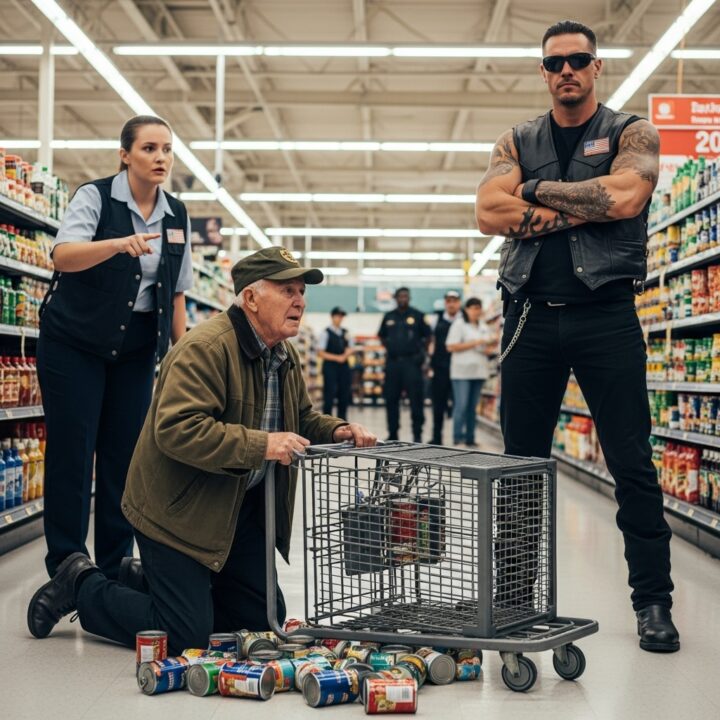
The biker didn’t rush. He didn’t shout. He walked forward slowly, eyes fixed on the old man struggling to kneel.
“Sir,” the supervisor snapped, noticing him, “this doesn’t concern you.”
The biker ignored her and bent down, steadying the cart so it wouldn’t fall again. He picked up a can and set it back carefully.
“Let me help,” he said to the old man.
That was enough.
A man in line scoffed.
“Great, now his buddy’s here.”
Another whispered, Figures.
The biker straightened, towering unintentionally over the supervisor. Tattoos. Leather. A presence that felt dangerous if you were already looking for danger.
“Step back,” she said. “Store policy.”
The biker didn’t raise his voice. He didn’t smile.
“He didn’t steal anything,” he said calmly.
Now eyes were on him.
“You threatening us?” someone asked.
“Should I call security?” the cashier said, already reaching for the phone.
The biker’s jaw tightened—but he said nothing more. He simply stood between the old man and the counter, quietly, deliberately, like a wall.
Phones came out. The word police floated into the air.
The old man looked up at the biker, panic filling his eyes.
“Please,” he whispered. “I can pay again. I don’t want trouble.”
The tension thickened. Every instinct in the room leaned toward escalation.
Security arrived fast. Two guards. Radios crackling.
“Sir, you need to move,” one said to the biker.
The biker didn’t.
Instead, he reached into his vest pocket.
Gasps rippled through the line.
“Hey!”
“Watch him!”
Slowly, deliberately, he pulled out his phone.
Not a weapon. Just a phone.
He unlocked it, thumb steady, and said one sentence—short, controlled, impossible to misinterpret.
“Please pull the camera footage.”
The supervisor laughed sharply. “We already saw enough.”
The biker finally looked at her directly. His eyes were calm. Cold, but not cruel.
“Then show it,” he said.
Silence.
The old man swayed slightly, gripping the counter. The guard hesitated, unsure whether to push the biker aside or listen.
For a moment, everything balanced on a razor’s edge—authority versus presence, assumption versus patience.
The supervisor folded her arms. “Fine,” she said. “But if this is a stunt—”
The screen turned.
Everyone leaned in.
No one breathed.
They heard it before they understood it.
A familiar voice from behind the counter.
“Oh. Oh no.”
The footage played.
The old man at the self-checkout. Slow. Careful. Scanning each item. One can slipped and fell to the lower rack. He bent down—too slow for the camera’s angle. The system registered it as missed.
The line grew quiet.
The supervisor’s face drained of color.
Behind the biker, more footsteps entered the store—measured, controlled. Two more bikers stepped in, nodding once to him. No words exchanged. No confrontation.
Just presence.
The power in the room shifted without a single raised voice.
The guard cleared his throat.
“Looks like… looks like a system error.”
No one spoke.
The old man stared at the screen, eyes wet now, shoulders sagging as if the weight he’d been carrying finally slipped off.
“I told you,” he whispered. “I told you.”
The biker stepped back then. Gave him space.
The supervisor swallowed hard.
“I… I’m sorry,” she said. Quietly. Too late.
The truth came out in fragments, not speeches.
The old man lived alone. Fixed income. Shopped the same day every week. Paid in exact change. Never caused trouble.
The biker? A local contractor. Former military. Disciplined. Known in the area not for noise—but for showing up when something felt wrong.
He didn’t scold anyone. Didn’t demand apologies.
He paid for the old man’s groceries without a word and handed him the receipt.
“You were right,” he said simply. “That’s all.”
The old man looked at him, eyes full.
“Thank you,” he said. “For seeing me.”
The biker nodded once and turned toward the door.
No speeches. No applause.
Just the soft hum of the lights again.
As the doors slid shut behind him, the store felt different—quieter, heavier.
And the old man walked out holding his bag a little tighter, a little straighter, his dignity returned not by words—but by one calm act of courage.
No one forgot that silence.