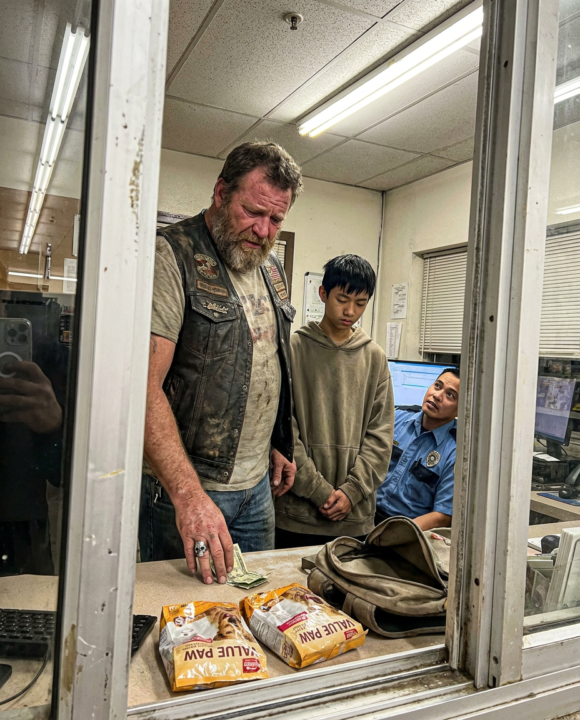
Part 2: An 11-Year-Old Boy Was Caught Stealing Three Bags Of Dog Food And Nothing Else — He Was Starving, And What We Found In That Abandoned Warehouse Put One Of Us On His Knees
Part 2
His name was Danh. Eleven years old.
The warehouse sat at the end of an access road behind the industrial block, tied up in some ownership dispute for a decade. Nobody goes back there. No power, no water, half the roof panels gone.
He pulled a section of corrugated siding aside — he’d made a door out of it, a real one, with a wire loop to hold it shut — and he stood there a second before he let me look.
He said, “Don’t be loud. Some of them get scared.”
Then I stepped inside and got hit with it.
Nine dogs.
They came at him all at once, the whole pack, tails going, no barking — and that’s the first thing I noticed, that they didn’t bark. They knew him. They knew the sound of that panel moving.
He went down on his knees in the middle of them and they swarmed him, and he was laughing, and it was the first time I’d seen his face do anything but look at the floor.
The place was clean.
I want to be precise about that. It was a derelict warehouse with no electricity and nine dogs living in it, and somebody had swept it. There was a corner set up with flattened cardboard and old blankets and towels. There was a row of plastic containers cut down into bowls, nine of them, lined up. There was a jug of water and a section of gutter pipe rigged under a roof gap to catch rain into a barrel.
An eleven-year-old had engineered a kennel out of garbage.
And he named them all. Every single one. He walked me down the line introducing them like they were people.
He told me which one was afraid of thunder. Which one wouldn’t eat if you watched him. Which one had a bad back leg and couldn’t do stairs. Which two had to be fed apart or they’d fight. Which one, a little brown one, still shook if a man raised his voice.
He knew all of it. Two years of it.
Part 3
Here’s where they came from.
Two years earlier this whole region flooded. Bad one. The river came up overnight and took out the low neighborhoods on the east side, and people got out with what they could carry.
You can’t carry a dog and a child and your documents. A lot of people had to choose.
So when the water went down, there were animals everywhere. Wandering the mud. Sitting on doorsteps of houses that weren’t houses anymore, waiting.
Danh was nine years old.
He’d lost his own house in it. He and his grandfather ended up in a rented back room in a different part of town, and every day on the way to and from school he walked past the flood zone while they were clearing it.
And the dogs were still there.
He started with one. A little brown one, the one who still shakes. Fed it out of his own lunch for three weeks before he understood that wasn’t going to work.
Then there were two. Then four.
By the time anybody would have noticed, if anybody had been looking, there were nine.
He found the warehouse when he was collecting scrap. He’d been picking through the industrial lots for recyclables — cans, bottles, metal, cardboard — and selling it to the buyer down the road.
That scrap money is what fed nine dogs for two years.
I asked him how much he made in a day. He told me. I’m not going to write the number because it’s humiliating, and I don’t mean humiliating for him.
That number, divided nine ways, is why he was standing in a security office with three bags of the cheapest food in the store.
Part 4
His home situation is why nobody knew.
He lived with his grandfather. And his grandfather had been slipping for a couple of years — the kind of slipping where a man is fine in the morning and lost by evening, where he calls his grandson by his dead son’s name, where he sits in a chair for six hours because he can’t remember what he got up for.
There was no one else. Danh’s parents were out of the picture in a way he didn’t explain and I didn’t push on.
So an eleven-year-old was cooking, cleaning, managing his grandfather’s medication as best a child can, going to school, collecting scrap, and running a nine-dog rescue out of an abandoned warehouse.
And he was doing it silently, because he’d worked out — the way these kids always work it out — that if adults found out how things really were at his house, something would happen. Someone would come. He’d get moved. His grandfather would get taken somewhere.
And the dogs would be nobody’s.
That’s the thing he said to me, standing in that warehouse, and it took the air out of me.
He said, “If I tell someone, they’ll put them down. Nine is too many. Nobody takes nine.”
He’d already thought it through. At eleven. He’d run the math on what happens to nine unwanted adult dogs in a shelter and he’d decided the only thing standing between them and that was him, so he’d keep his mouth shut and keep picking cans.
Two years of that.
Part 5
I called three brothers that night and we went back the next morning with food. Real food, sacks of it, and a crate of the rice-and-chicken stuff one of the guys’ wives cooks for their own dogs.
Bao came with us.
Bao’s been in the club a long time. He’s quiet, and he’s been quieter for two years, and everybody knows why.
Because we lost a brother in that flood.
His name was Tom. He got his neighbors out — a family with two small kids, got them onto a roof, got them across to the high ground. And then he went back in one more time, for his own house, for his dog.
He didn’t come back out of it.
They found Tom four days later, two kilometers downstream.
They never found the dog.
We looked. I want that known. We looked for weeks, all of us, every shelter and every pound and every notice board within fifty kilometers, because it was the only piece of him left to find. And nothing ever came back, and after a while we all quietly decided the dog had gone the same way he did.
Bao took Tom’s death harder than any of us. They were closest. He’d been riding with him since they were nineteen.
So Bao walked into that warehouse behind me with a sack of dog food on his shoulder, and the pack came at us, and he stopped dead.
There was an old dog toward the back that hadn’t gotten up.
Grey around the muzzle. Grey through the whole face. Lying on a folded blanket in the corner, watching, too stiff and too old to rush the door with the young ones.
Bao dropped that sack on the concrete.
And he said one word.
He said a name.
And that old grey dog got up.
Part 6
It was Tom’s dog.
I didn’t recognize her. Two years and a lot of hard living had changed her. Bao knew her in a second — he’d been at Tom’s house a thousand times, that dog had slept under the table at every card game we ever had.
She came across that warehouse floor slow, on bad hips, and put her head against Bao’s leg.
And he went down onto the concrete and stayed there.
Danh got scared. He thought he was in trouble. He started saying that he found her, that he didn’t steal her, that she’d been in the flood zone by herself and wouldn’t leave a doorstep so he’d carried her.
And Bao couldn’t answer him. Couldn’t get a word out.
I got down and turned the dog’s collar around with my fingers, because I could see there was one under all that matted fur.
Leather. Rotted through, cracked, barely holding. And on the tag, worn but readable:
Tom’s name. His phone number.
That dog had been wearing that collar for two years. Through a flood, through the mud, through a warehouse, on the neck of an animal a nine-year-old boy carried to safety because she wouldn’t leave a doorstep that didn’t have a house behind it anymore.
The whole time we were searching shelters and boards and pounds, she was four hundred meters behind a supermarket being fed out of a child’s scrap money.
Danh had named her something else. He didn’t know. How would he.
When we explained it to him — when Bao finally got himself together enough to tell that boy who the man on the tag was, and what he’d done in the flood, and what it meant that this dog was alive — Danh sat down on the floor next to her and cried.
Not about the trouble. He’d stopped being scared by then.
He said, “She used to wait by the door. I thought she was just old.”
She’d been waiting for Tom. For two years.
Part 7
We built a proper run behind the garage. Took four weekends.
Fenced, roofed, drained, concrete floor, real kennels with real beds, shade, water. All nine dogs came to it. Nobody got put down and nobody got separated, which was the only condition Danh had and the only one that mattered.
We pay a woman to look after them. That’s her job now.
Danh comes every day after school. Still names things, still knows which one’s afraid of thunder.
His grandfather got seen by an actual doctor for the first time in years. There’s a diagnosis now, and medication, and a care worker who comes three times a week. He’s not better — that’s not how it works — but he’s not lost and alone in a back room anymore either.
And a couple in the club, who’d been trying and failing to have kids for eleven years, applied to foster Danh formally. It took months of paperwork and home visits and every man in the club being on his absolute best behavior for the inspections.
They got approved. He lives with them now. He still sees his grandfather every single day, which was non-negotiable for everybody.
Tom’s dog lived another three years.
She spent them in the garage, not the run. She wouldn’t stay in the run, and after a week of her escaping we stopped fighting it.
There’s a bay in that garage where Tom always parked. First bay on the left. Nobody’s parked there since he died and nobody ever will.
That’s where she lay. Every day, all day, on a blanket in the empty bay where his bike used to be. Three years.
When she went, she went there.
Her collar hangs on the wall of our clubhouse now. The rotted leather, the cracked tag with his name on it.
And underneath it, on a small plate, we put the only line that ever needed saying:
Found by a boy who stole dog food and nothing else.
Because that’s the whole thing, isn’t it.
An eleven-year-old stood in a supermarket full of food, starving, and put nothing in his bag for himself. He fed nine animals nobody wanted for two years on cans he picked out of industrial lots.
And one of those nine was the last living thing our brother went back into the water for.
We searched for two years and found nothing.
A hungry kid found her in a week and carried her home.
If this one reached you, follow the page — there’s always another brother worth telling about.