A Young Mother Broke Down in a Public Restroom — A Biker Stood Guard Outside
She locked herself inside a public restroom stall, sobbing with her baby in her arms — unaware that a biker had taken position outside the door.
The rest stop sat just off the highway, a low concrete building surrounded by idling cars and the dull hiss of passing trucks. Inside, fluorescent lights hummed overhead, casting everything in a tired, unforgiving glow.
In the women’s restroom, a young mother collapsed onto the floor of a stall, knees pulled tight to her chest, one arm wrapped around her infant, the other covering her mouth to muffle the sound of her crying.
Her name was Megan Alvarez, twenty-three years old.
Her hands shook so badly she could barely hold her phone. The screen showed no missed calls. No messages. Just a cracked photo of her son, taken before everything started to fall apart.
“I don’t know what to do,” she whispered to herself. “I don’t know what to do.”
Outside the stall, footsteps passed. Laughter. A door slammed. Someone complained about the smell.
No one knocked.
No one asked if she was okay.
Megan wiped her face with the sleeve of her hoodie, rocking her baby gently. He whimpered, sensing her fear, his tiny fingers clutching at the fabric near her collarbone.
She hadn’t planned to stop here. She hadn’t planned for any of this.
A woman at the sinks muttered, “Some people shouldn’t have kids,” before walking out.
Megan flinched.
She slid the bolt tighter, as if that thin strip of metal were the only thing standing between her and the world.
That was when the restroom door opened again.
Heavy boots this time. Slow steps. Deliberate.
A man stopped just outside the women’s restroom.
Leather creaked softly as he shifted his weight.
No one knew why he was there.
No one knew who he was.
All they saw was a biker standing still, facing a door behind which a young mother was breaking apart.
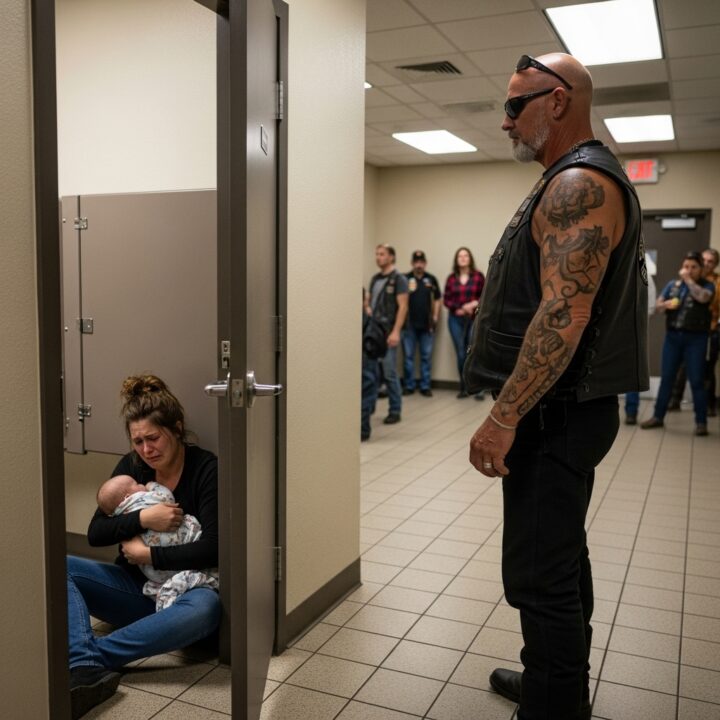
The biker didn’t enter.
He didn’t knock.
He simply stood there — feet planted, shoulders squared, back to the hallway — like a sentry who had chosen his post.
People noticed immediately.
A teenage girl whispered, “Why is that guy standing there?”
A man frowned. “Isn’t that the women’s restroom?”
Someone laughed nervously. “Creep.”
The biker didn’t react. Sunglasses hid his eyes. Tattoos ran down his forearms, disappearing under the short sleeves of his black shirt. His vest was plain, worn, carrying no message he felt the need to explain.
Inside the restroom, Megan heard the voices and froze.
Her breathing quickened.
“What if he’s waiting for me?” she thought. “What if I can’t get out?”
She hugged her baby tighter, tears soaking into his blanket.
Outside, a middle-aged woman confronted the biker. “Sir, you can’t stand here.”
The biker turned his head slightly. “I can.”
“That’s inappropriate.”
The biker shook his head once. “It’s necessary.”
The woman stepped back, unsettled. “I’m calling security.”
“Do that,” the biker said calmly.
Phones came out. Someone filmed. Another person whispered, “He’s probably dangerous.”
A security guard approached, hand on his radio. “Sir, what’s going on?”
The biker didn’t raise his voice. “Nothing.”
“Then move.”
The biker didn’t.
From the outside, it looked wrong — a biker loitering outside a women’s restroom, refusing to leave, drawing attention, refusing to explain.
People filled in the blanks themselves.
Inside the stall, Megan slid down the wall, panic tightening her chest. Whatever was happening out there was now because of her.
Her baby started to cry louder.
The sound cut through the restroom.
The biker heard it.
His jaw tightened, just slightly.
The security guard’s tone sharpened. “Sir, you need to step away right now.”
The biker finally spoke more than two words.
“She’s not safe,” he said.
The guard scoffed. “From what? You?”
The biker didn’t answer.
He reached into his vest.
Someone gasped.
Someone shouted.
Someone hit record.
But he only pulled out his phone.
Typed one message.
Sent it.
Then he placed the phone back in his pocket and folded his arms.
“We’ll wait,” he said.
And suddenly, the hallway felt very small.
Security called for backup.
Two guards now stood facing the biker. A state trooper walked in from outside, hand resting near his belt.
“What’s the situation?” the trooper asked.
“He won’t move,” the guard said. “He’s blocking the women’s restroom.”
The trooper studied the biker. “Sir, are you harassing someone inside?”
The biker met his gaze. “No.”
“Then explain yourself.”
The biker shook his head. “I don’t need to.”
That answer didn’t help.
Inside the stall, Megan pressed her forehead against the wall, shaking. Every instinct told her she had made a mistake stopping here.
She whispered, “Please don’t let them come in.”
Outside, the trooper stepped closer. “Sir, I’m giving you a lawful order.”
The biker remained still.
Behind him, the restroom door creaked slightly as Megan shifted. The sound made everyone tense.
“She’s in there with a baby,” the biker said quietly. “And someone scared her enough to lock herself in.”
The trooper hesitated — just a fraction.
“Who scared her?” he asked.
The biker didn’t answer.
He looked down the hallway instead.
Then, faintly at first, a sound rolled in from the parking lot.
Engines.
Not one.
More than one.
Low. Controlled.
The trooper turned his head. One of the guards frowned. “What is that?”
The biker finally spoke again, voice calm, certain.
“They’re here.”
The engines grew closer.
People stopped filming.
The hallway went silent.
And in that suspended moment — before anyone knew what would happen next —
every assumption in the room began to feel dangerously incomplete.