A Woman Was Robbed in Broad Daylight — And the Only Person Who Ran After the Thief Was a Biker Everyone Feared
The scream didn’t come from fear at first — it came from disbelief, the kind that freezes your body before your mind catches up.
The woman stood in the middle of the sidewalk, one hand still clutching air where her bag had been a second ago, eyes wide, breath caught halfway between a gasp and a cry. Her purse — worn leather, heavy with her life — was already ten yards away, bouncing against the hip of a man who ran without looking back.
For a split second, the street stalled.
Traffic lights blinked. A bus hissed at the curb. Coffee spilled from a paper cup. People turned their heads in slow, confused movements, like an audience unsure whether what they were seeing was part of the show.
Then she shouted.
Not a clean word. Not a sentence. Just a sound — raw, cracked, desperate — tearing itself out of her chest.
“He took my bag!”
Her voice echoed between storefront windows and brick walls. A few people flinched. One man raised his phone instinctively. A couple stepped backward, creating space instead of help. Someone muttered, “Did you see that?” as if the answer wasn’t obvious.
The thief didn’t slow down.
He darted between pedestrians, clipped a shoulder, knocked over a sign, and vanished toward the corner where the street narrowed and the crowd thickened. Every step carried him further from her — from her ID, her phone, her medication, the small envelope of cash she’d just withdrawn.
The woman staggered forward, then stopped.
Her knees buckled slightly. Her hands trembled. She looked small in that moment, swallowed by the noise and motion of a city that suddenly refused to notice her.
People watched.
Some shook their heads.
Some whispered.
Some did nothing at all.
And then — without warning, without announcement — the engine roared.
Not loud. Not aggressive. Just present.
A motorcycle idled at the edge of the block, low and steady, like it had been there the whole time, waiting. The rider swung one leg over and stood up in one smooth motion.
Leather vest. Faded jeans. Heavy boots planted on concrete.
He didn’t shout.
He didn’t ask questions.
He didn’t look at the crowd.
He looked only at the direction the thief had gone.
And then he ran.
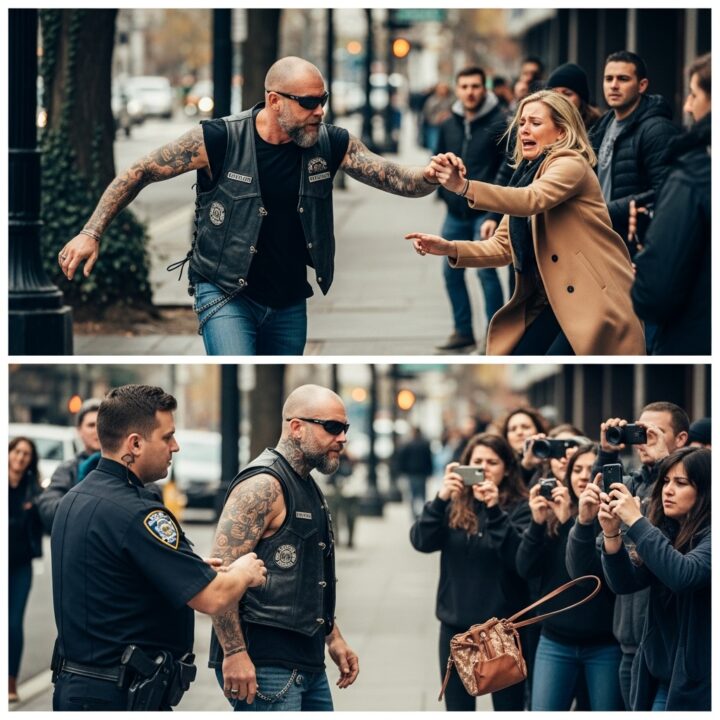
The moment the biker started moving, the energy shifted — not toward relief, but toward alarm.
People noticed him all at once.
The vest first. The patches. The way his shoulders filled the space between him and everyone else. Someone sucked in a breath too loudly. Another person reached out, not to stop the thief, but to pull a child closer.
“What’s he doing?” a woman asked sharply.
The biker cut through the crowd with long, controlled strides, eyes forward, jaw set. He didn’t weave wildly. He didn’t shove anyone aside. But his presence alone felt heavy, like pressure building in a sealed room.
The thief glanced back.
For the first time, fear flickered across his face.
He picked up speed.
So did the biker.
A man near the curb shouted, “Hey! Don’t!” — though it wasn’t clear who he was warning. Another voice yelled, “Call the police!” Someone else added, “That guy’s going to hurt him!”
The biker ignored all of it.
At the corner, the thief tried to cut left — straight into a street market crowded with stalls and bodies. The biker followed, boots pounding, leather creaking with each step.
A crate of apples went down. Someone screamed. A vendor cursed.
And suddenly, the chase no longer looked like justice.
It looked like violence waiting to happen.
The biker closed the distance fast. Too fast for comfort.
He reached out — not to strike, but to grab the strap of the purse — and the thief spun, panicked, swinging wildly. The bag hit the ground. The thief stumbled backward into a display table and fell.
Gasps rippled through the crowd.
The biker stood over him, breathing hard.
For one terrible second, everything looked wrong.
A large man in leather looming over a smaller man on the ground. Fists clenched. Muscles tense. No explanation. No badge. No uniform.
Someone shouted, “Get away from him!”
Another voice cracked, “You’re not the police!”
Phones were up now. Recording. Streaming. Capturing a moment stripped of context and loaded with judgment.
The biker didn’t raise his hands.
Didn’t step back.
Didn’t smile to reassure anyone.
He bent down, picked up the fallen purse, and stepped away from the thief.
The thief scrambled to his feet and bolted.
The biker didn’t chase him further.
That, somehow, made it worse.
“Why’d you let him go?” someone demanded.
“What did you do to him?” another yelled.
A security guard from a nearby building pushed through the crowd, hand already on his radio. “Sir, step back. Now.”
The biker turned slowly.
His face was calm. Not smug. Not angry. Just closed off, like a door that didn’t open for strangers.
He held the purse out, arm extended — not toward the guard, but toward the woman who was still standing where she’d been robbed, pale and shaking.
For a heartbeat, no one moved.
Then the guard blocked his path.
“Put it down,” the guard said. “We’ve got this.”
The biker didn’t argue.
Didn’t explain.
Didn’t say, I was helping.
He set the purse gently on the ground and took one step back.
Sirens wailed in the distance.
The crowd tightened.
And suddenly, the man who had run toward danger was standing alone in the center of suspicion.
The police arrived fast — faster than anyone expected.
Two cars. Lights flashing. Doors opening.
The officers took in the scene in seconds: the crowd, the biker, the shaken woman, the purse on the pavement. Their hands hovered near their belts, trained to read threats before stories.
“Sir,” one officer said, voice firm, eyes fixed on the biker. “Turn around.”
The biker complied immediately.
Hands behind his back. Slow. Deliberate.
The woman tried to speak. Her voice failed her.
“That’s him,” someone said — pointing, uncertain whether they meant helper or problem.
The guard launched into an explanation filled with assumptions and half-seen details. Words like chasing, confrontation, almost violent floated in the air, sticking where they could.
The biker said nothing.
He stood still while an officer patted him down. Leather. Keys. A phone.
The woman finally found her voice. “He— I think he was—”
“Ma’am,” the officer interrupted gently, “we’ll talk in a moment.”
Her purse lay untouched, inches from her feet, a symbol of safety that somehow no one dared return yet.
The crowd watched with the uncomfortable hunger of people waiting for a verdict.
The biker looked past them all.
Not defiant. Not afraid.
Just tired.
The officer asked, “Why did you chase him?”
The biker answered with a single sentence. Low. Even.
“Because nobody else did.”
That should have settled something.
It didn’t.
Another officer spoke into his radio. The word detain was used. Someone nodded.
The woman’s hands began to shake harder. She stepped forward. “Please—”
And then the biker did something small.
Something almost invisible.
He looked down at his phone, unlocked it, and sent a single text.
No drama.
No rush.
No explanation.
Just a tap. A pause. And the phone slipped back into his pocket.
The officers exchanged looks.
“Who’d you text?” one asked.
The biker met his eyes. “Someone who’ll clear this up.”
That was all.
The sirens faded. The street held its breath.
And for the first time since the scream, everyone waited — not knowing whether they were about to witness justice… or regret.
The sound came first.
Not sirens.
Not shouting.
Engines.
Low. Even. Controlled.
At first, it blended into the noise of the city — traffic, horns, distant construction. But then it separated itself, one steady rhythm becoming many, rolling closer like a tide that didn’t rush, didn’t hesitate.
Heads turned.
The officers noticed it too. One of them glanced over his shoulder, eyes narrowing slightly, recalculating.
The engines slowed at the edge of the block.
Then stopped.
Boots hit pavement.
Not all at once. One by one. Measured. Disciplined.
A line of motorcycles stood neatly at the curb — not blocking traffic, not creating a scene. Just present. Riders dismounted quietly, helmets under arms, vests worn without display. No revving. No posturing.
They didn’t look angry. They looked organized.
The crowd fell silent in that strange way people do when they sense control shifting but don’t yet understand why.
A man stepped forward from the group. Older than most. Gray at the edges of his beard. Calm eyes that had seen worse days than this one. He didn’t look at the biker in cuffs first.
He looked at the officers.
“Afternoon,” he said, voice steady. “Is there a problem here?”
The tone wasn’t confrontational. It wasn’t submissive either. It was the tone of someone used to being heard without asking.
One officer straightened instinctively. “Sir, this is an active situation.”
The man nodded. “Understood. That’s why we came.”
The officer paused. “You came… because?”
The older biker gestured gently with his chin — toward the man still standing with his hands behind his back.
“He texted us.”
That landed differently than shouting ever could.
A second man stepped forward — not a biker this time. Plain clothes. Clean jacket. He held up a badge just long enough to be recognized.
“Detective Harris,” he said. “I was two blocks away.”
The crowd stirred.
Phones lowered.
The guard took a step back without realizing he’d done it.
Detective Harris walked straight to the detained biker and stopped in front of him. Looked him up and down. Then smiled faintly.
“Still running after things nobody else will, huh?” he said.
The officer holding the biker’s arm froze.
“You know him?” someone asked from the crowd.
Harris nodded. “Yeah. I do.”
He turned to the officers. “You can let him go.”
A beat.
“Detective—” one officer started.
“He didn’t assault anyone,” Harris said calmly. “Didn’t threaten anyone. Retrieved stolen property and disengaged. That correct?”
No one answered.
Because it was.
The cuffs came off.
Metal clicked softly. Final. Irreversible.
The biker rolled his shoulders once, flexed his wrists, and stepped back into his own space without a word.
The woman finally pushed forward, clutching her coat with shaking hands. Harris picked up the purse and handed it to her personally.
“All yours,” he said gently.
Her fingers closed around it like it might disappear again.
She looked at the biker.
Tears welled — not dramatic, not loud. Just quiet, exhausted gratitude.
“I thought everyone just… watched,” she whispered. “You were the only one who ran.”
The biker nodded once.
Didn’t smile.
Didn’t explain.
Behind him, the other bikers stood still — not a wall, not a threat — just a reminder that he hadn’t been alone after all.
The crowd dispersed slowly.
Not because anyone told them to — but because the moment had passed, and staying felt intrusive now. Conversations resumed in lower tones. People avoided eye contact with the biker as they walked away, unsure whether to apologize or pretend they’d never judged him at all.
The woman lingered.
She opened her purse with trembling hands. Checked everything. Phone. Wallet. Medication bottle. A folded photo near the zipper — untouched.
She exhaled shakily.
“Thank you,” she said again, stronger this time.
The biker nodded.
“That’s it?” she asked softly. “You just… go?”
He hesitated, then spoke — voice low, even.
“You don’t owe me anything.”
She swallowed. “But everyone thought you were—”
“I know,” he said.
And that was the end of it.
He turned back toward the curb. Toward the motorcycles. Toward the men who had waited without asking questions.
As he walked away, Detective Harris called after him. “You ever think about letting someone else handle it?”
The biker paused. Just for a second.
Then: “Sometimes there isn’t anyone else.”
He mounted his bike.
The engine started — smooth, controlled, unremarkable.
The group rolled out one by one, leaving behind nothing but tire marks and a story that would be told incorrectly more often than not.
The woman stood there long after they were gone.
She replayed the moment in her mind — how fear had made her doubt the only man who acted, how appearances had nearly rewritten the truth.
She held her purse closer.
Not because it could be stolen again.
But because now, it carried something else.
A reminder that courage doesn’t announce itself.
That help doesn’t always look safe.
And that sometimes, the bravest thing in the street is the one person willing to run when everyone else freezes.
The city moved on.
But for those who had been there —
the silence afterward stayed.