A Tattooed Biker Wore A Tiny Leather Pouch On His Vest For Years — Until One Lost Tooth Revealed What He Had Been Carrying Over His Heart
The first time I saw the tiny leather pouch sewn over Boone Keller’s heart, I thought it held ashes, bullets, or something dangerous enough that no sane person would ask about it twice.
That was the kind of man Boone looked like.
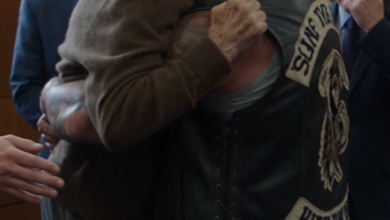
He was six-foot-five, white American, built wide through the chest and shoulders, with a shaved head, a black-and-silver beard, tattooed hands, and forearms roped with old scars from wrenches, wrecks, and years spent pulling motorcycles apart in garages that smelled like oil and bad coffee. His black leather vest carried the usual things people noticed first: faded patches turned unreadable by road dust, a scratched American flag pin, a small iron cross, and a few stitched places where something had been removed but not forgotten.
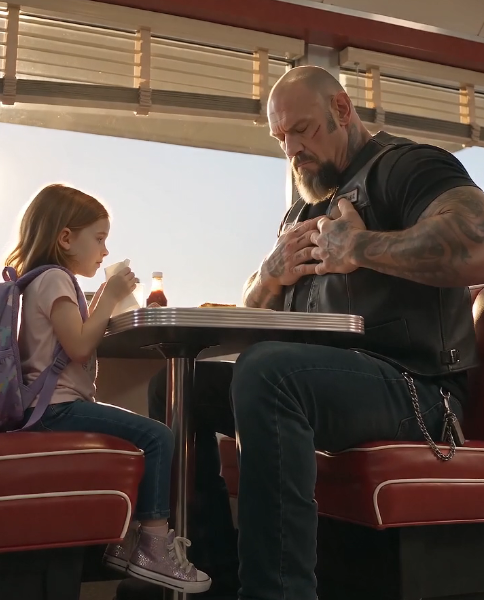
But the pouch did not belong with any of it.
It was small, no bigger than a child’s palm, hand-stitched from soft brown leather and sewn directly onto the left side of his vest, right over his heart. The flap closed with a little brass snap. Around the edges, the stitching was careful but uneven, the kind of work done by a man who knew leather but not delicacy. Every time Boone moved, the pouch shifted against the vest with a faint creak, and his left hand rose toward it without thought, like a man checking that something still breathed.
I owned the Sunridge Diner off Route 66 outside Kingman, Arizona, and bikers had been stopping there since before my father bought the place. I knew loud men, quiet men, dangerous men, men who wore grief like a weapon, and men who wore it like a jacket they could not take off. Boone Keller was harder to place. He rode with the Iron Saints, parked his black Harley-Davidson Road King at the far end of the gravel lot, and came in every Wednesday after school with his daughter, Daisy.
Daisy was six when I first met her. White American, small for her age, with pale skin, copper-brown hair, two missing teeth, and a voice that could boss a room before anyone remembered she was only in first grade. She wore glitter sneakers, carried a purple backpack covered in dinosaur stickers, and treated Boone like he was both her bodyguard and her horse.
“Dad, sit normal,” she would say when he lowered himself into booth six.
Boone would look down at his knees, wedged awkwardly under the table, and mutter, “This is normal for giants.”
She never laughed at that because she expected better material.
Everyone stared the first few times they came in. That was not unusual. Boone looked like the sort of man mothers moved children away from in grocery aisles. His boots hit the diner floor with a heavy knock. His wallet chain tapped against the booth. His vest creaked when he leaned forward to cut Daisy’s pancakes into careful squares. The contrast was almost too much to look at: skull tattoos on his fingers, a leather cut across his shoulders, and a tiny girl ordering him to pour syrup “in the lakes, not the mountains.”
Then Daisy lost a tooth in my diner.
It happened on a Wednesday in late October, right after school, when the afternoon sun was hitting the chrome napkin holders and turning the booths orange. Daisy was eating grilled cheese because she claimed soup was “wet punishment.” Boone sat across from her with a mug of black coffee untouched between his huge hands. Outside, his Harley cooled in the gravel, ticking softly beneath the Route 66 sign.
Daisy bit down, froze, and made a face.
Boone leaned forward so fast the coffee jumped in the mug.
“What?”
She opened her mouth and pointed.
There, sitting on her tongue like a tiny white pebble, was a baby tooth.
A woman at the next table looked over and smiled. “Looks like the tooth fairy’s coming.”
Daisy beamed, but Boone went still in a way I did not understand yet.
His hand lifted toward the pouch on his vest.
Not touching it.
Almost.
Daisy plucked the tooth from her mouth with a napkin and held it up like treasure.
“Dad,” she said, “don’t lose this one.”
This one.
That was the first seed.
Boone’s face changed when she said it. Not much. Men like him do not let their faces do much in public. But his eyes went somewhere far away, past the diner, past the highway, past every person who had ever misread him because it was easier than looking closer.
“I won’t,” he said.
His voice was rough, low, and too serious for a child’s tooth.
The woman at the next table laughed gently. “You keep them all?”
Boone looked at her.
Then at Daisy.
Then at the little white tooth resting in the napkin.
“Every one,” he said.
The room quieted, though nobody knew why. Even Daisy, who usually filled silence with questions, sat still for a moment and watched him fold the napkin with hands big enough to cover half the table. He did not put the tooth in his pocket. He did not hand it to me for a baggie. He unsnapped the tiny leather pouch on his vest, opened it just enough to slip the napkin inside, and closed it again with a soft click.
Right over his heart.
A trucker at the counter saw it and snorted.
“That some kind of biker charm?” he asked.
Boone did not answer.
Daisy did.
“It’s not a charm,” she said, frowning. “It’s me growing.”
The trucker laughed, not mean exactly, but careless.
Boone’s eyes lifted.
For one second, the whole diner remembered how big he was.
Then Daisy reached across the table and put her small hand on his knuckles. Boone looked down at it, breathed once through his nose, and let the moment pass. He picked up his coffee. His hand shook just enough for me to see the black surface tremble.
That should have been the whole story: a tough biker with a strange soft habit, a daughter proud of missing teeth, a diner full of people learning not to ask too many questions.
But that night, after closing, I found Boone standing alone beside his Harley in the empty gravel lot, holding the tiny leather pouch open under the yellow light, staring down at what was inside as if every tooth in it had a date, a place, and a sound attached.
When he heard the diner door open behind him, he closed the pouch fast.
I should have gone back inside.
Instead, I asked the question nobody in his club had dared to ask.
“Boone,” I said, “why do you wear them there?”
He looked down at the pouch, then toward the dark highway, where the last red taillights were disappearing toward Kingman.
And what he said next made me understand that Daisy’s teeth were not just keepsakes. They were proof of every year he had been afraid he might miss.
Part 2
Before I tell you what Boone said in the parking lot, you need to understand what people believed about him.
Kingman is not a small town in the postcard sense, but it still has small-town habits. People remember trucks, jackets, arguments, divorces, and the kind of mistakes a man hopes will age out of conversation. Boone Keller had made enough mistakes for the town to keep him filed under dangerous long after he had stopped being the person who earned that word.
He had been arrested twice in his twenties, both times for fights that started after midnight and ended with blood on somebody else’s shirt. He never denied it, never softened it, never turned it into a story about defending honor. When a younger biker once tried to call him a legend, Boone looked at him over a diner coffee and said, “Legend’s just a bad decision with a better narrator.”
That was Boone’s way. Few words. No decoration.
He had joined the Iron Saints after his last arrest, not because the club made him better, but because it put him around men who understood how close violence sits to grief when nobody teaches you the difference. Some of those men were still rough. Some were still trouble. But the brothers who mattered learned to show up when life got ugly. They fixed roofs, hauled furniture, covered shifts, passed envelopes, and sat in hospital parking lots without saying the thing everyone already knew.
Boone became road captain by thirty-eight. He led rides, watched mirrors, kept younger men from showing off, and made sure nobody rode angry if he could help it. His size made him noticeable, but his patience made men follow him. That patience did not arrive naturally. It had been built out of regret, one restrained moment at a time.
Then Daisy was born.
Her mother, Rachel Keller, was a nurse at the urgent care on Stockton Hill Road. She had red hair, a tired smile, and a way of talking to Boone that made him behave without realizing he was doing it. Rachel was not afraid of him. That might have been the first thing he loved. When they met after a chain broke on her car in a pharmacy parking lot, Boone had offered to tow it, and Rachel had said, “Do you always look like bad news, or is today special?”
He married her eighteen months later.
Daisy came two years after that, seven pounds, angry lungs, fist wrapped around Boone’s index finger before the nurse finished cleaning her. Boone kept the hospital bracelet in his wallet until the ink wore off. He carried Daisy around the garage in a sling while rebuilding transmissions, her little head tucked against his chest, her ears covered with padded baby headphones when the tools got loud. He learned to warm bottles, pack diaper bags, braid hair badly, and sing one off-key verse of “You Are My Sunshine” because it was the only song Rachel could get him to admit he knew.
For four years, Boone looked almost peaceful.
Then Rachel got sick.
Not dramatically at first. Fatigue. Bruises. Fever that came and went. The kind of symptoms working mothers explain away because there are lunches to pack and bills to pay. By the time the diagnosis came, the leukemia had already taken more ground than anyone wanted to say in front of Daisy.
Boone became the man in the hospital chair.
He sat beside Rachel through treatment, boots flat on the tile, leather vest folded over his knees, trying to make his large body take up less space in rooms where nurses moved quickly and fear seemed to hang from every IV pole. Daisy visited when Rachel was strong enough. She brought drawings, stuffed animals, and one tiny plastic tooth-shaped container from the drugstore because her first tooth had started to wiggle.
Rachel died before that tooth fell out.
That was the piece nobody in the diner knew.
After the funeral, Daisy stopped talking about teeth, school, bedtime stories, and anything that had belonged to the bright normal life before hospital rooms. Boone did not know how to pull her back. He could fix engines and tow wrecks. He could change tires in the dark and ride two hundred miles through wind that beat against his chest like fists. He could not convince a four-year-old that growing up was still allowed after her mother had stopped.
The first tooth fell out three months later, in the bathroom sink.
Daisy screamed because she thought something was wrong. Boone ran in so fast he hit his shoulder on the doorframe and cracked the wood. She stood on the step stool, mouth open, blood on her lip, tooth in the sink bowl, shaking so hard her little knees knocked together.
“I’m falling apart,” she sobbed.
Boone froze.
Those words would have broken a better man. They nearly ended him.
He lifted the tooth out of the sink, rinsed it, wrapped it in tissue, and held Daisy against him until the shaking stopped. Then he told her the only thing he could think of, the thing Rachel had once said when Daisy worried about getting bigger.
“No, baby,” he said. “You’re growing.”
Daisy asked if her mom would know.
Boone did not have a safe answer for that. So he made one with his hands.
That night, after Daisy finally slept, Boone went into the garage and cut a piece from Rachel’s old brown leather purse, the one she carried to work until the strap broke. He stitched a tiny pouch by hand, badly at first, then better after tearing it apart twice. He sewed it to the left side of his vest, right over his heart, because he did not know where else to put a piece of his daughter growing up without her mother there to see it.
By morning, the first tooth was inside.
That was the beginning.
Not the whole ritual yet.
Just the first stitch.
Part 3
The false climax happened the day the Iron Saints found out what was inside the pouch.
It was supposed to be a simple Saturday ride from Kingman to Seligman, one of those long desert loops men take when they need engine noise to scrape the week off their backs. The morning air was cold enough to sting. The bikes lined up outside Sunridge Diner before dawn, exhaust hanging low in the gravel lot, headlights throwing yellow pools across dust, boots, and the chrome edges of old machines.
Daisy was not with Boone that morning. She had a sleepover at her cousin’s house, which meant Boone looked both relieved and lost. Fathers like him do not always know what to do with silence when the child is safe somewhere else. He drank black coffee at the counter, checked his phone twice, and touched the pouch on his vest every few minutes.
Deke noticed first.
Deke was sixty, white American, with a white beard, Vietnam-era posture, and the kind of eyes that missed nothing because he had spent his life pretending to miss most things. He sat beside Boone, tore open three sugar packets for coffee he would still call black, and nodded toward the pouch.
“You ever gonna tell us what that is?”
The counter went quiet.
Not because the question was rude. Because every man in the club had wondered the same thing for years and decided Boone’s silence was worth respecting. The pouch had been there through rides, funerals, hospital visits, court hearings, and one wedding where Boone gave a speech so short it legally counted as a grunt. It had darkened with weather and oil from his hand. The brass snap had been replaced twice. Nobody had seen inside.
Boone looked at Deke.
“No.”
Deke nodded.
Fair enough.
That should have ended it.
Then a young prospect named Tyler made the mistake that young men make when they confuse closeness with permission. He was twenty-three, white American, new to the club, eager to prove fearlessness in all the wrong places. He laughed and said, “What, you got a lucky tooth in there or something?”
Boone’s coffee cup stopped halfway to his mouth.
The change in him was not loud.
That made it worse.
His shoulders settled. His jaw tightened. The diner felt smaller around him. Tyler’s smile faded as every older biker at the counter turned toward him with the same look, a silent warning that he had stepped onto ground he did not understand.
“What’d I say?” Tyler muttered.
Boone set the cup down carefully.
Not slammed.
Set.
That was always how you knew anger was near him. He became precise.
Daisy’s school called before anyone spoke again.
I was behind the counter when his phone buzzed. Boone looked at the screen, and every trace of threat left his face so quickly it almost hurt to watch. He answered with the voice he used only for her.
“Hey, baby.”
Then his expression changed.
“What happened?”
We could hear Daisy crying through the phone, high and panicked, though not the words. Boone stood. His chair scraped. His hand went to the pouch, then dropped to the counter, then curled once into a fist he opened immediately.
“I’m coming,” he said. “Stay with Mrs. Nolan. I’m coming now.”
He hung up and grabbed his helmet.
“What is it?” Deke asked.
Boone’s voice was rough.
“She lost another tooth at school. Kids laughed because she cried.”
Tyler looked like he wanted the floor to swallow him.
Boone moved toward the door. The whole club moved with him, not asking whether he needed them, because brotherhood sometimes means not making a man use the word need when his child is crying. Engines started in the gravel lot, low and rolling, and within two minutes the Iron Saints were headed toward Pine Hill Elementary with Boone in front, road captain no longer thinking about the ride, the route, the weather, or anything except a little girl holding a tooth and feeling too much like something had been taken from her again.
By the time they reached the school, the parking lot had already noticed.
A line of motorcycles pulling into an elementary school on a Saturday family fair morning will do that. Parents turned. Children stopped near the bounce house. A teacher near the entrance stiffened when she saw Boone stride toward the office in boots, leather, and a face carved from worry. His vest creaked with every step. The pouch sat over his heart, dark against the black leather.
Inside, Daisy sat in a plastic chair outside the nurse’s office, cheeks wet, one hand closed around a tissue. She looked very small under the fluorescent lights. Her copper-brown hair had come loose from one braid, and her front smile had another gap now, fresh and tender.
Boone dropped to one knee in front of her.
That image alone could have undone every rumor in town: six-foot-five of tattooed biker kneeling on school tile, helmet on the floor, huge hands open and empty in front of a crying child.
Daisy looked at him and tried to be brave.
“I didn’t want to lose it here,” she said.
Boone’s face changed.
“I know.”
“They laughed.”
“I know.”
“I wanted Mom.”
The hallway went still around that sentence.
Boone’s hand went to the leather pouch.
This time, he opened it.
Not all the way. Just enough for Daisy to see inside. Her crying slowed. She reached into her tissue and showed him the tooth. Boone took it with the gentleness of a man receiving something breakable from an altar.
Tyler, standing near the office door with the other bikers, saw what was inside the pouch.
So did Deke.
So did I, because I had followed in my truck after closing the diner for the emergency that somehow felt bigger than a school tooth.
Inside were tiny white teeth, each wrapped separately in bits of soft cloth, each marked with a date in Boone’s blunt handwriting.
Daisy leaned forward and whispered, “Is there room?”
Boone closed his eyes.
When he opened them, they were wet but steady.
“Always,” he said.
That should have ended the moment tenderly.
But then Tyler, still shaken by his joke at the diner, whispered the question everyone had been carrying for years.
“Brother… are those all hers?”
Boone turned his head slowly.
And for the first time, he answered.
Part 4
“Yes,” Boone said. “Every one.”
The hallway held that answer like breath.
Daisy was still sitting in the plastic chair, her knees tucked together, tissue in one hand, the newest tooth resting in Boone’s palm. Behind him, the Iron Saints stood in a line that looked wrong in an elementary school: leather vests, heavy boots, tattooed arms, rain dust on their jeans, faces shaped by highway wind and years of being misunderstood. Parents kept glancing at them from the family fair tables, unsure whether to be afraid, curious, or ashamed of both.
Boone did not speak to the hallway.
He spoke to Daisy.
“Your first one fell in the sink,” he said.
Daisy nodded.
“You thought you were falling apart.”
She looked embarrassed.
“I was little.”
“You were scared.”
Boone opened the pouch wider and pulled out the first tiny cloth bundle. He unfolded it just enough to show her, not enough to turn the moment into a spectacle for everyone else.
“I put it here because your mom wasn’t there to see it,” he said. “I figured if I kept it over my heart, I could carry it for both of us.”
Daisy’s lower lip trembled.
Boone pulled out another bundle.
“This one came out when you bit that apple at the county fair and got mad because the apple kept it.”
A small laugh moved through her tears.
“This one came out in your sleep, and you made me search the whole bed because you said the tooth fairy required evidence.”
Daisy wiped her face.
“She does.”
Boone nodded, serious.
“Right. Evidence.”
The newest tooth sat in his palm. He looked at it for a long moment, and every adult nearby seemed to understand at once what the pouch really held. Not teeth, exactly. Not a strange collection. Not a biker charm. Not something morbid or dangerous. It held birthdays he nearly missed because tow calls ran late. It held school mornings when Daisy smiled with new gaps. It held the proof that she kept growing after Rachel died, and that Boone had been there to witness what grief might have swallowed if he had looked away.
Tyler’s face crumpled first.
Not dramatically, but enough.
“I’m sorry,” he said.
Boone did not look at him.
Not yet.
Daisy touched the pouch.
“Do the other dads keep them?”
The question caught him off guard.
Some father nearby looked down at his own child. Another woman near the nurse’s office covered her mouth. People do not like realizing tenderness was available to them, but they never thought to build a place for it.
“I don’t know,” Boone said.
Daisy studied the pouch.
“Mom would have kept them in that blue box.”
Boone’s breath caught.
That was the twist inside the twist.
Rachel had a blue box. I knew because Boone told me later, months after this day, sitting at the diner counter long after closing. Rachel kept things in it: Daisy’s hospital bracelet, first curl, daycare art, tiny socks, birthday candles, a receipt from the first stroller they bought because she said someday Daisy would laugh at how much new parents panicked. After Rachel died, Boone could not open the box. It sat on the top shelf of their bedroom closet like a second grave.
The pouch began because he could not face the box.
But Daisy knew about it.
Children always know more than adults think. They know which doors stay closed. They know which names make the air tighten. They know when someone is carrying love in a strange shape because the normal shape hurts too much.
Boone looked at her.
“You know about the box?”
She nodded.
“Mom showed me. She said it was where little things go so big people remember.”
No one moved.
Deke took off his sunglasses.
Boone looked down at the pouch, then at the newest tooth in his palm.
“I couldn’t open it,” he said.
Daisy reached for his wrist.
“Can we put one in there too?”
That sentence changed his whole face.
The pouch had been Boone’s way of surviving Rachel’s absence. But Daisy was not asking him to stop wearing it. She was asking him to let her mother’s memory back into the ritual, to make room for the blue box and the leather pouch, for grief and growth, for the parent gone and the parent still kneeling on school tile with a tooth in his hand.
Boone nodded once.
It cost him something.
Everyone saw that.
Then the school nurse, Mrs. Nolan, stepped forward with a tiny plastic tooth case from her desk. It was shaped like a treasure chest, bright yellow, the kind schools keep for exactly these moments. She offered it to Boone.
He looked at it.
Then at Daisy.
She shook her head.
“No,” she said. “The pouch first.”
Boone’s mouth tightened, but not from anger.
He took a small piece of cloth from inside the pouch, wrapped the tooth carefully, and tucked it beside the others. Then he snapped the pouch closed with that soft brass click I had heard so many times in the diner. This time, everyone understood the sound.
It was not a latch.
It was a promise.
Then Daisy stood, stepped close, and pressed her face against the pouch on his vest, right over his heart. Boone’s huge hand came down over the back of her head, careful not to disturb the loose braid.
Tyler looked away.
Deke did not.
Deke watched like a man learning something he should have learned sooner.
When Boone finally stood, he turned toward Tyler.
The young prospect braced himself.
Boone’s voice was low.
“You asked if it was a lucky tooth.”
Tyler swallowed.
“Yes, sir.”
Boone touched the pouch.
“No luck in here.”
He looked down at Daisy, who had taken his hand.
“Just time.”
The family fair continued after that, because children can return to cupcakes faster than adults can return to themselves. But the hallway was not the same. Parents who had stepped away from the bikers now looked at them differently. Teachers whispered less. One father asked Boone where he had gotten the pouch made. Boone looked at him and said, “Made it myself.”
The man nodded, stunned by what he had not known to want until he saw it.
Outside, the Iron Saints stood beside their bikes in the school parking lot, not starting engines yet. Their ride to Seligman was forgotten. Daisy came out carrying a paper plate with half a cupcake, her missing tooth no longer in her hand but safely over her father’s heart.
Deke walked up to Boone.
For once, the old biker did not hide behind a joke.
“Brother,” he said, “Rachel would’ve liked that.”
Boone looked at the mountains beyond the school roof.
His eyes were wet.
Nothing fell.
“Yeah,” he said. “She would’ve told me my stitching was crooked.”
Daisy smiled around a bite of cupcake.
“It is.”
And Boone laughed.
Not loudly.
Enough.
Part 5
After that day, the pouch stopped being a mystery and became something harder for the town to dismiss.
At Sunridge Diner, people still looked when Boone walked in, but they looked longer now, and differently. The same trucker who had called it a biker charm came back two weeks later with his granddaughter, a shy Black American girl named Kendra who had just lost her first tooth. He stood near booth six, hat in hand, and asked Boone if he knew anyone who could make a little pouch for a kid who wanted to “keep proof.”
Boone stared at him for a long moment.
Then he said, “What color?”
That was how it started.
Not as a business. Boone would have hated that. It started with scraps of leather on a workbench at Keller Repair & Tow, a few brass snaps, and Daisy sitting on a stool with her homework while Boone cut small shapes under a hanging shop light. He made one for Kendra from soft red leather. Then one for a boy named Mason whose father was deployed and whose mother cried when he lost a tooth because milestones feel different when someone is overseas. Then one for a little Asian American girl named Lily who wanted hers shaped like a star, which Boone said was structurally impractical until Daisy told him not to be boring.
He made the star.
Badly.
Lily loved it.
The Iron Saints got pulled into it because brotherhood always starts as one man’s need and becomes everyone’s inconvenience. Deke learned snaps. Big Ron punched holes. Tyler, desperate to repair the damage of his careless joke, became the official thread cutter and took the job with almost painful seriousness. Boone did not forgive him with words. He gave him work. For men like them, that was sometimes the same thing.
The second seed returned in Rachel’s blue box.
A week after the school hallway moment, Daisy asked Boone to get it down from the closet. He put it off for one evening, then another, until Daisy stood in the bedroom doorway with her arms crossed in a way that looked so much like Rachel he had to sit on the edge of the bed.
“You said always,” she told him.
That was not fair, but children are not always fair when they are right.
Boone opened the closet.
The blue box sat on the top shelf, covered in dust, the lid slightly faded from sun that reached it through the blinds every afternoon. He brought it down with both hands and set it on the bed. Daisy climbed beside him. For several minutes, neither of them touched the lid.
Then Daisy put her small hand over his.
Together, they opened it.
Inside were the ordinary pieces of a life that had become unbearable because they were ordinary. A hospital bracelet. A curl of baby hair in a plastic sleeve. A tiny sock. A drawing of three stick figures under a yellow sun. Rachel’s handwriting on index cards: Daisy, first word, “light.” Daisy, first steps, kitchen to couch. Daisy, first pancake, hated it, fed to dog.
Boone sat very still.
Daisy lifted the newest tooth bundle from his leather pouch and placed it inside the blue box first. Then she took one of the older bundles and put that in too. Not all of them. Just two.
“One for Mom,” she said.
Boone nodded because speaking would have ruined him.
From then on, the ritual changed.
When Daisy lost a tooth, Boone carried it in the pouch first. Over his heart. Through the day. Sometimes through a ride. Sometimes through a school morning or a diner lunch or a long tow call in the desert heat. Then, when Daisy was ready, they opened the blue box together and moved one tooth inside, leaving the others in the pouch until she decided where they belonged.
It was not about choosing between him and Rachel.
That was the revelation.
It was about letting Daisy grow in both directions: toward the father still here and toward the mother who should have been.
The pouch became darker with use. The edges softened. The brass snap wore smooth under Boone’s thumb. Every tooth inside had a cloth wrap, a date, and usually a place. Bathroom sink. Diner grilled cheese. School fair. Backseat of truck. Campground apple. One simply said, “She laughed so hard it fell out.”
Daisy loved that one.
By the time she was eight, Boone had to remake the pouch larger. He did it from another piece of Rachel’s old purse, cutting carefully around the worn place where her hand had held it for years. He kept the original pouch inside the blue box, tucked beside the hospital bracelet and first curl.
When Daisy asked why he did not throw it away, he looked offended.
“You don’t throw away a first ride.”
She said that made no sense.
He said most true things didn’t.
The town kept changing by inches. Parents who once crossed away from Boone now stopped to ask about Daisy. Teachers no longer looked nervous when the Iron Saints came to school events, though Principal Hart still asked them not to block the fire lane with motorcycles. The diner filled with small leather tooth pouches, some on children’s backpacks, some hanging from rearview mirrors, some tucked into pockets by fathers and mothers who had never thought a baby tooth could deserve ceremony.
Boone never acted proud of it.
But Daisy did.
She told everyone, “My dad keeps growing-up stuff.”
That phrase spread.
Growing-up stuff.
It was better than keepsake. Better than charm. Better than memorial. It sounded like what it was: the small evidence that children keep moving forward, and that adults, if they are lucky, are allowed to carry pieces of the journey without owning it.
One afternoon, Daisy asked Boone if boys could keep tooth pouches too.
Boone looked at her like she had asked whether motorcycles needed wheels.
“Boys got teeth, don’t they?”
She nodded.
“Then yeah.”
That was Boone’s theology of tenderness. If the thing mattered, it mattered. No gender speech. No embarrassment. No apology for love taking a shape other men might not understand.
Still, the hardest moment came when Daisy lost her last baby tooth.
She was ten, taller now, with longer legs, sharper elbows, and a growing talent for sarcasm that made Boone blame Rachel at least once a week. The tooth came out at home during breakfast, stuck in a piece of toast. Daisy held it in her palm and stared at it with a strange expression Boone could not read.
He reached for the pouch.
She closed her hand.
“Wait,” she said.
Boone stopped.
Daisy looked toward the hallway, where Rachel’s blue box sat on the shelf now, no longer hidden in the closet.
“This is the last one,” she said.
Boone knew that.
He had known the way parents know things before children say them. But hearing it made the kitchen feel suddenly too bright. The ritual that had carried them from terror to tenderness, from a bathroom sink to school hallways to desert rides, had reached its final tooth.
He held out his hand.
Daisy placed the tooth in his palm.
For the first time, his fingers shook before he wrapped it.
Part 6
The last tooth stayed in the pouch for an entire year.
Daisy did not ask to move it to the blue box. Boone did not offer. Some things remain where they are until the heart has enough room to touch them. The pouch sat over his chest through summer heat, winter rides, diner breakfasts, school pickups, and one long trip to Flagstaff where Daisy fell asleep in the truck with her head against the window and Boone kept checking the rearview mirror like she was still small enough to disappear between blinks.
The Iron Saints noticed the change.
They knew better than to ask too quickly.
By then, the club had absorbed the ritual into its own strange language. When a member’s kid lost a tooth, someone would say, “Mark the mile.” When a new father complained about diapers, Deke would tell him, “You’ll miss the weight when it’s gone.” Tyler, no longer a prospect but patched in, carried a little black pouch on his keychain with his nephew’s first tooth inside, though he pretended it was for guitar picks until Daisy called him out in front of everyone.
Every October, Boone and Daisy rode to Rachel’s grave outside Kingman. At first, he drove the truck because Daisy was too young for long rides. Later, when she was big enough and Boone had become brave enough, they rode the Harley slowly down the cemetery road, Daisy behind him in a matte black helmet with a tiny daisy sticker on the back. The engine stayed low. Boone never revved in that place. He said the dead deserved quieter machines.
They brought flowers sometimes. Sometimes pancakes from the diner. Sometimes nothing but themselves.
The year of the last tooth, Daisy brought the blue box.
Boone carried it from the truck because it felt too heavy for its size. They sat beside Rachel’s stone with the desert wind moving dust across the grass and the highway sounding far away. Daisy opened the box and touched each thing lightly, as if greeting a room full of relatives.
Then she looked at the pouch.
“Today?” Boone asked.
She nodded.
His hands moved to the brass snap.
For years, that sound had meant he was keeping something safe. Now it sounded like letting go, which is sometimes the same thing with the door open. He took out the last tooth bundle, still marked with the date and one word: toast. Daisy laughed when she saw it, then cried because laughter and grief had learned to share a chair in their family.
They placed the last tooth in Rachel’s blue box.
Not alone.
Daisy took the first tooth from the box and placed it back in Boone’s pouch. He looked at her, confused.
She shrugged.
“You should keep the first mile.”
Boone stared at the tiny bundle.
The first mile.
That was what Daisy called it now. Not the first tooth. The first mile of growing up after loss. Boone pressed the bundle into the pouch, snapped it shut, and covered it with his palm. His eyes were wet, but nothing fell. Bikers like Boone did not cry easily, especially in cemeteries, but Daisy had stopped needing him to hide every storm.
She leaned against him.
“You can cry, Dad.”
He looked down at her.
“Not doing that.”
“You are.”
“Desert wind.”
“There’s no wind.”
“Could start.”
She smiled, and the smile looked so much like Rachel’s that Boone finally gave up pretending. He did not break down. He did not perform grief for the sky. One tear slid into his beard, and Daisy reached up to wipe it with her thumb like he had once wiped pancake syrup from her chin.
That became their echo.
Every year after, the first tooth rode with Boone over his heart, and the rest stayed in Rachel’s blue box. Not because one parent mattered more, but because the first mile belonged to the man who had been terrified in the bathroom doorway, holding a baby tooth and trying to convince his daughter she was not falling apart.
Some rituals end.
Some get smaller.
Some become part of the leather.
Part 7
Years later, when Daisy was thirteen and tall enough to roll her eyes at nearly everything, Boone still wore the pouch.
It had been restitched twice. The leather was darker now, shaped by weather, sweat, road dust, and the constant pressure of his left hand checking it without thought. The brass snap had a dull shine where his thumb had worn it smooth. Most people who met him still noticed the size, the beard, the tattoos, the vest, the Harley parked outside under desert sun.
Then, if they looked long enough, they noticed the pouch.
One afternoon, Daisy came into Sunridge Diner after school with braces on her teeth and a scowl that suggested the universe had personally betrayed her. Boone followed behind, helmet in one hand, leather vest creaking, trying not to smile because she had already informed him that smiling was rude under the circumstances.
She slid into booth six.
I brought pancakes without asking.
Daisy pointed at her mouth.
“Metal,” she said. “I’m basically a garage now.”
Boone looked at her braces.
“Good garage.”
She glared.
He poured syrup in the lakes, not the mountains.
Outside, his Harley cooled beneath the Route 66 sign, ticking softly in the heat. Inside, Boone’s hand moved once to the pouch over his heart. Daisy saw it. She always saw it.
“Still got the first one?” she asked.
Boone nodded.
“Always.”
She looked out the window toward the highway, toward the desert road that had carried them through every version of before and after. Then she reached across the table and tapped the pouch with two fingers, right over his heart.
“I’m still growing, you know.”
Boone’s face softened in that nearly invisible way I had learned to recognize.
“I know.”
Daisy smiled, braces flashing.
“Try to keep up.”
Boone laughed then, low and rough, the sound of a man who had spent years learning that love could be stitched into leather, wrapped in cloth, hidden inside a vest, and still somehow light the whole room when a child touched it.
That evening, they left after sunset. Daisy climbed onto the Harley behind him, helmet strap fastened, one hand gripping his vest near the tiny pouch. Boone started the engine, not loud, just enough to wake the gravel under the tires. The taillight moved slowly toward Route 66, red against the darkening desert.
The pouch rode over his heart.
First mile still inside.
Follow the page for more emotional biker stories about the people we almost misjudge before we truly see them.