A Tattooed Biker Dragged Me Away From an ATM While Strangers Called It a Robbery — Then Police Found What Was Waiting Behind My Card
The biker grabbed my left arm so hard my debit card flew across the concrete, then shoved me away from the ATM while a young man behind me shouted, “He’s robbing her—somebody stop him!”
For one frozen second, I believed him.
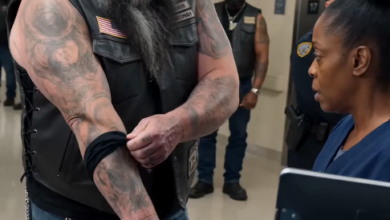
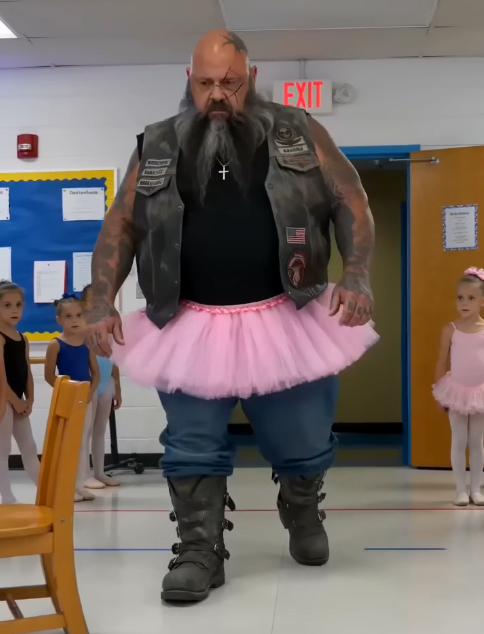
The biker stood between me and the machine outside Rivergate Credit Union on Highway 64 in Memphis, Tennessee. He had to be six-foot-five and close to three hundred pounds, with a shaved head, an iron-gray beard, tattooed knuckles, black ink running beneath his shirt collar, and a leather cut stretched across shoulders wide enough to block the entire ATM screen.
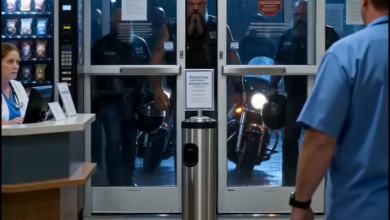
His black Harley idled at the curb, its V-twin pulse shaking the loose coins in my open purse.
“Give me my card,” I said.
He did not look at me.
“Stay back.”
That made the scene look worse.
I was forty-three, an elementary school office secretary, a widow, and the mother of a daughter starting community college in three weeks. Nearly every dollar I had saved for her first semester was sitting in the checking account connected to the card lying beside the biker’s boot.
The young man who had been waiting behind me stepped forward. He wore khaki pants, clean white sneakers, and a gray polo shirt. Compared with the biker, he looked like the person anyone would trust.
“Lady, get away from him,” he said. “I called the police.”
A woman near the night-deposit box raised her phone. Two people leaving the grocery store across the parking lot stopped to watch. Someone yelled that the biker had tried to steal my PIN, though I had not entered one.
The biker finally turned toward the young man.
“Don’t touch the card.”
“You don’t give orders here,” the young man replied.
The biker’s gaze dropped—not to my debit card, but to the phone in the young man’s right hand. A blue light blinked once along the phone’s edge, then disappeared beneath his palm.
I noticed it because the biker noticed it.
He moved again.
One heavy boot came down beside my card. His left hand pushed me farther behind him while his right fist struck the plastic frame around the ATM slot. The crowd gasped. A piece of black plastic cracked loose and hung from two thin wires.
It looked as though he were destroying the machine.
The young man lunged for the broken piece.
The biker caught his wrist.
Now everyone began shouting.
“Let him go!”
“He’s attacking that guy!”
“Where are the police?”
The woman recording moved closer until the biker pointed one tattooed finger toward her without releasing the young man.
“Back up. Nobody touches that machine.”
His voice was low. Controlled. More frightening than a yell.
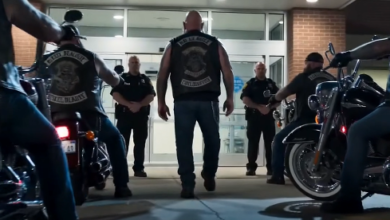
Two riders near the curb had already dismounted their Harleys. One was a broad Black man with a silver beard. The other was a middle-aged Latina woman wearing a weathered leather jacket. They looked ready to help their brother, but the biker gave them a slight shake of his head.
They stopped.
That puzzled me more than anything else. Why would a man who appeared to be committing a robbery prevent his own friends from protecting him?
Sirens rose along Highway 64.
The young man smiled.
“You’re done now,” he whispered.
The biker looked past him toward a green utility van parked near the drive-through lane. Its driver had started the engine but had not turned on the headlights.
Then the biker glanced at the card slot, the hanging wires, and the phone trapped beneath the young man’s hand.
“No,” he said. “You are.”
Three unmarked vehicles swept into the parking lot. Doors opened. Armed officers poured out, ordering everyone to show their hands.
I raised mine.
The crowd moved away.
The biker did neither.
Instead, he pulled the young man against his chest, turned both of them toward the ATM, and shouted one sentence that made the officers run past me.
“Second man’s in the green van.”
I thought the police were about to arrest the frightening biker who had thrown me from the machine—but they had been waiting for the two clean-cut men standing closest to me.
Part 2 — The Man Beside the Machine
The green van moved before the officers reached it.
Its tires chirped against the pavement, but it traveled less than twenty feet. A black Harley touring bike rolled from the curb and stopped sideways across the exit, not charging the van or striking it, just occupying the one patch of asphalt the driver needed.
The rider was Leon “Switch” Harris, the broad Black biker who had dismounted moments earlier. He planted both boots and kept his hands on the bars while the van stopped inches from his front wheel.
The Latina rider, Rosa Alvarez, pulled Switch backward by his leather collar just as officers surrounded the vehicle.
Neither biker crossed the police line.
I learned later that restraint mattered.
Switch was fifty-five, a retired industrial electrician who had known the gray-bearded biker for nineteen years. Rosa was a forty-nine-year-old emergency-room nurse who had stitched both men after crashes, bar fights, garage accidents, and one foolish attempt to move a refrigerator using a motorcycle trailer.
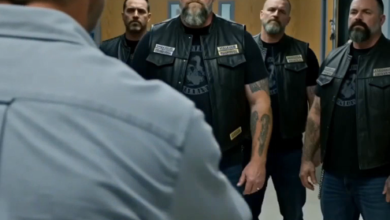
They belonged to a small Memphis riding club called Second Watch. Its members were veterans, first responders, mechanics, nurses, and two schoolteachers. They had planned to meet that morning before delivering backpacks to a community center on Summer Avenue.
The gray-bearded biker had made them promise not to interfere.
At the time, they did not know why.
I stood behind a patrol car while officers pulled the van driver onto the pavement. He wore a green work shirt without a company logo, tan utility pants, and an identification badge turned backward on a plastic clip. A magnetic cabinet key, three blank debit cards, a screwdriver, and a coil of thin wire fell from his pockets.
The young man in the gray polo stopped smiling.
The biker released his wrist only when a female officer placed him in handcuffs. Then he stepped away without touching my card, the cracked plastic, or the phone that had dropped beside the ATM.
“Hands where I can see them,” another officer ordered.
The biker slowly opened his leather cut.
A gold badge hung inside.
Nobody spoke.
Detective Sergeant Gabriel Maddox of the Memphis Police Department’s Financial Crimes Unit looked nothing like the investigators I had seen on television. He wore no pressed shirt, no polished dress shoes, and no neat shoulder holster beneath a business jacket.
His badge rested beside an old canceled debit card held in a clear plastic sleeve.
The name on that card was Eleanor Maddox.
I saw it for less than a second before he closed his vest.
One of the officers unlocked the handcuffs around the young man’s wrists and transferred them to the suspect. Another photographed the cracked device hanging from the machine. A third placed orange evidence markers around my debit card, the phone, two screws, and a piece of adhesive tape.
The woman who had been filming lowered her phone.
“Wait,” she said. “The biker is a cop?”
No one answered her.
Gabriel walked toward me, but I backed away.
He stopped immediately.
That was the first time I saw uncertainty on his face. Not fear. Not shame. Something smaller, almost uncomfortable, as if he knew how to stand in front of a gun but had never learned where to put his hands after frightening an innocent woman.
“Ms. Whitaker?”
I had never given him my name.
“How do you know who I am?”
“Your appointment at the branch was in the surveillance briefing.”
That answer did not calm me.
I had scheduled a meeting with a loan officer because my daughter, Maya, needed a tuition payment before Monday. The branch was closed on Saturdays, but the exterior ATM remained open. I planned to withdraw three hundred dollars for a plumber, then return Monday to transfer Maya’s tuition.
Only the bank knew that.
“You were watching me?”
“I was watching the machine.”
“You grabbed me.”
“Yes, ma’am.”
“You threw me away from it like I was nothing.”
His jaw tightened beneath his beard. “Your card was less than an inch from the reader.”
“That does not give you the right to put your hands on me.”
“No, ma’am.”
I expected an excuse. He did not offer one.
“I had four seconds,” he said. “I used them badly.”
The directness took some heat out of me, though not enough.
Behind him, a technician lifted the black plastic device using gloved hands. It was shaped like the real mouth of the ATM card reader, but the underside contained a narrow circuit board and a battery no larger than a postage stamp.
A second officer peeled a thin film from the keypad.
The film had tiny pressure contacts beneath every number.
I looked at my card on the ground.
Gabriel followed my eyes.
“They wanted the stripe and the PIN,” he said. “The man behind you had the receiver. The van driver installed the hardware.”
“You knew?”
“We suspected. We didn’t have both men identified until he closed in behind you.”
The clean-cut young man had stood less than two feet from my shoulder. He had smiled when I apologized for taking too long. He had even told me not to rush.
Every calm word now felt dirty.
Gabriel glanced toward the cruiser where officers had placed him.
“He needed you to finish.”
Then I understood why the biker had shoved me sideways instead of pulling me straight back. A tiny pinhole camera was hidden above the keypad, angled toward my right hand. By forcing me left, Gabriel had moved my card number and fingers out of its view.
He had not been trying to reach my purse.
He had been blocking the camera with his body.
Still, one question would not leave me.
“If this was a police operation, why didn’t you close the ATM before I arrived?”
Gabriel looked toward the green van.
“We were waiting for the installer to return for the device. He arrived six minutes early.”
“And you let me walk up?”
“No.”
For the first time, his voice sharpened.
“My partner was supposed to stop you at the sidewalk. Someone drew him away with a medical emergency call from the bus shelter.”
We both turned.
An empty wheelchair sat beneath that shelter.
There was no patient.
The emergency had been staged to open a path to the ATM.
The two men had not merely reacted when they saw me.
They had been waiting for someone exactly like me.
Part 3 — Four Seconds
The officers separated everyone in the parking lot.
I sat in the back of an ambulance while a paramedic examined the darkening marks on my arm. Gabriel stood fifty feet away with Captain Tasha Green, the Financial Crimes Unit commander, receiving the kind of quiet reprimand that needed no shouting.
Every few seconds, he looked toward me.
Captain Green noticed.
“Eyes here, Maddox.”
His head turned back.
I could not hear most of their conversation, but I caught enough.
The surveillance team had been following a string of ATM compromises across Shelby County for eight weeks. The criminals installed skimming overlays on Friday evenings, collected card data during weekend traffic, then removed the devices before banks opened Monday.
They chose machines near highways.
Quick entry. Quick exit.
At the first location, thirty-two accounts had been compromised. At the second, eighteen. At the third, investigators found only adhesive residue because the device was already gone.
The Rivergate ATM was supposed to be different.
A bank technician had placed a silent sensor beneath the original card bezel. When the fake reader was attached at 8:41 that morning, the sensor alerted Captain Green’s team. Officers watched from unmarked vehicles while the man in the green work shirt installed the device and drove away.
The clean-cut man remained nearby.
He bought coffee. Checked his phone. Sat at the bus shelter. Walked through the grocery store. Returned to the ATM line whenever a customer approached, then left before anyone inserted a card.
He was testing the police response.
Gabriel recognized that pattern.
The team planned to allow the installer to return, recover the device, and lead them to the equipment used for cloning cards. Until then, a plainclothes officer would quietly redirect every customer.
That officer was Detective Paul Dorsey, the “homeless” man beneath the bus shelter.
At 8:57, someone called 911 and reported that an elderly man had collapsed behind the adjacent pharmacy. Dorsey left his position to check. No one had collapsed.
At 8:59, I entered the parking lot.
The installer’s green van turned back from Highway 64 at the same moment. The gray-shirted accomplice moved behind me, holding the Bluetooth receiver in his phone.
Captain Green told Gabriel to wait.
If they arrested only the man behind me, the van driver might escape with the cloning equipment. If they moved too early, weeks of surveillance would produce one low-level suspect and a device that could be replaced within hours.
Gabriel waited.
Three seconds.
I opened my purse.
Two seconds.
I raised my debit card.
One second.
The gray-shirted man activated the receiver.
Gabriel moved before Captain Green gave the signal.
He crossed twelve feet of pavement, seized my arm, and pulled me out of the camera’s angle. He hit the false bezel with the heel of his hand so it could not be removed or erased remotely.
Then the shouting began.
The crowd saw a biker assault a woman.
The suspects saw a biker ruin their device.
Only Gabriel knew those two misunderstandings were buying the surveillance team the same thing.
Time.
The gray-shirted man shouted “robbery” because he needed strangers to surround Gabriel. If the crowd fought the biker or forced him away from the ATM, the man could recover the receiver and flee.
The van driver started his engine while everyone looked at me.
Gabriel watched both.
Captain Green later told me she saw his old patrol instincts take over. He made himself the biggest problem in the parking lot so the real problem could not disappear.
He also created another danger.
A tall man wearing a red baseball cap came from the grocery store and grabbed Gabriel’s shoulder. Gabriel did not strike him. He pivoted, released the hand, and stepped back between the stranger and the evidence.
“Stay out of it,” Gabriel warned.
“I saw what you did to that woman.”
“You saw half.”
The man swung anyway.
Switch took one step from the curb.
Rosa caught his vest.
“Rook said hold,” she told him.
Rook was Gabriel’s road name. He earned it because he could sit motionless for an hour, studying a room, then cross it in one straight line when everyone else finally understood the danger.
Switch’s hands closed at his sides.
The brotherhood faced its test there—not on a highway or during a fight, but in the six yards between their motorcycles and a friend being attacked by strangers.
They obeyed.
Gabriel ducked the punch, placed one palm against the man’s chest, and guided him backward without dropping him. The restraint looked almost gentle, though nothing else about Gabriel did.
The gray-shirted suspect used that moment to crouch near my debit card.
Gabriel’s boot came down over the phone.
“Don’t.”
The suspect froze.
Sirens arrived seconds later.
By the time officers pulled the van driver out, the crowd had divided into people who believed Gabriel was a robber, people who thought he was a violent vigilante, and people who had begun to understand that the broken plastic on the ATM did not belong there.
No one understood everything.
Neither did I.
At the precinct, an officer asked whether I wanted to file a complaint against Gabriel for using excessive force. My arm ached. My anger was not imaginary just because he had uncovered a crime.
“I want to know exactly why he touched me,” I said.
The officer wrote that down.
Two hours later, Gabriel entered the interview room without his vest.
He wore a faded black T-shirt over tattooed arms. A pale scar crossed his left shoulder, disappearing beneath the sleeve. Without the leather, beard, and motorcycle behind him, he still looked formidable, but older too.
Tired.
He placed a paper cup of water on the table, then sat across from me.
“I should’ve announced myself,” he said.
“You had four seconds.”
“Still should’ve.”
“Would I have listened?”
“Probably not fast enough.”
His honesty irritated me again because it left nothing obvious to attack.
I asked whether the suspects could have drained my account.
“If you inserted the card and entered the PIN, they would’ve had enough to create a magnetic-stripe copy. They planned cash withdrawals at older terminals before sunrise.”
“How much did they know about me?”
“We don’t know yet.”
“They knew about my bank meeting.”
“Maybe. Or they knew the kind of person who uses this branch on Saturday morning.”
“What kind is that?”
His eyes remained on mine.
“Someone carrying a balance worth stealing.”
My stomach tightened.
I had $12,640 in that account. Eleven years of skipped vacations, repaired shoes, evening work at football games, and grocery lists with nothing unplanned.
Maya’s first semester.
My emergency fund.
The last of the insurance money from my husband’s death.
Gabriel saw my face change.
He did not ask the amount.
Instead, he rested both hands on the table, keeping the tattooed knuckles where I could see them.
“I pulled her away so she wouldn’t lose every dollar she had,” he had told Captain Green in the parking lot.
Now he said it directly to me.
“I’m sorry I made saving it look like something else.”
That should have ended the conversation.
It did not.
Captain Green opened the interview-room door and placed a clear evidence bag on the table. Inside was the phone Gabriel had trapped beneath his boot.
“We unlocked it,” she said.
On the screen were seven customer names, partial account numbers, withdrawal limits, and scheduled deposit dates.
My name was eighth.
But beside mine, someone had typed two words that had nothing to do with an ATM.
WIDOW. TUITION.
Part 4 — What They Knew
I stopped breathing for a moment.
The bank knew I was a widow because my husband’s life insurance payment had entered the account. The bank knew about Maya’s tuition because I had written it in the appointment notes.
The criminals should not have known either.
Captain Green sat beside Gabriel and explained that the suspects had not selected Rivergate by chance. The van driver, Evan Pike, had worked for a regional ATM maintenance subcontractor until six months earlier. His access was terminated after he copied internal service schedules.
He kept more than schedules.
Pike had exported customer appointment notes from terminals used by branch employees. Most notes were harmless: mortgage question, replacement card, address update. Some contained enough context to identify customers expecting large deposits or payments.
Weddings.
Funerals.
Home sales.
College tuition.
Insurance settlements.
The second man, Nolan Briggs, sorted those customers by vulnerability and likely balance. He searched social media, public obituaries, property records, and community posts. Then he waited behind them at compromised machines.
He had found my husband’s obituary.
He had found Maya’s college announcement on her high school page.
He knew Saturday was the day before my tuition appointment.
“That emergency call from the bus shelter?” Captain Green said. “Briggs placed it. He needed our officer gone when you arrived.”
The crew had studied the police too.
Gabriel leaned back, and his chair gave a soft metal complaint beneath his weight.
“He recognized me late,” he said.
“Why would he recognize a biker?”
Captain Green looked at him.
Gabriel did not answer.
She did.
“Because Sergeant Maddox has worked every skimming case in this district for twelve years.”
I looked at the old canceled card beneath the clear sleeve inside his vest.
Eleanor Maddox.
Gabriel saw me looking.
He removed the card and placed it on the table.
The edges were rounded from years of handling. A faded blue stripe crossed the front. “Eleanor M. Maddox” was printed above an expiration date from more than a decade earlier.
“My mother’s,” he said.
Eleanor had been a sixty-eight-year-old retired cafeteria worker when a skimmer captured her card at a gas-station ATM outside Jackson, Tennessee. She entered her PIN beneath a fake camera smaller than a shirt button.
By the next morning, $18,700 was gone.
The bank eventually reimbursed most of it, but the investigation took nine weeks. Eleanor missed a property-tax payment, canceled a medical procedure, and borrowed money from Gabriel’s younger sister without telling him.
The dollars came back.
Her confidence did not.
She stopped using cards. Stopped answering the phone. Hid cash in coffee cans around her apartment, then forgot where she put them. Every conversation about the theft ended with the same sentence.
“I should’ve seen it.”
Gabriel was a patrol officer then. He told her the device had fooled hundreds of people and that trained employees had missed it.
She still blamed herself.
“She thought being deceived meant she was stupid,” Gabriel said. “Those men count on that.”
He transferred into financial crimes after her case closed. Colleagues assumed he would stay a year, grow bored with spreadsheets, and return to the street.
He stayed twelve.
The tattoos came earlier. The Harley came earlier still. He did not disguise himself as a biker for police work; he was one long before he became an investigator.
That explained something the crowd had missed.
Gabriel had not arrived in costume.
The leather was worn because he wore it. The knuckles were scarred because he rebuilt engines. The silver ring on his right hand carried the emblem of Second Watch, a rook standing over a small clock face.
When he tapped that ring twice against his belt in the parking lot, he was signaling his surveillance partner.
When he told Switch and Rosa to hold, he was protecting them from entering an active operation.
When he refused to pick up my card, he was preserving fingerprints and preventing anyone from claiming he had tried to steal it.
When he struck the false reader, he separated its battery contact and stopped Briggs from issuing a remote erase command through the phone.
Every threatening movement had been precise.
Every precise movement had looked threatening.
Yet the deeper truth did not excuse everything.
The bruises on my arm remained.
Gabriel knew it.
Three days later, he came to Rivergate Credit Union while I met with the bank’s fraud officer. This time, he wore a plain gray shirt, clean jeans, and no leather vest. The attempt at looking harmless made him seem more uncomfortable than a suit would have.
Maya sat beside me.
She was eighteen, thin, sharp-eyed, and less impressed by badges than most adults. When Gabriel introduced himself, she looked at my arm.
“You did that?”
“Yes.”
“You saved her money?”
“Yes.”
“Both can be true?”
Gabriel paused.
“Both are true.”
Maya nodded once. She respected people who did not crawl away from an ugly fact.
Gabriel placed a small foam training model on the table. One side showed a real ATM card slot. The other showed an overlay attached with adhesive. He demonstrated how the fake housing shifted when pulled.
“Always check the slot,” he said. “Cover your hand over the keypad. If anything moves, walk away.”
Maya tried it.
Then she pointed at the tiny camera hole above the number pad.
“How did Mom miss that?”
“Because it was made to be missed.”
He turned toward me.
“So was I.”
That sentence followed me for weeks.
The arrest made local news, but the first video posted online began after Gabriel grabbed me and ended before officers removed his handcuffs. The caption described a “biker attacking a woman at a Memphis ATM.”
By evening, it had been shared thousands of times.
Some viewers called him a thief. Others called him a hero after a second clip showed the false reader. A few decided I had participated in staging the entire scene.
Gabriel refused interviews.
Captain Green wanted to release the surveillance footage to correct the record, but the district attorney worried it would expose camera positions before Pike and Briggs were indicted.
Gabriel told her to leave it alone.
“People saw what they saw,” he said.
I heard about that through Rosa.
She visited the school where I worked to deliver the backpacks Second Watch had been carrying that morning. Gabriel did not come. He believed my students might recognize him from the video and become frightened.
Rosa set forty-six backpacks along the office wall.
“He’s good at staying away when he thinks his face makes things harder,” she said.
“Does it?”
“Sometimes.”
She placed the last backpack on my counter. A small reflective strip had been stitched across its front.
“He also knows when staying away is easier for him than apologizing twice.”
That afternoon, I called Gabriel.
“Come to the school Friday,” I said.
There was a pause on the line.
“Why?”
“Because the children need to hear about card safety.”
“I can send another detective.”
“I didn’t ask for another detective.”
He came wearing his leather cut.
That was my condition.
If the students were going to learn how easily appearances could mislead them, the lesson needed the man everyone had judged in the first three seconds.
Part 5 — The Card Inside His Vest
Gabriel parked his Harley outside Kingsbury Elementary at 2:40 on Friday afternoon.
The engine’s low rumble reached the office before he did. Teachers looked through classroom windows. Children near the pickup lane pressed their faces to the glass.
He entered carrying the training ATM in both arms.
His tattoos showed. His beard remained wild. The leather cut had blank black patches except for the small Second Watch rook near the lower seam. He removed his sunglasses before crossing the front desk and waited while I printed his visitor pass.
The sticker looked absurd on his chest.
Maya, who had volunteered to help, laughed for the first time since the incident.
Gabriel looked down at the sticker.
“Undercover work,” he said.
The fifth graders gathered in the cafeteria. I expected questions about the arrest, but children noticed different things from adults.
One asked why his beard was two colors.
Another asked whether the motorcycle was louder than a tornado.
A boy in the front row wanted to know whether the skull tattoo on Gabriel’s hand meant he had killed someone.
“No,” Gabriel said. “Means I made bad art choices at nineteen.”
The room loosened.
Then he placed the fake reader over the training ATM. It clicked into place so cleanly that the entire cafeteria went quiet.
He asked for volunteers to identify which machine was safe.
Every child chose the wrong one.
Gabriel did not tell them they had failed. He showed them where to pull, what to cover, and when to leave. He explained that smart people were deceived every day because criminals built traps to resemble things people already trusted.
“Getting fooled once isn’t shameful,” he said. “Staying silent helps the thief.”
I wondered whether he was speaking to the children or to Eleanor Maddox.
After the presentation, a fifth-grade girl named Laila waited beside the stage. Her grandmother had lost money to a phone scam and refused to report it because she feared the family would take away her independence.
Gabriel crouched so he would not tower over her.
“Would she talk to a lady detective?” he asked.
Laila nodded.
He wrote Captain Green’s office number on the back of his visitor pass. Then he crossed out his own name so Laila could hand it to her grandmother without explaining the frightening biker.
That small act told me more about him than the arrest.
The robbery appearance had not been a dramatic exception hiding a perfect man. Gabriel was impatient, blunt, and too willing to use his body as the quickest answer to a problem. His first marriage had ended partly because he carried work home in silence. He slept four hours on a good night and rebuilt motorcycles when he could not sleep at all.
He also remembered which victims needed a female investigator, which elderly witnesses could not climb courthouse stairs, and which families would rather receive information by mail because unknown phone calls frightened them.
Complex.
Not polished.
Real.
The case against Pike and Briggs grew larger. Investigators recovered card-making equipment from the green van’s false floor: a magnetic encoder, blank cards, microcameras, keypad membranes, batteries, and eleven ATM overlays shaped for different machines.
The suspects had collected information on eighty-three people.
They had successfully compromised twenty-one accounts before Rivergate.
Police froze the remaining targets before money disappeared. Several victims had ignored suspicious withdrawals because each amount was small. Pike and Briggs had tested cards with twenty-dollar purchases, then planned to empty the strongest accounts during a coordinated overnight run.
My account was marked for $4,800 in ATM withdrawals and retail gift-card purchases.
Maya’s tuition would have failed Monday morning.
The thought made my hands cold every time I remembered the card hovering near that false slot.
There was one final discovery.
Briggs’s phone contained photographs of Gabriel taken over six weeks. Outside the station. At a diner. Beside his mother’s grave. Riding with Second Watch along Route 51.
They had identified the detective hunting them.
The staged emergency at the pharmacy was not only meant to remove Detective Dorsey. It was designed to pull Gabriel’s attention away long enough for me to use the ATM.
Briggs expected him to protect the operation instead of the customer.
Gabriel chose me.
Captain Green later said that choice almost cost the entire case. The suspects might have escaped. Gabriel might have been suspended for breaking the arrest plan. The crowd might have seriously injured him before officers arrived.
When I asked whether she had disciplined him, she gave me a tired smile.
“I made him write a forty-three-page report.”
“That sounds cruel.”
“You haven’t read his reports.”
He wrote in short sentences. Some pages contained more white space than words. His account of grabbing me used no heroic language.
Subject raised debit card. Accomplice activated receiver. Civilian officer displaced from position. Immediate action required. I pulled Ms. Whitaker left of camera view. Force caused bruising. I regret the injury. Waiting was not reasonable.
At the bottom, Captain Green had written:
Action justified. Method requires review.
Gabriel agreed.
He began teaching a new four-second response for officers working financial-fraud scenes: identify yourself, block the machine, move the customer only if contact is unavoidable, and explain as soon as the threat is controlled.
He named the sequence Eleanor.
His mother never saw it. She died three years before Rivergate, but her old debit card stayed inside his vest beside the badge.
“It reminds me which one matters first,” he told me.
“The card or the badge?”
“The person who trusted both.”
On the morning Pike and Briggs pleaded guilty, I sat behind Gabriel in court. He wore a dark suit that could not hide the breadth of his shoulders. The leather cut rested across his knees.
Briggs looked smaller without his clean polo and confident smile.
His attorney argued that the crew had never taken money from me. Gabriel did not react. He simply opened his vest, touched Eleanor’s canceled card, and waited while prosecutors described every victim whose account had been tested.
Twenty-one people had lost money.
Eighty-three had been selected.
One hundred and four names filled the evidence file.
The judge sentenced both men under multiple fraud, identity-theft, and conspiracy counts. Restitution would take years, perhaps longer.
Outside court, reporters waited for Gabriel.
He walked past them.
One called after him, “Sergeant Maddox, do you consider yourself a hero?”
Gabriel stopped just long enough to look at me.
“No,” he said. “I was standing close.”
Then he carried his leather vest down the courthouse steps.
Part 6 — First Friday
Rivergate Credit Union replaced the exterior ATM.
The new machine had a recessed card reader, improved anti-skimming sensors, and a bright mirror above the keypad. The bank also removed the narrow divider that had allowed someone to stand close behind a customer without appearing unusual.
On the first Friday of every month, Gabriel parked his Harley near the curb.
That was pension-deposit day for many older customers.
He never stood directly beside the machine. He stayed near the entrance with a cup of bitter gas-station coffee, pretending to check messages while people completed their transactions.
Sometimes someone recognized him from the video.
A few asked for photographs. He refused politely.
One man called him the ATM Avenger. Gabriel looked so offended by the name that Rosa laughed for nearly a minute.
Second Watch began carrying small demonstration readers in their saddlebags. During food drives, veterans’ breakfasts, and charity rides, they showed people how false ATM parts could shift beneath a firm pull.
They did not collect names or donations.
They showed the trick, answered questions, and rode away.
Switch built the training models from discarded bank equipment. Rosa printed a one-page guide using letters large enough for customers with poor eyesight. Captain Green reviewed every line so the riders would not accidentally teach criminals more than victims needed to know.
Gabriel handled the demonstrations.
He never described what happened to his mother unless someone admitted being ashamed after losing money. Then he removed Eleanor’s card from his vest and set it on the table.
“Smartest woman I knew,” he would say. “Still fooled her.”
That was enough.
My bruises disappeared after eleven days. The memory took longer.
For months, a sudden hand on my shoulder made my body tighten. Gabriel knew because I told him. He did not defend himself or remind me what he had prevented.
He apologized again.
Then he changed the way he approached people.
I saw the difference one cold November morning. An elderly white woman stood at the Rivergate ATM while a man on her phone instructed her to withdraw cash for a “federal bond.” Gabriel recognized the scam from twenty feet away.
The old Gabriel might have taken the phone.
This time, he stopped outside her reach.
“Ma’am, I’m Sergeant Maddox. May I show you my badge?”
She turned slowly.
He held the badge where she could read it, then waited.
“May I ask who is on the phone?”
She gave him permission.
Only then did he step closer.
The caller hung up as soon as Gabriel spoke. The woman began trembling, and he guided her inside without touching her arm. I watched from my car while he walked half a pace behind, huge enough to frighten anyone, careful enough not to.
Four seconds had changed him too.
Afterward, I handed him a coffee.
He sniffed it.
“This has sugar.”
“You’ll survive.”
“Questionable.”
We stood beside his Harley while the November wind moved along Highway 64. Eleanor’s card rested inside his vest. My new debit card stayed zipped in my purse.
Neither of us mentioned the first time we met.
We did not need to.
Part 7 — One Inch
A year after the arrests, Maya completed her first two semesters of community college.
The tuition payment went through on time. She studied cybersecurity after changing her major from business administration, partly because a piece of fake ATM plastic had shown her how much damage could hide inside something ordinary.
For her final class project, she built a simple training website for older adults. It used no frightening warnings and no language that made victims feel foolish.
Gabriel tested every page.
He complained about the font.
Maya enlarged it.
He complained that the fake reader photographs were too clean.
She added fingerprints, scratches, and cheap adhesive.
He approved.
Rivergate invited them to demonstrate the project on a Saturday morning. Customers gathered in the lobby while Second Watch motorcycles lined the curb. The riders wore leather, faded jeans, heavy boots, gray beards, old scars, and expressions that made the security guard nervous until Rosa brought him coffee.
Gabriel arrived last.
His Harley settled into its familiar uneven pulse before he cut the engine. In the silence, I heard boots strike pavement, a chain wallet tap against denim, and the soft creak of leather as he removed his gloves.
A new ATM stood where the compromised machine had been.
Gabriel stopped in front of it.
For a moment, his right hand hovered near the card slot. Then he pulled the housing once, covered the keypad with his other palm, and stepped away.
Maya smiled.
“You passed.”
“Barely.”
A woman waiting behind us recognized him. She whispered something to her husband, then looked toward me.
“Are you the woman from the video?”
“I am.”
“Did he rob you?”
Gabriel’s beard shifted around the beginning of a reluctant smile.
I looked at the one-inch space between my fingers and the machine—the distance that had separated an ordinary Saturday from the loss of everything my husband and I had saved.
“No,” I said. “He made sure someone else couldn’t.”
The woman studied Gabriel’s tattoos, vest, scarred hands, and silver rook ring. Then she looked at Eleanor’s old card inside the clear sleeve beside his badge.
“What did he say afterward?”
I remembered his first command.
Stay back.
I remembered the crowd shouting, the false reader cracking, the clean-cut criminal smiling, and Gabriel making himself look guilty because there was no time to look kind.
But the sentence that remained belonged to the parking lot after the handcuffs changed wrists.
“I pulled her away,” he had said, “so she wouldn’t lose every dollar she had.”
Gabriel started his Harley.
The Second Watch riders followed, one engine after another, until the glass windows trembled with their low mechanical thunder. He lifted two fingers toward Maya, nodded once to me, and turned toward Highway 64.
His red taillight became smaller between the Saturday traffic.
Eleanor’s card rode beside his badge.
And the machine behind us was clean.
Follow our page for more powerful biker stories about intimidating riders whose quiet choices reveal the courage, loyalty, and humanity hidden beneath leather, tattoos, and road-worn scars.