Part 2: A Security Camera Caught a Tattooed Biker Giving His Seven-Year-Old Daughter the Entire Umbrella—Twenty-Five Minutes Later, His Club Learned Why
Part 2:
Before the lemonade stand, most people in Paducah knew Raymond Mercer only as Hollow.
The name came from his years welding hollow steel tubing, though strangers invented darker explanations. They saw the shaved head, the neck tattoos, the scar cutting through his right eyebrow and the black leather cut.
They heard his Harley before dawn.
Rumor filled whatever facts were missing.
I knew more because Hollow and his family lived in the apartment above my bakery for almost two years.
They arrived six winters earlier with three suitcases, a crib mattress and a cardboard box containing everything from their kitchen.
Lucy was fourteen months old.
Elena carried her up the stairs. Hollow carried everything else.
He had lost his welding job after the plant closed. Their rental house outside Metropolis, Illinois, had been sold from beneath them. A week later, the transmission failed in their truck.
They crossed the Ohio River with forty-six dollars.
Hollow’s motorcycle was the only valuable thing he still owned.
Elena asked him to keep it.
That surprised me.
“You need groceries,” I said.
“We need him to remain himself,” she answered.
The Harley had belonged to Hollow’s older brother, Michael, who died in Iraq. Selling it would have paid several months of rent.
Elena refused to let grief become an invoice.
Instead, she removed her mother’s locket.
It was small, oval and made of dull gold. Inside were two miniature photographs: Elena’s mother on one side and Elena as a child on the other.
Hollow pawned it.
He promised to retrieve it after his first paycheck.
He did find work.
But Lucy developed pneumonia. The first paycheck paid for medication. The second repaired the truck. By the time Hollow returned to the pawnshop, the locket had been sold.
He told Elena.
She said it was only an object.
Hollow did not believe her.
For six years, he carried the pawn ticket inside his leather cut.
Not because it could recover anything.
Because he thought guilt deserved a receipt.
Hollow’s place in the Iron Hounds Motorcycle Club was complicated.
He had been a member for twenty-one years. He planned routes, repaired bikes and sat beside injured brothers in hospital rooms.
But he hated receiving help.
If his roof leaked, he patched it alone. If his hand hurt, he wrapped it tighter. When the welding accident crushed two fingers and reduced his work hours, he told the club after surgery.
Preacher called that pride.
Hollow called it privacy.
The disagreement nearly ended their friendship.
“You’d ride four hundred miles for any one of us,” Preacher told him. “But you won’t let us cross the street for you.”
“Different thing.”
“Only from your side.”
Hollow turned away.
That was his habit whenever words came too close.
Lucy had inherited his stubbornness without inheriting his silence.
The lemonade idea began when she overheard Elena speaking to my bakery assistant.
Elena’s birthday was approaching. My assistant asked what she wanted.
“Eight hours of sleep,” Elena said. “And maybe my mother’s locket back, if birthdays are granting impossible wishes now.”
She laughed.
Lucy did not.
That evening, she asked Hollow what a locket cost.
He told her it depended.
“Can seven dollars buy one?”
“Some.”
“One that opens?”
“Maybe.”
“One with gold?”
“Not real gold.”
Lucy considered this.
She had seven dollars in a glass jar.
The following morning, she asked me whether I knew any jewelry stores. I showed her a small oval locket displayed in the window of Ramsey’s Antiques.
It was not Elena’s original locket.
But it resembled it.
The price was eighty-nine dollars.
Lucy counted the money in her jar again.
Then she asked Hollow to build a lemonade table.
He agreed before learning why.
When she finally told him, he offered to pay the difference.
Lucy refused.
“Mom works for our things.”
“She’s an adult.”
“So?”
Hollow had no answer that could survive her stare.
He built the table from scrap cedar at the motorcycle shop. He sanded every edge smooth. He painted one leg twice because Lucy disliked the first shade of yellow.
The Iron Hounds offered to become her first customers.
Hollow said no.
“She wants to earn it.”
That decision mattered later.
At the time, it sounded reasonable.
Saturday morning began warm.
Lucy squeezed lemons until her fingers hurt. Elena had picked up an extra shift at the nursing home and would not return until evening.
At noon, Hollow carried the table to Jefferson Street.
Clouds arrived at 1:20.
Rain followed.
I watched father and daughter argue beneath the maple tree. Hollow suggested postponing the sale. Lucy said her mother’s birthday was the next day.
“The locket might sell,” she said.
“We’ll find another.”
“It won’t be that one.”
Hollow looked across the street toward the antique store.
Ramsey’s window displayed the locket on blue velvet.
He knew Lucy was not trying to buy jewelry.
She was trying to restore something he believed he had taken from Elena.
“Fifteen more minutes,” he said.
The rain strengthened.
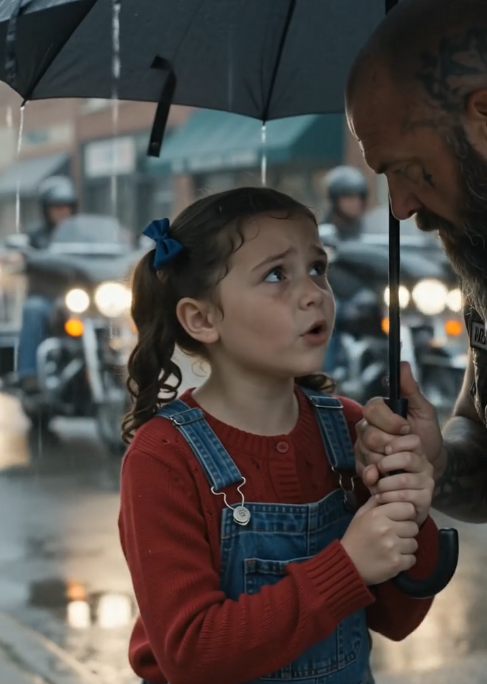
He opened the umbrella.
Lucy believed they were sharing it. Then she noticed water streaming from his beard.
“Dad, come closer.”
“Table leg’s sinking.”
It wasn’t.
He stood behind the weak corner and kept the umbrella over her.
Five minutes passed.
Ten.
No buyers.
Hollow could withstand cold rain, scar pain and embarrassment. Watching hope fade from his daughter’s face was harder.
He reached for his wallet.
Lucy covered the money jar.
“No.”
“One cup.”
“You live with me.”
“Still thirsty.”
“No family customers.”
Hollow almost smiled.
“Harsh business policy.”
Preacher saw them from across the intersection.
He had stopped for fuel while returning from a veterans’ funeral. Beneath the gas-station canopy, he watched Hollow hold the umbrella at an angle that left his entire right side exposed.
He saw Lucy rearrange the empty cups.
Preacher took a photograph.
Not of Lucy’s face.
Of Hollow’s boots standing in running water behind the dry yellow table.
Then he sent one message to the Iron Hounds’ group:
Hollow needs nothing. Lucy’s selling lemonade at Jefferson and Third. One dollar. Rain price is whatever your conscience says. No speeches.
He expected five riders.
Eighteen came.
Boone rode from a transmission shop nine miles away. Rosa left a family cookout. Mateo arrived wearing work clothes beneath his leather cut. Two members were already halfway home toward Tennessee and turned around.
Rook Bell saw the message while sitting beside his estranged teenage son at a diner. He hesitated.
His son read the screen.
“Go,” the boy said.
Rook shook his head.
“We just got our food.”
“I’ll go with you.”
That was the first time his son had asked to ride beside him in almost a year.
The message moved people for different reasons.
Not everyone came for Hollow.
Some came because they remembered being seven and wanting to give something they had earned. Some came because a father standing unprotected behind his child looked familiar.
None came to be seen.
When the engines appeared, Hollow knew immediately.
He stepped in front of Lucy because he feared she would misunderstand what was happening.
She wanted customers.
Not donors.
Preacher understood.
He parked first and approached alone.
“One lemonade.”
Lucy poured carefully.
“That’s one dollar.”
Preacher placed a twenty on the table.
“I’ve got a large motorcycle. Large thirst.”
“It’s raining.”
“Still thirsty.”
Lucy looked at Hollow.
Her father’s jaw tightened.
“Take the dollar,” he told Preacher.
“I don’t have change.”
“You own a tire shop.”
“Bad at cash management.”
Lucy giggled.
She accepted the bill.
The next rider paid twenty. So did the third.
Hollow objected again.
Rosa leaned across the table.
“Your daughter set the price for lemonade. She didn’t set a maximum tip.”
Lucy thought about this.
“Tips count as earning?”
Hollow looked trapped.
I answered from beneath the bakery awning.
“They do at my shop.”
The line continued.
Each rider waited his turn. Engines shut down. Helmets came off. No one crowded the table.
Boone told Lucy the lemonade had “excellent structural integrity.” Mateo took one sip, blinked at its sourness and declared it powerful enough to remove rust.
Nobody asked for sugar.
Hollow remained wet behind the table.
Not one rider tried to share the umbrella with him.
That might sound unkind.
It wasn’t.
They understood the gesture belonged to father and daughter. Stepping beneath it would have changed what he was giving her.
So they stood in the rain, too.
The eighteenth rider was Rook’s sixteen-year-old son, Mason.
He wore no leather vest, only a borrowed helmet and a soaked denim jacket. He placed a crumpled five-dollar bill on the table.
“I can only do five.”
Lucy pushed four dollars back.
“You’re a kid.”
“I’m sixteen.”
“Still.”
He accepted the change.
His father watched from the motorcycle.
Something softened in Rook’s face.
The lemonade stand was helping more than one family.
After the final cup, Lucy carried the money jar beneath the umbrella and counted.
Three hundred forty-one dollars.
She counted again because the amount seemed impossible.
Then she leaned toward Hollow.
“Dad, I can buy Mom’s present now.”
He turned away.
Rain covered most evidence, but not all.
His beard moved once beneath a hard breath. His scarred fingers pressed against his eyes.
Preacher pretended to inspect a tire.
Boone studied the clouds.
Eighteen bikers suddenly found other places to look.
That was one of the quiet rules of their brotherhood.
Witness the moment.
Do not steal a man’s dignity from it.
The velvet box created the first problem.
Preacher had visited Ramsey’s Antiques while the club was gathering. He intended to ensure no one else purchased the locket before Lucy could cross the street.
The shopkeeper recognized Elena’s name.
Then she retrieved a second item from the safe.
The original locket.
It had returned to Paducah two weeks earlier.
The woman who bought it six years ago had died. Her grandson brought several pieces of jewelry to Ramsey’s for appraisal. Inside the locket were Elena’s family photographs, along with the pawnshop inventory number.
Ramsey’s owner traced the old ticket to Hollow.
She had been trying to contact him.
Preacher purchased the newer locket only to reserve it for Lucy. The original was not his to sell or give away until ownership could be verified.
That was why Hollow covered the box when Preacher revealed it.
He had recognized the worn hinge.
For six years, he had imagined recovering that locket. Now that it sat within reach, he was terrified Elena would see the night of their poverty inside it instead of her mother’s face.
“Tell Lucy,” Preacher said quietly.
“Tomorrow.”
“You’ve waited six years.”
“One more day.”
Lucy stood beneath the umbrella holding the money jar.
“What’s in the box?”
Hollow swallowed.
“Your mom’s history.”
“Is that good?”
“Depends how I tell it.”
Lucy handed him the jar.
“Tell it true.”
Seven years old.
No mercy.
They entered Ramsey’s Antiques together.
The riders remained outside.
Hollow did not want eighteen leather vests turning a family transaction into a public event. Preacher agreed and ordered everyone toward my bakery.
I served coffee and pie while rainwater formed dark pools beneath their boots.
Across the street, Lucy placed ninety dollars on the antique counter.
The owner accepted one dollar.
“No,” Hollow said.
“She earned it,” the woman answered. “I’m respecting the sale.”
She gave Lucy eighty-nine dollars in change.
Then she placed both lockets before her.
One shone brightly.
The other was scratched, dull and slightly bent along the edge.
Lucy picked up the old one.
“This one.”
“The new one is prettier,” Hollow said.
“This one knows Mom.”
The shop owner opened it.
Elena’s mother appeared on one side. Eight-year-old Elena smiled from the other, missing a front tooth.
Lucy touched the photograph.
“She looked like me.”
Hollow turned his face again.
Lucy closed the locket and placed it inside the velvet box.
Then she pushed the remaining money toward the shopkeeper.
“Can you fix the hinge?”
The repair cost thirty-two dollars.
Lucy paid it.
She kept the rest for a birthday cake and flowers.
Not charity.
A transaction.
Her own.
The second problem arrived at 5:30.
Someone had uploaded security footage from the gas station across the intersection. The clip showed eighteen bikers surrounding a child’s lemonade stand beneath a storm.
Without sound, it looked threatening.
The caption claimed a motorcycle club had forced a little girl to remain outside while they filmed themselves buying drinks.
By evening, the video had thousands of views.
People accused Hollow of exploiting Lucy. Others accused the club of staging the entire scene for attention.
A local reporter called.
Preacher wanted to release the full story.
Hollow refused.
“My kid’s not club publicity.”
“If we say nothing, they’ll decide what happened.”
“They already did.”
“The nursing home will see it. Elena will see it.”
Hollow looked toward the upstairs apartment where Lucy was wrapping the locket.
“Then I tell my wife before strangers do.”
Preacher followed him onto the bakery porch.
“We can protect the club.”
“Protect the kid.”
“Doing both is possible.”
“Not if the camera stays on her.”
Their voices rose.
Eighteen riders had answered one message, but brotherhood became more difficult after the easy part. Buying lemonade cost twenty dollars.
Accepting public judgment cost pride.
Preacher called a vote.
The Iron Hounds would not post Lucy’s name, show her face or explain the birthday gift. They released one sentence:
A child was operating a voluntary lemonade stand with her father present. Our members purchased lemonade and left. The family requests privacy.
That was all.
No heroic photographs.
No fundraising link.
No demand for praise.
The club absorbed the insults.
For Hollow, that restraint proved more than the money had.
They had not come to make themselves look good.
They had come because a little girl still believed somebody might stop in the rain.
Elena returned at 7:10.
She entered my bakery carrying a broken umbrella and wearing pale-blue nursing scrubs. She saw the wet bikers first.
Then Hollow.
His shirt had dried unevenly beneath his leather cut. Lucy stood beside him holding a badly wrapped velvet box and a small bakery cake with her mother’s name written in crooked icing.
Elena looked around.
“What happened?”
Lucy stepped forward.
“I worked.”
“That sounds serious.”
“I sold lemonade.”
“In the storm?”
“Dad had an umbrella.”
Everyone looked at Hollow.
Elena noticed his wet boots.
“Of course he did.”
Lucy handed her the gift.
Elena opened the box.
The bakery became still.
She saw the locket.
Her mother.
Her childhood photograph.
The scratch near the hinge.
Her fingers began trembling.
“How?”
Hollow stepped closer.
“I pawned it.”
“I know.”
“I didn’t get it back.”
“I know that, too.”
“I should’ve sold the bike.”
Elena closed the box.
“No.”
“Your mother gave you that.”
“Your brother gave you the Harley.”
“We needed food.”
“And we ate.”
He stared at her.
For six years, Hollow had rehearsed an apology built around his failure. Elena would not accept the premise.
“You kept our baby warm,” she said. “You found work. You stayed. Stop turning the worst month of our marriage into proof you were the worst man in it.”
Hollow’s face tightened.
Lucy tugged his wet jeans.
“Mom likes it.”
“I see that.”
“Did I fix it?”
Elena crouched.
“You brought it home. That’s different.”
Lucy considered this distinction.
Then she nodded.
Hollow understood it, too.
Some things could not be restored to what they were.
They could still come home.
The security-camera twist surfaced the next morning.
I reviewed my bakery footage because a reporter asked whether it showed Lucy being forced to stay.
It showed the opposite.
At 1:54, while Lucy looked down at her notebook, Hollow tried to move the umbrella toward himself. The wind shifted it. Lucy noticed his wet shoulder.
She stood on her chair and pushed the handle back toward him.
Hollow moved it over her again.
She pushed.
He returned it.
They continued this quiet argument three times.
Finally, Hollow crouched and said something. The camera had no audio, but Lucy later told me his words:
“Dads are waterproof.”
She knew that was false.
She allowed him the lie.
At 2:08, another detail appeared.
Hollow removed two folded twenty-dollar bills from his wallet. He looked toward Lucy’s jar, then put them away.
He could have pretended to be a customer.
He didn’t.
Lucy had asked to earn the gift from someone who did not owe her love. Hollow respected that, even while watching her fail.
That was what Preacher recognized from the gas station.
The soaked biker was not helpless.
He was honoring the terms of his daughter’s courage.
I gave the footage to the family, not the reporter.
Hollow watched it once.
Then he asked me to delete my copy.
I did.
Some evidence proves a story.
Other evidence becomes part of what the story must protect.
Lucy returned to the same corner the following summer.
The sky was clear.
She sold lemonade for one dollar. A line formed before she finished setting out the cups.
This time, Hollow set a rule.
“No tips over five.”
Preacher arrived first carrying exact change.
“Club policy?” he asked.
“Parental.”
“Under protest.”
Lucy poured his lemonade.
The Iron Hounds did not arrive together. They came individually throughout the afternoon so ordinary customers would not feel crowded.
Rook brought his son.
Boone brought his granddaughter.
Rosa arrived in a pickup because her Harley needed repairs. Hollow teased her until she threatened to charge him double for lemonade.
The stand earned one hundred twelve dollars.
Lucy used the money to buy school supplies for children at Elena’s nursing home whose grandparents were raising them.
Nobody suggested it.
That was her decision.
The locket became Elena’s Sunday jewelry.
She wore it to church, family dinners and Lucy’s school programs. The repaired hinge remained slightly crooked.
Hollow noticed every time.
One evening, he offered to have it corrected properly.
Elena covered it with her hand.
“No.”
“Why?”
“Because Lucy paid for that hinge.”
That ended the discussion.
The pawn ticket remained inside Hollow’s leather cut until his fifty-fourth birthday.
Elena found it while repairing a torn seam. She placed it on the kitchen table.
“You don’t need this.”
“I know.”
“Then why carry it?”
Hollow rubbed his scarred knuckles.
“Reminds me.”
“Of what?”
“What things cost.”
Elena turned the ticket over.
On the blank side, she wrote:
WE CAME HOME.
Then she returned it.
Hollow carried that version for another year.
Afterward, he placed it inside Lucy’s baby book beside the photograph from her first lemonade stand.
Not the viral image.
A quiet one I took after the motorcycles left.
Lucy stood beneath the umbrella holding the empty pitcher. Hollow was behind her, soaked from head to boots, his face turned toward the street.
If you looked closely, one enormous hand rested against his eyes.
Five years later, the Iron Hounds still used “lemonade weather” as a private expression.
It did not mean rain.
It meant someone needed help but would never ask.
When Boone’s wife entered chemotherapy, Preacher sent two words to the group.
Lemonade weather.
Fourteen riders appeared to drive her to appointments.
When Rook lost his apartment after a factory closure, nobody offered charity. They hired him to repair the clubhouse roof and paid him before the work began.
When Hollow needed another operation on his crushed hand, he told the club himself.
That was progress.
Preacher read the message twice because Hollow had never asked first.
Eighteen riders arrived at the hospital.
Hollow complained.
They stayed.
On Lucy’s twelfth birthday, she asked Hollow why he had let the bikers pay twenty dollars.
“I tried to stop them.”
“But you didn’t make me give it back.”
“They were customers.”
“They were your brothers.”
Hollow considered the distinction.
“Both.”
“Were you embarrassed?”
“Little.”
“Because you needed help?”
“Because they saw it.”
“Saw what?”
Hollow looked toward the locket around Elena’s neck.
“That I couldn’t make your day work by myself.”
Lucy leaned against his tattooed arm.
“Maybe it wasn’t supposed to work by yourself.”
Hollow grunted.
“You been talking to Preacher?”
“He talks a lot.”
“True.”
The original yellow table eventually wore out.
Hollow kept one cedar plank from it. He mounted it above his workbench without painting or engraving anything across the wood.
Beneath it hung the black umbrella.
One rib remained bent from the storm.
On Elena’s fiftieth birthday, Lucy placed the locket around her mother’s neck and asked whether she remembered the rainy stand.
“I remember eighteen motorcycles,” Elena said.
“I remember Dad dripping on the floor.”
Hollow looked offended.
“I dried.”
“Eventually.”
Preacher laughed from the porch.
The club had gathered for dinner, though no one wore a patch inside the house. They were not there as a motorcycle club.
They were family carrying pies, folding chairs and too much food.
Rain began after sunset.
Lucy, now eleven, stepped outside and opened the old black umbrella. One side sagged.
Hollow joined her.
She tilted it toward him.
He moved it back.
“Dad.”
“What?”
“I’m not seven.”
“Rain’s still rain.”
“You’re not waterproof.”
He looked toward the driveway where eighteen motorcycles reflected the porch light through the falling water.
“No,” he said. “Guess I’m not.”
This time, he stepped beneath the umbrella.
They stood shoulder to shoulder, neither entirely dry.
Inside, Elena opened the crooked locket.
Outside, the rain kept falling.
Nobody needed to turn away.
Sometimes brotherhood sounds like eighteen engines in a storm.