Part 2: A One-Legged Biker Removed His Prosthetic in Front of an Eight-Year-Old Double Amputee—Five Years Later, She Led 100 Harleys Without Knowing What He Had Sold
Part 2 — The Man Who Sat Outside
My name is Dana Hart, and before the crash I believed there were two kinds of difficult days: those you endured and those you solved. I worked as an elementary school secretary, raised Lily alone after her father left when she was four, paid bills late but paid them, and kept emergency snacks in the glove compartment because preparation felt like control.
The crash removed that belief before it removed anything else.
A drunk driver named Wade Collins crossed the center line on Route 66 at 8:17 on a wet Friday evening. I remember Lily singing with the radio. I remember headlights entering our lane. I remember waking upside down with rain moving across the shattered windshield.
I do not remember the surgeons telling me they could not save her legs. I remember their mouths moving, but grief sometimes turns language into silent pictures.
Lily survived.
Everybody kept repeating those two words as if survival ended the sentence.
At the rehabilitation hospital in Springfield, she learned to transfer from a bed into a wheelchair. She learned pressure relief, balance, skin care, and how to move through a bathroom designed for adults. She learned that strangers praised ordinary actions after disability because they could not imagine what else to say.
She did everything the therapists asked.
Then she came home and stopped.
Our front steps had been replaced by a temporary plywood ramp donated by a church group. The ramp worked, but Lily refused to use it. Her classmates sent cards. She asked me to put them in a drawer without reading them.
The first person she allowed near her was Rook, and even he was not invited.
He arrived carrying two coffees, set one on the porch rail for me, and sat far enough from the door that Lily could watch without feeling cornered. He spoke about the weather, a stubborn lawn mower, and the neighbor’s dog stealing one of his gloves.
He never spoke about legs unless Lily did.
That restraint mattered.
People had begun treating her body like public property. Adults asked what doctors planned to do, when she would receive prosthetics, whether she felt phantom pain, and how high the amputations were. Some questions came from love. They still took something from her.
Rook asked permission even to move her wheelchair.
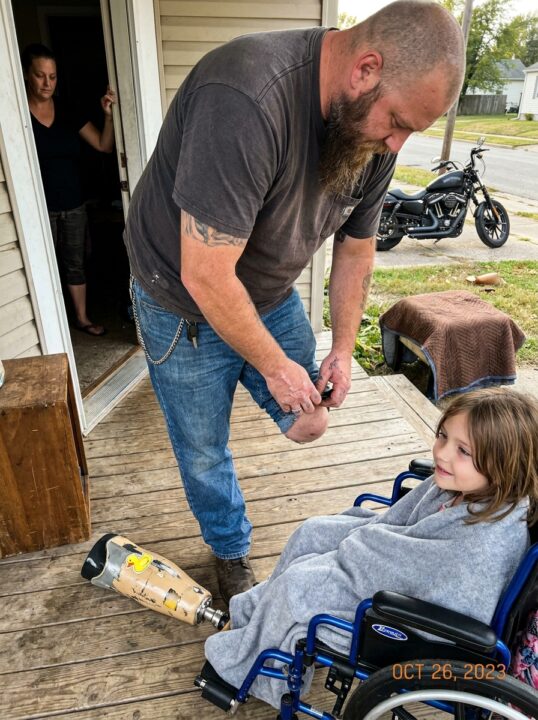
The week after showing her his prosthetic, he brought a large sheet of cardboard and placed it on our porch. Across it he had drawn the rough outline of a three-wheeled handcycle.
Lily examined it.
“It looks like a lawn chair married a bicycle.”
“That’s the design goal.”
“It’s ugly.”
“So am I. Still useful.”
She laughed again.
The first frame came from an adaptive recreation center in Tulsa. It was too wide for our doorway and too long for Lily to turn easily. Rook borrowed it anyway, dismantled the seat, and carried each measurement back to his garage.
His club brothers arrived after dark.
I watched from my kitchen as large men in leather cuts unloaded metal tubing, a child-sized seat, wheel hubs, brake cables, and a box of parts donated by a bicycle shop. Their boots struck Rook’s concrete floor. Wrenches clicked. A grinder screamed briefly, then stopped.
Rook had remembered Lily hated sudden noise.
After that, he texted before using power tools.
The Road Saints were not sentimental men. Their clubhouse stood behind an old tire warehouse near Interstate 44, where coffee tasted burned and every chair had duct tape somewhere on it. Yet they approached Lily’s project with the seriousness of aircraft mechanics.
Earl “Grudge” Maddox handled the steering linkage. Tomas “Switch” Alvarez rebuilt the hand crank. A retired welder named Clay “Preacher” Dunn made a chain guard because Rook refused to let Lily’s sleeve catch.
They argued about everything.
Rook listened to Lily.
She wanted the frame dark blue, not pink. She wanted a small basket behind the seat and a horn that sounded like a duck. She did not want flowers, glitter, or the word “brave” painted anywhere.
Rook wrote every preference on masking tape above his workbench.
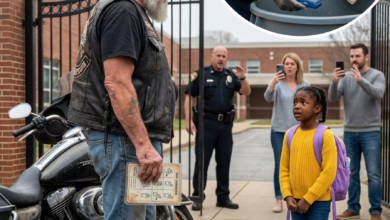
The first time he invited her into the garage, she stopped at the driveway. The open door revealed motorcycles, chains, welding helmets, oily tools, and nine tattooed riders trying to pretend they were not waiting for an eight-year-old girl’s approval.
Lily turned her wheelchair around.
Rook said nothing.
The next day he rolled the unfinished handcycle outside and worked on the lawn. The club followed, carrying tools and folding chairs. They moved the entire workshop into daylight without mentioning why.
Lily came out after twenty minutes.
She watched Rook install the left hand crank, then told him it was crooked.
It was not.
He loosened it anyway and asked her to hold the level.
By the end of the afternoon, grease covered two of her fingers. She stared at the black marks as if they belonged to someone she had misplaced.
Rook handed her a shop rag.
She refused it.
“I want Mom to see.”
That night, she asked me to leave the grease until morning.
Part 3 — Three Wheels and the First Fall
Rook did not build Lily a miracle.
He built her something that failed repeatedly.
The first chain slipped whenever she pushed hard. The front wheel pulled right. The donated seat pressed against a healing area and had to be replaced. The brake lever required more hand strength than an eight-year-old had.
Each problem angered Lily because adults had promised the tricycle would make her feel free. Rook had never used that word.
“It’ll let you move,” he said. “Moving comes first.”
Her first attempt happened inside his fenced driveway on an overcast October afternoon. Rook positioned the low handcycle beside her wheelchair while I hovered close enough to make Lily furious.
“I can help,” I said.
“I know.”
“You might tip.”
“I know.”
Rook locked both chairs and demonstrated the transfer without pretending his body worked like hers. He sat on the concrete, removed his prosthetic, and shifted himself using his arms until he occupied the handcycle seat.
Lily watched the mechanics of it.
No speech. No performance.
He returned to the ground, attached his leg, and stood.
“Your turn.”
Her first transfer took nine minutes. Her shoulders shook. Sweat gathered along her hairline despite the cold. Twice she asked us to stop touching her.
Rook kept his hands open and visible.
When she finally settled into the seat, he tightened the chest strap and inspected the wheels. Lily wrapped both hands around the cranks.
Nothing happened.
“You’ve got the brake on,” he said.
“You put it on.”
“Then we know it works.”
She released it.
The handcycle moved six inches.
Lily froze.
A dozen Road Saints stood behind the garage pretending to inspect motorcycles. Every head turned when the wheels rolled.
She pushed again.
One foot.
Then three.
Rook walked beside her, his uneven stride matching the slow rotation of her arms. She completed half a circle in the driveway before the front wheel struck a crack and stopped.
Her hands slipped.
The handcycle tilted.
I ran.
Rook reached her first, planting his body between Lily and the concrete. The frame landed against his hip. His prosthetic twisted beneath him with a sharp metal sound.
Lily screamed.
Rook remained on the ground.
“Machine’s fine,” he said.
“I’m not asking about the machine!”
That was the first time she had sounded like herself.
Rook rolled onto his back, released his prosthetic socket, and pulled the leg free. A small plastic connector had cracked.
Lily stared at it.
“I broke you.”
“No.”
“I did.”
Rook held up the damaged piece. “This was old before you were born.”
She began to cry, not quietly and not gracefully. She struck the handcycle with both fists and shouted that she hated it, hated her chair, hated roads, hated the man who hit us, and hated Rook for pretending any of this could become normal.
The club members moved away.
Rook stayed on the concrete.
When Lily’s voice failed, he said, “Good.”
I nearly slapped him.
Lily stared through wet hair.
“What?”
“You finally said it where somebody could hear.”
She told him to shut up.
He nodded.
Then he sat beside the overturned handcycle with his damaged prosthetic across his lap until her breathing slowed.
The false victory had lasted eleven feet.
For three weeks, Lily refused to ride again. She continued visiting the garage, but only to sort bolts or paint the frame. Rook repaired his prosthetic without showing her. He also widened the handcycle’s rear axle, lowered its center of gravity, changed the front caster angle, and installed a padded bar to limit tipping.
He did not ask her to try.
Instead, he rode it himself.
The seat barely contained him. His knees rose awkwardly, one trouser leg pinned beneath his thigh, while his tattooed arms turned the child-sized cranks. He traveled down the sidewalk at the speed of a tired turtle.
Neighbors stared.
Lily watched from our ramp.
“You look stupid,” she called.
“Machine works, then.”
She laughed, rolled down the ramp, and followed him.
The second attempt happened without an audience. Rook dismissed the club. He asked me to remain behind the fence where Lily could see me but not feel my hands waiting.
She transferred faster.
The wheels moved.
At the driveway crack, she stopped, studied it, and pushed harder.
The handcycle crossed.
Rook followed on foot for one block. At the corner, Lily turned toward our house, her arms trembling but steady.
She had traveled 0.6 miles when we returned.
That night, Rook painted a short white mark on his garage wall and wrote the distance beneath it. Over the next year, the marks multiplied: one mile, three, five, eight.
Lily began outpatient prosthetic training in Kansas City. Her first temporary legs felt heavy and unfamiliar. She stood between parallel bars while a therapist supported her hips.
Rook attended once.
He waited outside the therapy room until Lily called him in. Then he rolled up his jeans, detached his own prosthetic, and showed her the scars inside his socket.
“Mine still gets mad,” he said.
“After ten years?”
“Bodies hold grudges.”
She practiced another step.
The insurance company covered basic prosthetic devices but denied the higher-function knees recommended for an active bilateral amputee. Their letter described the components as not medically necessary.
Rook read the sentence twice.
Then he folded the letter and placed it inside his vest.
I did not yet understand what that meant.
Part 4 — What the Club Could Not Afford
The Road Saints began raising money without using Lily’s photograph.
Rook prohibited it.
“No hospital-bed pictures,” he told the club. “No sad kid beside a donation jar.”
They held a breakfast at the clubhouse, repaired motorcycles for donations, auctioned tools, and organized a seventy-mile ride from Joplin to Grand Lake. Lily attended the start in her handcycle but left before the engines fired.
The fundraiser brought in $18,460.
Her new prosthetic system would cost more than three times that amount after insurance.
I applied for grants. Some required photographs. Others wanted an essay describing how Lily’s disability had affected our family. One application asked what “exceptional achievement” she would pursue if funded.
She was nine.
She should not have needed to promise greatness to receive legs that fit.
Rook never said that aloud. He helped me gather medical records, drove us to appointments when my car failed, and learned more about sockets, liners, microprocessor knees, and gait training than any biker had reason to know.
At the club, pressure grew.
The Road Saints had promised to finance Christmas gifts for 240 children that year. Their clubhouse roof leaked. Grudge needed shoulder surgery. Switch’s wife had lost her job.
Several members believed the club could not keep pouring money into one family.
They were not cruel.
They were afraid.
During a meeting in January, a member named Cal “Bishop” Avery said what others had been circling.
“We helped build the cycle. We paid travel costs. We raised eighteen grand. Where does it stop?”
Rook stood at the end of the table.
“When she stops needing it.”
“That ain’t an answer.”
“It’s mine.”
Bishop removed his club ring and placed it on the table. “Brotherhood takes care of brothers.”
Rook looked around the room. “Then don’t spend club money.”
The argument lasted almost two hours. Voices rose. Chairs scraped. Someone struck the table. Rook did not threaten anyone, but by midnight three members were ready to leave and the Toy Run budget had become part of the fight.
Grudge finally asked the question no one else would.
“What are you planning?”
Rook touched the folded insurance letter inside his vest.
“Nothing that belongs to the club.”
The next morning, he opened the rear door of his garage.
Inside stood a red 1986 Harley-Davidson Electra Glide known throughout southwest Missouri as Ruby. The paint was dark enough to look black at night. The chrome carried scratches from decades of roads. A hand-tooled leather strap crossed the fuel tank, and beneath the seat was a small metal plate stamped with two names: MASON and ELI.
Eli Mercer had been Rook’s younger brother.
They bought Ruby from a police auction when Rook was twenty-three and Eli was nineteen. The motorcycle arrived in boxes after a garage fire. They rebuilt it over six winters, working after shifts at a machine shop.
Eli died of leukemia before the bike was fully finished.
Rook completed it alone.
Ruby was the motorcycle he rode to his brother’s funeral. It was the bike he crashed ten years later when the pickup struck him on Interstate 44. The left side had been destroyed, but Rook rebuilt it again after losing his leg.
People offered to buy it for years.
He always refused.
Then a collector from Tulsa named Leonard Vance called the club looking for a restored shovelhead-era touring bike with documented history. Grudge mentioned Ruby as a joke.
Rook called him back.
Leonard arrived on a cold Sunday morning. He examined the frame numbers, engine work, old photographs, and metal plate beneath the seat. Then he named a price.
Fifty-eight thousand dollars.
Rook did not bargain upward.
He added three conditions. Leonard could not remove Eli’s nameplate. He could not repaint the motorcycle. And he could never tell Dana Hart or Lily why Rook sold it.
Leonard asked whether he was in debt.
“No.”
“Then why sell?”
Rook placed Lily’s denied insurance letter on the workbench.
Leonard read it.
“You could start a public fundraiser.”
“Kid’s had enough strangers looking at what’s missing.”
Rook signed the title.
When Leonard loaded Ruby into an enclosed trailer, the Road Saints stood along the garage wall. Nobody tried to stop him. Bishop, the man who had challenged the expense, removed his cap.
Rook watched the trailer door close.
The garage changed shape after that. A clean rectangle remained where Ruby’s tires had rested for years. Oil marks traced the place beneath the engine. One red paint chip lay near the workbench.
Rook picked it up and placed it in his wallet.
That afternoon, he rode his black Road King to our house and handed me an envelope.
Inside was a cashier’s check addressed to the prosthetics clinic.
I stared at the amount.
“Where did this come from?”
“Benefit fund.”
“Which benefit?”
“Private one.”
I tried to return it.
Rook closed my hand around the envelope.
“Don’t make her audition for legs.”
I should have asked more questions.
Instead, I held the check against my chest and cried in his driveway while he studied a loose bolt on his handlebar as if it required his full attention.
Lily received her new prosthetic knees that spring.
Rook told everyone Ruby was undergoing engine work.
The club repeated the lie.
For five years.
Part 5 — Learning to Fall Forward
Lily’s first permanent prosthetic sockets were purple because the clinic had no dark blue material available. She hated them immediately.
Rook brought black vinyl wrap and covered the purple sections in the clinic parking lot. He worked slowly around the curves, smoothing every wrinkle with his thumb.
The prosthetist objected until Lily stood and said, “They’re mine.”
Rook looked away to hide a smile.
Walking did not replace the handcycle. It gave Lily another choice.
Some days she used both prosthetic legs. Some days one. Some days neither. She learned early that independence did not mean choosing the option that made other people most comfortable.
Rook understood that before I did.
When I urged her to practice walking inside a grocery store, he asked why the wheelchair was unacceptable.
“Because she needs confidence.”
“She has confidence.”
“She needs to use the legs.”
“They’re tools, Dana. Not a test.”
I resented him for that sentence because it was correct.
Lily grew. Every growth spurt changed her socket fit. Her skin broke down. Insurance approvals arrived late. She missed school for appointments and then worked at night to catch up.
Rook never called her inspirational.
He called her mechanic.
At ten, she could remove the rear wheel from her handcycle. At eleven, she learned to adjust brakes. At twelve, she redesigned the seating position because the original frame no longer fit her growing body.
The Road Saints helped her build version two.
This machine looked nothing like the awkward tricycle Rook first drew on cardboard. It had a low dark-blue frame, wide rear wheels, a seven-speed hand crank, a bright headlight, a safety flag, and the same ridiculous duck horn.
Lily welded part of the chain guard herself.
Rook stood behind her wearing a heavy glove over the hand guiding the torch. He did not move her arm. He only remained close enough to stop it if necessary.
The club’s annual Toy Run became the biggest December ride in Jasper County. Riders collected gifts for families who could not afford them, then transported the toys from the clubhouse to a community center near Schifferdecker Park.
Lily attended each year.
She never joined the procession.
The sound of more than one hundred motorcycles still pressed against the memory of the crash. She could tolerate one Harley, then five, then twenty from a distance. A mass start remained too much.
Rook never pushed.
He started his motorcycle after she left or asked the club to depart in smaller groups. The Road Saints complained once. He reminded them that toys arrived even if engines did not perform for spectators.
When Lily turned thirteen, she entered the clubhouse meeting carrying a route map.
“I want to lead the Toy Run.”
Silence followed.
Grudge stopped pouring coffee.
Rook studied her face. “On what?”
“My cycle.”
“Route’s fourteen miles.”
“I’ve done twenty.”
“Traffic’s different.”
“So teach me.”
I objected immediately. The route crossed three major intersections. Winter weather could turn without warning. Her handcycle sat low, making visibility a serious concern.
Lily listened to every argument.
Then she asked Rook what he thought.
He took the map from her and drew three marks. One at the hill near Main Street, another at the railroad crossing, and the last where Range Line Road narrowed.
“You lead from here to the community center,” he said. “First section starts at walking speed. We block the crossings legally. Support vehicle stays close.”
“You mean yes?”
“Means training.”
For six weeks, they practiced before sunrise on Sundays.
Rook rode behind her.
Never beside.
He taught her hand signals, lane position, braking distance, shoulder checks, and what to do if a chain dropped. Two Road Saints blocked empty intersections while she rehearsed turns.
The first time a pickup passed too close, Lily froze.
Rook moved his Harley between the truck and her handcycle. He did not chase the driver. He held position until her hands returned to the cranks.
“Look forward,” he said.
“I’m trying.”
“Don’t try. Pick a point.”
She chose a stop sign two blocks away.
The wheels began moving.
On the final practice ride, sleet touched the road. I expected Rook to cancel. Instead, he let Lily make the decision.
She checked the pavement, temperature, and forecast.
“Not today,” she said.
Rook nodded.
The choice to stop counted too.
The night before the Toy Run, he gave her an old pair of black leather gloves. They were too large, so he had sewn new seams along the fingers.
“These Eli’s?” she asked.
Rook went still.
She had heard the name from Grudge but did not know the story.
“Were.”
“Will you want them back?”
“Bring them home dirty.”
She wore them to bed.
Part 6 — One Hundred Engines Behind Three Wheels
December 14 arrived cold and clear.
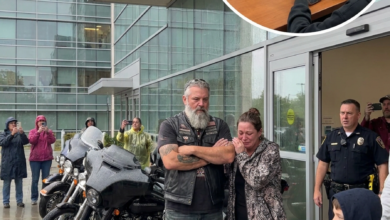
By eight in the morning, 117 motorcycles filled the parking lot behind the Road Saints clubhouse. Exhaust drifted through white air. Leather creaked. Toy bags were strapped across seats and packed into support trucks.
At the front stood Lily’s dark-blue handcycle.
It looked impossibly small.
She wore a black riding jacket over a gray sweatshirt, reflective bands around both arms, and Rook’s altered gloves. Her prosthetic legs rested inside padded braces along the sides of the frame, though the hand cranks powered every turn of the wheels.
People gathered along the route.
Some raised phones when they saw the child at the front. Rook asked the club photographer not to film her transfer into the cycle.
“Film the ride,” he said. “Not the work she did before it.”
Lily tested her brakes twice.
Rook crouched beside the front wheel. His black Harley waited near the back of the formation.
“Why are you riding last?” she asked.
“Best view.”
“That’s a lie.”
“Road captain’s privilege.”
“You’re not president.”
“Exactly.”
She reached down and tapped the yellow duck sticker he had transferred from his first prosthetic onto the handcycle frame.
Rook looked toward the motorcycles behind her.
“You don’t have to carry them,” he said. “They’re following the route, not your shoulders.”
Lily nodded.
At 9:05, Grudge raised one gloved hand.
The engines started.
The sound moved through the parking lot like thunder trapped under steel roofs. Lily’s shoulders tightened. Her hands closed around the cranks.
Rook remained beside her until she looked back.
One hundred riders waited.
Nobody revved.
Nobody shouted.
The entire club held the engines at a low idle while Lily counted five breaths.
Then she squeezed the duck horn.
It made a ridiculous squeak.
Laughter broke the tension.
Lily pushed.
Three wheels crossed the painted line at the clubhouse exit. Behind her came Grudge and Switch on their Harleys, followed by rows of riders carrying dolls, bicycles, board games, winter coats, and boxes wrapped in plastic.
Rook mounted last.
I rode in the support van six vehicles behind Lily. Through the windshield, I watched her dark-blue safety flag move between the motorcycles. At every intersection, club members blocked traffic under police supervision, then returned to formation.
The hill near Main Street slowed her.
The motorcycles slowed too.
Lily’s arms worked harder. Her breath clouded in front of her. The handcycle drifted left, corrected, and continued upward.
Nobody passed.
At the top, she lifted one glove.
One hundred hands answered.
People along the sidewalk cheered. Lily did not look at them. Her eyes remained on the road point Rook had taught her to choose.
At the railroad crossing, a freight train delayed the procession for nine minutes. Engines shut down one by one. Silence spread across the line.
A little boy waiting with his father approached Lily and examined the handcycle.
“Is that a motorcycle?” he asked.
“Not yet,” she said.
Rook heard from the rear through the club radio.
“Don’t give her ideas,” he replied.
When the barrier lifted, Lily sounded the duck horn again.
The ride entered Schifferdecker Park shortly before ten. Volunteers formed a corridor near the community center, expecting the Harleys to lead.
Instead, Lily arrived first.
Three wheels.
Two prosthetic legs.
One hundred motorcycles behind her.
She crossed the finish line and locked the brakes. The riders spread out across the lot. Rook entered last, exactly as promised.
Lily raised both arms.
This time she laughed long enough for everyone to hear.
Rook parked behind her, dismounted, and checked the handcycle’s rear axle before he accepted a single handshake.
As always, he guarded what others celebrated.
Part 7 — The Bill of Sale
The truth arrived inside a plain white envelope three days after the Toy Run.
There was no return address. Inside was a copy of Ruby’s title transfer, a photograph of Rook standing beside a red Harley, and a handwritten note from Leonard Vance.
Mrs. Hart,
Mason made me promise not to contact you. I kept that promise for five years. After seeing your daughter lead the Toy Run, I decided the promise had reached its proper end.
The purchase price was $58,000.
I believe you already know where it went.
I did not.
Not completely.
The transfer date matched the week Rook gave me the cashier’s check. Eli’s name appeared on the metal plate beneath the motorcycle seat. On the back of the photograph, someone had written: Ruby, finished 1994.
I drove to the clubhouse with the papers shaking in my hand.
Rook was replacing a damaged latch on the toy-storage trailer. He saw the envelope and stopped working.
“You sold it.”
He looked toward Grudge.
Grudge raised both palms. “Wasn’t me.”
“Why didn’t you tell us?”
Rook returned the screwdriver to his pocket. “Wasn’t your bike.”
“It was your brother’s.”
“Mine after he died.”
“You lied about the benefit fund.”
“Private benefit.”
I wanted gratitude to sound like anger because anger was easier to carry.
“You sold the one motorcycle you could never replace.”
Rook leaned against the trailer. The empty lower section of his right trouser leg shifted against the prosthetic beneath it.
“Legs weren’t replaceable either.”
Lily had followed me inside.
Neither of us heard her approach.
She took the photograph from my hand and stared at the red Harley. “That’s Ruby?”
Rook said nothing.
“You sold Eli’s bike for my legs?”
“No.”
The answer stopped her.
Rook pointed toward the hallway, where her handcycle stood beside boxes of donated toys.
“I sold my bike because I chose to sell my bike. Your legs are yours. Don’t tie them to what I gave up.”
Lily’s chin tightened. “You should’ve told me.”
“What would you have done?”
“I don’t know.”
“Exactly.”
“You could have kept it.”
“Could’ve.”
“You loved it.”
“Yep.”
“More than the black one?”
“Different thing.”
Lily looked again at Eli’s name. “Then why?”
Rook’s voice dropped.
“Because a machine shouldn’t sit in my garage while a kid waits for somebody to decide whether she deserves to move.”
He picked up the screwdriver.
The conversation was over for him.
It was not over for Lily.
She asked Grudge to tell her about Ruby. Over the next month, she learned how the Mercer brothers found the fire-damaged motorcycle, how Eli sanded the first fuel tank, how Rook completed the wiring after the funeral, and how the crash that took Rook’s lower leg nearly destroyed the bike a second time.
She also learned what had been inside Ruby’s old saddlebag.
Eli’s road notebook.
It contained gas receipts, crude maps, motel names, mechanical notes, and a list titled Things We Build When We Have Money. Near the bottom, Eli had written: Something a kid can ride.
Leonard had found the notebook after buying Ruby. He sent Rook a copy but preserved the original with the motorcycle.
That sentence explained the yellow duck sticker too. Eli had placed it inside the saddlebag after teasing Rook that every terrifying motorcycle needed one harmless thing.
Rook transferred the duck to his prosthetic after losing his leg.
Then to Lily’s handcycle.
The seeds had been there from the first afternoon on our porch.
Rook had not arrived because he believed a damaged man could repair a damaged child. He hated that idea. Neither of them was broken machinery.
He came because someone had once remained beside him after his crash.
Eli’s widow, Marlene, sat outside Rook’s rehabilitation center every Thursday. She never asked him to be positive. She brought coffee, listened to him swear, and waited until he was ready to learn the prosthetic.
Rook did for Lily what Marlene had done for him.
He stayed close without demanding progress.
The motorcycle sale was not the beginning of his kindness. It was the part money could measure.
The rest could not be invoiced.
Part 8 — Bringing Ruby Home
Lily decided to buy Ruby back.
Rook refused to help.
“I’m thirteen,” she told him. “I know I can’t buy a Harley tomorrow.”
“Good start.”
“I can raise money.”
“No.”
“You raised money for me.”
“Not the same.”
“Why?”
“Because I said so.”
She called him a stubborn old goat.
He accepted the title.
The Road Saints supported her carefully. They would not pressure Leonard or expose the private sale online. Lily did not want sympathy money anyway.
Instead, she created an adaptive-cycle workshop inside one corner of the clubhouse. Families brought used wheelchairs, bicycles, handcycles, walkers, and mobility equipment. The club repaired or modified what it safely could, working with licensed therapists when seating or medical needs were involved.
They charged those who could pay.
They quietly waived fees for those who could not.
Lily placed a red metal cashbox on the bench and labeled it RUBY FUND. Rook removed the label. Lily replaced it.
This continued eleven times.
On the twelfth, he left it alone.
The workshop grew. A local bicycle shop donated components. A prosthetics clinic provided discarded practice parts. High school engineering students joined on Saturdays.
Lily became good at asking what a person wanted before designing anything.
One boy wanted speed. An older woman wanted stability. A veteran wanted a brake he could operate with limited grip. A six-year-old girl wanted purple wheels and refused every practical color suggestion.
Rook painted them purple.
Two years passed.
The Ruby Fund reached $19,400, nowhere near the motorcycle’s value. Then Leonard Vance visited the workshop.
He arrived without Ruby and watched Lily adjust a handcycle seat for a boy with cerebral palsy. Rook noticed him but did not interrupt.
After the family left, Leonard placed Eli’s original road notebook on the workbench.
“I’ve put eight hundred miles on her,” he said.
Rook opened the notebook but did not touch it.
“Runs right?”
“Runs beautifully.”
“Then what’s the problem?”
Leonard looked toward Lily’s red cashbox. “I bought a motorcycle. Turns out I’ve been storing a promise.”
Rook’s expression hardened. “Don’t give it away.”
“I’m not.”
Leonard offered a trade.
The adaptive workshop would build ten customized cycles each year for children whose families could not afford them. Leonard would return Ruby and donate the fund’s cash to cover materials.
Lily agreed before Rook could refuse.
Ruby came home on a Sunday in October.
Leonard rode it instead of using a trailer. The red motorcycle turned onto West Twenty-Fourth Street while Rook stood in his driveway holding a wrench.
The engine note reached him first.
He did not move.
Ruby stopped beside the dark oil rectangle that had remained visible on his garage floor for seven years. Leonard shut off the engine and held out the key.
Rook stared at it.
“Deal wasn’t with me,” he said.
Lily rolled forward in her handcycle.
“It is now.”
Rook looked at the motorcycle, at Eli’s name beneath the seat, and at the yellow duck sticker Lily had placed on the mirror.
Then he asked the only question that mattered to him.
“Ten cycles a year?”
“Minimum.”
He took the key.
No one applauded. Grudge had warned the club that Rook might leave if they turned the moment into a ceremony.
Rook placed one scarred hand on Ruby’s fuel tank. His shoulders shifted once beneath the leather cut.
Lily pretended not to see.
The next December, she led the Toy Run again. Ruby rode at the back, its engine steady beneath Rook, while the dark-blue handcycle guided more than one hundred Harleys through Joplin.
He could have ridden beside her.
He never did.
The rear position gave him room to see every wheel, every intersection, every vehicle approaching too quickly, and every moment Lily might need somebody close without being watched.
At the community center, she stopped and looked over her shoulder.
Rook lifted two fingers from Ruby’s handlebar.
Lily sounded the duck horn.
One hundred engines answered.
He still rode last.
As always.
Follow the page for more biker stories—and leave ROOK for the next road where a silent guardian waits behind the crowd.