A Little Girl Handed a Tattooed Biker an Old Coin and Asked If He Still Kept Promises—Thirty Years Earlier, He Had Given It Away Beside a Wreck
The little girl placed an old coin beside my motorcycle gloves and asked, “Do you still keep promises?”—and before I could answer, I saw the damaged edge I had spent thirty years trying not to remember.
She couldn’t have been more than eight. Her yellow raincoat was buttoned wrong, and she held the remaining half of a blueberry muffin in a napkin, carefully folded so the crumbs wouldn’t fall. Behind her, an elderly woman stood between two tables, catching her breath. Neither looked like they belonged among fourteen men in leather eating breakfast before a charity ride outside Knoxville.
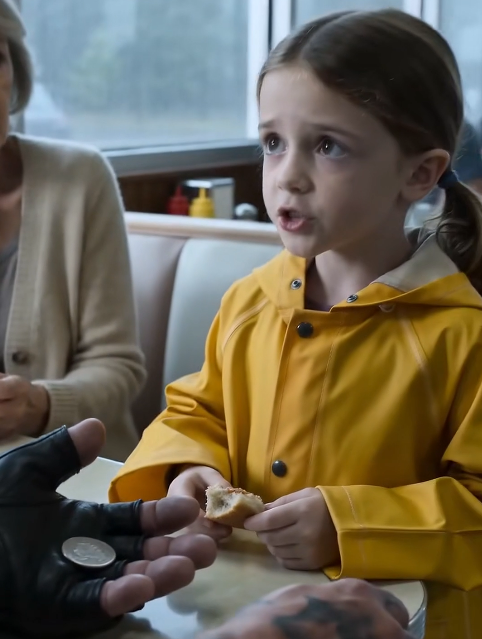
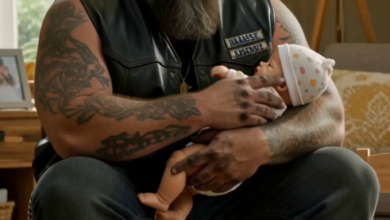
My name is Ray Dawson. I was sixty-two that fall, six-foot-four, with a shaved head, a gray beard, and forearms people sometimes studied before deciding to sit somewhere else. Around the club, they called me Hammer. That morning, a waitress had moved a glass syrup bottle away from my elbow as though she expected me to break it.
Now I was afraid to touch a little girl’s coin.
“Sweetheart,” the elderly woman said, “we were going to ask first.”
The girl kept looking at me. “I did ask.”
Across the table, Boone stopped cutting his pancakes. Somebody near the windows laughed at a joke he hadn’t realized was over. Outside, one of our Harleys started, its low rumble vibrating through the diner glass, then settled into a steady idle.
I knew that coin. Not the way you recognize an old photograph after somebody explains who’s in it. I knew it before my mind caught up.
A Kennedy half dollar. The eagle nearly smooth on the back. A crescent missing from the rim where my father had caught it in a bench vise while trying to straighten a bent key. There was a shallow mark beneath the date, too, made by a punch he kept beside his lathe. I used to rub that spot when I needed my hands occupied.
The last time I’d seen it, another little girl had been sitting beneath my jacket outside an emergency department. Her shoes were wet. One sock had slid halfway down her heel. Every time the automatic doors opened, she stood up.
Thirty years earlier.
I put both palms on the table because my hands had started shaking.
“Where did you get that?”
“My mom.”
The woman reached us then. She had a cane, a canvas purse, and the exhausted patience of someone who had already explained a difficult situation several times that morning. She rested a hand on the girl’s shoulder without pulling her away.
“I’m Ruth,” she said. “This is Nora. I apologize for interrupting.”
“You’re not interrupting.” My voice came out rougher than I meant. “Your mother’s name?”
Nora looked at Ruth, checking whether that was something she could tell a stranger. Ruth nodded.
“June.”
I looked down again. The coin lay beside a smear of butter and my black gloves. Such a small thing. It had crossed three decades and found me at a sticky diner table on a Saturday morning when my biggest concern had been whether the rain would ruin our ride.
Boone pushed his chair back quietly. He knew something had happened. He just didn’t know whether to give me room or stand closer.
Nora unfolded her napkin and offered the muffin to Ruth.
“You didn’t eat yours.”
That small movement got to me more than the question had. She was frightened, though I couldn’t yet say why, and still keeping track of somebody else’s breakfast.
“Is your mom all right?” I asked.
Ruth’s grip shifted on her cane.
“She’s at the hospital.”
I heard the motorcycle outside shut down. In the sudden quiet, the dishwasher rattled behind the kitchen doors.
Nora nudged the coin toward me with one finger. “She said you might not remember her face. But you’d remember this.”
I wanted to ask a dozen questions. Instead, I pulled out the empty chair beside me and waited until Ruth helped her sit.
“Tell me what she said.”
Nora reached into her coat for a folded envelope. My name was written across it, beneath a smaller name almost nobody used anymore.
Then she said, “Mom told me what happened when you gave it to her. But she said you don’t know what happened after you left.”
Part 2 — The Night I Gave It Away
The envelope could wait. Nora was watching my face too closely, trying to decide whether she had made a mistake. I asked the waitress for milk, another muffin, and a chair with a back cushion for Ruth. Boone moved our helmets off the bench. Nobody asked about the ride.
“Your mom was about your age when we met,” I told Nora. “Maybe a little younger.”
“Eight,” Ruth said. “She was eight.”
That was when I recognized Ruth—not her face, but the way she corrected a detail without apologizing for it. Thirty years had bent her shoulders and thinned her hair. I remembered a younger woman running through hospital doors in bedroom slippers, carrying a child’s overnight bag.
She had been the person we were waiting for.
In October of 1996, I was thirty-two, working at a truck repair shop by day and taking whatever side work I could find at night. My daughter, Emily, was four. My marriage was still young enough that I believed buying things for my family counted the same as spending time with them.
I had been sober a little over two years. Before that, I had given my wife, Beth, plenty of reasons to stop believing me. Nothing dramatic enough to make a movie about. Just broken plans, missing money, and evenings when she heard my truck outside and didn’t know which version of me would come through the door.
My father had given me the half dollar after my first full year without a drink. It wasn’t a recovery token. It was simply a coin he’d carried through years of factory shifts.
“Keep your hands busy,” he’d said. “Your mouth’s made enough arrangements.”
He wasn’t a sentimental man. That was his speech.
The night I met June, rain had turned the two-lane road outside town into a long black ribbon. I was driving the shop pickup back from a roadside repair when I came around a curve and saw headlights pointing into the trees.
Another driver had already stopped. He was on the phone with emergency services, giving directions badly because he was scared. I left my hazard lights on and went toward the car.
I won’t dress that night up. There was broken glass, rain, and a child crying for her mother. I followed the dispatcher’s instructions as best I could until the responders arrived. June was brought out and wrapped in a blanket. Her mother needed more help than anyone standing on that shoulder could give.
June caught my sleeve when a paramedic tried to guide her toward the ambulance.
“Are you leaving?”
I had a wife at home and a four-year-old who would be asleep already. I had grease under my nails, an early shift coming, and no connection to that child beyond having taken the same road.
But she was holding my sleeve with both hands.
“Not yet,” I told her.
At the hospital, I called Beth from a wall phone. She listened without interrupting, then said, “Stay until somebody gets there.”
June had been checked over. A staff member stayed nearby while they tried to reach family. I sat beside her in a molded plastic chair, still wearing the damp work shirt beneath my leather vest.
She asked where her mother was. I said the doctors were with her.
She asked whether her mother would come out soon. I said I didn’t know.
That answer cost me. Adults like to give children something smooth to hold, even when it isn’t true. I wanted to tell her everything would be all right because I wanted her to stop looking at the doors.
Instead, I gave her the only promise I could keep.
“I’ll stay here until somebody you know comes.”
She studied me. “Even if it takes a long time?”
“Even then.”
After a while, she noticed me turning the half dollar between my fingers. I told her it had belonged to my dad. She asked whether it was lucky.
“No,” I said. “Just familiar.”
She held out her palm. I put it there.
When she asked whether I needed it back, I closed her fingers over it. “Keep it tonight. Something to hold while we wait.”
We waited more than four hours. A nurse brought crackers. June ate one and saved the other packet for her mother. I remember that with a clarity I wish I didn’t have.
Ruth arrived shortly before dawn. I watched June get up, hesitate, then run into her arms. A doctor asked Ruth to step aside. June returned to my chair while they spoke, and I knew from Ruth’s face afterward that the news had not been good.
There was no proper goodbye. People needed signatures, information, a quiet room. I gave my name and number to a staff member in case anyone needed a witness account. Then I drove home.
For years, the memory stayed fixed there: a wet child, an unopened packet of crackers, a family walking down a hospital corridor without me.
Back at the diner, Nora listened with her milk untouched.
“Mom still has trouble with those doors,” she said.
“What doors?”
“The ones that open by themselves.”
Ruth looked away. I understood then that the night had kept going for June, long after I had turned off that road.
Part 3 — What We Could Offer by Monday
June was thirty-eight now. She worked as a nurse, lived twenty minutes away, and was scheduled for major surgery on Monday. Ruth explained it plainly, without turning breakfast into a medical briefing. June’s team had been preparing for weeks. The operation wasn’t a surprise, but the closer it came, the harder she found it to speak about leaving Nora outside those doors.
“She didn’t send a child to find a stranger,” Ruth added. “I want you to understand that.”
“I do.”
“She found the club through the shop. Called and asked where you meet. I spoke with your secretary yesterday.”
Boone nodded. “Marlene told me somebody might come by. Didn’t know the rest.”
Nothing about it was magic. There had been phone calls, an address, a woman deciding whether to risk asking for help. Somehow that made the coin lying between us feel heavier.
June had written the letter before going into the hospital the previous afternoon. She wanted to see me, if I was willing. Ruth had brought Nora because June had asked her daughter whether she wanted to meet “the man from the coin story.”
Nora had invented the question herself.
“She didn’t tell you to say that?” I asked.
Nora shook her head. “I needed to know.”
Fair enough.
I opened the envelope. The letter was short enough to fit on one sheet, though she had crossed out the first line twice.
Ray,
You once sat beside a girl who thought every adult walking through a door might be leaving her forever. I’m that girl.
I’m not asking you to tell my daughter I will be fine. Please don’t. I’m asking whether you might sit with Aunt Ruth for a little while on Monday. She says she doesn’t need anybody. She said that thirty years ago, too.
There’s something else I’d rather tell you in person.
June.
Under the signature, in smaller writing, she had added: I kept the coin. I kept more than the coin.
I read it twice.
Then I did something that came easier to me than sitting still with fear: I started organizing. I asked about parking fees, meals, school pickup, and how long Ruth expected to stay. I pulled out my phone and called Marlene. I made a list on the back of a breakfast receipt.
A problem with errands was easier than a problem with doors.
The trouble was that Monday was already spoken for. Our club had promised volunteers and money for a roof repair at a local veterans’ housing project. Boone had coordinated it for two months. Three men had taken unpaid time off. The roofer had reserved equipment, and residents were already moving belongings away from the affected rooms.
“We can split up,” I said.
Boone didn’t answer immediately.
“What?”
“We can split up,” he agreed. “But we’re not walking away from them.”
“I didn’t say we were.”
“You were about to.”
He said it quietly, with Nora at the other end of the table choosing a muffin for Ruth. Still, I felt my neck get hot. I had been the one who called the housing project important. Now another story had put a hand on my sleeve, and I was ready to make the first group wait.
Boone tapped the receipt beside my phone.
“Don’t make a new promise out of a broken one.”
I didn’t like hearing it. I needed to.
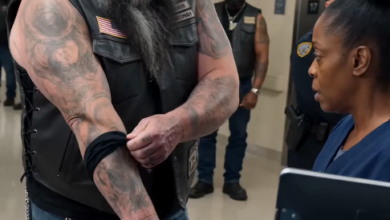
We worked out what was possible. Boone would lead the roof crew. Marlene could bring Ruth home for clothes. Luis could cover my morning appointments at the shop. I could be at the hospital from six until noon, then arrange the afternoon with people June had approved.
No procession. No engines outside a patient wing. No strangers crowding Nora.
Just a schedule.
Ruth watched us with an expression I couldn’t read.
“What?” I asked her.
“June thought you might be busy.”
“I am.”
She smiled then, tiredly. “That’s usually the problem.”
After breakfast, I drove my truck behind Ruth’s car to the hospital. Nora had asked whether I would bring the motorcycle, but a steady rain had begun, and I wanted room for anything they might need carried home.
At June’s room, I stopped outside the open door.
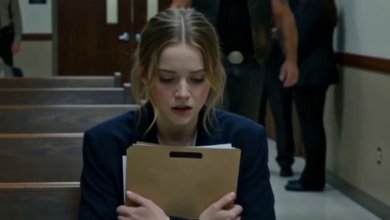
She was sitting upright with a blanket over her knees, wearing glasses and a loose gray sweater. There was nothing about her face I could have picked out of a crowd. Thirty years changes a child beyond recognition.
Then she saw me and pressed her thumb into her palm, exactly where the coin would rest.
“Still got the vest,” she said.
“Different vest.”
“Same shoulders.”
I didn’t know whether to hug her. She solved that by holding out her hand. I took it carefully, aware of the hospital wristband, the small adhesive marks on her skin, the ordinary signs of somebody having spent too much time being examined.
Ruth took Nora downstairs for a sandwich. June waited until they were gone.
“I was afraid you wouldn’t come.”
“I nearly turned your letter into a grocery list.”
She laughed softly. “Aunt Ruth would have appreciated the groceries.”
Then she looked at the chair beside her bed.
“Would you sit down?”
I did. For a few minutes, we talked about her work, Nora’s school, and the lousy parking garage. I began to relax. Perhaps meeting her alive, grown, and willing to remember me kindly was all the unfinished business I had carried.
Then she asked, “Was your wife’s name Beth?”
My hand stopped on the arm of the chair.
June looked down at the blanket.
“I thought so. I’ve been wondering how to tell you.”
Part 4 — The Woman Who Had Already Come Back
Beth had died seven years earlier. Most people who knew me knew that much. They knew she had taught second grade, that she could silence a room without raising her voice, and that I still drove past her old school sometimes without intending to.
They did not know the part I couldn’t forgive myself for.
She had become ill while I was away overnight collecting a used shop lift. Emily called me, then the hospital called. I started home immediately. A wreck closed the interstate. I took a secondary road and lost more time behind storm debris.
I spoke to Beth once by phone. She sounded annoyed with the gown they had given her. She told me where she had put the insurance cards. I told her I was coming.
By the time I arrived, she was gone.
There were people in the room. A doctor. A nurse whose face I barely registered. Emily stood beside the bed, staring at a paper cup crushed between her hands. The nurse said Beth had not been alone.
I heard it as something kind that people were trained to say.
Seven years later, June was watching me remember.
“I was working that night,” she said.
“At County?”
“Yes.”
I shook my head before I meant to. Not because I doubted her. Because there are moments when you can feel your mind trying to protect the shape of an old hurt. If something changes, you have to touch all of it again.
“You were her nurse?”
“For part of the night. Another nurse was managing her care. I was able to stay with her when your daughter had to step out.”
She wasn’t claiming credit for treatment. She was telling me who had occupied the chair.
Beth had asked June whether somebody had reached me. June said yes. Beth had described me as “a refrigerator with a beard,” which made June smile now and made my throat close.
“She said you would worry about being late,” June told me. “Not the drive. Being late.”
I stared at the floor.
“She said you’d spent a lot of your life trying to make up time.”
That was Beth. She could fit my whole history into one sentence and still leave room for affection.
June had stayed beside her. They talked about Emily’s teaching job, the mint plants taking over our back steps, and the fact that I never replaced a worn shirt until Beth secretly put it in the rag box.
Then Beth asked about the half dollar June kept in a small pouch clipped inside her work bag. June had taken it out during a quiet moment, turning it between her fingers.
“She noticed the mark,” June said. “Asked where I got it.”
June told her about the accident. About a big mechanic in a leather vest who had sat with her until Ruth arrived.
Beth asked his name.
When June said Raymond Dawson, Beth closed her eyes and smiled.
“She said, ‘That sounds like my Ray.’”
I put my hands over my face. Not to hide tears. Not yet. I needed something solid against my eyes because the room wouldn’t stay still.
“Why didn’t you tell me?”
“I tried to say something that night. You couldn’t hear much. There were people asking you questions, and your daughter needed you.”
She paused before continuing.
“I wrote afterward. Twice. Both envelopes came back.”
We had moved out of that house quickly. Too quickly, Emily said at the time. I sold the place with the mint plants and the bedroom where Beth’s reading glasses still lay on the nightstand. I told myself the move was practical.
June had sent the letters to the address Beth gave her.
“I could have kept looking,” she said. “I didn’t know whether reaching you would help or hurt. Then years passed.”
There was no accusation in it. That almost made it harder.
“What did she say?” I asked.
June understood what I meant.
“She asked me to tell you she knew you were coming.”
I waited.
“That’s all?”
“That’s what she wanted passed on.”
I had imagined a hundred final messages. Forgiveness. Instructions. Some enormous sentence that could make the ending bearable. Beth had left me something smaller and more exact.
She knew I was coming.
June reached into her bedside drawer and took out a folded sheet protected in a plastic sleeve. It was a copy of one of the letters she had tried to send.
I read the first lines, then had to stop.
The little girl from the rain had grown into the woman who sat with my wife while I fought traffic and counted miles. She had already returned the thing I thought she was only now asking to borrow.
“You don’t owe me Monday,” June said.
I lowered the letter.
“What?”
“I need you to hear that. This isn’t payment. What happened with Beth wasn’t payment, either.”
She was firm about it. A nurse’s voice, maybe. Or simply a woman who had spent too long preparing to be misunderstood.
“I didn’t know who she was when I sat down. She needed someone. That was enough.”
I nodded, but she kept looking at me until I said it.
“All right.”
“And you can say no. Nora has Ruth. My friends are helping. We won’t disappear if you can’t do this.”
That was the moment the coin changed again for me. It wasn’t a debt, or a token redeemable after thirty years. June hadn’t sent her daughter to collect.
She had given me a way to knock on a door I had spent seven years avoiding.
I folded the letter and asked whether I could keep the copy.
“That one’s yours,” she said.
On my way out, I stopped beside a vending machine and called Emily. We hadn’t had a real conversation in months. Our exchanges had become weather reports, birthday acknowledgments, and questions about whether the truck needed tires.
When she answered, I said, “I learned something about your mom.”
Her voice changed.
“Dad?”
I sat down before I tried to tell her.
Part 5 — Monday, Six O’Clock
Emily listened without filling the silence. That was another thing she had inherited from Beth. When I finished, she asked whether I was alone.
“Yes.”
“Are you okay to drive?”
“In a minute.”
She offered to come get me. I said I could manage, then caught myself turning kindness into something I needed to refuse.
“Could you stay on the phone a while?”
“Of course.”
We talked until the vending machine lights switched off behind me. I told her about June’s surgery and Nora’s question. Emily asked practical things: who was keeping Nora’s school informed, whether Ruth had meals, whether the child had somewhere familiar to sleep.
I had thought of rides and money. Emily thought of a toothbrush in the right bathroom.
She didn’t offer to repair our relationship that night. Neither did I. Before hanging up, she asked me to call after Monday’s update. It was a small opening. I tried not to lean on it so hard that it broke.
Sunday, our club met at the shop. The roof project was still happening. Boone stood beside a whiteboard, dividing tools and people into groups. I had expected somebody to complain about the hospital schedule, and a younger member named Travis finally did.
“So we’re pulling guys off a job for somebody Hammer knew one night?”
The room tightened. I could see three men preparing to answer him badly.
“Fair question,” I said.
It was. He had taken a day off work. He had a mortgage and two children, and he knew the housing project had been counting on us.
“Nobody’s being pulled off,” Boone said. “Roof’s covered.”
Travis glanced at me. “Then what do you need?”
“A lunch delivery. Maybe somebody to drive Ruth home later. Only if June wants that person involved.”
He studied the board again. “I can bring lunch.”
That was the size of the answer. No speech. No sudden transformation. Just a man finding something he could actually do.
We made one other rule: no photographs of Nora, no hospital posts, no story about what heroes we were. June could tell people whatever she wanted. We weren’t using her daughter to explain why we had missed a ride.
Monday morning, I arrived at five forty-seven with coffee for Ruth and a bag of plain bagels. Nora was wearing a purple sweatshirt and carrying a stuffed rabbit with one flattened ear. She looked at the clock above the elevators, then at me.
“You’re early.”
“Traffic behaved.”
She seemed to consider whether that was a good enough explanation. Then she moved her backpack off the chair beside her.
June had asked for Nora to see her before she went in. Ruth took her upstairs. I stayed in the waiting area, where a television explained home renovations to nobody.
When Nora returned, her face had changed. Not crying. Carefully arranged.
“Mom said she’ll see me afterward.”
I nodded.
“She said they think it will help.”
“That’s what she told me.”
Nora sat down and put the rabbit on her knees. “Do you think she’s scared?”
“Probably.”
“Me too.”
“I know.”
I could have told her to be brave. Instead, I opened the bag and asked whether she wanted the top or bottom half of a bagel. She chose the top. We ate over napkins while Ruth read the same page of a magazine without turning it.
Waiting was less impressive than riding in. It involved finding a bathroom, charging a phone, and learning which chair didn’t squeak. Nora colored a picture. Ruth fell asleep for eleven minutes and woke apologizing. I walked down the corridor to call Boone, who reported a problem with the roof decking and assured me they were handling it.
At noon, I was supposed to leave for the shop.
I had told Nora that clearly. Marlene was coming, and Ruth knew the plan. Still, when I stood to stretch shortly before twelve, Nora’s hand closed around the half dollar in her pocket.
“You going?”
“Not yet.”
The words struck me so hard I had to look away.
Thirty years ago, I had been able to stay until Ruth came. Now I had another promise across town: a customer who needed his work truck back, a mechanic covering for me, people whose lives didn’t stop because mine had become meaningful.
I knelt beside Nora’s chair.
“I’m leaving at twelve like we talked about. I’ll be back at three thirty. Ruth stays. Marlene’s coming to help.”
“What if Mom comes out while you’re gone?”
“Then Ruth calls me.”
“What if she doesn’t?”
I didn’t answer too fast.
“Then I come back at three thirty anyway.”
Nora looked at my face, checking the seams of that promise.
“All right.”
At the shop, I worked badly for the first fifteen minutes, then better. Ordinary work helped. There was a stubborn bolt, a parts delivery, a customer who had no idea where I’d spent the morning.
At three twelve, I washed my hands.
At three twenty-seven, I walked back into the waiting room. Nora saw me before Ruth did. She didn’t run over. She simply moved her backpack again.
The chair was still mine.
Part 6 — The Hours Nobody Could Shorten
The surgery ran longer than expected. Staff gave Ruth updates, but none contained the sentence Nora was waiting for. The afternoon light moved across the waiting room carpet. A man in work boots slept with his chin against his chest. Somebody’s soup went cold on a side table.
Travis arrived with lunch packed in individual containers, though it was almost dinner by then. He had remembered napkins and forgotten forks.
“Outstanding operation,” I told him.
He looked horrified until Ruth started laughing.
It was the first time she had laughed all day. Travis went hunting for utensils as though somebody had assigned him a rescue mission. Nora watched him leave and asked whether all my friends were that big.
“Some are bigger.”
“Do they all forget forks?”
“Most of us.”
For a little while, she ate. That counted as progress.
Near evening, Nora asked if her mother’s mother had died during an operation. Ruth set down her cup.
“No, honey. After the accident.”
“Mom said you came.”
“I did.”
“And Ray stayed.”
“Yes.”
Nora stared at the half dollar. “Then staying doesn’t stop it.”
The room seemed to go quiet around that sentence, though the television kept talking and the elevators kept arriving. I felt the old temptation again—to give her something smooth, something that sounded like certainty.
“No,” I said. “It doesn’t.”
Ruth reached for her hand.
Nora looked angry now, which was easier to see than the careful face she’d worn all day. “Then what’s the coin for?”
I took a breath.
“It wasn’t supposed to stop anything. Your mom needed something to hold.”
She turned it over. “I thought maybe—”
“I know.”
I didn’t know exactly what she had imagined. Luck, perhaps. A promise big enough to make hospitals behave. Adults do versions of that, too. We arrange objects, repeat sentences, and believe that if we love correctly, the worst thing will notice and go elsewhere.
Nora pushed the coin into Ruth’s palm.
“I don’t want it right now.”
Ruth closed her fingers around it without arguing.
I stayed where I was. There was nothing to fix with my hands. That was harder than any roadside repair I had ever made.
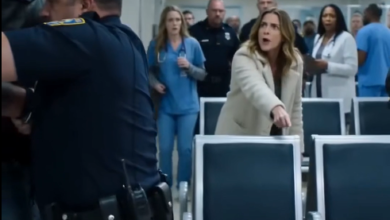
At a little after seven, someone came to speak with Ruth. She stood so quickly her cane fell against the chair. I picked it up while she listened.
June had come through the operation. There were things the team would need to watch closely, and recovery would take time. Ruth asked questions. I understood enough to know we were being given hope, not a guarantee.
When Ruth turned toward Nora, the girl searched her face before she spoke.
“She’s here,” Ruth said. “They’re taking care of her.”
Nora began crying then—quietly at first, then with her whole face pressed into Ruth’s sweater. I stood nearby holding a bag of forgotten bagels, feeling useless and grateful and more tired than I had been after a thousand-mile ride.
Later, when Nora was ready, we went where staff directed us. She could only visit briefly. I waited outside while Ruth went in with her.
Through the doorway, I heard Nora say, “Ray came back.”
Not that I’d bought lunch. Not that I belonged to a club. I had returned at the hour I named.
June’s answer was too quiet for me to hear.
Recovery wasn’t a straight line. There were difficult days, a longer stay than anybody wanted, and one afternoon when Nora refused to leave Ruth’s house for school. None of it became a montage just because we had reached the part where people hoped for one.
We brought groceries. We drove when asked. We stopped by when invited and left when June was tired. Boone finished the roof project, including the damaged decking, and sent me a photograph of the repaired building rather than the men who repaired it.
Emily came with me one Sunday. She brought soup in containers labeled with masking tape and asked June whether she could hear more about Beth.
I waited in the hallway with Nora while they talked. We shared crackers from a vending machine.
This time, nobody saved a packet for someone who wasn’t coming.
Part 7 — A Place for the Coin
June came home on a windy Thursday afternoon. The club did not line the street with motorcycles. She had specifically said she wanted a nap, not a parade.
So Luis fixed a loose porch rail before she arrived. Marlene stocked the refrigerator. Travis left a paper bag containing an absurd number of plastic forks. Nora discovered it first and laughed hard enough to call her mother from the hallway.
I helped Ruth carry her overnight bag to the car. She had stayed longer than she intended and was ready for her own bed.
“You know,” she said, “I tried to thank you properly thirty years ago.”
“You did.”
“I said two words in a corridor.”
“Seemed like enough.”
She leaned on her cane and studied me.
“You’ve gotten better at being thanked.”
I wasn’t sure that was true. I was trying.
A few weeks later, June invited me for dinner. Nora had set an extra place at the kitchen table and placed the half dollar beside my fork. For a second, I thought she was returning it.
“Is this where we’re keeping it now?” I asked.
She shook her head. “We need to decide.”
June brought a dish from the oven and lowered herself carefully into her chair. She still moved slowly. Some days she had more energy than others. The operation had helped, but it hadn’t turned her into someone who would never need care again.
We were learning the ordinary version of relief.
“What are the choices?” I asked.
Nora counted them on her fingers. “You. Mom. Me. Or a box.”
“A box sounds qualified.”
She ignored that.
“Mom says it’s yours because your dad gave it to you.”
“I gave it to your mom.”
“Mom says she only needed it that night.”
June smiled. “I may have kept it a little longer.”
Nora picked it up and examined the crescent in the rim. I had explained how the damage happened. She liked that part of the story: a grown man using a coin badly while trying to fix something else.
“Did your dad get mad?”
“At himself.”
“Did he throw it away?”
“No.”
She seemed satisfied.
After dinner, she brought out a small wooden box with uneven purple paint along the lid. Inside were a spare house key, a smooth stone, and a folded photograph of Ruth pretending not to enjoy a birthday hat.
“It can live here,” Nora said. “Then nobody has to carry it all the time.”
June looked at me over her daughter’s head.
I nodded. That sounded right.
Months passed. We found a rhythm that didn’t require an emergency. I came for dinner some Thursdays. Nora visited the shop with June and learned that mechanics spend a surprising amount of time looking for tools they were holding a minute earlier.
The club kept its existing commitments. June never became our public success story. At the diner, people occasionally asked how I knew Ruth’s family. I said we’d met a long time ago.
Emily and I began having breakfast twice a month. Sometimes we talked about Beth. Sometimes we argued over something small and managed not to let it become everything.
One morning she brought an old photograph of our backyard. Beth stood beside a patch of mint with gardening gloves tucked into her pocket.
“I didn’t want you to sell it so fast,” Emily said.
“I know.”
“I wasn’t ready.”
“I wasn’t, either. I just left.”
That was the whole conversation for a while. Then she slid the photograph closer and asked whether I wanted a copy. It wasn’t forgiveness on command. It was breakfast continuing.
The following October, nearly a year after Nora found me, I went to her school concert. June sat on one side of me, Ruth on the other. My leather vest creaked every time I shifted, and Ruth finally told me to hold still.
Nora spotted us from the risers. She raised one hand—not waving, exactly, just checking that we saw her. I raised mine.
Afterward, she asked if I could come next Thursday, too.
“What happens Thursday?”
“Nothing. Dinner.”
I checked my phone before answering. I had learned to do that.
“Yes. Six.”
At five fifty-eight the next Thursday, I parked outside their house. Rain tapped the windshield. Through the kitchen window, I could see June taking plates from a cupboard while Nora argued with the rabbit’s flattened ear.
On the shelf behind them sat the purple box.
The coin stayed inside.
I knocked.
Follow our page for more biker stories about old promises, chosen family, and the quiet people who keep finding their way back.