Part 2: A Dozen Bikers Surrounded a Police Car at Midnight — But the Child Inside Wasn’t Afraid of Them
Part 2
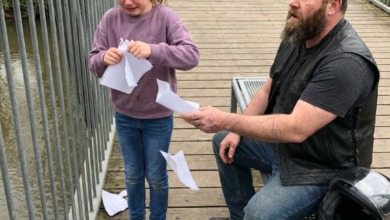
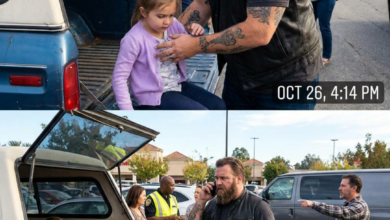
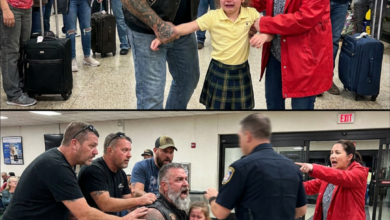
My name is Claire Dawson, and I worked twenty-six years in pediatric emergency care before I learned that fear does not always look like fear. Sometimes it looks like anger, sometimes it looks like silence, and sometimes it looks like a little girl pressing both feet against the inside of a police cruiser because the people trying to save her are wearing the wrong clothes.
The officer who had stopped me was named Daniel Price. I learned that later, after the road got quiet and the official report had to explain why a motorcycle club was standing around a police vehicle at 12:38 in the morning. At that moment, all I knew was that he looked exhausted, with a split lip, a torn sleeve, and eyes that kept moving between the child and the woods beyond the shoulder.
His partner, Officer Renee Walsh, stood nearer to the cruiser. She was calm, but her hands were clenched so tightly around her flashlight that her knuckles had gone pale. Her uniform shirt had a dark smear across the shoulder, and there was mud on one knee.
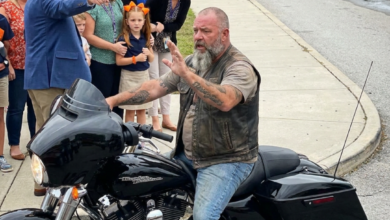
The bikers had formed a wide circle, not close enough to trap the police, but close enough to block the view from traffic. It took me a moment to understand that part. Their bodies were not a wall against the officers. They were a wall against the world.
The President stayed on one knee beside the rear passenger door, his leather cut creaking when he shifted his weight. The cold air smelled of exhaust, pine, wet leaves, and the faint metallic scent that always seems to appear after a hard night. His name, I heard one of the riders say, was Wade Mercer, but nobody called him Wade out there.
They called him Preacher.
That name sat strangely on him.
He had a cross tattooed behind one ear, but he also had scar tissue across one eyebrow and letters inked across his fingers that looked like they had been done in a kitchen, not a shop. His beard was white, his eyes were pale blue, and his face had the patient sadness of a man who had learned not every rescue ends the way you pray it will.
Inside the cruiser, Lily was curled on the far side of the back seat, wrapped in an emergency blanket. She was small for eight, with tangled brown hair stuck to her wet cheeks and one pink sneaker missing. Her hands clutched a stuffed rabbit so tightly its ear had twisted under her fingers.
Officer Walsh spoke softly through the open door.
“Lily, honey, we’re not taking you back there.”
The girl shook her head hard.
“No men.”
Her voice was hoarse.
“No uniforms.”
Officer Price stepped back immediately, guilt flashing across his face. He was not offended. He understood. That was the second thing that made me stop judging the scene too quickly.
Preacher did not move closer.
He looked at the ground near the cruiser door instead of staring at Lily, giving her the mercy of not being watched.
“No men in the car,” he said. “No uniforms near the door. You hear me say it, and they hear me say it.”
Officer Walsh nodded.
“That’s right, Lily. Nobody is coming in.”
Lily’s breathing stayed too fast.
I could hear it from where I stood, that sharp little inhale followed by a broken push of air. Panic breathing. I had coached children through it in emergency rooms after car wrecks, asthma attacks, dog bites, and nights they were too young to name.
“May I sit near the tire?” I asked.
Officer Walsh looked at Lily. “She’s a nurse, sweetheart. Her name is Claire. She’ll stay outside.”
Lily did not answer, but she did not scream either, so I took that as permission and lowered myself carefully onto the cold shoulder near the rear wheel. My knees complained, but I ignored them.
From that angle, I could see her eyes.
That is where the story changed for me.
She was not afraid of bikers.
She was afraid of the moment after rescue, when adults start deciding things over a child’s head and every safe word sounds like another order.
I looked toward Preacher.
“How long has she been like this?”
“Since they got her out of the house,” he said.
His voice was quiet enough that he did not startle her.
“How do you know her name?”
Preacher’s jaw moved once.
“Her granddad rode with us.”
One of the bikers behind him shifted his weight. A chain wallet clicked softly against denim. Nobody spoke, but grief moved through the circle like a wind.
Officer Price looked at me and explained the rest in low pieces. A neighbor had called 911 after hearing shouting from a rental house near the edge of Bellevue. The child’s mother was out of state for work, unreachable at first. The stepfather had been drinking and violent enough that both officers had to enter fast. Lily hid in a laundry closet and would not come out until Officer Walsh crawled low enough to show empty hands.
They had done almost everything right.
But when they got her into the cruiser, she saw Officer Price’s uniform in the front seat and folded inward like a snapped branch.
Then came the strange detail.
While Officer Walsh tried to calm her, Lily kept whispering one word.
Harley.
At first, they thought she was asking for a person.
Then Walsh remembered something Lily had said in the closet.
“Grandpa’s motorcycle.”
Preacher lowered his head.
His white beard hid most of his mouth, but not the way his throat tightened.
“Her granddad was Tommy Vale,” he said. “Road name was Saint.”
The rider with the cane behind him muttered, “Best man I ever rode behind.”
Preacher nodded once.
“Died last spring.”
Suddenly the engines made sense.
Not completely.
But enough to hurt.
The officers had called the only people who could bring back the sound of a dead grandfather without pretending the world had not broken.
Part 3
The crisis did not begin when the bikers arrived. It began ten minutes later, when a second police vehicle pulled up too fast and almost ruined everything.
A county deputy stepped out, young and broad, with his flashlight high and one hand near his belt. He saw the bikes, the circle of leather cuts, the patrol SUV, and the President kneeling beside the open door. His training filled in the wrong story before anyone could stop it.
“Everybody back away from the vehicle,” he shouted.
Lily screamed.
It was not a child being dramatic.
It was the sound of a body recognizing danger before the mind can explain that the danger has changed.
Preacher lifted both hands slowly, still kneeling, palms open to the deputy.
“Easy,” he said.
The deputy shouted again, louder this time.
The bikers did not move.
Not because they were defying him, but because none of them wanted the engines to surge, the boots to scrape, or the circle to break in a way that would make Lily think something was coming for her.
Officer Walsh turned sharply.
“Deputy, lower your voice.”
He hesitated, confused and embarrassed in the way young men get when they have walked into a scene they do not understand.
Officer Price moved toward him, speaking quickly, but the damage had already reached the child. Lily had jammed herself into the corner of the back seat, emergency blanket over her head, both knees to her chest.
Her breathing shifted from panic to danger.
Too fast. Too shallow. No rhythm.
I leaned toward the open door but stayed outside the frame of it.
“Lily,” I said, keeping my voice steady, “I’m Claire. I’m still by the tire. Nobody is getting in.”
No answer.
Preacher lowered his hands.
His left hand trembled once before he pressed it flat against his thigh. That tiny movement told me more about him than any patch on his vest.
He was not calm because this was easy.
He was calm because someone had to be.
“Engines down,” he said.
The riders adjusted without revving, without showing off, without turning the moment into noise. The rumble dropped into a slow, even pulse that filled the shoulder beneath us. It was not loud now. It was steady.
Preacher closed his eyes for half a second.
Then he began to breathe out loud.
Slow.
Measured.
Not like a therapist.
Like a man trying to keep himself from breaking open.
“In with the rumble,” he said. “Out with the quiet.”
Lily’s blanket shook.
He said it again.
“In with the rumble. Out with the quiet.”
The bikers behind him followed.
Twelve rough men and women in leather began breathing together on the shoulder of Highway 70, while blue lights flashed over their faces and passing cars slowed to witness a thing they could not easily describe.
Officer Walsh knelt beside me.
She took off her hat and set it on the asphalt.
That mattered.
Lily peeked from under the blanket.
The uniform was still there, but the shape had changed. A woman with tired eyes. Empty hands. No hat. No command.
“You are not in trouble,” Walsh said. “You are not going back tonight. I promise you that.”
The girl looked past her toward Preacher.
“Is Grandpa there?”
Nobody answered too fast.
That was mercy too.
Preacher swallowed, and I saw the big man’s eyes shine in the lights.
“No, sweetheart,” he said. “But his brothers are.”
The words hit the bikers behind him.
One man looked away toward the trees. Another closed his fist around a helmet so tightly the leather creaked. A woman with silver hair touched the patch over her heart and did not let go.
Lily slowly lowered the blanket.
Her face was pale except for one red mark along her cheek that made Officer Walsh’s mouth tighten. The child looked at the motorcycles, then at the old men, then back at Preacher.
“Grandpa said you were loud.”
A broken little smile almost reached Preacher’s beard.
“He was louder.”
Lily blinked, and a tear slid down without her wiping it.
“He said bikers don’t leave kids behind.”
Preacher bowed his head.
For a moment, every engine on that shoulder sounded like a promise being remembered.
Then the radio on Officer Price’s shoulder crackled.
The stepfather was in custody, but he was demanding the child be brought back to the house because he had “rights.”
Lily heard enough.
Her eyes went empty.
And the small progress we had made vanished.
She pressed herself against the opposite door and whispered, “He’ll find me.”
Preacher’s expression changed.
Not into rage.
Into something colder.
The kind of restraint men earn only after learning what rage costs.
“He won’t,” he said.
But Lily shook her head.
“You don’t know him.”
Preacher looked at the cruiser floor, then at the little rabbit crushed under her hands.
“I know men like him,” he said.
That was the first time I felt there was another story under his words.
Part 4
The main twist came from Officer Walsh’s body camera, not from anything dramatic Preacher said.
By then, the scene had stretched past one in the morning. An ambulance had arrived but stayed back because Lily refused to move from the cruiser, and nobody wanted to drag a terrified child from the first place she had decided was safer than the house.
A child protective services worker was on the way from Davidson County, but the night had that slow emergency feeling where everyone is waiting for the right person while the wrong fear keeps growing.
The deputy who had shouted earlier stood alone near his cruiser, shame written all over him.
The bikers kept the circle.
Engines breathing. Headlights low. No one performing toughness.
Then Officer Walsh reviewed a clip from her body camera to confirm Lily’s exact words from the house. She wanted to document the child’s fear of uniforms, but what she found was something else.
In the shaky footage from inside the rental home, Lily was inside the laundry closet, curled between a mop bucket and a basket of towels. Officer Walsh was lying flat on the hallway floor, speaking softly through the gap.
“Who can we call, Lily?”
The child’s answer was muffled.
“Grandpa.”
“Do you know Grandpa’s phone number?”
“He’s gone.”
Walsh’s voice softened. “Is there anyone else?”
A long silence.
Then Lily whispered, “The loud men.”
Walsh did not understand at first.
“What loud men?”
“The ones who came when Mommy cried.”
The camera shifted, catching only carpet, baseboard, and Lily’s bare foot tucked in shadow.
Then the girl said, “Grandpa said if bad men come, listen for the Harleys.”
Walsh paused the video there.
Preacher stared at the screen.
The riders behind him had gone completely still.
Officer Price looked at the President and asked, “What does that mean?”
Preacher did not answer right away.
A woman biker stepped forward from the circle. Her name was June, and she had the hard posture of a person who has held too many families together with both hands.
“Tommy made us promise,” she said.
Preacher’s jaw tightened.
June continued anyway.
“Before he died, he told us his granddaughter might need us someday. Said the stepfather had a temper. Said the mother was scared but not ready to leave. He didn’t want to make it worse unless Lily was in danger.”
Officer Walsh looked stunned.
“He reported it?”
“He tried,” June said. “Not enough proof. Not enough cooperation. You know how that goes.”
I did know.
Every nurse knows.
The worst homes often learn how to look normal when the right person knocks.
Preacher looked toward Lily, who was watching through the open door with huge, exhausted eyes.
“Saint kept a folder,” he said.
Officer Price frowned. “A folder?”
Preacher nodded toward one of the bikes.
“In my saddlebag.”
The deputy who had shouted earlier stepped forward. “I’ll get it.”
Preacher’s eyes moved to him.
The deputy stopped.
Then, more quietly, he said, “May I get it?”
Preacher gave one slow nod.
That was the second twist.
The bikers had not come only because of the sound.
They had come because a dead grandfather had prepared for a night he feared might happen.
The folder was thick, sealed in a plastic sleeve, with dates written in careful block letters. Photos of bruises on the mother’s arm. Notes about threats overheard through phone calls. A copy of a temporary protective order she had once started but never completed. Names of neighbors. Dates when Lily stayed overnight at her grandpa’s trailer after “accidents.”
And on the first page, in shaky handwriting, a note from Tommy Vale.
If my granddaughter ever asks for the loud men, believe her.
That sentence changed the road.
Officer Walsh read it twice.
Preacher looked away into the trees.
I understood then why the club President had come himself, why twelve riders had left their beds after midnight, and why the engines stayed low instead of roaring. They were not there to frighten anyone.
They were keeping a dead man’s promise at the exact volume his granddaughter could survive.
Part 5
After the folder came out, every small detail began to return with a different meaning.
The bikers had parked in a circle not to trap the cruiser, but to shield Lily from headlights, strangers, cameras, and the terrifying openness of the road. Their Harley lights were not aimed at the police. They were angled outward, forming a border that kept passing cars from seeing too much of a child’s worst night.
The silence had not been intimidation.
It had been discipline.
Even the President’s kneeling position made sense now. Preacher had stayed below Lily’s eye level the whole time, never blocking the door, never making himself bigger than he already was.
That is the thing people do not understand about men who have learned restraint the hard way.
They know their size has consequences.
Preacher knew.
He used every inch of his body carefully, as if one wrong movement could become another wound Lily would carry.
The child protective services worker arrived close to two in the morning, a middle-aged woman named Mrs. Alvarez with a wool coat thrown over pajama pants and the kind of eyes that had seen enough to skip politeness without losing kindness.
She read the note from Tommy Vale.
Then she crouched near the open cruiser door, well outside Lily’s reach.
“Your grandfather wrote this for you,” she said. “He wanted us to listen.”
Lily looked at the folder.
Her lower lip trembled.
“Grandpa knew?”
Preacher answered before anyone else could turn it into paperwork.
“He knew you were brave,” he said.
That was all.
Not the whole ugly truth.
Not the history.
Not the failures.
Just the one thing a child could hold.
Mrs. Alvarez explained that Lily would not be returned to the house that night. Her mother had finally been reached and was driving back from Knoxville with a state trooper escort arranged through family services. Until then, Lily could go to a children’s advocacy center, or, if she needed a few minutes first, she could sit with the engines until she was ready.
Lily looked at Officer Walsh.
“Can she come?”
Walsh nodded immediately.
“Anywhere you want me.”
Then Lily looked at Preacher.
“Can the loud men come too?”
The official answer should have been complicated.
Jurisdiction. Procedure. Liability. Boundaries.
But Mrs. Alvarez had been doing the job long enough to know when safety arrives in unusual clothes.
“They can follow,” she said. “From behind.”
Preacher nodded once.
“No closer than you want.”
Lily looked down at her stuffed rabbit.
“Grandpa always rode in front.”
The riders behind Preacher shifted.
That grief moved again.
Preacher touched two fingers to the patch on his chest. I had not noticed it before because it was black thread on black leather, almost hidden beneath a larger club emblem.
Saint.
Tommy’s road name.
Preacher stood slowly, knees stiff, boots scraping softly against the asphalt.
“Then tonight he rides in front,” he said.
A rider brought Tommy’s old helmet from one of the bikes.
It was scratched and faded, with a small angel sticker on the back that looked like a child had placed it there years earlier. Preacher held it with both hands, and for the first time that night, he looked less like a President and more like a brother carrying the last piece of someone home.
He placed the helmet on the passenger seat of his own Harley, secured it with a strap, and stepped back.
Lily watched through the cruiser window.
Her breathing changed.
Not fixed.
Not healed.
But steadier.
Officer Walsh helped her out of the cruiser by letting Lily hold the edge of her sleeve instead of her hand. That choice mattered. A child who has had too many hands on her body should be allowed to choose how contact happens.
When Lily’s pink sneaker touched the asphalt, the bikers all turned slightly away.
Not because they did not care.
Because they did.
No staring.
No crowding.
No pity pressed against her face.
Only engines waiting in the cold.
Preacher did not approach until Lily nodded.
Then he knelt again, slower this time, and kept his hands resting on his own knees.
“You did real good,” he said.
Lily stared at his beard.
“You sound like Grandpa.”
Preacher’s eyes went wet, but no tear fell.
Biker men of his generation often know how to bleed before they know how to cry.
“He taught me how to talk when it mattered,” he said.
That was the third twist.
Tommy Vale had not just been a member of the club.
He had once saved Preacher too.
June told me later that Preacher had come to them twenty years earlier after prison, after losing his family, after almost becoming the kind of man nobody lets near children. Tommy was the first one who made him sleep on a couch instead of in a bar parking lot. Tommy was the first one who said, “You can be dangerous, Wade, or you can be useful. Pick one.”
Preacher picked useful.
And twenty years later, he was kneeling outside a police cruiser, using everything dangerous about his presence to make a little girl feel protected instead of afraid.
Part 6
The ride to the advocacy center lasted only sixteen minutes, but people in Nashville still talk about it like it was a funeral procession, a rescue escort, and a ghost story all in one.
Officer Walsh drove the cruiser with Lily in the back seat and Mrs. Alvarez beside her. Officer Price followed behind them. The deputy who had shouted stayed last, not because anyone ordered him there, but because he seemed to understand he needed to watch rather than lead.
The bikers rode in two lines around the police vehicles, not blocking traffic, not speeding, not showing off. Preacher rode at the front with Tommy’s old helmet strapped beside him, and the rest kept their engines low enough that the sound came through the cruiser like a memory instead of a threat.
I followed in my little gray Honda because nobody told me not to, and by then I could not leave.
At the center, Lily did not want to go inside at first.
Buildings can become scary when too many adults say they are safe.
Preacher stopped his Harley near the curb and turned the engine off, but Lily immediately tensed inside the cruiser. He saw it through the rear window.
So he started the engine again.
Not loud.
Just enough.
The soft rumble filled the driveway.
Lily stepped out.
Officer Walsh stayed beside her, hat still off, uniform jacket unzipped so she looked less like the thing Lily feared. Mrs. Alvarez opened the front door and waited without calling her name too many times.
That matters too.
Adults love repeating a scared child’s name as if ownership can calm terror.
Preacher knew better.
He simply sat on his bike, gloved hands resting on the bars, while Lily walked one step, then another, toward the doorway.
Halfway there, she turned back.
“Will you be here when Mom comes?”
Preacher looked at Mrs. Alvarez.
She gave a small nod.
He looked back at Lily.
“Until she does.”
Lily studied him for a long moment, deciding whether men could still mean what they said.
Then she went inside.
The bikers stayed in that parking lot until sunrise.
Nobody drank.
Nobody smoked near the entrance.
Nobody made the night about them.
They stood by their bikes with coffee from a gas station and spoke in low voices while the city slowly changed colors around them. The sky went from black to bruised purple, then to that pale Tennessee blue that makes ordinary places look forgiven for a few minutes.
At 6:12 in the morning, Lily’s mother arrived.
She came out of a state trooper’s vehicle before it fully stopped, barefoot in slip-on shoes, hair tangled, face hollowed by a fear I recognized too well. She had the look of a woman who had spent years explaining bruises until the explanations became smaller than the danger.
She ran inside.
We heard Lily cry out once.
Then both of them were crying.
Preacher turned away from the window.
He gave them privacy, but I saw his shoulders loosen.
June stood beside him.
“Saint would’ve liked that,” she said.
Preacher nodded.
“He should’ve been here.”
June looked at Tommy’s helmet on the Harley seat.
“He was.”
That was as close as bikers get to church sometimes.
A week later, I learned what happened to the stepfather through Officer Walsh. He was charged, and because of Tommy’s folder, the case had more than one night of evidence. Lily and her mother entered a protected housing program. The club paid for the first month of storage so they would not have to return to that house for their belongings.
Nobody announced it online.
Nobody posed for a photo.
The only reason I know is because Mrs. Alvarez told me quietly in the hospital cafeteria when she brought another child in for evaluation.
“Those bikers,” she said, stirring sugar into terrible coffee, “they show up cleaner than some church committees.”
I laughed, but softly.
Because she was right.
Two months later, I saw Preacher again at a grocery store on Charlotte Pike. He was standing in the cereal aisle with a shopping cart full of bottled water, socks, granola bars, and three boxes of Lucky Charms.
He looked terrifying under fluorescent lights.
A little boy pointed at him and hid behind his father.
Preacher noticed.
Then he reached into his cart, picked up one box of cereal, and set it back like he had suddenly remembered the world was always watching him first and understanding him later.
I almost walked past.
Instead, I said, “How’s Lily?”
He looked at me for a moment before recognition settled in.
“She’s got two shoes now,” he said.
That was all he offered at first.
Then his face softened.
“She sends us drawings.”
“What kind?”
“Motorcycles mostly,” he said. “Bad wheels. Good hearts.”
I smiled.
He looked down at the cereal boxes.
“She drew Saint with wings last week.”
His voice went rough at the edges.
I did not make him say more.
Some men share grief the way they pass a wrench: briefly, carefully, and only to someone who will not drop it.
Part 7
Every month now, on the first Friday after sunset, a few Harley engines idle outside the children’s advocacy center in Nashville.
Not close to the doors.
Not loud enough to scare anyone.
Just present.
Sometimes a child asks to hear them. Sometimes no one does, and the riders leave after ten minutes without being seen by anyone who matters. Preacher still rides in front when the night calls for it, but Tommy’s helmet stays strapped to the passenger seat whenever Lily is involved.
She is nine now.
Her mother works mornings at a bakery and nights toward a nursing certificate, and Lily keeps a picture of her grandfather taped inside her closet door. Beside it is another drawing, made in purple crayon, of twelve motorcycles around a police car under a black sky.
At the bottom, in careful child handwriting, she wrote: They weren’t trapping me. They were keeping the dark out.
I still think about that night whenever I hear motorcycles after midnight.
I think about how wrong fear can be when it dresses itself as certainty. I think about a police officer wise enough to call men the world mistrusted, and a biker President strong enough to kneel instead of stand tall.
Mostly, I think about Lily stepping from that cruiser while twelve engines breathed for her.
And Preacher whispering beside the door.
“Just breathe with the engines.”
Follow the page for more stories about the people we nearly misunderstand before we finally see them.