Next part: A Bruised Young Mother Ran Into A Tennessee Diner At Midnight With Her Little Girl And Her Dog, Begging A Tattooed Biker To Pretend He Was Her Husband. The Man Hunting Her Wore A Badge. And The Photo In Her Daughter’s Pocket Changed Everything.
Part 2 — The Door
Ronnie Haskett filled the doorway like he owned it.
He was thirty-three, clean-cut and polite, the kind of deputy who coached T-ball and remembered every waitress’s name. He took off his hat and shook the rain from it.
“Evening, Darlene.” Then, softer: “Emmy. Let’s go home, baby.”
Emmy didn’t move. She held Maisie so tight the little girl squeaked.
“She’s with me,” Hollis said.
Ronnie looked him up and down, from the braided beard to the tattoos to the patch on the vest, and smiled like he’d been handed a gift.
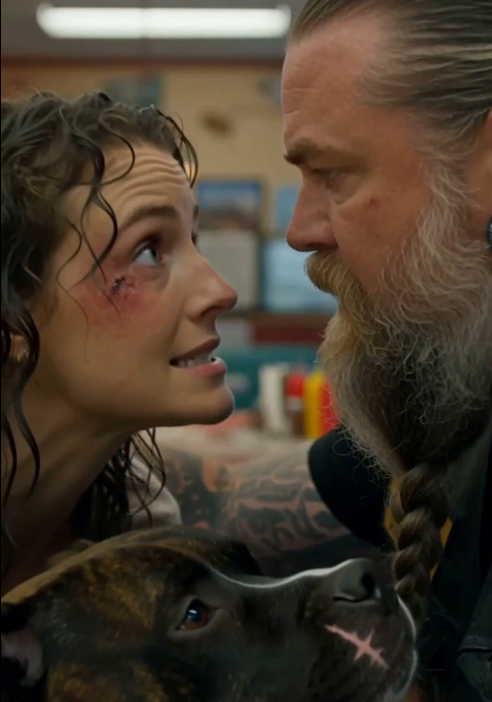
“That right? And who are you supposed to be?”
“Her husband.”
Ronnie laughed out loud. “Well, that’s funny, because I’m her husband. Got a marriage license and a mortgage to prove it.” He stepped forward. “Move, sir.”
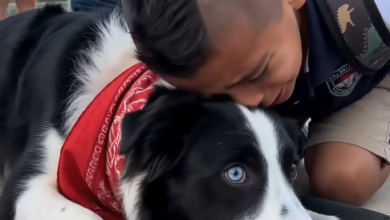
Honey growled. It was a low, rolling sound from deep in her chest, and her one good ear went flat.
“And that dog bit me tonight,” Ronnie said. “She’s going to animal control.”
Behind the counter, Darlene raised her phone and held it steady. The trucker in the booth sat up, awake now. Four witnesses, two cameras. Hollis watched the deputy count them.
“You got a warrant, show it,” Hollis said. “Otherwise she stays till sunup and leaves when she wants.”
Ronnie’s jaw worked. Then he dropped his voice, reasonable and sad.
“You don’t know what you’re stepping in, biker. She’s sick. She’s off her meds. She ran out into a thunderstorm with my daughter at midnight.” He looked past Hollis at his wife. “This isn’t over, Emmy. Dad’s gonna want to talk to you.”
He left. The cruiser sat idling in the lot for four full minutes with its lights off. Then it pulled away.
Hollis sat down hard in the nearest booth.
His hands were shaking, and that bothered him more than the gun had.
Because Ronnie had put a splinter in him. She’s sick. Off her meds. Hollis didn’t know this woman. He’d taken a stranger’s whisper over a lawman’s word because of a bruise and a pair of eyes, and the last time he’d trusted his gut over his good sense, somebody had died.
Maisie had fallen asleep across her mother’s lap. The photo was still in her fist.
Emmy gently worked it free and turned it over. On the back, in faded blue ballpoint, was a looping woman’s handwriting Hollis had not seen since he was twenty-one.
My two wild ones. Hollis & Emmy-bug. July 2002.
Emmy looked at him. At the ladybug on his thumb.
“Hollis?” she whispered.
He couldn’t answer. He just nodded, and the whole diner went blurry.
On October 17, 2003, he had been supposed to stay home with her. His mother, Carla, had a late shift at the Cracker Barrel on Interstate Drive. But Hollis was twenty-one, and there was a party in Sparta, and a girl, and a bike with a full tank. He’d told his mother he’d be back by ten.
So Carla had buckled Emmy into the back seat of her yellow Grand Am and taken her along.
Carla never came home. Hit-and-run, Highway 111, the report said. Emmy was four. The state decided a twenty-one-year-old with a bar fight on his record wasn’t fit to raise her. The adoption was sealed. He had searched for twenty years. Three years ago, he’d finally stopped.
If I’d stayed home that night.
He’d been saying it to himself for twenty-three years.
Headlights washed across the window again. This time it was a white Tahoe with a gold star on the door.
A tall older man climbed out slowly, settled a cream Stetson on his head, and walked toward the diner like a grandfather coming to church.
Emmy’s face went white. She grabbed Hollis’s hand under the table.
“That’s Ronnie’s dad,” she breathed. “Don’t let him near Maisie.”
Why would a woman be more afraid of a kind-faced old sheriff than of the husband who’d just threatened her?
Part 3 — Emmy-Bug
The summer of 2002 smelled like cut grass and two-stroke oil.
Carla Grady rented a tin-roofed house on Old Sparta Road with a carport that leaked. She waited tables at the Cracker Barrel, sang Patsy Cline while she did the dishes, and called her children “my two wild ones.” She said it like a complaint. It never was.
Hollis was twenty and had just bought his first bike, a rusted chopper he rebuilt from parts under that leaky carport. His three-year-old sister sat on an upturned bucket and watched him for hours.
She was obsessed with ladybugs. So he called her Emmy-bug, and nobody else was allowed to.
He painted her a helmet. Red with black dots, three sizes too big. She wore it to the grocery store. She wore it to bed. Carla took a picture of the two of them on the chopper with a drugstore camera and wrote on the back in blue ballpoint.
At night, when Emmy had bad dreams, Hollis would tap the back of her hand three times.
I got you, bug.
It worked every time.
That August, Carla sewed Emmy a stuffed ladybug out of red felt, with black button spots, and stitched a crooked white E on its belly so it could never get mixed up at daycare. Emmy named it Dot. Dot went everywhere Emmy went.
Carla kept the photo tucked in the sun visor of her yellow Grand Am. “So I’ve got my wild ones with me,” she said.
And every time she buckled Emmy into that back seat, she said the same thing to Hollis, half joking.
“If anything ever happens, you get my Emmy-bug out first. You hear me?”
He always said he heard her.
Part 4 — The Sheriff’s Offer
Sheriff Earl Haskett took off his hat before he came through the door.
He was sixty-three, with a silver mustache and a slow Middle Tennessee drawl. He’d been sheriff of Putnam County for five terms, and he looked like the kind of man you’d trust with your grandkids. He nodded to Darlene, then walked to Emmy’s booth and stopped a respectful six feet away.
“Emmy, honey.” His voice cracked a little. “I am so sorry.”
He laid a sheet of paper on the table. It was an administrative leave order, signed and time-stamped 11:58 p.m. tonight. Deputy Ronald Haskett, relieved of duty pending internal review.
“I suspended my own son on the drive over,” Earl said. “Whatever he did to you tonight, he’ll answer for it. I should’ve seen it sooner.” He looked at Maisie, asleep, and his eyes glistened. “There’s a bed at Genesis House. It’s a women’s shelter, right here in Cookeville. I already called Linda. They’re expecting you.”
Emmy stared at the paper. Her grip on Hollis’s hand loosened, just slightly.
It was a good offer. It sounded like help.
“And you.” Earl turned to Hollis and nodded toward the door. “Walk with me a minute, son.”
Outside, the rain had softened to a mist. The sheriff stood under the diner awning, next to Hollis’s bike, and spoke low.
“I know who you are. Grady. You’re Carla’s boy.” He sighed. “I was one of the first deputies on scene that night in ’03. Terrible thing. I never forgot it.”
He took out his phone and showed Hollis a photo of a typed report.
Witness states a motorcycle was observed traveling eastbound at high speed from the scene at approximately 11:40 p.m.
“Somebody saw a motorcycle leaving that crash, Hollis.” Earl’s voice was gentle. “You were on 111 that night. Coming home from Sparta. I know you were.” He put a hand on Hollis’s shoulder. “I never pushed it. You were a grieving kid. But you walk into my county twenty-three years later and put yourself between my son and his family? Folks are going to start asking questions I’ve kept quiet a long time.”
Hollis’s mouth went dry.
He had been on Highway 111 that night. He’d been riding home from Sparta around eleven-thirty, drunk on cheap beer and a girl’s laugh, pushing the chopper way too fast through the curves.
He didn’t remember seeing a wreck.
But he didn’t remember much of that ride at all.
When he turned back to the diner, Emmy was standing at the glass door. She’d heard. She was looking at him, and for the first time that night, she looked afraid of him.
Had Hollis Grady ridden past his own mother’s wreck in the dark and kept going?
Part 5 — What the Collar Held
Emmy and Maisie spent the rest of the night at Genesis House. Dogs weren’t allowed, so Honey went home with Hollis to the small apartment above the fabrication shop in Algood. She slept across his doorway, the way she must have slept across Emmy’s.
Hollis didn’t sleep at all.
At 7:10 a.m., his phone rang. It was an unknown number.
“It’s Emmy.” She was whispering. “I’m on the shelter phone. Listen to me. Honey’s collar. Cut the inner lining. Near the buckle.”
He found it with his pocketknife: a tiny heat-sealed bag, sewn between two layers of nylon.
Inside was a microSD card.
He put it in his laptop. There were forty-one photos, all taken on a phone in a dim garage.
A Rubbermaid tote on a concrete floor. A folder of yellowed papers. A handwritten police report on a carbon-copy form, dated October 18, 2003, and signed by a Deputy Carl Moody.
Hollis read it three times.
Debris at scene: white automotive paint transfer, one chrome push-bar bracket consistent with law enforcement pursuit vehicle. Rear seat occupant: female child, approx. 4 yrs, removed from vehicle by responding officer E. Haskett prior to EMS arrival.
No motorcycle. No witness. And a child in the back seat, pulled out of the wreck by Earl Haskett himself.
The next photo was the official typed report, the one on file with the county. It said single occupant. It had a witness who saw a motorcycle. And at the bottom, in small print, was a revision stamp.
Amended: March 11, 2019.
Hollis felt the floor tilt. March 2019 was the month he’d posted on every Tennessee Facebook group he could find. Looking for my baby sister Emily Grady. We called her Emmy-bug. Born 1999, Cookeville. Please share. Forty thousand shares.
Somebody had seen it and started rewriting history.
There was more.
A body-shop invoice from a garage in Sparta, dated October 20, 2003. Ford Crown Victoria, white. Replace front push bar, right fender. Paid cash: $1,900. Customer: E.H.
And at the bottom of the tote, photographed on top of the papers, was a small red felt ladybug with black button spots.
A crooked white E was stitched on its belly.
Dot.
Hollis made a sound he didn’t recognize. Honey lifted her head and pressed her muzzle into his knee.
The last photo was a screenshot of a text thread on Ronnie’s phone, from Earl to Ronnie, dated three weeks ago.
Keep her home. Keep her off that computer. You know what’s at stake for this family. Election’s in August.
Hollis called the shelter back.
“Three weeks ago I found that box,” Emmy whispered. “I was looking for Christmas lights. That’s when Ronnie started hitting harder. He knew what I’d seen.” Her voice broke. “Earl drove his cruiser that night. He hit Mom, Hollis. He pulled me out. And then he let the whole county believe it was nobody.”
“And then made sure it looked like me.”
Through the phone, he heard a door open, voices, a man saying her name.
“Emmy?”
The line went dead.
Two minutes later, his phone buzzed again. It was a text from Tiny Beasley, who rode with him in the Cumberland Ridge Riders.
Brother. Channel 4 just ran your face. Warrant’s out. Aggravated kidnapping.
How do you prove the truth when the man who writes the reports is the one you’re accusing?
Part 6 — Eleven Miles
By noon, Hollis Grady was the most wanted man in Putnam County.
The sheriff’s office statement ran on every Nashville station. A local motorcycle club member, previously convicted of assault, forced his way between a deputy and his family overnight and is believed to be holding the deputy’s wife against her will. Consider him dangerous.
The 2003 bar fight, the one that had cost him his sister, was on the evening news.
At 12:40, two deputies and a county doctor arrived at Genesis House with an emergency certificate for involuntary mental health evaluation, signed by Ronnie Haskett and Dr. Glen Whitt, who had been Earl’s fishing partner for twenty years. The shelter director argued with them for fifteen minutes. She lost. Emmy was driven to the behavioral health unit at Cookeville Regional in the back of a cruiser.
Maisie went home with her grandparents.
Hollis wasn’t at the shop when they came for Honey. His landlord watched through the window as animal control used a catch pole on her. Ronnie’s complaint was attached to the seizure order: Dog bit a law enforcement officer. Dangerous dog. Recommend euthanasia.
Her hearing was set for Monday morning.
At 2:15, a search warrant team went through Hollis’s apartment. They took his laptop and every phone charger he owned, and they took the microSD card out of the laptop’s slot.
Evidence related to kidnapping, the receipt said.
His boss at Algood Metal Fab called at three. “Hollis, I got a sheriff’s lieutenant sitting in my office. I can’t have you on the floor right now. I’m sorry, man.”
Three of his club brothers were pulled over on State Route 111 within an hour, one after another. Cracked taillight. Expired tag. Failure to signal. Every one of them was searched and held on the roadside for ninety minutes.
The message was clear. Anybody who stood next to Hollis Grady would pay for it.
By nightfall, he had a bike he couldn’t ride without being spotted, a phone he’d shut off so it couldn’t be tracked, and no evidence. The woman he’d just found was locked in a hospital ward, and the only person who believed her was him.
He did the only thing he could think of.
He walked.
It was eleven miles along the back roads to a curve on Highway 111 west of Sparta. He’d put a white wooden cross there himself, twenty-three years ago, with two-by-fours and a can of paint. Every few years he came back and repainted it.
It was nearly midnight when he got there. The rain had come back. He sat down in the wet gravel with his back against a fence post and stared at the cross in the dark.
You get my Emmy-bug out first. You hear me?
He had heard her. He just hadn’t been there.
Then, from somewhere down the highway, came a sound. A jingle. Paws on wet asphalt, uneven and limping.
Honey came out of the darkness. Mud to her belly. Her collar was gone. There was a torn scrap of chain-link wire still caught in the fur of her back leg. She had dug out under a kennel run somewhere and crossed half the county in the rain.
She didn’t come to Hollis.
She went straight to the cross, put her nose to the base of it, and started digging, fast and hard, as if she’d been there a hundred times before.
What was buried under his mother’s cross that a dog would cross eleven miles to find?
Part 7 — What Emmy Buried
It was a Mason jar, wrapped in two trash bags and a strip of duct tape, buried eight inches down under the base of the cross.
Honey sat back on her haunches, panting, and watched Hollis open it with muddy hands.
Inside were the originals. The carbon-copy report in Deputy Moody’s handwriting. The body-shop invoice from Sparta. And Dot, the little red ladybug, soft and faded now, with its crooked white E.
There was also a folded letter on Genesis House stationery, dated Thursday, and a photocopy of a cashier’s check.
Pay to the order of Emily Haskett. $40,000.00. Drawn on Earl Haskett’s personal account at First National Bank of Cookeville. Dated ten days ago.
Hollis read the letter by the light of a passing truck.
Hollis,
If you’re reading this, something went wrong and Honey brought you here. She’s been coming here with me every Sunday for two years. Ronnie thinks we go to the park.
I need to tell you the truth, because I’ve lied to everybody else.
When I found the box, I didn’t go to the police. I went to Earl. I told him I’d make copies, and that I wanted forty thousand dollars to take Maisie and disappear, and I’d never show anybody. He paid me in two days.
I sold out Mom, Hollis. I sold out what he did to her so I could get my baby out of that house. I wasn’t going to fight. I was going to run to my cousin’s in Oregon and let it all stay buried. Even Mom.
And there’s something else.
I knew who you were. I found your Facebook posts two years ago. Emmy-bug. I read every one. I never answered, because Ronnie read my phone and because I was ashamed of what my life had turned into. I also knew you ate at the Blue Moon every Thursday after your shift. When I ran tonight, I didn’t run toward the lights.
I ran toward you.
I used you. I’m sorry. I didn’t know how else to ask.
— Emmy
Hollis sat in the rain for a long time with the letter in his lap and Honey’s head on his knee.
He was angry, and it surprised him how much. She’d taken money from the man who killed their mother. She’d watched him search for two years and said nothing. She’d picked him out like a tool from a shelf.
Then he thought about a twenty-one-year-old kid riding to a party in Sparta while his mother buckled a four-year-old into a yellow car.
Nobody in this family had clean hands. Not one of them.
Earl had paid her and gotten nothing back. That was why the violence got worse, and why they needed her locked in a ward and the dog destroyed. Earl hadn’t bought her silence. He’d only proven she had something worth buying.
At 6:15 a.m., Hollis borrowed a phone from a farmer loading hay at a feed store in Sparta and called Tiny.
Tiny called his cousin, a paralegal in Nashville. The paralegal called Special Agent Monica Reyes of the Tennessee Bureau of Investigation.
At 9:40 a.m., Dr. Anjali Patel, the attending psychiatrist at Cookeville Regional, discharged Emmy Haskett. There was no clinical basis for involuntary hold, she wrote in the chart, and she added a note about the certifying physician that would later end his career.
Emmy called the number Tiny had given her. Her voice was hoarse.
“Is Honey okay?”
“She found Mom’s cross,” Hollis said. “She found all of it.”
Emmy started to cry.
“Earl’s announcing for re-election at five today,” she said when she could talk. “Courthouse square. Channel 4’s covering it live. Ronnie will be there with Maisie. Earl wants the town to see a family.”
Agent Reyes had agreed to be there too.
But would a jar of old papers be enough against a man who had already rewritten the truth once?
Part 8 — The Courthouse Square
At five o’clock on Saturday, the courthouse square in Cookeville was packed. Four hundred people stood on the lawn around the old limestone courthouse. There was a bluegrass band, a table of sweet tea in plastic cups, and a Channel 4 camera on a tripod by the gazebo. A local Facebook page was streaming live.
Sheriff Earl Haskett stood at a podium draped in red, white and blue. His wife, Patsy, sat behind him with Maisie on her lap. Ronnie stood beside them in a pressed civilian suit, his suspension already forgotten by the crowd.
“Thirty years,” Earl was saying, “I have given this county my whole heart—”
The rumble started on Broad Street.
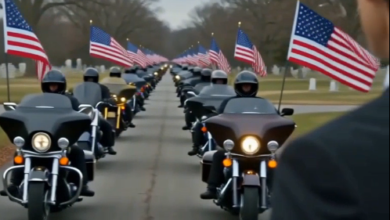
Sixty motorcycles from the Cumberland Ridge Riders rolled onto the square in a slow double line. When they reached the curb, every engine cut at once. The silence was so sudden that the banjo player stopped mid-song.
Hollis walked across the grass. Emmy was beside him in a borrowed denim jacket, her bruise still yellow-purple at the edges. Honey walked between them on a short leash, clean now, with a TBI evidence tag clipped to a new collar. Agent Monica Reyes walked behind them with a leather briefcase.
The crowd parted.
Earl’s smile never moved. “Folks, that man is wanted for kidnapping. My daughter-in-law is not well. Deputies—”
“Sheriff.” Reyes held up her credentials for the camera. “Tennessee Bureau of Investigation. We have some questions about October 17, 2003.”
A murmur rolled across the lawn.
Earl chuckled, warm and easy. “Ma’am, I answered those questions twenty-three years ago. That was a hit-and-run. I never met the Grady family in my life. I was home in bed that night. Ask my wife.”
Patsy stared at her lap.
Emmy stepped up to the second microphone, the one meant for the prayer. Her hands were shaking. She held up a carbon-copy form so the Channel 4 camera could see it.
“This is the original report. The one Deputy Carl Moody wrote the morning after. It says a child was pulled from the back seat.” Her voice cracked. “It says you pulled her out, Earl. I was in that car.”
“That’s a forgery,” Earl said sharply. The warmth was gone. “She’s been in a psychiatric ward, folks. This poor girl doesn’t know what’s real.”
Then his face softened, and he leaned toward her, almost fatherly, speaking into the microphone.
“Emmy-bug, honey, you were four years old. You can’t possibly remember a—”
He stopped.
The whole square heard it.
Hollis stepped forward, his voice very quiet. “What’d you call her, Earl?”
Earl said nothing.
“Nobody on this earth has called me that since the night my mother died,” Emmy said. Tears were running down her face, but she didn’t wipe them. “Not Ronnie. Not Patsy. Not you. Not once in the six years I’ve been in your family.” She held up the small red ladybug with the crooked white E. “The last person who said it was my mother. In that car. Telling whoever was standing outside the window to get her Emmy-bug out first.”
Four hundred people went completely silent.
“You kept her toy in your garage for twenty-three years,” Emmy whispered.
Earl took one step back from the podium.
Maisie had slipped off Patsy’s lap and was running toward her mother across the grass. Earl reached down for her, fast, maybe out of habit, maybe not.
Honey moved.
She didn’t bite. She didn’t bark. She stepped between the little girl and the old man’s hand and stood there, stiff-legged, her one good ear straight up and a low rumble in her chest.
Earl’s hand stopped in the air.
Then Ronnie Haskett walked out from behind his father. His face was gray.
“Dad,” he said. His voice was shaking. “You told me she saw a motorcycle.”
Would Ronnie Haskett protect his father one more time, with the whole county watching?
Part 9 — I Got You, Bug
He didn’t.
Ronnie took his badge from his pocket, the one he wasn’t supposed to be carrying while suspended, and laid it in Agent Reyes’s open hand.
“I’ll tell you everything,” he said hoarsely. “What he told me about 2003. What he paid me to do. And what I did to her.” He didn’t look at Emmy. He couldn’t. “All of it.”
Earl Haskett was escorted off the courthouse square at 5:31 p.m. by two TBI agents, in front of four hundred voters and a live camera. He didn’t say a word.
In the months that followed, a Putnam County grand jury indicted him on charges of fabricating evidence, official misconduct, and tampering with government records. The district attorney reopened the 2003 death of Carla Grady. Deputy Carl Moody, now retired in Florida, flew back to testify. He said he’d been ordered to “lose” his original report, and that he’d kept a copy in his own garage for twenty-three years, just in case. Earl withdrew from the sheriff’s race in June.
Ronnie Haskett pleaded guilty to domestic assault and violating his oath. He lost his badge and his pension, and he got a two-year protective order he’d never be able to talk his way around. He asked, through his lawyer, to see Maisie someday. Emmy said maybe, when Maisie was old enough to decide for herself.
Emmy turned the forty thousand dollars over to the TBI as evidence, uncashed from the account she’d parked it in. The prosecutors declined to charge her. Her lawyer called it “a desperate mother’s escape fund.” Emmy called it what it was. She said it out loud on the stand, and then she said she was sorry. To her mother, mostly.
Dr. Glen Whitt surrendered his medical license in September.
The dangerous-dog order against Honey was vacated in about four minutes by a general sessions judge who looked at the Channel 4 footage, then at the dog, and said, “Case dismissed. Somebody get that animal a steak.”
Hollis didn’t forgive Emmy all at once, and she didn’t ask him to. There were Sunday afternoons when they sat on his tailgate and said nothing for an hour. There was one terrible fight in a Waffle House parking lot about the Facebook posts she’d read and never answered. There was a long silence after it.
Then, the next Thursday, she walked into the Blue Moon Diner at midnight and sat down in his booth like she’d always been there.
She kept coming every Thursday after that.
On a warm night in May, the rain was light and steady on the roof, and the same trucker was asleep in the same booth. Darlene brought over three coffees and a plate of bacon she pretended was for the humans.
Honey lay under the table with her head across Hollis’s boot.
Maisie sat on the counter stool next to him, swinging her legs. She was wearing a red helmet painted like a ladybug, three sizes too big. Hollis had painted it in his shop with a can of red Rust-Oleum and a Sharpie.
Emmy took out the old photo and laid it on the table next to Maisie. The same grin. The same helmet. Twenty-four years apart.
Nobody said anything for a while.
Then Emmy reached across the table, a little awkwardly, and tapped the back of her brother’s big tattooed hand.
Three times.
Tap. Tap. Tap.
Hollis looked down at her hand on his. Then up at her face. Their mother’s eyes looked back at him.
“I got you,” Emmy said softly.
Under the table, Honey sighed, the long, deep sigh of a dog who can finally stop standing guard.
Hollis turned his hand over and held hers.
“I know, bug,” he said. “I know.”
Follow this page for more stories about the dogs who stand guard when no one else will, and the families they bring back together.