A Boy Was Beaten for Protecting His Sister — A Biker Arrived at the Exact Wrong Moment
He didn’t throw the first punch — he threw his body in front of his sister, and that’s when the beating began.
It happened outside a strip mall on the edge of town, the kind of place people stop without looking twice. A dollar store. A laundromat. A pizza joint glowing under a flickering sign.
That’s where Caleb Turner, fourteen years old, stood shaking.
His sister Lily, nine, was behind him, crying into the sleeve of his hoodie. Her backpack lay open on the concrete, crayons scattered like something fragile had already broken.
“Give it back,” Caleb said, voice cracking but steady enough to mean it.
Three older teens laughed.
One shoved him hard in the chest. Caleb stumbled but didn’t fall. He spread his arms wider, making himself bigger than he felt, blocking Lily’s view with his back.
“Just walk away,” someone nearby muttered.
Another voice said, “Kids these days.”
The punch came fast. Then another.
Caleb hit the ground hard, scraping his palms, but he pushed himself back up. Blood ran from his nose. He didn’t swing back.
He didn’t run.
He just stepped back in front of his sister again.
Lily screamed.
People slowed. Cars rolled past. A phone came up. Then another.
No one stepped in.
That’s when the sound of a motorcycle cut through the noise.
The engine dropped low.
Too close.
Too sudden.
A biker rolled into the lot and killed the engine.
And for a brief second — no one knew who was about to get hurt next.
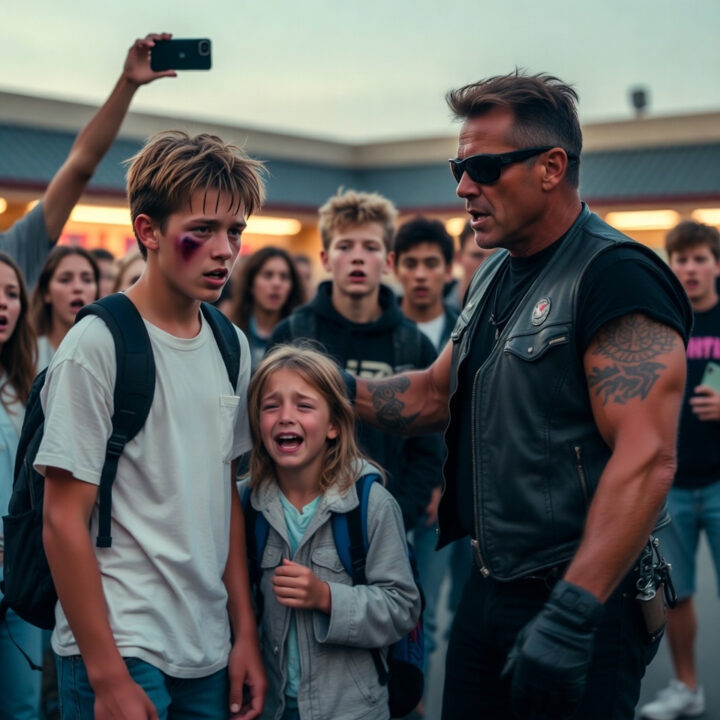
The biker dismounted quickly.
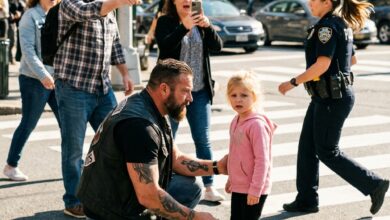
Leather vest. Short sleeves. Tattoos climbing both forearms. Dark sunglasses even though the sun was already dropping behind the buildings.
He took two fast steps forward.
“Enough,” he said.
From across the lot, it looked exactly like what people expected.
A biker charging into a fight.
A grown man stepping toward teenagers.
A situation about to explode.
Someone shouted, “Hey!”
Another yelled, “Call the cops!”
The teens backed away a step — then squared up again.
“What are you gonna do?” one of them sneered.
The biker moved between them and the kids without touching anyone. His shoulders were wide. His stance firm. He didn’t posture — he positioned.
“You hurt?” he asked Caleb, not taking his eyes off the group.
Caleb nodded, swallowing blood. Lily clutched his jacket from behind.
The biker turned his head slightly. “You two stay behind me.”
From the sidewalk, it didn’t look protective.
It looked threatening.
A woman screamed, “Get away from those kids!”
Someone yelled, “He’s gonna kill someone!”
Phones were up now. Recording. Framing the story before it finished happening.
The biker ignored the shouting. He looked at the teens.
“Walk,” he said.
One of them laughed nervously. “You don’t tell us what to do.”
The biker reached into his vest.
A gasp rippled through the crowd.
“Gun!” someone screamed.
But he pulled out his phone.
Typed one message.
Sent it.
Then he slid the phone away and stood still.
“We’re done here,” he said.
Sirens wailed faintly in the distance.
And suddenly, the biker wasn’t the rescuer in people’s eyes — he was the threat.
Police arrived fast.
Two cruisers. Lights flashing. Officers stepping out with hands already tense.
“What’s going on?” one shouted.
Everyone talked at once.
“He attacked them!”
“He showed up and escalated everything!”
“He’s dangerous!”
The biker raised his hands slowly. “I didn’t touch anyone.”
One officer stepped between him and the kids. “Turn around.”
Caleb tried to speak. “They—”
“Quiet,” someone snapped at him. “We’ll handle this.”
Lily was shaking now, hiding her face in Caleb’s back.
The biker watched that, jaw tightening just enough to notice.
“You gonna listen to the kids?” he asked calmly.
The officer frowned. “We’ll decide that.”
The teens stood off to the side, suddenly quiet, eyes down. One wiped his knuckles.
The biker looked at them once — long enough to remember their faces.
Then he reached into his vest again.
The officers tensed instantly.
Slowly, deliberately, he made a call.
“Yeah,” he said into the phone. “We’ve got minors. Parking lot on Pine.”
That was all.
He ended the call.
“Who did you call?” an officer demanded.
The biker didn’t answer.
From down the road, a low mechanical rumble began to build.
More than one engine.
The crowd turned.
Caleb felt it in his chest before he heard it clearly.
The biker finally spoke again, voice steady.
“They’re coming.”
And in that suspended moment — before anyone could say another word —
no one was sure whose side the street was about to take.
The sound arrived before the sight.
Not sirens.
Not shouting.
Engines.
Low. Even. Measured, like men who understood when noise helped—and when it didn’t.
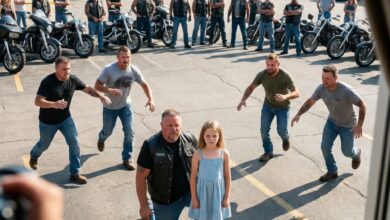
Heads turned toward the road. One motorcycle rolled into the lot. Then another. Then another. They didn’t rush the curb. They didn’t fan out. They parked in a clean line, engines cutting one by one until the air felt strangely lighter.
Helmets came off. Gloves tucked away. Boots touched pavement with purpose, not threat.
An older biker stepped forward—early sixties, gray at the temples, posture straight. He nodded to the officers first. Not defiant. Respectful.
“Evening,” he said.
The officer in charge eyed the line of bikes, then the kids, then the biker who had stepped in. “We’ve got a report of an altercation.”
The older biker nodded once. “So do we.”
He didn’t look at the crowd. He didn’t look at the teens who had backed away. He looked at Caleb and Lily.
“Anyone hurt?” he asked.
Caleb lifted his chin, blood drying under his nose. “I’m okay.”
Lily peeked out from behind him, eyes wide.
The older biker turned to the officers. “Before you decide anything—ask them.”
A beat. The officer hesitated, then crouched to Caleb’s level. “Tell me what happened.”
Caleb swallowed. “They took my sister’s stuff. I told them to stop. They hit me.”
The words landed without flourish. Simple. True.
The teens shifted. One stared at the ground. Another kicked at the curb.
The officer straightened. “Is that accurate?”
Silence answered first. Then a quiet, “Yeah,” from the back.
The crowd’s energy changed—not loud, not dramatic. Just… corrected.
The biker who had stepped in didn’t gloat. He didn’t move. He stayed where he was, a wall that no longer needed to be tall.
Paperwork followed. Consequences arrived without spectacle. No cheers. No speeches.
The officers walked the teens aside. A cruiser door opened and closed.
Caleb leaned down to gather Lily’s crayons from the concrete. His hands shook now that it was over.
The first biker crouched beside him. “You did good,” he said quietly.
Caleb looked up. “I was scared.”
The biker nodded. “That’s how you know it mattered.”
He reached into his vest and pulled out a clean handkerchief, offering it without ceremony. Caleb pressed it to his nose.
Lily tugged the biker’s sleeve. “Thank you.”
He smiled—small, almost embarrassed. “You’re welcome.”
The older biker gave a subtle signal. Engines turned over again—soft, respectful. The line rolled out as cleanly as it had arrived.
People put their phones away. Conversations restarted—lower, slower.
Caleb stood there a moment longer, watching the bikes disappear. He wrapped an arm around Lily’s shoulders.
Later, he would remember the punch. And the fear. And the crowd that didn’t move.
But what would stay with him was this: the moment someone stepped in, was misunderstood, and stayed anyway.
Because sometimes courage isn’t loud.
Sometimes it doesn’t explain itself.
Sometimes it stands between what’s wrong and who can’t move,
long enough for the truth to catch up.